Muslim literary awards conferred; Teesta slams saffron forces

[email protected] (CD Network)
January 30, 2016

Mangaluru, Jan 30: Renowned human rights activist Teesta Setalvad lamented that those who do not believe in constitutional values, liberty and democracy are currently ruling India.

townhall 12

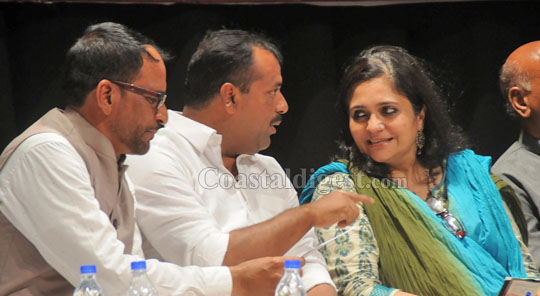
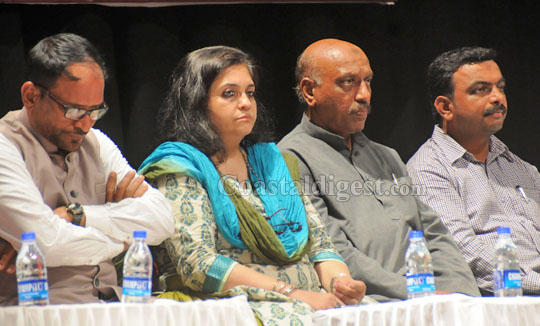
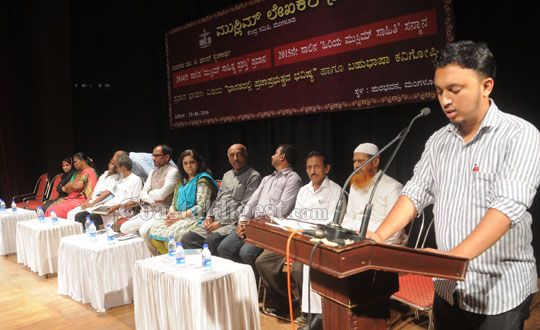
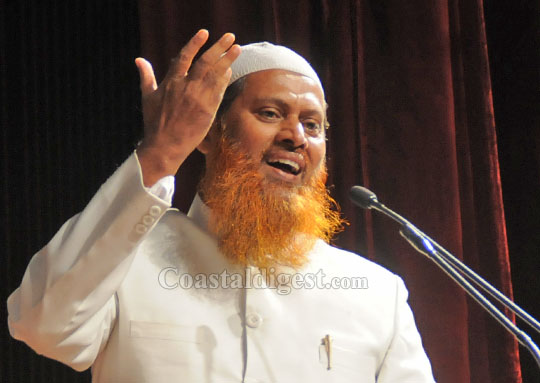
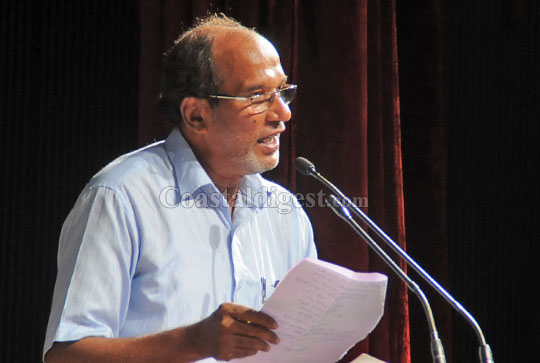
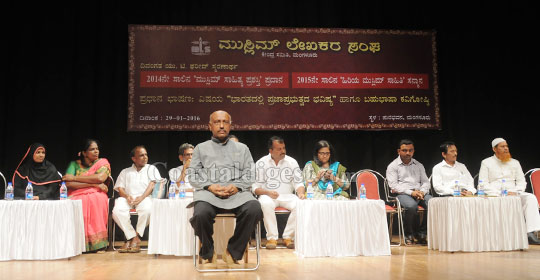
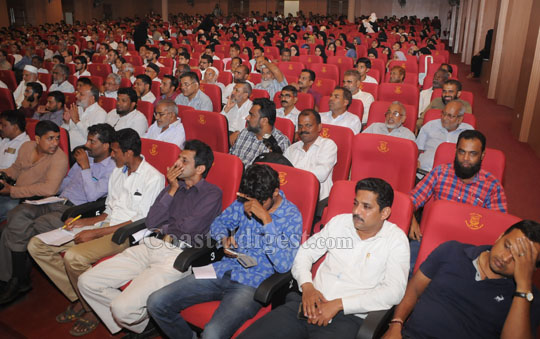
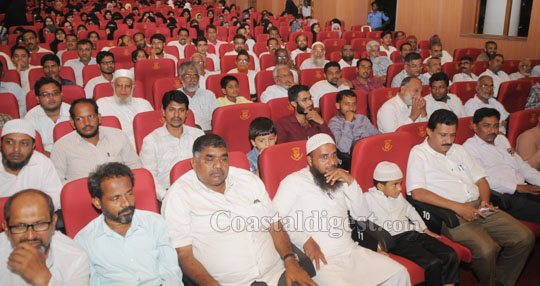
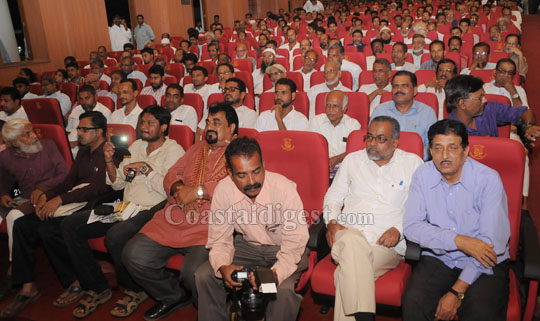
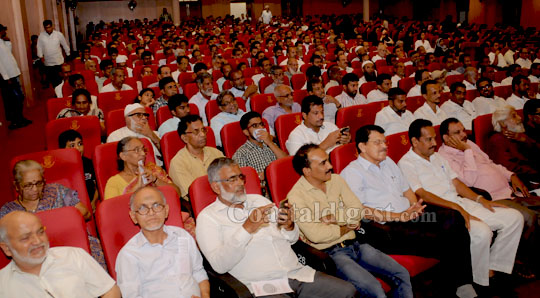
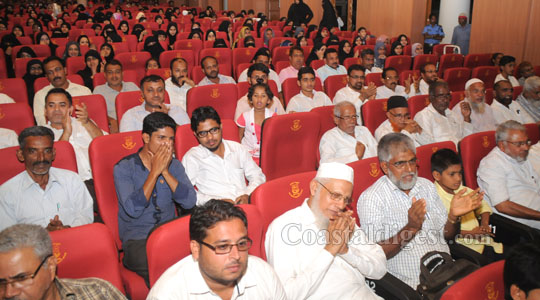
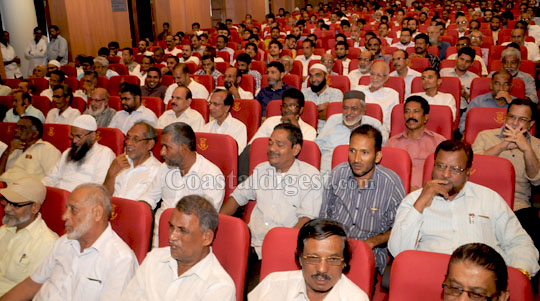
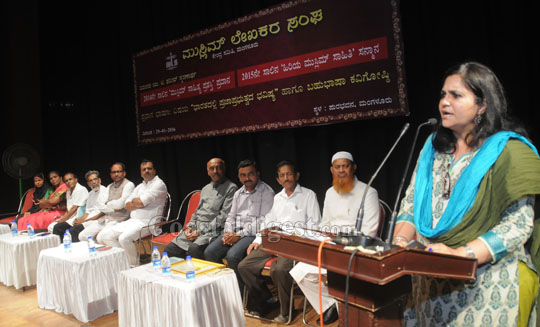
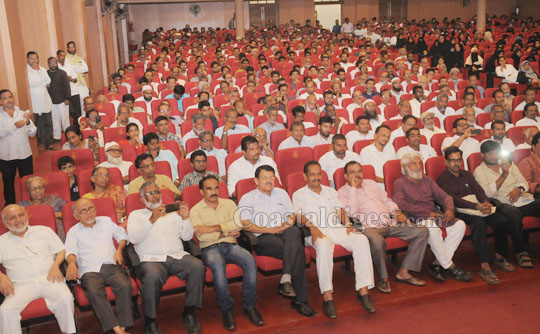
Delivering a talk on ‘Future of Democracy in India’ at a programme organized by the Muslim Lekhakara Sangha (MLS), a Kannada literary association for Muslims, to honour its annual literary award winners at Town Hall in the city on Friday evening, Ms Setalvad called upon the people for a collective fight against fascist and communal forces.

She asserted that the ones who are ruling India and dreaming of a Hindu nation were not part of India’s freedom movement against the British colonialists.

Expressing frustration over saffronization of education, she said that in states like Gujarat and Haryana primary school students are being taught that modern science and practice of plastic surgery was prevalent among ancient Hindus.

Reiterating that fascists in India have been misusing religion to spread violence, she said consolidation of political power and implementation of the agenda of ‘divide and rule’ are among the multiple motives behind the eruption of communal violence in the country. Through this, religion is being misused by political powers and the masses are being mislead, she claimed.

“We should not be a religion-based nation. Everybody has an equal share of citizenship. But, there are forces which do not believe in the Constitution,” she lamented.

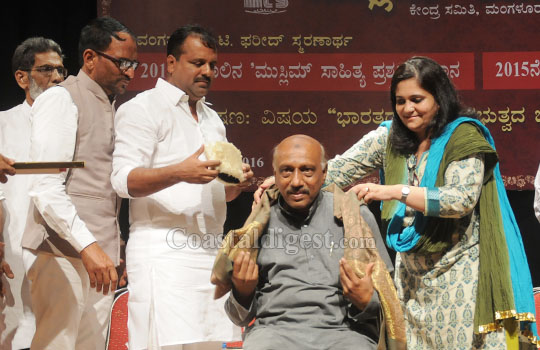
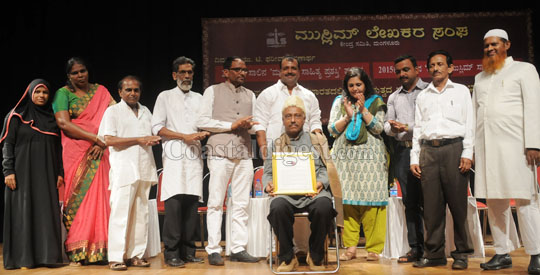
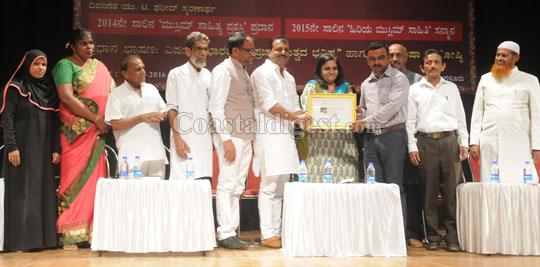
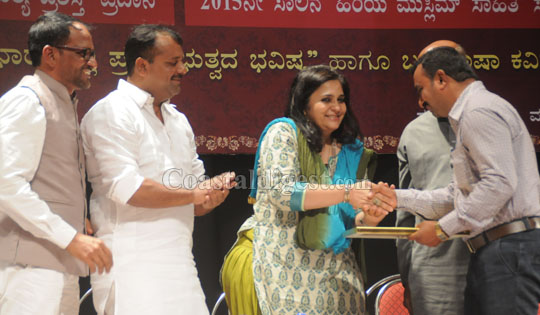
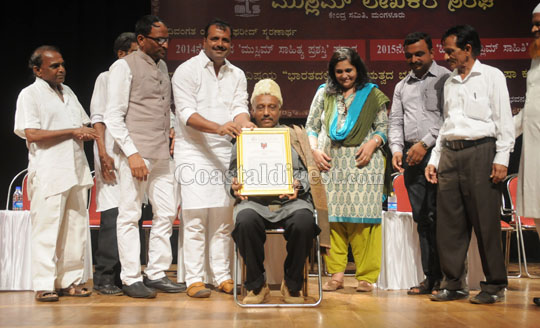
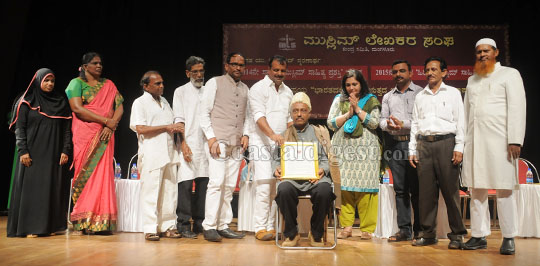
On the occasion, Muslim Sahitya Prashasti-2014 instituted by MLS in memory of Late UT Fareed was conferred on Sanavullah Navilehal, Davanagere for his work ‘Onti Marada Kelage’ Kannada writer Fakeer Mohammed Katpady was honoured as ‘senior Muslim litterateur-2015’. Health and Family Welfare Minister UT Khader conferred the awards.

A multi-lingual poet’s meet was also held on the occasion. Mohammed Baddur, Peruru Jaru, Jyoti Chelyaru, Abdussalam Madani, Abdurrahman Kuthethur, Ayisha UK, Shamshad Mukri presented their poems.

Umar UH, president of MLS, presided over the programme. Shaukath Ali, general secretary, welcomed. Sadeed recited Quranic verses in the beginning. BA Mohammed Ali compered the programme.

townhall 5


townhall 15

townhall 1

townhall 2

townhall 3

townhall 6

townhall 8

townhall 10

townhall 11

townhall 13

townhall 14

townhall 17

townhall 18

townhall 19

townhall 20

townhall 21

townhall 22

townhall 24

townhall 25

Comments

Zahoor Ahmed
 - 
Saturday, 30 Jan 2016

Thanks to MLS for organizing such kind of event and inviting Well known Human rights activist to your event.

Add new comment

  • Coastaldigest.com reserves the right to delete or block any comments.
  • Coastaldigset.com is not responsible for its readers’ comments.
  • Comments that are abusive, incendiary or irrelevant are strictly prohibited.
  • Please use a genuine email ID and provide your name to avoid reject.
News Network
April 4,2020

New Delhi, Apr 4: The Supreme Court on Friday urged Karnataka and Kerala to amicably resolve their issues concerning a border blockade that has choked the free flow of vehicles carrying essential items and patients in the midst of the COVID-19 outbreak.

Karnataka, which imposed the blockade, justified that its border was sealed to “combat the spread of the pandemic by preventing the movement of people from the bordering districts of Kerala to Karnataka”.

The State had moved the Supreme Court, challenging a Kerala High Court order on April 1 to open the border. Kerala has countered that patients from the State cannot be denied access to health care. Besides, the blockade has severely affected the supply of essential items, from medicines to food, to Kerala.

On Friday, a Supreme Court Bench of Justices L. Nageswara Rao and Deepak Gupta urged the States to not confront each other in the midst of an unprecedented public health crisis. Instead, it asked the Chief Secretaries of both States to sit with the Union Health Secretary and iron out a solution. Meanwhile, the apex court urged Kerala not to take any precipitative action based on the High Court order.

The court issued notice to Kerala on the appeal filed by Karnataka, represented by advocate Shubhranshu Padhi. It listed the case for further hearing on April 7.

Karnataka, in its appeal against the High Court order, said the blockade was put in place in the interest of public health. The situation regarding Coronavirus was “really dire”, it said. It warned that opening the blockade would cause a law and order issue as its local population wanted the border to remain sealed.

Karnataka argued that Kerala was the “worst-affected” State in the country with nearly 194 coronavirus cases. In this, Kasaragod, adjoining Karnataka, was the “worst affected” district of Kerala with over a 100 positive cases.

MP’s plea

The court also separately considered a writ petition by Kasaragod MP Rajmohan Unnithan for an order to forthwith open the State border.

The parliamentarian, represented by advocates Haris Beeran and Pallavi Pratap, urged the court to issue an ex-parte stay on the operation of the blockade imposed by Karnataka with its border States.

Mr. Unnithan said Karnataka’s blockade was “ill-planned and dangerous” and had led to loss of lives. Two patients from Kerala, in need of urgent medical care, died after their ambulances were denied entry at the border by the Karnataka authorities. 

Comments

Add new comment

  • Coastaldigest.com reserves the right to delete or block any comments.
  • Coastaldigset.com is not responsible for its readers’ comments.
  • Comments that are abusive, incendiary or irrelevant are strictly prohibited.
  • Please use a genuine email ID and provide your name to avoid reject.
Ram Puniyani
February 4,2020

As democracy is seeping in slowly all over the world, there is an organization which is monitoring the degree of democracy in the individual countries, The Economist Intelligence Unit. As such in each country there are diverse factors which on one hand work to deepen it, while others weaken it. Overall there is a march from theoretical democracy to substantive one. The substantive democracy will herald not just the formal equality, freedom and community feeling in the country but will be founded on the substantive quality of these values. In India while the introduction of modern education, transport, communication laid the backdrop of beginning of the process, the direction towards deepening of the process begins with Mahatma Gandhi when he led the non-cooperation movement in 1920, in which average people participated. The movement of freedom for India went on to become the ‘greatest ever mass movement’ in the World.

The approval and standards for democracy were enshrined in Indian Constitution, which begins ‘We the people of India’, and was adopted on 26th January 1950. With this Constitution and the policies adopted by Nehru the process of democratization started seeping further, the dreaded Emergency in 1975, which was lifted later restored democratic freedoms in some degree. This process of democratisation is facing an opposition since the decade of 1990s after the launch of Ram Temple agitation, and has seen the further erosion with BJP led Government coming to power in 2014. The state has been proactively attacking civil liberties, pluralism and participative political culture with democracy becoming flawed in a serious way. And this is what got reflected in the slipping of India by ten places, to 51st, in 2019. On the index of democracy India slipped down from the score of 7.23 to 6.90. The impact of sectarian BJP politics is writ on the state of the nation, country.

Ironically this lowering of score has come at a time when the popular protests, the deepening of democracy has been given a boost and is picking up with the Shaheen Bagh protests. The protest which began in Shaheen Bagh, Delhi in the backdrop of this Government getting the Citizenship amendment Bill getting converted into an act and mercilessly attacking the students of Jamia Milia Islamia, Aligarh Muslim University along with high handed approach in Jamia Nagar and neighbouring areas.  From 15th December 2019, the laudable protest is on.

It is interesting to note that the lead in this protest has been taken by the Muslim women, from the Burqa-Hijab clad to ‘not looking Muslim’ women and was joined by students and youth from all the communities, and later by the people from all the communities. Interestingly this time around this Muslim women initiated protest has contrast from all the protests which earlier had begun by Muslims. The protests opposing Shah Bano Judgment, the protests opposing entry of women in Haji Ali, the protests opposing the Government move to abolish triple Talaq. So far the maulanas from top were initiating the protests, with beard and skull cap dominating the marches and protests. The protests were by and large for protecting Sharia, Islam and were restricted to Muslim community participating.

This time around while Narendra Modi pronounced that ‘protesters can be identified by their clothes’, those who can be identified by their external appearance are greatly outnumbered by all those identified or not identified by their appearance.

The protests are not to save Islam or any other religion but to protect Indian Constitution. The slogans are structured around ‘Defence of democracy and Indian Constitution’. The theme slogans are not Allahu Akbar’ or Nara-E-Tadbeer’ but around preamble of Indian Constitution. The lead songs have come to be Faiz Ahmad Faiz’s ‘Hum Dekhenge’, a protest against Zia Ul Haq’s attempts to crush democracy in the name of religion. Another leading protest song is from Varun Grover, ‘Tanashah Aayenge…Hum Kagaz nahin Dikhayenge’, a call to civil disobedience against the CAA-NRC exercise and characterising the dictatorial nature of the current ruling regime.

While BJP was telling us that primary problem of Muslim women is Triple talaq, the Muslim women led movements has articulated that primary problem is the very threat to Muslim community. All other communities, cutting across religious lines, those below poverty line, those landless and shelter less people also see that if the citizenship of Muslims can be threatened because of lack of some papers, they will be not far behind in the victimization process being unleashed by this Government.

While CAA-NRC has acted as the precipitating factor, the policies of Modi regime, starting from failure to fulfil the tall promises of bringing back black money, the cruel impact of demonetisation, the rising process of commodities, the rising unemployment, the divisive policies of the ruling dispensation are the base on which these protest movements are standing. The spread of the protest movement, spontaneous but having similar message is remarkable. Shaheen Bagh is no more just a physical space; it’s a symbol of resistance against the divisive policies, against the policies which are increasing the sufferings of poor workers, the farmers and the average sections of society.

What is clear is that as identity issues, emotive issues like Ram Temple, Cow Beef, Love Jihad and Ghar Wapasi aimed to divide the society, Shaheen Bagh is uniting the society like never before. The democratisation process which faced erosion is getting a boost through people coming together around the Preamble of Indian Constitution, singing of Jan Gan Man, waving of tricolour and upholding the national icons like Gandhi, Bhagat Singh, Ambedkar and Maulana Azad. One can feel the sentiments which built India; one can see the courage of people to protect what India’s freedom movement and Indian Constitution gave them.

Surely the communal forces are spreading canards and falsehood against the protests. As such these protests which is a solid foundation of our democracy. The spontaneity of the movement is a strength which needs to be channelized to uphold Indian Constitution and democratic ethos of our beloved country.


Comments

Add new comment

  • Coastaldigest.com reserves the right to delete or block any comments.
  • Coastaldigset.com is not responsible for its readers’ comments.
  • Comments that are abusive, incendiary or irrelevant are strictly prohibited.
  • Please use a genuine email ID and provide your name to avoid reject.
News Network
March 13,2020

Bengaluru, Mar 13: Upset over her husband’s insistence that expenses for her heart ailment be borne by her parents, a 26-year-old homemaker hanged herself at her residence in Manjunatha Nagar, near RT Nagar, on Tuesday midnight.

RT Nagar police said Lakshmi Sharma was also being harassed by her husband Dharmananda Sharma to divorce him. Dharmananda, his father Krishnakumar and mother Sharavati were arrested on Wednesday and remanded in judicial custody.

An investigating officer said Lakshmi had left a suicide note explaining the torture she underwent.

Comments

Add new comment

  • Coastaldigest.com reserves the right to delete or block any comments.
  • Coastaldigset.com is not responsible for its readers’ comments.
  • Comments that are abusive, incendiary or irrelevant are strictly prohibited.
  • Please use a genuine email ID and provide your name to avoid reject.