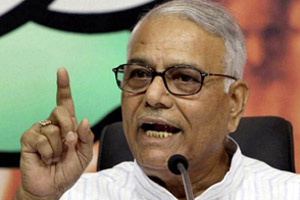
Modi govt may meet same fate as that of Indira's: Yashwant

January 31, 2016

Dona Paula (Goa), Jan 31: Veteran BJP leader Yashwant Sinha today tore into Prime Minister Narendra Modi and his government, saying there is no dialogue and they may meet the same fate as the Indira Gandhi-led Congress which was drubbed in the elections after Emergency.yashwant

Sinha, who along with some other BJP veterans has been marginalised in the party, was speaking at a panel discussion at the 'Difficult Dialogues' conference here, where CPI-M general secretary Sitaram Yechury also spoke.

"There is absolutely no scope of no dialogue... This is the great strength of Indian democracy. There will be aberrations here and there, there might be concerns about the present situation. But the great Indian society will take care of it and consign to dust those who do not believe in dialogue in India," Sinha said.

"The people of India will consign him to the dust, you just have to wait for the next elections," Sinha, who was finance minister in Atal Bihari Vajpayee government, said without naming Modi.

Alluding to the general elections in 1977 when Congress was ousted from power, he said such a neglect (of dialogue) will make the government last "19 months", the same duration as the Emergency.

We all know how the people of India reacted to the Emergency which was the "most concerted democratic effort in our country to still the voice of dissent", he said.

Replying to intervention from Yechury on need to ensure that dialogue in the society doesn't get stifled, he said, "I would only say that the stifler is in for serious trouble."

The veteran BJP leader also rued the fact that Opposition was not letting Parliament function. Without naming, he took a potshot at a Congress leader, who he said never raised concerns on the GST Bill in the standing committee meetings but later raised objections.

Under Vajpayee, the NDA government was able to pass several important legislations with the help of dialogue (with opposition), Sinha said.

His onslaught comes on the same day when another BJP leader, actor-MP Shatrughan Sinha, said that veteran leaders Vajpayee, L K Advani and Murli Manohar Joshi "deserve much more than what they have been given".

"Currently these leaders including me are trapped between oppression and respect," Shatrughan said in Pune.

Comments

aharkul
 - 
Sunday, 31 Jan 2016

Just wait and see.... within one year what happen Indian democracy..

Goodman
 - 
Sunday, 31 Jan 2016

BJP built on wrong ideology, wrong foundation. So tower can not stand on cracking foundation.

Add new comment

  • Coastaldigest.com reserves the right to delete or block any comments.
  • Coastaldigset.com is not responsible for its readers’ comments.
  • Comments that are abusive, incendiary or irrelevant are strictly prohibited.
  • Please use a genuine email ID and provide your name to avoid reject.
Agencies
May 23,2020

New Delhi, May 23: The nationwide lockdown will no longer help India in its fight against COVID-19, and in its place community-driven containment, isolation and quarantine strategies have to be brought into play, leading virologist Shahid Jameel said.

The recipient of Shanti Swarup Bhatnagar Prize for Science and Technology also stressed that testing should be carried out vigorously to identify coronavirus hotspots and isolate those areas.

"Our current testing rate at 1,744 tests per million population is one of the lowest in the world. We should deploy both antibody tests and confirmatory PCR tests. This will tell us about pockets of ongoing infection and past (recovered) infection. This will provide data to open up gradually and let economic activity resume," Jameel told PTI in an interview.

He stressed that testing has to be dynamic to continuously monitor red, orange and green zones and change these based on that data.

About community transmission of COVID-19 in India, Jameel said the country reached that stage long ago.

"We reached community transmission a long time ago. It's just that the health authorities are not admitting it. Even ICMR's own study of SARI (severe acute respiratory illness) showed that about 40 per cent of those who tested positive for SARS-CoV-2 did not have any history of overseas travel or contact to a known case. If this is not community transmission, then what is?" he posed.

Lockdown bought India time in its fight against coronavirus, but continuing it is unlikely to yield any further dividend, Jameel said.

"Instead, community-driven local lockdowns, isolations and quarantines have to come into play. Building trust is most important so that people follow rules. A public health problem cannot be dealt with as a law-and-order problem."

The nationwide lockdown, initially imposed from March 25 to April 14, has been extended thrice and will continue at least till May 31. The virus has claimed 3,720 lives and infected over 1.25 lakh people in the country so far.

Jameel has expertise in the fields of molecular biology, infectious diseases, and biotechnology. He is the CEO of Wellcome Trust/Department of Biotechnology's India Alliance and is best known for extensive research in Hepatitis E virus and HIV.

He said COVID-19 will eventually be controlled through herd immunity, which is acquired in two ways – when a sufficient fraction of the population gets infected and recovers, and with vaccination.

"It is estimated that for SARS-CoV-2 at least 60 per cent of the population would have to be infected and recovered, or vaccinated. This will happen over the course of the next few years," Jameel said.

Herd immunity is reached when the majority of a population becomes immune to an infectious disease, either because they have become infected and recovered, or through vaccination. When that happens, the disease is less likely to spread to people who aren't immune, because there just aren't enough infectious carriers.

"India has 1.38 billion people, a population density of about 400/sq km and a healthcare system ranked at 143 in the world. If we allow 60 per cent people to get infected quickly in the hopes of herd immunity, that would mean 830 million infections," Jameel said.

"If 15 per cent need hospitalization that means about 125 million isolation beds (we have 0.3 million). If five per cent need oxygen and ventilatory support, this amounts to about 42 million oxygen support and ICU beds; we have 0.1 million oxygen support beds and 34,000 ICU beds. This would overwhelm the healthcare system causing mayhem," he said.

Jameel said if the population level mortality is 0.5 per cent that would mean 40 lakh deaths. "Are we prepared to pay this price for herd immunity in the short term? Clearly not," he said.

He said it is unlikely that a vaccine would be available by the end of the year.

"Even then, we don't know yet how long it would give protection – weeks, months, one year, a few years? I don't think we will return to pre-coronavirus days for at least the next 3-5 years. This is also a chance to evaluate if we want to return to those unsustainable, environment-damaging ways. COVID-19 is a timely warning to reform our way of living," he said.

Jameel said it is hard to predict but plausible that COVID-19 would return in second or third wave.

"Later waves come when we don't understand the disease and become lax. A comparison to Spanish Flu is not entirely valid because in 1918 no one knew what caused it. No one had seen a virus till the mid-1930s as the electron microscope needed to view those was invented in 1931," he said.

"Today we know a lot more about the pathogen, its genetic makeup, how it transmits and how to prevent it. We need to be sensible and follow expert advice," he said.

If there is any scientific evidence linking deforestation, rapid urbanisation, climate change with pandemics like COVID-19, he said zoonotic viruses -- those that jump from animals to humans -- happen so when wild animal–human contacts increase.

"Deforestation destroys animal habitats bringing them closer to humans. When you cut forests, bats come to roost on trees closer to human habitations. Their viruses in secretions/stool get transmitted to domestic animals and on to humans. This happened clearly with Nipah virus outbreak in Malaysia in 1997-98 from fruit bats to pigs to humans," he said.

"COVID-19 possibly arose in wet animal markets due to dietary habits that bring all kinds of live and dead wild animals in close contact with humans," Jameel added.

Comments

Add new comment

  • Coastaldigest.com reserves the right to delete or block any comments.
  • Coastaldigset.com is not responsible for its readers’ comments.
  • Comments that are abusive, incendiary or irrelevant are strictly prohibited.
  • Please use a genuine email ID and provide your name to avoid reject.
News Network
April 19,2020

New Delhi, Apr 19: The government on Sunday prohibited the sale of non-essential items through e-commerce platforms during the ongoing lockdown, four days after allowing such companies to sale mobile phones, refrigerators and ready-made garments.

Union Home Secretary Ajay Bhalla issued an order excluding the non-essential items from sale by the e-commerce companies from the consolidated revised guidelines, which listed the exemption given to the services and people from the purview of the lockdown.

The order said the following clause "E-commerce companies. Vehicles used by e-commerce operators will be allowed to ply with necessary permissions" is excluded from the guidelines.

The previous order had said such items were allowed for sale through e-commerce platforms from April 20.

However, the reason for reversing the order is not known immediately.

Comments

Add new comment

  • Coastaldigest.com reserves the right to delete or block any comments.
  • Coastaldigset.com is not responsible for its readers’ comments.
  • Comments that are abusive, incendiary or irrelevant are strictly prohibited.
  • Please use a genuine email ID and provide your name to avoid reject.
Agencies
June 30,2020

United Nations, Jun 30: India accounts for 45.8 million of the world's 142.6 million "missing females" over the past 50 years, a report by the United Nations said on Tuesday, noting that the country along with China form the majority of such women globally.

The State of World Population 2020 report released on Tuesday by the United Nations Population Fund (UNFPA), the world organisation's sexual and reproductive health agency, said that the number of missing women has more than doubled over the past 50 years - from 61 million in 1970 to a cumulative 142.6 million in 2020.

Of this global figure, India accounted for 45.8 million missing females as of 2020 and China accounted for 72.3 million.

Missing females are women missing from the population at given dates due to the cumulative effect of postnatal and prenatal sex selection in the past, the agency said.

Between 2013 and 2017, about 460,000 girls in India were missing' at birth each year. According to one analysis, gender-biased sex selection accounts for about two-thirds of the total missing girls, and post-birth female mortality accounts for about one-third, the report said.

Citing data by experts, it said that China and India together account for about 90-95 per cent of the estimated 1.2 million to 1.5 million missing female births annually worldwide due to gender-biased (prenatal) sex selection.

The two countries also account for the largest number of births each year, it said.

The report cites data by Alkema, Leontine and others, 2014 National, Regional, and Global Sex Ratios of Infant, Child, and under-5 Mortality and Identification of Countries with Outlying Ratios: A Systematic Assessment' from The Lancet Global Health.

According to their analysis, India has the highest rate of excess female deaths, 13.5 per 1,000 female births, which suggests that an estimated one in nine deaths of females below the age of 5 may be attributed to postnatal sex selection.

The report notes that governments have also taken action to address the root causes of sex selection. India and Vietnam have included campaigns that target gender stereotypes to change attitudes and open the door to new norms and behaviours.

They spotlight the importance of daughters and highlight how girls and women have changed society for the better. Campaigns that celebrate women's progress and achievements may resonate more where daughter-only families can be shown to be prospering, it said.

The report said that successful education-related interventions include the provision of cash transfers conditional on school attendance; or support to cover the costs of school fees, books, uniforms and supplies, taking note of successful cash-transfer initiatives such as Apni Beti Apna Dhan' in India.

It said that preference for a male child manifested in sex selection has led to dramatic, long-term shifts in the proportions of women and men in the populations of some countries.

This demographic imbalance will have an inevitable impact on marriage systems. In countries where marriage is nearly universal, many men may need to delay or forego marriage because they will be unable to find a spouse, the report said.

This so-called "marriage squeeze", where prospective grooms outnumber prospective brides, has already been observed in some countries and affects mostly young men from lower economic strata.

"At the same time, the marriage squeeze could result in more child marriages, the report said citing experts.

Some studies suggest that the marriage squeeze will peak in India in 2055. The proportion of men who are still single at the age of 50 is forecast to rise after 2050 in India to 10 per cent, it said.

The UN report said that every year, millions of girls globally are subjected to practices that harm them physically and emotionally, with the full knowledge and consent of their families, friends and communities.

At least 19 harmful practices, ranging from breast ironing to virginity testing, are considered human rights violations, according to the UNFPA report, which focuses on the three most prevalent ones: female genital mutilation, child marriage, and extreme bias against daughters in favour of sons.

Harmful practices against girls cause profound and lasting trauma, robbing them of their right to reach their full potential, says UNFPA Executive Director Dr. Natalia Kanem.

This year, an estimated 4.1 million girls will be subjected to female genital mutilation. Today, 33,000 girls under age 18 will be forced into marriages, usually to much older men and an extreme preference for sons over daughters in some countries has fuelled gender-biased sex selection or extreme neglect that leads to their death as children, resulting in the 140 million missing females.

The report said that ending child marriage and female genital mutilation worldwide is possible within 10 years by scaling up efforts to keep girls in school longer and teach them life skills and to engage men and boys in social change.

Investments totalling USD 3.4 billion a year through 2030 would end these two harmful practices and end the suffering of an estimated 84 million girls, it said.

A recent analysis revealed that if services and programmes remain shuttered for six months due to the COVID-19 pandemic, an additional 13 million girls may be forced into marriage and 2 million more girls may be subjected to female genital mutilation between now and 2030.

The pandemic both makes our job harder and more urgent as so many more girls are now at risk, Kanem said.


Comments

Add new comment

  • Coastaldigest.com reserves the right to delete or block any comments.
  • Coastaldigset.com is not responsible for its readers’ comments.
  • Comments that are abusive, incendiary or irrelevant are strictly prohibited.
  • Please use a genuine email ID and provide your name to avoid reject.