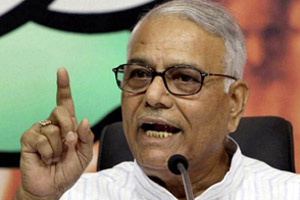
Modi govt may meet same fate as that of Indira's: Yashwant

January 31, 2016

Dona Paula (Goa), Jan 31: Veteran BJP leader Yashwant Sinha today tore into Prime Minister Narendra Modi and his government, saying there is no dialogue and they may meet the same fate as the Indira Gandhi-led Congress which was drubbed in the elections after Emergency.yashwant

Sinha, who along with some other BJP veterans has been marginalised in the party, was speaking at a panel discussion at the 'Difficult Dialogues' conference here, where CPI-M general secretary Sitaram Yechury also spoke.

"There is absolutely no scope of no dialogue... This is the great strength of Indian democracy. There will be aberrations here and there, there might be concerns about the present situation. But the great Indian society will take care of it and consign to dust those who do not believe in dialogue in India," Sinha said.

"The people of India will consign him to the dust, you just have to wait for the next elections," Sinha, who was finance minister in Atal Bihari Vajpayee government, said without naming Modi.

Alluding to the general elections in 1977 when Congress was ousted from power, he said such a neglect (of dialogue) will make the government last "19 months", the same duration as the Emergency.

We all know how the people of India reacted to the Emergency which was the "most concerted democratic effort in our country to still the voice of dissent", he said.

Replying to intervention from Yechury on need to ensure that dialogue in the society doesn't get stifled, he said, "I would only say that the stifler is in for serious trouble."

The veteran BJP leader also rued the fact that Opposition was not letting Parliament function. Without naming, he took a potshot at a Congress leader, who he said never raised concerns on the GST Bill in the standing committee meetings but later raised objections.

Under Vajpayee, the NDA government was able to pass several important legislations with the help of dialogue (with opposition), Sinha said.

His onslaught comes on the same day when another BJP leader, actor-MP Shatrughan Sinha, said that veteran leaders Vajpayee, L K Advani and Murli Manohar Joshi "deserve much more than what they have been given".

"Currently these leaders including me are trapped between oppression and respect," Shatrughan said in Pune.

Comments

aharkul
 - 
Sunday, 31 Jan 2016

Just wait and see.... within one year what happen Indian democracy..

Goodman
 - 
Sunday, 31 Jan 2016

BJP built on wrong ideology, wrong foundation. So tower can not stand on cracking foundation.

Add new comment

  • Coastaldigest.com reserves the right to delete or block any comments.
  • Coastaldigset.com is not responsible for its readers’ comments.
  • Comments that are abusive, incendiary or irrelevant are strictly prohibited.
  • Please use a genuine email ID and provide your name to avoid reject.
News Network
April 28,2020

New Delhi, Apr 28: With 1,594 new cases of COVID-19 reported in the last 24 hours and 51 deaths, India's total count of coronavirus cases surged to 29,974, said the Union Ministry of Health and Family Welfare on Tuesday.

The total cases are inclusive of 7,026 cured and discharged patients, one migrated and 937 deaths.

At present, there are 22,010 active COVID-19 cases in the country.

Addressing a press conference here, Lav Agarwal, Joint Secretary, Union Health and Family Welfare Ministry, said that in the last 28 days, 17 districts have had no new Covid-19 cases. "This means we need to maintain constant vigil," he added.

Comments

Add new comment

  • Coastaldigest.com reserves the right to delete or block any comments.
  • Coastaldigset.com is not responsible for its readers’ comments.
  • Comments that are abusive, incendiary or irrelevant are strictly prohibited.
  • Please use a genuine email ID and provide your name to avoid reject.
Agencies
June 29,2020

From March through May, around 1 crore migrant workers fled India’s megacities, afraid to be unemployed, hungry and far from family during the world’s biggest anti-Covid-19 lockdown.

Now, as Asia’s third-largest economy slowly reopens, the effects of that massive relocation are rippling across the country. Urban industries don’t have enough workers to get back to capacity, and rural states worry that without the flow of remittances from the city, already poor families will be even worse off -- and a bigger strain on state coffers.

Meanwhile, migrant workers aren’t expected to return to the cities as long as the virus is spreading and work is uncertain. States are rolling out stimulus programs, but India’s economy is hurtling for its first contraction in more than 40 years, and without enough jobs, a volatile political climate gets more so.

“This will be a huge economic shock, especially for households of short-term, cyclical migrants, who tend to come from vulnerable, poor and low-caste and tribal backgrounds,” said Varun Aggarwal, a founder of India Migration Now, a research and advocacy group based in Mumbai.

In the first 15 days of India’s lockdown, domestic remittances dropped by 90%, according to Rishi Gupta, chief executive officer of Mumbai-based Fino Paytech Ltd., which operates the country’s biggest payments bank.

By the end of May, remittances were back to around 1750 rupees ($23), about half the pre-Covid average. Gupta’s not sure how soon it’ll fully recover. “Migrants are in no hurry to come back,” Gupta said. “They’re saying that they’re not thinking of going back at all.”

If workers stay in their home states long term, policymakers will have more than remittances to worry about. If consumption falls and the new surplus of labor drives wages down, Agarwal said, “there will also be a second-order shock to the local economy. Overall, not looking good.”

India announced a $277 billion stimulus package in May and followed it up with a $7 billion program aimed at creating jobs for 125 days for migrants in villages across 116 districts. Separately, local authorities are also looking for solutions.

Officials in Bihar have identified 2,500 acres of land that could be made available to investors, said Sushil Modi, deputy chief minister of Bihar, a state in east India. “We can use this crisis as an opportunity to speed up reforms,” he said.

The investors haven’t materialised yet, and in the meanwhile, state governments are relying on the national cash-for-work program that guarantees 100 days worth of wages per household.

Skilled workers don’t want to do manual labor offered through the program, and even if they did, says Amitabh Kundu of RIS, many think of it as beneath their station. “There will be an increase in social tensions,” he predicts. “Caste may again start playing a role. It’s absolute chaos.”

For skilled workers, initiatives vary:

* Uttar Pradesh, which received 3.2 million people, is compiling lists of skilled workers who need employment and trying to place them with local manufacturing and real estate industry associations. So far, the government says, it’s placed 300,000 people with construction and real estate firms.

* Bihar has placed returners in state-run infrastructure projects and hired others to stitch uniforms and make furniture for government-run schools, even as they waited in quarantine centres, said Pratyay Amrit, head of the state’s disaster management department.

* The eastern state of Odisha announced an urban wage employment program aimed at putting as many as 450,000 day labourers to work through September. Some 25,000 people have been employed, so far, under the scheme, G. Mathivathanan, principal secretary for housing and urban development said.

Attracting Investments

It’s not clear any of this will be enough to make a dent, says Ravi Srivastava, professor at New Delhi-based Institute of Human Development, adding that the states don’t have much of a track record on economic development.

“It was the failure of these states to improve governance and put development plans in place that led to the out-migration in the first place,” he said.

But officials and workers’ rights advocates see opportunity. Uttar Pradesh has established liaisons to encourage companies from the US, Japan and South Korea to establish manufacturing in the state. There and in Madhya Pradesh and Rajasthan, the government has made labour laws more friendly to employers, making it easier to hire and fire workers.

Modi, the minister from Bihar, said the migration may also give workers--historically a disenfranchised group--new power, particularly as urban centres struggle. “The way industries treated workers during the lockdown -- didn’t pay them, the living conditions were poor -- now these industries will realize the value of this force,” Modi said.

“In the days to come, labour will emerge as a force that can’t be ignored anymore,” he added. “That’s the new normal. We will work out how to ensure dignity, rights to our people who are going to work in other states.”

Bihar is due for elections by November, a vote that could be an early test of the mass migration’s political consequences. The state is currently governed by a coalition that includes Prime Minister Narendra Modi’s Bharatiya Janata Party. Amitabh Kundu, a fellow at the Research and Information System for Developing Countries, a New Delhi-based government think-tank, said migrant workers are likely to be angry voters.

“Chief ministers are telling these migrants that they will not have to go back for work,” he said. “But their capacity to do something miraculous in the next four to five months is doubtful. If they can retain even one-fourth of the migrants, I would call it a success.”


Comments

Add new comment

  • Coastaldigest.com reserves the right to delete or block any comments.
  • Coastaldigset.com is not responsible for its readers’ comments.
  • Comments that are abusive, incendiary or irrelevant are strictly prohibited.
  • Please use a genuine email ID and provide your name to avoid reject.
News Network
May 27,2020

Muzaffarpur, May 27: A toddler's vain attempt to wake up his dead mother from eternal sleep on a railway platform in Bihar's Muzaffarpur on Wednesday presented the most poignant picture of the massive migrant tragedy unfolding across several states.

A video tweeted by Sanjay Yadav, an aide to RJD leader Tejashwi Yadav, shows the child walking unsteadily up to his mother's body, tugging at the blanket placed over her, and when failing to wake her up, covering his own head with it.

As the mother still lay still, he wobbles away from her, announcements continuing in the background about the arrival and departure of trains that would bring in tens of thousands of people in a rush to get away from hunger and hardship they face in large cities that could sustain them no more.

"This small child doesn't know that the bedsheet with which he is playing is the shroud of his mother who has gone into eternal sleep. This mother died of hunger and thirst after being on a train for four days. Who is responsible for these deaths on trains? Shouldn't the opposition ask uncomfortable questions?" tweeted Yadav.

However, police had a different story to tell.

Ramakant Upadhyay, the Dy SP of the Government Railway Police in Muzaffarpur, said the incident occurred on May 25 when the migrant woman was on way to Muzaffarpur from Ahmedabad by a Shramik Special train.

He told reporters the woman, who was accompanied by her sister and brother-in-law, had died on the Madhubani bound train.

"My sister-in-law died suddenly on the train. We did not face any problem getting food or water," the officer said, quoting the deceased's brother-in-law who he did not name.

He said on getting information, poice brought down the body and sent it for postmortem.

Citing the brother-in-law of the deceased, Upadhyay said she was aged 35 years and was undergoing treatment for "some disease" for the last one year in Ahmedabad. "She was also mentally unstable," he said.

When persistently queried about the cause of death, he said,"Only doctors can tell".

A massive exodus of migrant workers is on in several parts of the country, unprecedented in magnitude since Partition.

The humanitarian crisis still unfolding on highways and railway platforms has shone light on disturbing tales of entire families walking hundreds of kilometres with little children on foot in a seemingly endless march to escape hunger.

People have been found travelling on trucks and in the hollow of concrete mixing plants, and in many cases, dying from hunger and exhaustion before reaching their destinations.

Comments

Add new comment

  • Coastaldigest.com reserves the right to delete or block any comments.
  • Coastaldigset.com is not responsible for its readers’ comments.
  • Comments that are abusive, incendiary or irrelevant are strictly prohibited.
  • Please use a genuine email ID and provide your name to avoid reject.