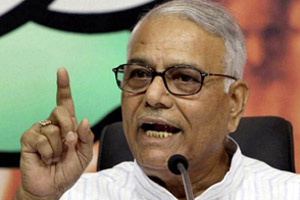
Modi govt may meet same fate as that of Indira's: Yashwant

January 31, 2016

Dona Paula (Goa), Jan 31: Veteran BJP leader Yashwant Sinha today tore into Prime Minister Narendra Modi and his government, saying there is no dialogue and they may meet the same fate as the Indira Gandhi-led Congress which was drubbed in the elections after Emergency.yashwant

Sinha, who along with some other BJP veterans has been marginalised in the party, was speaking at a panel discussion at the 'Difficult Dialogues' conference here, where CPI-M general secretary Sitaram Yechury also spoke.

"There is absolutely no scope of no dialogue... This is the great strength of Indian democracy. There will be aberrations here and there, there might be concerns about the present situation. But the great Indian society will take care of it and consign to dust those who do not believe in dialogue in India," Sinha said.

"The people of India will consign him to the dust, you just have to wait for the next elections," Sinha, who was finance minister in Atal Bihari Vajpayee government, said without naming Modi.

Alluding to the general elections in 1977 when Congress was ousted from power, he said such a neglect (of dialogue) will make the government last "19 months", the same duration as the Emergency.

We all know how the people of India reacted to the Emergency which was the "most concerted democratic effort in our country to still the voice of dissent", he said.

Replying to intervention from Yechury on need to ensure that dialogue in the society doesn't get stifled, he said, "I would only say that the stifler is in for serious trouble."

The veteran BJP leader also rued the fact that Opposition was not letting Parliament function. Without naming, he took a potshot at a Congress leader, who he said never raised concerns on the GST Bill in the standing committee meetings but later raised objections.

Under Vajpayee, the NDA government was able to pass several important legislations with the help of dialogue (with opposition), Sinha said.

His onslaught comes on the same day when another BJP leader, actor-MP Shatrughan Sinha, said that veteran leaders Vajpayee, L K Advani and Murli Manohar Joshi "deserve much more than what they have been given".

"Currently these leaders including me are trapped between oppression and respect," Shatrughan said in Pune.

Comments

aharkul
 - 
Sunday, 31 Jan 2016

Just wait and see.... within one year what happen Indian democracy..

Goodman
 - 
Sunday, 31 Jan 2016

BJP built on wrong ideology, wrong foundation. So tower can not stand on cracking foundation.

Add new comment

  • Coastaldigest.com reserves the right to delete or block any comments.
  • Coastaldigset.com is not responsible for its readers’ comments.
  • Comments that are abusive, incendiary or irrelevant are strictly prohibited.
  • Please use a genuine email ID and provide your name to avoid reject.
News Network
January 9,2020

Srinagar, Jan 9: Envoys from 15 countries including the United States were shown around Srinagar on Thursday, the first visit by New Delhi-based diplomats since the government stripped Kashmir of its semi-autonomous status and began a harsh crackdown five months ago.

The diplomats were driven by Indian authorities in a motorcade amid tight security from the airport to the military headquarters in Srinagar, where they were briefed on the security situation, an army officer said. He spoke on condition of anonymity as he was not authorized to speak to reporters.

They also held discussions with civil society members and some Kashmiri politicians, said Raveesh Kumar, spokesman for the Ministry of External Affairs (MEA).

The objective of the visit, organized by the Union government, was for the envoys to see first-hand “how things have progressed and how normalcy has been restored to a large extent'' in Kashmir since August, Kumar told reporters in New Delhi.

In October, a group of European Parliament members had visited the region, which is claimed by both India and Pakistan.

The delegation that visited Kashmir on Thursday included US ambassador to India Kenneth Juster and diplomats from Bangladesh, Vietnam, Norway, the Maldives, South Korea, Morocco, Niger, Nigeria, Argentina, the Philippines, Fiji, Uzbekistan, Peru and Togo.

Offices, shops and businesses were open in Srinagar on the cold winter day, but the diplomats did not stop to talk to people as they moved to different venues of their meetings.

They were to fly to Jammu, the winter capital of Kashmir, later Thursday and return to New Delhi on Friday.

Congress leader Jairam Ramesh pointed out the oddity of taking foreign diplomats to the troubled state but not allowing allowing Indian political leaders to freely visit it.

The National Conference said it was "disappointed" with the way the government brought envoys from various countries to "endorse" its "claims of normalcy" in the union territory. The party alleged that it was no more than a "guided tour" with access limited to "handpicked individuals who toe the government line".

“The NC wishes to ask these envoys that if the situation in Jammu & Kashmir is "normal", then why are scores of people, including three former chief ministers, under detention for almost 160 days and why have the people been denied access to the internet for over 5 months?" a statement issued by the party said.

Kumar dismissed as unfounded criticism of the visit, and said more such visits to Kashmir by New Delhi-based diplomats are likely in the near future.

Comments

Add new comment

  • Coastaldigest.com reserves the right to delete or block any comments.
  • Coastaldigset.com is not responsible for its readers’ comments.
  • Comments that are abusive, incendiary or irrelevant are strictly prohibited.
  • Please use a genuine email ID and provide your name to avoid reject.
Agencies
June 22,2020

Mumbai, Jun 22: After downgrading India's outlook to negative from stable, Fitch Ratings on Monday revised the outlook on nine Indian banks to negative.

The outlook on the Long-Term Issuer Default Ratings (IDR) was revised to negative from stable due to the banks' high dependence on the Centre to re-capitalise them.

Accordingly, the IDR outlook of the Export-Import Bank of India, the State Bank of India, the Bank of Baroda, the Bank of Baroda (New Zealand), the Bank of India, the Canara Bank, the Punjab National Bank, ICICI Bank and Axis Bank Ltd have been downgraded to negative.

"At the same time, Fitch has affirmed IDBI Bank Limited's (IDBI) IDR while maintaining the outlook at negative," Fitch said in a statement.

The rating actions follow Fitch's revision of the outlook on the 'BBB-' rating on India to negative from stable on June 18, due to the impact of the escalating coronavirus pandemic on India's economy.

"The IDRs for all the above Indian banks are support-driven and anchored to their respective SRFs," the statement said.

"They are based on Fitch's assessment of high to moderate probability of extraordinary state support for these banks, which takes into account our assessment of the sovereign's ability and propensity to provide extraordinary support."

According to the statement, the negative outlook on India's sovereign rating reflects an increasing strain on the state's ability to provide extraordinary support, due to the sovereign's limited fiscal space and the significant deterioration in fiscal metrics due to challenges from the COVID-19 pandemic.

"The rating action does not affect the banks' Viability Rating (VR). EXIM does not have a VR as its role as a policy bank makes an assessment of its standalone credit profile less meaningful."

Comments

Add new comment

  • Coastaldigest.com reserves the right to delete or block any comments.
  • Coastaldigset.com is not responsible for its readers’ comments.
  • Comments that are abusive, incendiary or irrelevant are strictly prohibited.
  • Please use a genuine email ID and provide your name to avoid reject.
News Network
April 21,2020

New Delhi, Apr 21: The historic rout in oil markets that sent US crude prices plummeting to as much as minus USD 40 a barrel is unlikely to translate into any big reduction in petrol and diesel prices in India as domestic pricing is based on different benchmark, and refineries are already filled up to brim and cannot buy US crude just yet.

With storage capacity already overflowing amid coronavirus-induced demand collapse, traders rushed to to get rid of unwanted stocks triggering the collapse of US West Texas Intermediate (WTI) crude for May delivery.

Indian Oil Corp (IOC) Chairman Sanjiv Singh said the collapse was triggered by traders unable to take deliveries of crude they had previously booked because of a demand collapse. And so they paid the seller to keep oil in their storage.

"If you look at June futures, it is trading in positive territory... around USD 20 per barrel," he said.

Low oil prices may seem good in short-term but in the long run it will hurt the oil economy as producers will have no surplus to invest in exploration and production which will lead to a drop in production, he said.

He did not comment on retail fuel prices that have been static since March 16.

Oil companies have not changed rates despite a fall in international prices as they first adjusted them against the increase that was warranted from a Rs 3 per litre hike in excise duty and close to Re 1 per litre additional cost of switching over to cleaner BS-VI grade fuel from April 1.

Petrol in Delhi is priced at Rs 69.59 a litre and diesel comes for Rs 62.29 per litre.

"The negative price has no direct impact on India or Indian oil prices, as this has taken place due to crude oil produced and traded within the US. India's prices are driven partly by another benchmark, the Brent, which is still trading at USD 25/barrel. Therefore, the retail price of fuels in India are unlikely to fall," said Amit Bhandari, Fellow, Energy and Environment Studies, Gateway House.

Also, Indian refineries are already overflowing as fuel demand has evaporated due to the unprecedented nationwide lockdown imposed to curb spread of COVID-19. So, they can't rush to buy US crude.

The refineries have already cut operating rate to half because the fuel they produce has not been sold yet.

India imports 4 million barrels/day (1.4 billion barrels/year) of oil. The country has been benefitting from the falling prices of oil for the last five years, when oil dropped from a peak of USD 110/barrel to USD 50-60/barrel last year, enabling India to invest in public service programmes.

"However, the additional USD 30 fall of this week is good for India - but there is also a downside. If oil prices are too low, the economies of oil-rich gulf countries will be hurt, threatening the job prospects of the 8 million Indians working in the Gulf countries. India is the largest recipient of foreign remittances due to these workers – very low oil prices will hurt this cash stream," Bhandari said.

He said the negative price of oil shows how much oil oversupply exists in international markets today. "Global oil consumption has fallen due to the COVID-19 pandemic that traders are willing to pay customers to get rid of the barrels they can't store. The world does not have enough storage capacity, and dumping the oil is an environmental crime."

The first half of April saw Brent crude oil prices plummet 63.6 per cent to USD 26.9 per barrel. Prices of Western Texas Intermediate (WTI), the American oil, had also fallen similarly by 63.1 per cent.

But on April 20, WTI prices turned rapidly negative because traders on the Nymex exchange rushed to offload their May futures positions a day before expiry of contracts (on April 21).

Such WTI futures are traded on the Nymex exchange with contracts settled in physical crude oil. Problem is, those who had gone long are unable to find storage facilities for the oil and had to liquidate their contracts before expiry. This caused the plunge in WTI prices.

Contrast to this, June WTI Nymex futures prices is hovering around USD 21, while Brent for June delivery is at USD 25.

Miren Lodha, Director, CRISIL Research said the demand for crude oil was declining already because of economic slowdown when the COVID-19 pandemic-driven lockdowns crushed it further.

Consequently, oil demand is expected to contract by 8-10 million barrels per day (mbpd) in 2020 assuming demand recovery begins from the third quarter of the year, he said, adding if recovery doesn't happen by then, further demand destruction could occur.

On the supply side, producers reining in output following a strategic deal between OPEC members, Russia and the US.

Under this agreement, OPEC+ would reduce oil production by 9.7 mbpd for May and June, but gradually ease the curb to 7.7 mbpd between July and December 2020, and to 5.8 mbpd till April 2022 to stabilise prices.

"This is expected to reduce some surplus in the market by the end of 2020," Lodha said.

Crude oil demand is expected to decline by over 20 mbpd in April alone. Typically, monthly global demand is about 100 mbpd. Given this scenario, supply curbs would have limited influence.

Consequently, Brent oil prices is expected to be in the USD 25-30 range for the second quarter while increasing marginally in the last 2 quarters of 2020.

"The gigantic inventory build-ups and lack of storage facilities would also put pressure on prices," he said, adding overall Brent could average USD 30-35 in 2020, with a strong downward bias.


Comments

Add new comment

  • Coastaldigest.com reserves the right to delete or block any comments.
  • Coastaldigset.com is not responsible for its readers’ comments.
  • Comments that are abusive, incendiary or irrelevant are strictly prohibited.
  • Please use a genuine email ID and provide your name to avoid reject.