Udupi: Foundation stone laid for Salihath First Grade College at Tonse

[email protected] (CD Network)
February 4, 2016

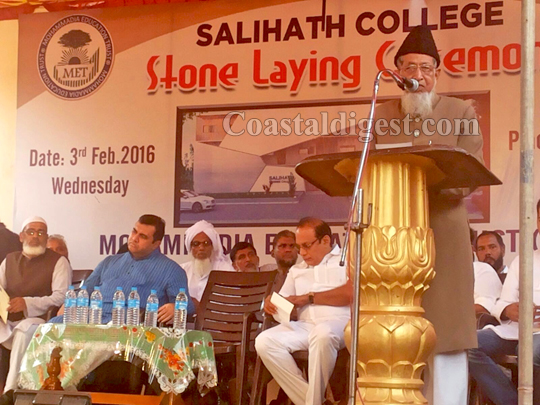
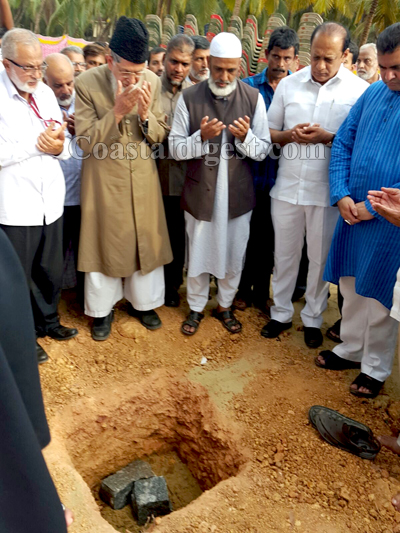
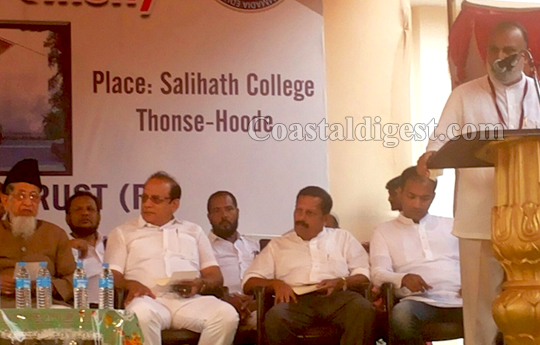
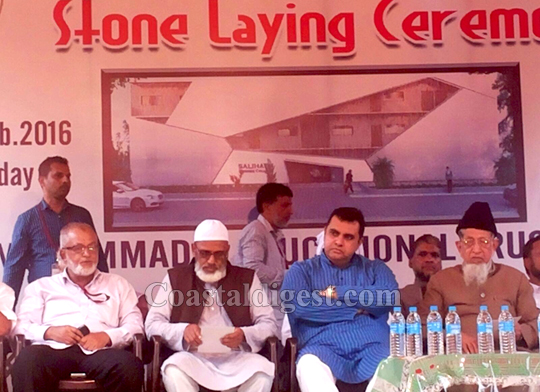
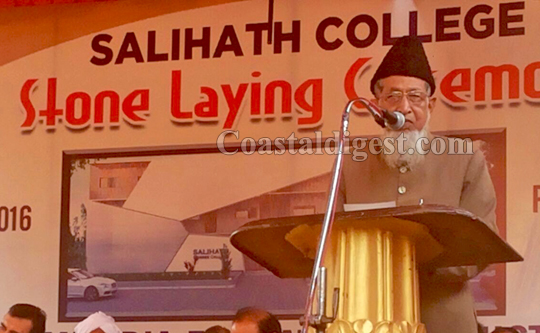
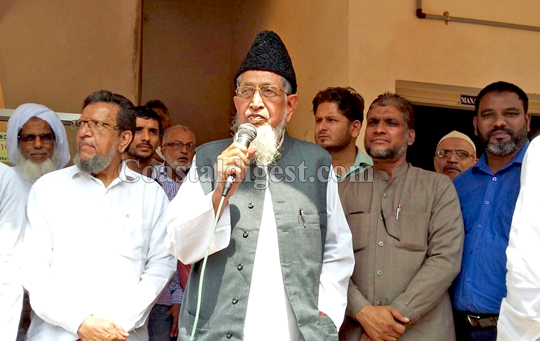
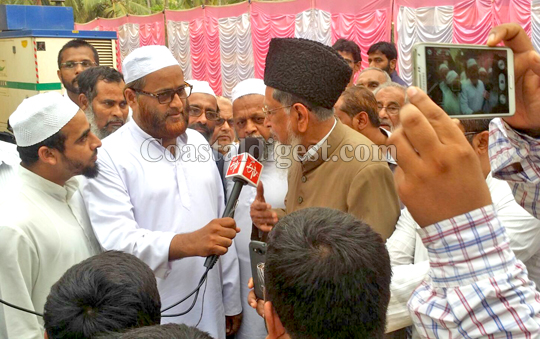
Udupi, Feb 4: The foundation stone laying ceremony of the Salihath First Grade College was held on Wednesday at Tonse, Hoode in Udupi district. Maulana Syed Jalaluddin Umari, national president of Jama’ath-e-Islami Hind led the stone laying ceremony.

salihathcollege 4

Speaking on the occasion, Umari said that the religion of Islam had made education compulsory for both men and women. Moral education is must to morally uplift the new generation, he added.

Vinay Kumar Sorake, Urban Development Minister, uploaded the contribution of the Trust in the field of education. “If India has to achieve number-1 position in the world in the field of education by 2020 private education institutions like this should play a prominent role,” he said.

The proposed women’s college is an addition to the several institutions run by the Mohammadia Educational Trust in Hoode. The new degree college would start functioning from 2016-17 academic year.

Mohammed Idris, vice-president of the Trust, said that the new three-storied building would be constructed at a cost of Rs. 2 crore and each floor would measure 6,700 square ft. The ground floor would be ready in six months.

The trust had started a nursery school in Hoode in 1980. It started a Kannada medium high school for girls in 1996 and an English medium school in 1998. It also started a pre-university college in 2009.

Already, more than 1,000 students were receiving education in the institutions run by the trust. The intention in starting all these institutions was to provide educational facilities to students in rural areas, he added.

Atharulla Sharif, president of the State-unit of Jama’ath-e-Islami Hind and Pramod Madhwaraj, MLA, Udupi, were present among others.

salihathcollege 1

salihathcollege 2

salihathcollege 3

salihathcollege 5

salihathcollege 6

salihathcollege 7

salihathcollege 8

Comments

SURESH
 - 
Friday, 5 Feb 2016

Why they are worshipping mother godess Earth.
Anyway nice to see this..

Mohmmed Ishaq
 - 
Thursday, 4 Feb 2016

Brother Naren, its a Stone laying for college building!
They are not worshiping stone, Snakes, S.Linga etc etc.
\Worship the Creator not his Creations\""

Suresh
 - 
Thursday, 4 Feb 2016

Yes dear naren, Do you have any problem? Look in to yourself dont interfere in others work

IBRAHIM.HUSSAIN
 - 
Thursday, 4 Feb 2016

Good wishes to Mohammadiya Education Trust.

It is learnt that Salihat is charging exorbident fee for the students in their Primary and Higher secondary Schools. If the trust is serving the community, there should be a fee structure which is lower than the other private schools or colleges. This will help the poor muslim students. Recent days Eductional institutions in Muslim community become commercialed like others that is highly undesirable. In the name of Education to Muslim Girls and boys, the commercialized practice is undesirable.

I urge Salihat college have to be very reasonable in their fee structure and wish they are model to others.

zameer baikadi
 - 
Thursday, 4 Feb 2016

Congratulations Salihat Management.

Salihat Management is doing great job in the field of Education in Hoode, May Allah reward them for their noble initiative.

Naren Kotian
 - 
Thursday, 4 Feb 2016

Are they worshiping stones? (ref pic number 2)

Shabbir Ahmed …
 - 
Thursday, 4 Feb 2016

Excellent job. May Allah accept their noble work. It is the basic
necessity for our girls who wants to pursue college education.
They can have their college education in their village no need to go far cities.
Morover Salihath is doing very good in the field of education.. May Allah bless them again. Aameen

mohammad
 - 
Thursday, 4 Feb 2016

excellent work...May Allah accept it

Add new comment

  • Coastaldigest.com reserves the right to delete or block any comments.
  • Coastaldigset.com is not responsible for its readers’ comments.
  • Comments that are abusive, incendiary or irrelevant are strictly prohibited.
  • Please use a genuine email ID and provide your name to avoid reject.
coastaldigest.com news network
May 25,2020

Ernakulam, May 25: Miscreants belonging to self-proclaimed Hindutva outfits have demolished a church set erected for the shoot of a Malayalam film at Kalady in Kerala’s Ernakulam district.

The set was erected to shoot the climax scene of the super hero film Minnal Murali, directed by Basil Joseph and starring Tovino Thomas and newcomer actor Femina.

The incident took place on Sunday. Members of the Antharashtra Hindu Parishad claimed that with the help of their sister outfit Antarashtra Bajrang Dal, they demolished the church set, erected on an island on the Periyar river in Kalady.

Hari Palode, the General Secretary of AHP, an organisation founded by Praveen Togadia, boasted on Facebook that they were not used to pleading to anyone, and decided to demolish the church set that was constructed near the Adi Sankaracharya mutt. 

“When they built such a structure in front of the Mahadeva shrine in Kalady, we said no. We had also submitted several complaints. We do not have the habit of pleading. We decided to demolish it. Our self respect must be protected at all cost,” AHP’s General Secretary Hari Palode wrote on his Facebook post along with pictures of members demolishing the set. 

The post also credited members of the Anrarashtra Bajrang Dal and its Ernakulam Division President Malayatoor Ratheesh for participating in the ‘service work’ of razing the church set. 

Mini Biju, member of Kalady Town panchayat confirmed that the film unit had indeed secured permission from the department before going ahead with the construction of the set.

“They had submitted a letter seeking permission to raise a temporary set. This was back in February before construction began. The panchayat committee had approved this request,” Mini said.

Comments

Add new comment

  • Coastaldigest.com reserves the right to delete or block any comments.
  • Coastaldigset.com is not responsible for its readers’ comments.
  • Comments that are abusive, incendiary or irrelevant are strictly prohibited.
  • Please use a genuine email ID and provide your name to avoid reject.
News Network
February 3,2020

Bengaluru, Feb 3: A wave of dissatisfaction has hit the six-month-old BJP government against the backdrop of chief minister B S Yediyurappa's announcement to induct 13 aspirants in the second cabinet expansion on February 6.

In the first cabinet expansion, the chief minister had inducted 17 ministers on August 20, 2019.

Among the 13, ten will be those defectors from Congress and the JD(S) who were disqualified earlier and won the assembly by-election in December last year.

The rest will be the 'native BJP leaders', as deputy chief minister Govind Karjol put it.

Speculations are rife that Mahadevapura MLA Arvind Limbavali, Hukkeri MLA Umesh Katti and C P Yogeshwar, who had lost to H D Kumaraswamy from Channapatna assembly segment,would be inducted.

If Yogeshwar is included in the cabinet then he will bethe second minister after Deputy chief minister Laxman Savadi who had lost and yet made it to the cabinet.

The possible induction of Yogeshwar and Savadi, who was made deputy chief minister despite losing the assembly elections, are also a "reason" for discontent in the BJP.

Hectic activities began in the power corridor and MLAs started forming groups to impress upon the chief minister to include their members in the ministry.

While one group was from the "Kalyana Karnataka" region, the others were the defectors who will be excluded in the cabinet expansion.

A few MLAS from 'Kalyana Karnataka' region or erstwhile Hyderabad-Karnataka region comprising six districts, met at the Legislature Home and held a meeting.

The meeting was led by Shorapur MLA Narasimha Nayak akaRaju Gouda and Honnalli MLA M P Renukacharya.
The MLAs of the Kalyana Karnataka region were unanimous that their backward region should get representation in the cabinet.

Later, Gouda met the Chief Minister and requested that their region be given adequate representation in the cabinet, which is lacking development.

Talking to reporters, Gouda said, "We had given representations to all the MPs, MLAs and the chief minister. Today also we all had a meeting and later called on the Chief Minister requesting him to make any MLA from our region a minister."

He said any imbalance in cabinet expansion will cause trouble to the MLAs from Kalyana Karnataka region.

"If you make the defeated candidates ministers then include 120 people in the cabinet," an aggrieved Gouda taunted.

Renukacharya too echoed the same sentiments.

"If you give preference to the defeated candidates then what will happen to those who won the election? Where should the winners of election go? We emphasise upon giving preference to the winners."

On the other hand, the defectors who jumped the Congress and the JD(S) ship and helped form the BJP government too had a meeting in Bengaluru, said BJP sources.

They were unanimous that not only the 11 MLAs who won theelection be made ministers but also A H Vishwanath and M T BNagaraj who had unsuccessfully contested the assembly by- polls from Hunasuru and Hoskote on a BJP ticket.

Vishwanath, who was quite vocal on Sunday for dropping his name, was mellowed down on Monday after meeting Yediyurappa.

However, his insistence for getting a cabinet berth remained intact.

"I did not make any proposal before him and will not do it in future because he (Yediyurappa) knows what has to be done,"Vishwanath told reporters after meeting the chief minister.

When he was reminded of Yediyurappa's statement that therewere legal complications in making him a minister, Vishwanath said, "This government has legal experts and the advocate general. They will speak."

Amid speculations that Athani MLA Mahesh Kumathalli may not get a cabinet berth in the reshuffle, the defected MLAs led by Gokak BJP MLA Ramesh Jarkiholi, had a meeting to decide their future strategy, said party sources.

Currently, there are 18 ministers, including the chief minister, in the cabinet, which has a sanctioned strength of 34. Sixteen berths are vacant.

The cabinet expansion exercise will be a delicate task for Yediyurappa as he has to ensure adequate representation for various castes and regions.

The ministry already has eight Lingayats, including Yediyurappa; three Vokkaligas; a Brahmin; three SCs, two OBCs and one ST.

Opposition parties have been critical of the BJP and Yediyurappa over the delay in the cabinet expansion, alleging he is weak and his administration has collapsed.

Reacting to the cabinet expansion, former chief minister Siddaramaiah quipped, "A drama is taking place. Let it happen on February 6. Afterwards we will see what all happens."


Comments

Add new comment

  • Coastaldigest.com reserves the right to delete or block any comments.
  • Coastaldigset.com is not responsible for its readers’ comments.
  • Comments that are abusive, incendiary or irrelevant are strictly prohibited.
  • Please use a genuine email ID and provide your name to avoid reject.
Ram Puniyani
January 14,2020

In the beginning of January 2020 two very disturbing events were reported from Pakistan. One was the attack on Nankana Sahib, the holy shrine where Sant Guru Nanak was born. While one report said that the place has been desecrated, the other stated that it was a fight between two Muslim groups. Prime Minister of Pakistan Imran Khan condemned the incident and the main accused Imran Chisti was arrested. The matter related to abduction and conversion of a Sikh girl Jagjit Kaur, daughter of Pathi (One who reads Holy Guru Granth Sahib in Gurudwara) of the Gurudwara. In another incident one Sikh youth Ravinder Singh, who was out on shopping for his marriage, was shot dead in Peshawar.

While these condemnable attacks took place on the Sikh minority in Pakistan, BJP was quick enough to jump to state that it is events like this which justify the Citizenship Amendment Act (CAA). Incidentally CAA is the Act which is discriminatory and relates to citizenship with Religion, which is not as per the norms of Indian constitution. There are constant debates and propaganda that population of Hindus has come down drastically in Pakistan and Bangla Desh. Amit Shah, the Home minister stated that in Pakistan the population of Hindus has come down from 23% at the time of partition to 3.7% at present. And in Bangla Desh it has come down from 22% to present 8%.

While not denying the fact that the religious minorities are getting a rough deal in both these countries, the figures which are presented are totally off the mark. These figures don’t take into consideration the painful migrations, which took place at the time of partition and formation of Bangla Desh later. Pakistan census figures tell a different tale. Their first census was held in 1951. As per this census the overall percentage of Non Muslim in Pakistan (East and West together) was 14.2%, of this in West Pakistan (Now Pakistan) it was 3.44 and in Eat Pakistan it was 23.2. In the census held in Pakistan 1998 it became 3.72%. As far as Bangla Desh is concerned the share of Non Muslims has gone down from 23.2 (1951) to 9.6% in 2011.

The largest minority of Pakistan is Ahmadis, (https://minorityrights.org/country/pakistan/) who are close to 4 Million and are not recognised as Muslims in Pakistan. In Bangla Desh the major migrations of Hindus from Bangla Desh took place in the backdrop of Pakistan army’s atrocities in the then East Pakistan.

As far as UN data on refugees in India it went up by 17% between 2016-2019 and largest numbers were from Tibet and Sri Lanka.  (https://www.un.org/en/development/desa/population/migration/publication…)

The state of minorities is in a way the index of strength of democracy. Most South Asian Countries have not been able to sustain democratic values properly. In Pakistan, the Republic began with Jinnah’s classic speech where secularism was to be central credo of Pakistan. This 11th August speech was in a way what the state policy should be, as per which people of all faiths are free to practice their religion. Soon enough the logic of ‘Two Nation theory” and formation of Pakistan, a separate state for Muslim took over. Army stepped in and dictatorship was to reign there intermittently. Democratic elements were suppressed and the worst came when Zia Ul Haq Islamized the state in collusion with Maulanas. The army was already a strong presence in Pakistan. The popular formulation for Pakistan was that it is ruled by three A’s, Army, America and Allah (Mullah).

Bangla Desh had a different trajectory. Its very formation was a nail in the coffin of ‘two nation theory’; that religion can be the basis of a state. Bangla Desh did begin as a secular republic but communal forces and secular forces kept struggling for their dominance and in 1988 it also became Islamic republic. At another level Myanmar, in the grip of military dictatorship, with democratic elements trying to retain their presence is also seeing a hard battle. Democracy or not, the army and Sanghas (Buddhist Sang has) are strong, in Myanmar as well. The most visible result is persecution of Rohingya Muslims.

Similar phenomenon is dominating in Sri Lanka also where Budhhist Sanghas and army have strong say in the political affairs, irrespective of which Government is ruling. Muslim and Christian minorities are a big victim there, while Tamils (Hindus, Christians etc.) suffered the biggest damage as ethnic and religious minorities. India had the best prospect of democracy, pluralism and secularism flourishing here. The secular constitution, the outcome of India’s freedom struggle, the leadership of Gandhi and Nehru did ensure the rooting of democracy and secularism in a strong way.

India so far had best democratic credentials amongst all the south Asian countries. Despite that though the population of minorities rose mainly due to poverty and illiteracy, their overall marginalisation was order of the day, it went on worsening with the rise of communal forces, with communal forces resorting to identity issues, and indulging in propaganda against minorities.

While other South Asian countries should had followed India to focus more on infrastructure and political culture of liberalism, today India is following the footsteps of Pakistan. The retrograde march of India is most visible in the issues which have dominated the political space during last few years. Issues like Ram Temple, Ghar Wapasi, Love Jihad, Beef-Cow are now finding their peak in CAA.

India’s reversal towards a polity with religion’s identity dominating the political scene was nicely presented by the late Pakistani poetess Fahmida Riaz in her poem, Tum bhi Hum Jaise Nikle (You also turned out to be like us). While trying to resist communal forces has been an arduous task, it is becoming more difficult by the day. This phenomenon has been variously called, Fundamentalism, Communalism or religious nationalism among others. Surely it has nothing to do with the religion as practiced by the great Saint and Sufi traditions of India; it resorts mainly to political mobilization by using religion as a tool.

Comments

Ashi
 - 
Tuesday, 14 Jan 2020

If Malaysia implement similar NRC/CAA, India and China are the loser.

Add new comment

  • Coastaldigest.com reserves the right to delete or block any comments.
  • Coastaldigset.com is not responsible for its readers’ comments.
  • Comments that are abusive, incendiary or irrelevant are strictly prohibited.
  • Please use a genuine email ID and provide your name to avoid reject.