Tanzanian girl stripped, beaten in Bengaluru; 'deeply pained' says Sushma

[email protected] (News Network)
February 3, 2016

Bengaluru, Feb 3: The African students in north Bengaluru closed ranks on Wednesday as details emerged of a mob of locals allegedly attacking and stripping a Tanzanian girl in the neighourhood on Sunday.

The 21-year-old girl who had been attacked met with top police officials on Wednesday to narrate what the mob had done to her. She gave her statement at the DCP's office in Peenya.tanzanian
As the details spread, community leaders were constantly in touch with their fellow nationals and relayed the safer routes they should take when commuting between their homes and colleges.

"We are now scared of every Indian around us after what happened to me," the 21-year-old student of a city college told mediapersons at Sapthagiri Hospital, where she was taken for a medical test by police.

External affairs minister Sushma Swaraj took note of the incident and tweeted, "We are deeply pained over the shameful incident with a Tanzanian girl in Bengaluru."

She asked the state government to ensure the safety and security of all foreign students.

Earlier, in a note verbale, Tanzania high commission asked the external affairs ministry to take strong legal action against those who assaulted the girl.

Bengaluru police on Wednesday registered a case under 354 IPC (outraging the modesty of a woman) against unidentified persons.

Four locals were taken into custody later in the evening.

The girl's nightmare unfolded around 7.30pm on Sunday when she and her three Tanzanian friends were going in a car in Ganapathinagar, off Hesaraghatta Main Road. Almost 2km away and about 30 minutes hour earlier, a car driven by a Sudanese student had run over Shabana Taj, 35, who had been walking with her husband, electrical contractor Sanaullah.

A mob allegedly comprising locals, who were rioting following the accident, stopped the girl's car. "We got out of the car and there were many people around. There was a policeman standing nearby and I asked him what had happened. He said nothing. A friends rushed to me and asked me not to walk around. By then, the mob started hitting him," she said.

"They pushed me around and hit me. I was wearing a T-shirt. They tugged at it and tore it, leaving me literally without anything. They continued to thrash us and we ran for our lives. My friends and I hopped onto a bus. The driver didn't move and the other passengers threw us out. We were at the mob's mercy. A passerby who offered me a T-shirt was also attacked. They thrashed us again till we took shelter near some shops," she said.

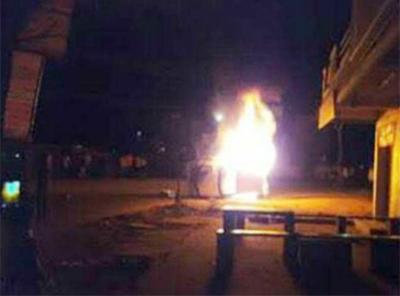
The mob, meanwhile, had set ablaze the car.

As they made their way to Sapthagiri Hospital, the mob chased them. Even at the hospital, the mob allegedly threatened to storm the hospital if the Africans were not sent out.

Police sources said they took the girl's statement on Wednesday, confirming there's been a three-day delay in acting on the incident.

African student leaders condemned the killing of the woman in an accident involving a Sudanese student but said the law should take its course. However, attacking innocent people based on their ethnicity should not be tolerated, they said, adding that the matter has been taken up with their embassies too.

"A woman has died and those responsible for the accident should be brought to book. But these students had nothing to do with it," said Bosco Kweesi, legal adviser to the African students.

A leader of the Tanzanian association, said she and some of her friends rushed to the police station Sunday night, seeking help to take their injured compatriots to hospital. "They plainly refused to come to our help or accept our complaint.. Police already had one of our fellow nationals who was in no way connected to the accident in their custody. A policeman told us that 'you all look alike and your fellow national will be set free only if you bring the guilty African car driver'," she said.

Comments

mohammad.n
 - 
Thursday, 4 Feb 2016

She asked the state government to ensure safety and security of all FOREIGN STUDENTS. What about indian students safety? What about indian ladies safety? What about justice for raped indian girls?

Worst ruling indian government, nothing less than a british rule before independence, worried about foreigners rather than the Indians which should be the most priority.

Mohammed SS
 - 
Thursday, 4 Feb 2016

Sushma Didi, show more and more pain as you want BJP govt. in Karnataka, there Is no such pain in your backyard for criminal acts and incidents where your party is ruling... apply Burnol deeply in to your backyard

Add new comment

  • Coastaldigest.com reserves the right to delete or block any comments.
  • Coastaldigset.com is not responsible for its readers’ comments.
  • Comments that are abusive, incendiary or irrelevant are strictly prohibited.
  • Please use a genuine email ID and provide your name to avoid reject.
News Network
January 6,2020

Hubballi, Jan 6: Elected representatives of the BJP, Congress and JD(S) on Sunday decided to sink their differences and fight unitedly for Karnataka’s rightful share in the Mahadayi and Kalasa-Banduri water dispute with Goa.

The meeting convened by JD(S) MLC Basavaraj Horatti here saw participation of BJP ministers Prahlad Joshi and Jagadish Shettar, Congress and JD(S) lawmakers, among others.

After a 70-minute closed door meeting, MLC Horatti told reporters that they discussed the water dispute in detail and decided to take steps based on inputs from legal and technical experts on the rightful apportioning of water. “Today, we took the first big step towards the overall development of the region, unencumbered by political divisions,” he said.

Though the air was filled with a sense of jubilation as the issue had united seemingly hostile political parties on one side, a few activists expressed disappointment that the meeting failed to set a timeline to resolve the dispute.

Comments

Add new comment

  • Coastaldigest.com reserves the right to delete or block any comments.
  • Coastaldigset.com is not responsible for its readers’ comments.
  • Comments that are abusive, incendiary or irrelevant are strictly prohibited.
  • Please use a genuine email ID and provide your name to avoid reject.
News Network
June 10,2020

Bengaluru, Jun 10: Internet connectivity, provided under the central government's BharatNet initiative, will be improved in rural areas of Karnataka in the next two to three months, said Deputy Chief Minister CN Ashwath Narayan.

After video conferencing with heads of different agencies and officials, on improving the quality of internet in rural areas, Ashwath Narayan said, "I reviewed the progress of the BharatNet implementation and the steps to be taken to improve the quality of internet connectivity in the next two to three months."

"We also discussed the possibility of giving the implementation of BharatNet to a different agency. We will seek permission from the central government and continue the project. We will ease communication with rural people by ensuring quality and high-speed internet to all Gram Panchayats," he added.

When BSNL officials and other agency representatives who attended the video conference shared their problems, the Deputy Chief Minister assured to solve them through proper coordination.

"Through BharatNet, several government schemes are being implemented in rural areas. Civic service centres are issuing birth and death certificates, Aadhaar cards and social security pensions among others. Of the total 6,000 Gram Panchayats in the state, 4,000 have high-speed internet connectivity, and the remaining will be provided with better internet connectivity through a new agency,'' said Ashwath Narayan.

Additional Secretary (e-governance) Rajeev Chawla, Additional Chief Secretary (IT-BT) EV Ramana Reddy, Principal Secretary (RDPR) Uma Mahadevan, Director (IT) Meena Nagaraj, Collegiate Education Director Pradeep and other senior officials were present in the meeting.

Comments

Add new comment

  • Coastaldigest.com reserves the right to delete or block any comments.
  • Coastaldigset.com is not responsible for its readers’ comments.
  • Comments that are abusive, incendiary or irrelevant are strictly prohibited.
  • Please use a genuine email ID and provide your name to avoid reject.
Ram Puniyani
June 29,2020

In Minneapolis, US an African American, George Floyd lost his life as the white policeman, Derek Chauvin, caught hold of him and put his knee on his neck. This is a technique developed by Israel police. For nine long minutes the knee of the while policeman was on the neck of George, who kept shouting, I can’t breathe.

Following this gruesome murder America erupted with protests, ‘Black lives matter’. The protestors were not just African Americans but also a large section of whites. Within US one police Chief apologized for the act of this. In a touching gesture of apology the police force came on its knees. This had reverberations in different parts of the World.

The act was the outcome of the remnants of the racial hatred against blacks by the whites. It is the hatred and the perceptions which are the roots of such acts of violence. What was also touching that the state of democracy in US is so deep that even the police apologized, the nation, whites and blacks, stood up as a sensitive collective against this violence.

US is not the only country where the brutal acts of violence torment the marginalized sections of society. In India there is a list of dalits, minorities and adivasis who are regularly subjected to such acts. But the reaction is very different. We have witnessed the case of Tabrez Ansari, who was tied to the pole by the mob and beaten ruthlessly. When he was taken to police station, police took enough time to take him to hospital and Tabrez died.

Mohsin Sheikh, a Pune techie was murdered by Hindu Rashtra Sena mob, the day Modi came to power in 2014. Afrazul was killed by Shambhulal Regar, videotaped the act released on social media. Regar believed that Muslims are indulging in love Jihad, so deserve such a fate. Mohammad Akhlaq is one among many names who were mob lynched on the issue of beef cow. The list can fill pages after pages.

Recently a young dalit boy was shot dead for the crime of entering a temple. In Una four dalits were stripped above waste and beaten mercilessly. Commenting on this act the Union Minister Ramvilas Paswan commented that it is a minor incident. Again the list of atrocities against dalits is long enough. The question is what Paswan is saying is the typical response to such gruesome murders and tortures. In US loss of one black life, created the democratic and humane response. In India there is a general silence in response to these atrocities. Some times after a good lapse of time, the Prime Minister will utter, ‘Mother Bharati has lost a son’. Most of the time victim is blamed. Some social groups raise their voice in some fora but by and large the deafening silence from the country is the norm.

India is regarded as the largest democracy. Democracy is the rule of law, and the ground on which the injustices are opposed. In America though the present President is insensitive person, but its institutions and processes of democratic articulations are strong. The institutions have deepened their roots and though prejudices may be guiding the actions of some of the officers like the killer of George, there are also police officers who can tell their President to shut up if he has nothing meaningful to say on the issue. The prejudices against Blacks may be prevalent and deep in character, still there are large average sections of society, who on the principles of ‘Black lives matter’. There are large sections of vocal population who can protest the violation of basic norms of democracy and humanism.

In India by contrast there are multiple reasons as to why the lives of Tabrez Ansari, Mohammad Akhlaq, Una dalit victims and their likes don’t matter. Though we claim that we are a democracy, insensitivity to injustices is on the rise. The strong propaganda against the people from margins has become so vicious during last few decades that any violence against them has become sort of a new normal. The large populace, though disturbed by such brutalities, is also fed the strong dose of biases against the victims. The communal forces have a great command over effective section of media and large section of social media, which generates Hate against these disadvantaged groups, thereby the response is muted, if at all.

As such also the process of deepening of our democracy has been weak. Democracy is a dynamic process; it’s not a fixed entity. Decades ago workers and dalits could protest for their rights. Now even if peasants make strong protests, dominant media presents it as blocking of traffic! How the roots of democracy are eroded and are visible in the form where the criticism of the ruling dispensation is labelled as anti National..

Our institutions have been eroded over a period of time, and these institutions coming to the rescue of the marginalized sections have been now become unthinkable. The outreach of communal, divisive ideology, the ideology which looks down on minorities, dalits and Adivasis has risen by leaps and bounds.

The democracy in India is gradually being turned in to a hollow shell, the rule of law being converted in to rule of an ideology, which does not have faith in Indian Constitution, which looks down upon pluralism and diversity of this country, which is more concerned for the privileges of the upper caste, rich and affluent. The crux of the matter is the weak nature of democracy, which was on way to become strong, but from decades of 1980s, as emotive issues took over, the strength of democracy started dwindling, and that’s when the murders of the types of George Floyd, become passé. One does complement the deeper roots of American democracy and its ability to protect the democratic institutions, which is not the case in India, where protests of the type, which were witnessed after George Floyd’s murder may be unthinkable, at least in the present times. 

Comments

Add new comment

  • Coastaldigest.com reserves the right to delete or block any comments.
  • Coastaldigset.com is not responsible for its readers’ comments.
  • Comments that are abusive, incendiary or irrelevant are strictly prohibited.
  • Please use a genuine email ID and provide your name to avoid reject.