


ZP/TP polls: BJP manifesto promises to eradicate corruption

February 7, 2016

Bengaluru, Feb 7: The State BJP, in its manifesto for the zilla and taluk panchayat polls, has sought to give a thrust to capacity building at the local bodies level and also take the NDA model of development to the grassroots.
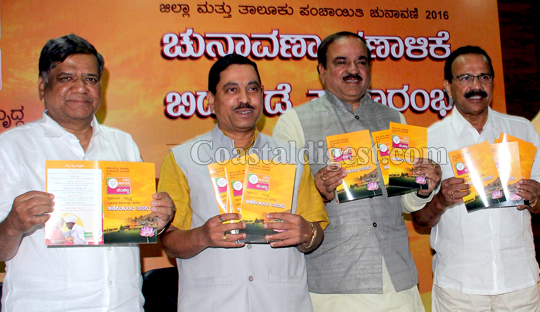
BJPmanifesto

Launched in the presence of State leaders in Bengaluru on Saturday, the manifesto also lists priorities across 20 sectors, including administration, social welfare, agriculture, education and housing in rural local bodies.

The elections for the zilla and taluk panchayats are scheduled to be held across 30 districts in two phases on February 13 and 20.

BJP?State president Pralhad Joshi said the Congress government had failed to keep its promise made ahead of the Assembly elections of decentralisation of administration and providing more power to panchayat raj institutions.

The NDA government has successfully launched several welfare and development schemes after coming to power in May 2014, Joshi said and added that the party would strive to replicate these schemes at the grassroots.

Former minister Vishweshwara Hegde Kageri, who headed a committee to draft the manifesto, said the document was also a pointer to BJP’s priorities to panchayat raj institutions if it comes to power in the 2018 Assembly polls. Union?Ministers Ananth Kumar, D?V?Sadananda Gowda and former ministers Suresh Kumar and R?Ashoka were among those present during the manifesto launch.

Key agenda

Pressure the government to increase annual grants to zilla and taluk panchayats to Rs 10 crore and Rs 5 crore, respectively

Eradicate corruption in panchayat bodies by setting up vigilance cells

Constitution of planning boards at ZP/TP level to chalk out annual development action plan

Construction of student hostels with good infrastructure and amenities in rural

areas

Provide thrust to solar power to energise pumpsets

Upgrading of village roads

Drinking water facilities and toilets in all rural schools

Better facilities in rural primary health centres

Comments

suresh
 - 
Sunday, 7 Feb 2016

ha ha ha corruption!!! Vyapam Scam, Anar Patel - Gujarat Scam, Food supply scam, chikki scam-Maharastra, Modi -Rajasthan Scam. Mining scam-, land denotification - Karnataka, which corruption you are going to stop? Do you have the guts to punish these anti nationalists?

Deepak Kumar
 - 
Sunday, 7 Feb 2016

Chunavi Jumla..
Shameless liars.
Anti national pudaris

Add new comment

  • Coastaldigest.com reserves the right to delete or block any comments.
  • Coastaldigset.com is not responsible for its readers’ comments.
  • Comments that are abusive, incendiary or irrelevant are strictly prohibited.
  • Please use a genuine email ID and provide your name to avoid reject.
News Network
January 29,2020

Newsroom, Jan 29: Karnataka’s capital has earned the unwelcome distinction of global capital of traffic congestion. According to a report by TomTom, the Netherlands-based global provider of navigation, traffic and map products, Bengaluru beat 415 other cities across 57 countries to earn the title of world's most traffic congested city in 2019.

“Bengaluru takes the top spot this year with drivers in the southern Indian city expecting to spend an average of 71% extra travel time stuck in traffic," TomTom said in the ninth edition of its annual Traffic Index.

Three other Indian cities, namely, Mumbai, Pune and New Delhi are also ranked in the 2019 edition of TomTom’s Traffic Index of the world’s most traffic-congested cities. 

The report released on Tuesday ranks cities by the average time added to a trip. TomTom index also includes details on when congestion is heaviest and lightest, how highways compare with surface streets, and how much time drivers wasted waiting for other drivers to get out of their way.

Following closely on the heels of Bengaluru is Manila, Philippines, with the similar 71% traffic congestion. Among the top five worst traffic affected cities are Mumbai and Pune from India at the fourth and fifth place respectively, while Bogota, Colombia is on third spot.

Delhi, the national capital of India is on the 8th spot, while Moscow (Russia), Lima (Peru), Istanbul (Turkey) and Jakarta (Indonesia) are on 6th, 7th, 9th and 10th spot respectively.

Mumbai recorded a 65% traffic congestion with 9th September, 2019 being the worst day. On an average, a Mumbaikar lost 209 hours in traffic congestion. Pune has 59% traffic congestion with 2nd August, 2019 being the worst day. 193 hours are lost due to congestion. Delhi, on the other hand, has 56% traffic congestion. 23rd October, 2019 was the worst day, while 190 hours are lost in traffic congestion.

Interestingly, among all the four Indian cities, Delhi has the most number of cars. Previous studies have concluded that Delhi has the best road conditions among the Metro cities of India.

If you are wondering what exactly the percentages mean, a 53% congestion level in Bangkok, for example, means that a trip will take 53% more time than it would during Bangkok’s baseline uncongested conditions.

TomTom calculates the baseline per city by analyzing free-flow travel times of all vehicles on the entire road network – recorded 24/7, 365 days a year. The report by Dutch navigation and mapping company ranks cities by the average time added to a trip. It also includes details on when congestion is heaviest and lightest, and how much time drivers wasted waiting for other drivers to get out of their way.

Comments

Add new comment

  • Coastaldigest.com reserves the right to delete or block any comments.
  • Coastaldigset.com is not responsible for its readers’ comments.
  • Comments that are abusive, incendiary or irrelevant are strictly prohibited.
  • Please use a genuine email ID and provide your name to avoid reject.
News Network
May 22,2020

Bengaluru, May 22: Karnataka government on Thursday announced that weddings scheduled for May 24 and May 31 are exempted from complete lockdown on Sundays.

As per an earlier advisory issued by the State government with regard to weddings, not more than 50 guests shall be allowed and the consumption of liquor on the occasion will be prohibited.

According to the advisory, sanitisers should be provided at the entry and other appropriate places at the venue. Also, thermal screening of all persons shall be conducted at the entry of the venue. The scanner should be held 3-15 cms away from a person's forehead.

Apart from this, the venue shall be "clean and hygienic," and a "nodal person shall be identified for overseeing the arrangements and coordination at the venue."

Also, a list of attendees with contact details has to be maintained and all guests should have downloaded Aarogya Setu app.

Comments

Add new comment

  • Coastaldigest.com reserves the right to delete or block any comments.
  • Coastaldigset.com is not responsible for its readers’ comments.
  • Comments that are abusive, incendiary or irrelevant are strictly prohibited.
  • Please use a genuine email ID and provide your name to avoid reject.
News Network
July 8,2020

Bengaluru, Jul 8: The expert committee constituted by the Karnataka government to look into imparting online education in the wake of the COVID-19 lockdown submitted its report on Tuesday to the Minister for Primary and Secondary Education, S Suresh Kumar.

Amid growing pressure by educational institutions to allow them to run online classes for the students, the government set up the committee headed by noted educationist M K Sridhar.

The Minister told reporters that some schools wanted to run online classes, including for LKG and UKG students. It had also come to the government's notice that schools were reportedly charging hefty fees in the name of online teaching, he added.

"To address the concerns of parents, schools, and the future of the children, the committee was formed,"Kumar said. He further said that the government would study the recommendations and hold discussions with officials and various stakeholders before arriving at a decision.

The Education Department said that the committee, in its report, titled "Continuation of Learning in School Education of Karnataka: Guidelines During COVID-19 Pandemic for Technology Enabled Education and Beyond", has recommended teaching online or by using printed material. The committee suggested that children in the age group of three to six be taught online by way of story-telling, rhymes and games strictly in the presence of parents thrice a week just for one session a day For students from class one to three, it advised two periods a day and three days a week for online teaching.

Students from class three to five would have classes five days a week and two classes for 30 minutes a day. For students from class six to eight, there could be three classes a day for a duration of 30 minutes to 45 minutes each, while for students of class nine and 10 there would be four sessions a day between 30 and 45 minutes each.

The committee also suggested usage of Doordarshan and Akashwani for the government school children. Suresh Kumar said there were a few petitions filed in the Karnataka High Court regarding online teaching to the children.

Comments

Add new comment

  • Coastaldigest.com reserves the right to delete or block any comments.
  • Coastaldigset.com is not responsible for its readers’ comments.
  • Comments that are abusive, incendiary or irrelevant are strictly prohibited.
  • Please use a genuine email ID and provide your name to avoid reject.