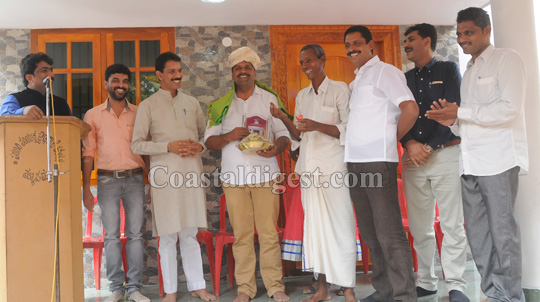
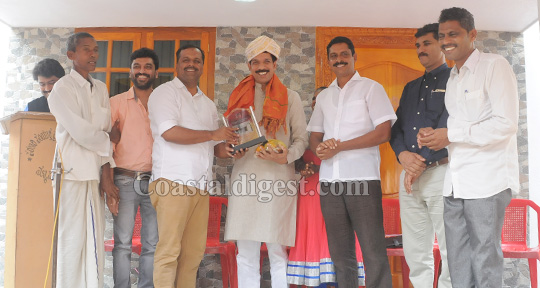
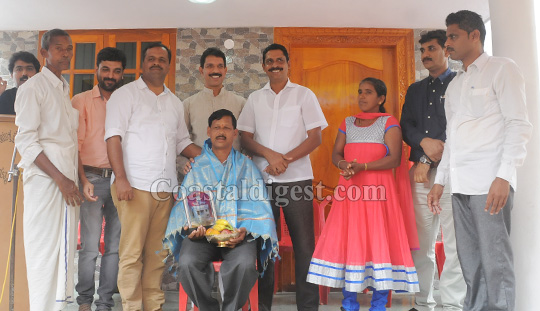
Thank you UCA: 'Saint of Letters' Harekala Hajabba enters new house

[email protected] (CD Network | Photos by Suresh)
February 8, 2016

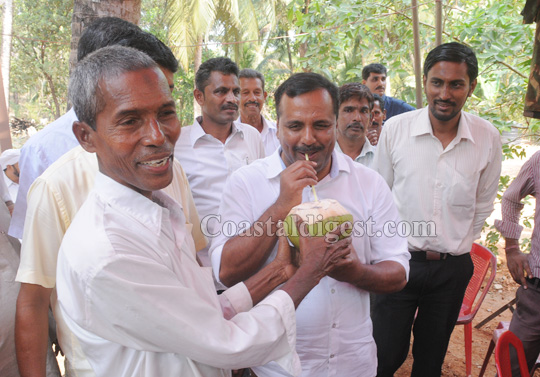
Mangaluru, Feb 8: "I never dreamt of living in a house that is worth Rs 15 lakh in my life. Today I am extremely happy, thankful and I pray for the well-being of the donor, who built a house for me," said Harekala Hajabba, 61, who is popularly known as 'Akshara Santha' or 'Saint of Letters'

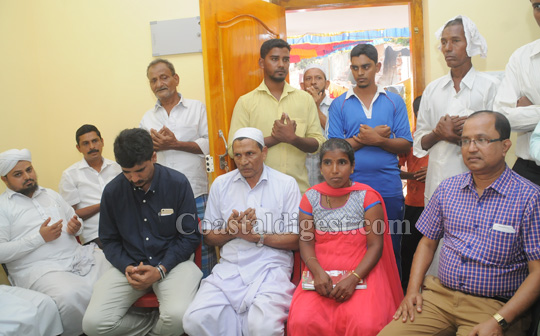
harekala hajabba  4

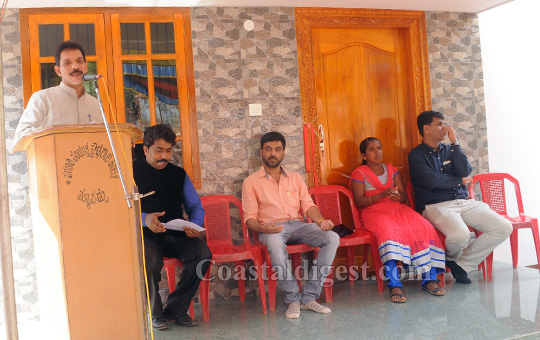
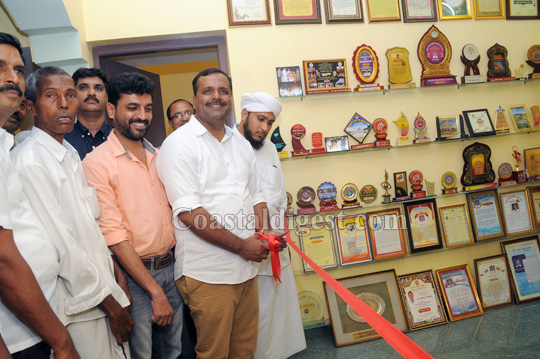
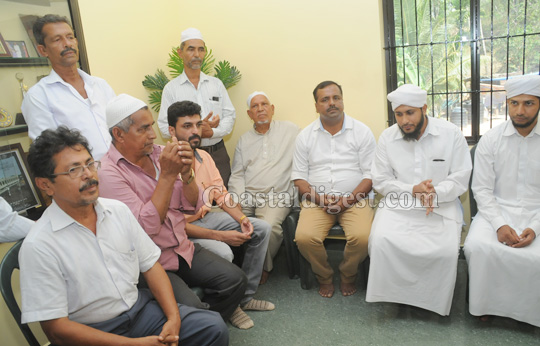
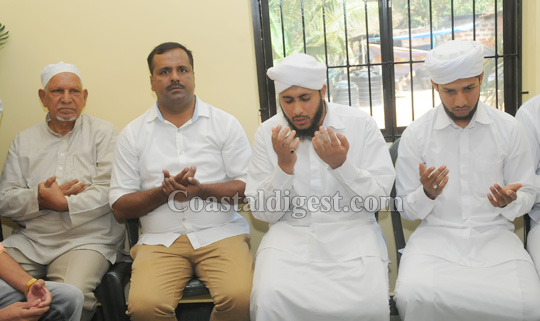
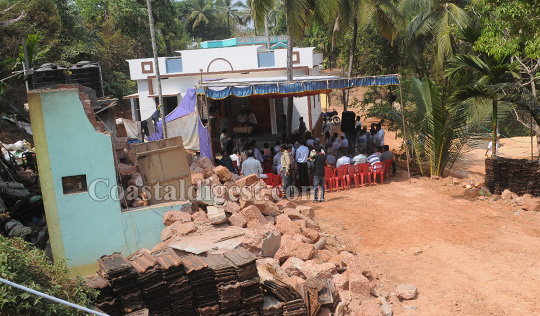
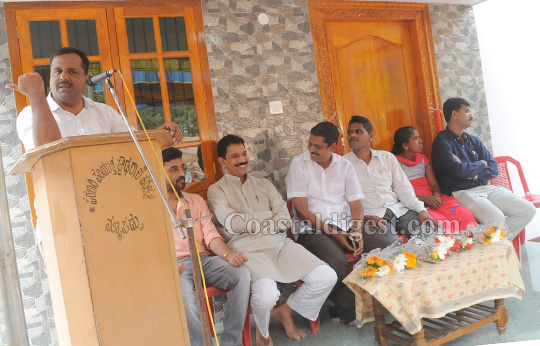
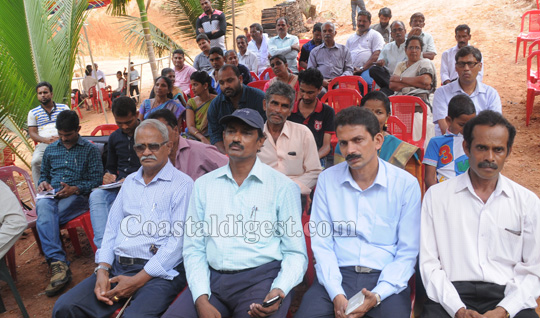
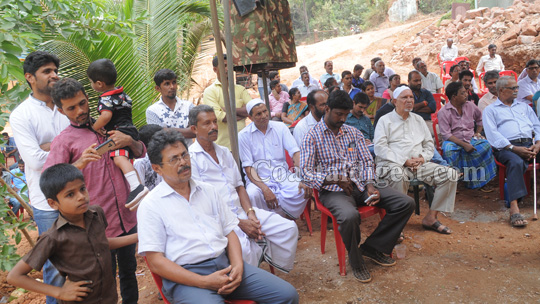
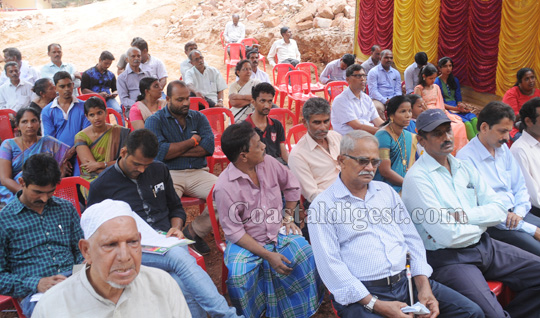
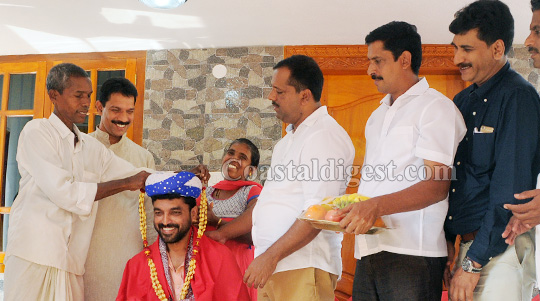
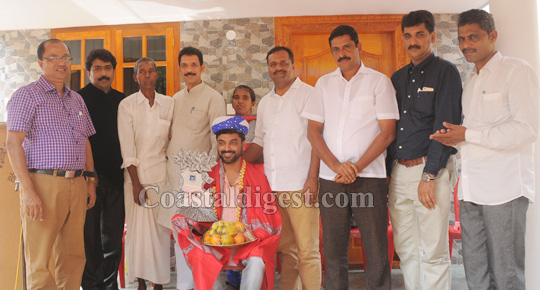
Despite being an uneducated, Hajabba fought tirelessly to build built a government school at Newpadpu in Harekala about 20 kms here by pooling money he earned and by seeking donors help. However, he had forgotten to build a house for his wife and three children. Hajabba was worried about his family very much, but he never showed it to others. At this juncture, the United Christian Association (UCA) has come forward to build 760 sqft house at a cost of Rs 15 lakh for Hajabba. On Sunday, a house warming ceremony was held in the presence of Muslim clergies, UCA president Alban Menezes, Dakshina Kannada MP Nalin Kumar Kateel and minister for health and family welfare U T Khader.

"I am an ordinary man and I have not earned a single rupee for myself. On September 13, 2004, there were no chairs in my house when four journalists came to talk to me about my struggle for a school in my village. Now I own this houses only because of media persons and organisations like United Christian Association," said Hajabba, who left no stones unturned to start a government school in his village and later to construct a new block for it.

Hajabba, who has been selling orange near State Bank bus stand, was literally struggling to meet both ends at his partially damaged tiled roof house, where five member family with ailing wife were living. In fact, it is the initiative of UCA president Alban Menezes, a young builder in the city, that led to construction of a two bed room RCC house for Hajabba.

"I understood the problems of Hajabba when he was admitted to hospital. Doctors, who treated Hajabba, told me that he was suffering from anxiety due to poverty. I felt really sad when I saw a great achiever suffering from poverty and living in a dilapidated house. Hence, I decided to construct a house for him through UCA. While nearly 1.5 lakh was collected through UCA members, I spent nearly Rs 13.5 lakh. Very soon, I will provide compound wall and gate for his house spending additional Rs 2 lakh," said Alban Menezes, who had donated many houses and did several charity works earlier.

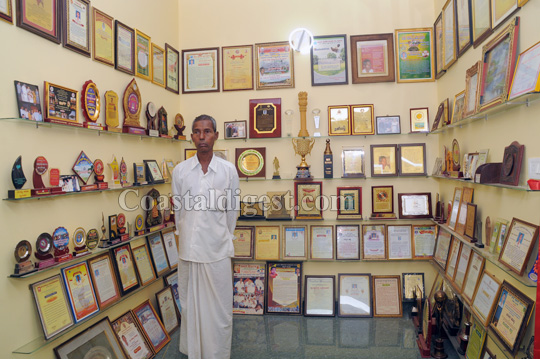
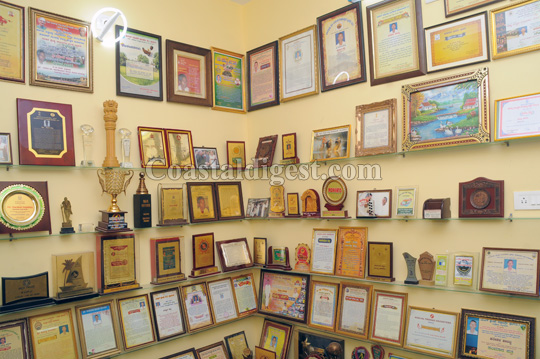
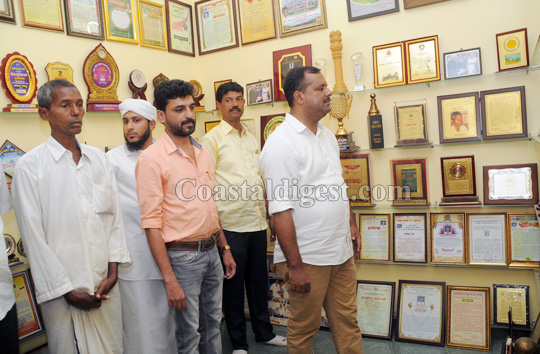
Menezes said that a separate space has been provided in the new house for Hajabba to display all awards, citations and mementos he received during his journey as a crusader of education.

harekala hajabba  1

harekala hajabba  2

harekala hajabba  3

harekala hajabba  5

harekala hajabba  6

harekala hajabba  7

harekala hajabba  8

harekala hajabba  9

harekala hajabba  10

harekala hajabba  11

harekala hajabba  12

harekala hajabba  13

harekala hajabba  14

harekala hajabba  15

harekala hajabba  16

harekala hajabba  17

harekala hajabba  18

harekala hajabba  19

harekala hajabba  20

harekala hajabba  21

harekala hajabba  22

harekala hajabba  23

Comments

Ahmed Bava
 - 
Tuesday, 9 Feb 2016

Congratulations UCA President Mr. Alban Menezes and Members really great work done by you for a Great person Mr.HAJABBA. HUMANBEING

A.Ullal
 - 
Tuesday, 9 Feb 2016

We admire you. sir.. I am proud that my fellow countryman have done great contribution towards education. Where he built school for kids when kids reach of school was far at site.
He is a role model for us.

A.Ullal
 - 
Tuesday, 9 Feb 2016

We admire you. sir.. I proud that my fellow countryman done grate contribution towards education. Were he build school for kids when kids reach of school is far at site.
He is role model for us.

rikaz
 - 
Monday, 8 Feb 2016

I hope because of this house he can keep up his health and serve more and better to poorer section of the society.

Government should think of giving him pension monthly basis...and I think it's not right time for him to go in the heat of sun and work and bring money for his social work as well his family...

Sherief
 - 
Monday, 8 Feb 2016

Mr.Alban Menezes and UCA's generous contribution in the form of donating new built home to Akshara Santha Janab Hajabba is truly appreciable. Your donation of a house is an inspiration to all of us. I hat's off for your generosity and commitment for helping the society is sincerely appreciated.

ABUL
 - 
Monday, 8 Feb 2016

Great job and highly praisable noble work by UCA. Bieng a muslim community memeber Janab Hajabba never recognised by his own community people where he stays with many muslim millionaires surroundings.
Hats off once again UCA.Keep it up

Muzaffar Ali
 - 
Monday, 8 Feb 2016

Congratulations ... UCA
Very Good deed by UCA

IBRAHIM.HUSSAIN
 - 
Monday, 8 Feb 2016

It is praise worthy that UCA and Alban understood the pain of Hajabba and built a house for this Akshara Santha. At the same time it is unfortunate, millionaire Muslim people, charity institutions around his area neither understood this Akshara Santha, nor his pitiful life in a lapidated house where he was living. Politician throng on the opening day, but never thought of his need.

Once again salute to Mr. Alban and UCA for this noble work.

Add new comment

  • Coastaldigest.com reserves the right to delete or block any comments.
  • Coastaldigset.com is not responsible for its readers’ comments.
  • Comments that are abusive, incendiary or irrelevant are strictly prohibited.
  • Please use a genuine email ID and provide your name to avoid reject.
Agencies
February 20,2020

India ranked 77th on a sustainability index that takes into account per capita carbon emissions and ability of children in a nation to live healthy lives and secures 131st spot on a flourishing ranking that measures the best chance at survival and well-being for children, according to a UN-backed report.

The report was released on Wednesday by a commission of over 40 child and adolescent health experts from around the world. It was commissioned by the World Health Organization (WHO), UN Children's Fund (UNICEF) and The Lancet medical journal.

In the report assessing the capacity of 180 countries to ensure that their youngsters can survive and thrive, India ranks 77th on the Sustainability Index and 131 on the Flourishing Index, it said.

Flourishing is the geometric mean of Surviving and Thriving. For Surviving, the authors selected maternal survival, survival in children younger than 5 years old, suicide, access to maternal and child health services, basic hygiene and sanitation, and lack of extreme poverty.

For Thriving, the domains were educational achievement, growth and nutrition, reproductive freedom, and protection from violence.

Under the Sustainability Index, the authors noted that promoting today's national conditions for children to survive and thrive must not come at the cost of eroding future global conditions for children's ability to flourish.

The Sustainability Index ranks countries on excess carbon emissions compared with the 2030 target. This provides a convenient and available proxy for a country's contribution to sustainability in future.

The report noted that under realistic assumptions about possible trajectories towards sustainable greenhouse gas emissions, models predict that global carbon emissions need to be reduced from 39·7 giga­ tonnes to 22·8 gigatonnes per year by 2030 to maintain even a 66 per cent chance of keeping global warming below 1·5°C.

It said that the world's survival depended on children being able to flourish, but no country is doing enough to give them a sustainable future.

"No country in the world is currently providing the conditions we need to support every child to grow up and have a healthy future," said Anthony Costello, Professor of Global Health and Sustainability at University College London, one of the lead authors of the report.

"Especially, they're under immediate threat from climate change and from commercial marketing, which has grown hugely in the last decade," said Costello – former WHO Director of Mother, Child and Adolescent health.

Norway leads the table for survival, health, education and nutrition rates - followed by South Korea and the Netherlands. Central African Republic, Chad and Somalia come at the bottom.

However, when taking into account per capita CO2 emissions, these top countries trail behind, with Norway 156th, the Republic of Korea 166th and the Netherlands 160th.

Each of the three emits 210 per cent more CO2 per capita than their 2030 target, the data shows, while the US, Australia, and Saudi Arabia are among the 10 worst emitters. The lowest emitters are Burundi, Chad and Somalia.

According to the report, the only countries on track to beat CO2 emission per capita targets by 2030, while also performing fairly – within the top 70 – on child flourishing measures are: Albania, Armenia, Grenada, Jordan, Moldova, Sri Lanka, Tunisia, Uruguay and Vietnam.

"More than 2 billion people live in countries where development is hampered by humanitarian crises, conflicts, and natural disasters, problems increasingly linked with climate change," said Minister Awa Coll-Seck from Senegal, Co-Chair of the commission.

The report also highlights the distinct threat posed to children from harmful marketing.

Evidence suggests that children in some countries see as many as 30,000 advertisements on television alone in a single year, while youth exposure to vaping (e-cigarettes) advertisements increased by more than 250 per cent in the US over two years, reaching more than 24 million young people.

Studies in Australia, Canada, Mexico, New Zealand and the US – among many others – have shown that self-regulation has not hampered commercial ability to advertise to children.

Children's exposure to commercial marketing of junk food and sugary beverages is associated with purchase of unhealthy foods and overweight and obesity, linking predatory marketing to the alarming rise in childhood obesity, it said.

The number of obese children and adolescents increased from 11 million in 1975 to 124 million in 2016 – an 11-fold increase, with dire individual and societal costs, the report said.

To protect children, the authors call for a new global movement driven by and for children.

Specific recommendations include stopping CO2 emissions with the utmost urgency, to ensure children have a future on this planet; placing children and adolescents at the centre of global efforts to achieve sustainable development, the report said.

New policies and investment in all sectors to work towards child health and rights; incorporating children's voices into policy decisions and tightening national regulation of harmful commercial marketing, supported by a new Optional Protocol to the UN Convention on the Rights of the Child, it said.


Comments

Add new comment

  • Coastaldigest.com reserves the right to delete or block any comments.
  • Coastaldigset.com is not responsible for its readers’ comments.
  • Comments that are abusive, incendiary or irrelevant are strictly prohibited.
  • Please use a genuine email ID and provide your name to avoid reject.
Media Release
February 14,2020

Veteran journalist P. Sainath has said that the nation is in a crisis. And this crisis is not limited to just the rural area. It has become a national crisis at various areas such as agriculture, education, economy, job creation etc.

He was delivering the endowment lecture on the topic ‘Indian democracy at the post-liberalization and post-truth era’ at Media Manthan 2020 organized by the PG department of journalism and mass communication at St Aloysius College (Autonomous). 

Mr Sainath said that the many policies adopted in the 90s led to India becoming unusually unequal. Referring to the speech Ambedkar had made at the Constituent Assembly while handing over the draft of the Constitution, Mr Sainath said, “Ambedkar had warned about the weakness of Indian democracy that liberty without equality allows the supremacy of a few over the multitude. Liberty, equality and fraternity must be kept together as we cannot have one without the other.” 

Mr Sainath stated that the agrarian crisis was no longer about the loss of productivity, employment or about farmer suicide; it was a societal, civilizational crisis. Commenting on the lopsided policies such as cow-slaughter ban, he explained how cow slaughter ban had adversely affected many industries due to their interdependency. While Muslims who slaughtered cows were rendered helpless, the cattle traders who were mostly OBCs lost their earnings as the cattle prices crashed. An important industry like Kolhapur sandals industry in Maharashtra went bankrupt as a result of the cow slaughter ban in Maharashtra. He said the policymakers had no idea how the rural industries were interconnected. Demonetisation too devastated the rural economy as 98 percent of rural transactions happen through cash. 

Mr Sainath also spoke about the crisis of inequality which affects the Dalits and the Adivasis far more than anyone else as 90 percent of the rural households take home less than Rs 10,000/- per month. “Women are yet another group whose labour is never counted in the gross domestic product. Women and girls globally do unpaid work which amounts to about 12.5 billion working hours per year. Monetarily speaking, this is worth 10.8 trillion dollars,” Mr Sainath added. 

Speaking about the crisis of jobs Mr Sainath said that major companies were laying off employees just to create more profits for the investors and the adoption of artificial intelligence in the industry would further destroy millions of jobs.

Rector of St Aloysius College Institutions Fr Dionysius Vaz SJ, Principal Dr (Fr) Praveen Martis SJ, HOD of Journalism and Mass Communication department Dr (Fr) Melwyn Pinto SJ were present.

‘Veerappan and Vijay Mallya’s business models are interesting!’

Addressing the gathering during his endowment lecture on Friday, Mr Sainath made an interesting comment on the so called ‘revenue model’. “Whenever I visit IIMs and IITs for lectures on my PARI project, the students there ask me what my revenue model for my project is. I tell them that I do not have a revenue model. In fact, journalism does not begin with a revenue model. Gandhiji, Ambedkar, Bhagat Singh were all great journalists. But they did not have a revenue model,” Mr Sainath said.

On a lighter note, he said that the best revenue model that he liked was that of forest brigand Veerappan and liquor baron Vijay Mallya. “Veerappan ruled the forest for forty years and from the top ministers to the villagers he could dictate terms and liver royally. Similarly, Mallya’s revenue model was to steal the banks and run away abroad and live like a king,” Mr Sainath added.

Journalism is not and can never be a business. It is a calling, he opined. While newspaper can be a business, television can be a business, journalism per se cannot be reduced to a business. “Unfortunately today, journalists are recruited on a contract basis and they have no bargaining power; and there are no unions to fight for their cause. Hence, they are at the mercy of the corporate media houses for their survival and are made to write stories that cannot be called journalism,” Mr Sainath said.

Answering a question as to the pressures he faced as a journalist, he said that external pressures from the government or others could be very well handled. It is the internal pressures from once own media house that journalists find it difficult to manage.


Comments

Add new comment

  • Coastaldigest.com reserves the right to delete or block any comments.
  • Coastaldigset.com is not responsible for its readers’ comments.
  • Comments that are abusive, incendiary or irrelevant are strictly prohibited.
  • Please use a genuine email ID and provide your name to avoid reject.
News Network
June 6,2020

Bengaluru, Jun 6: Karnataka Chief Minister B S Yediyurappa on Saturday said hotels and restaurants would be allowed to re-open, but the precautionary measures laid down by the Centre against coronavirus were mandatory.

The Chief Minister on Friday held a meeting with the tourism and transport department, also stakeholders, regarding revival of tourism in the state.

Hotels associations and transport companies have said they would follow the guidelines issued by the government, an official press release said here.

The Karnataka government had said it would go by the Centre's direction on opening religious places of worship, shopping malls, hotels, restaurants and other hospitality services on June 8.

Buses, hotels and taxi owners association placed some demands at the meeting, the release said, adding that Yediyurappa informed them that he would examine their demands and take appropriate decisions.

The Chief Minister also released a handout regarding the guidelines that need to be followed as the tourism department is opening hotels, guest houses and tourist destinations.

Deputy Chief Minister Laxman Savadi, Tourism Minister C T Ravi and senior officials of the department participated in the meeting.

The government had, on Thursday, said safaris, trekking, jungle lodges and resorts in areas that fall outside the COVID-19 containment zones can re-open provided they adhere to social distancing, hygiene as issued by the governments.

Comments

Add new comment

  • Coastaldigest.com reserves the right to delete or block any comments.
  • Coastaldigset.com is not responsible for its readers’ comments.
  • Comments that are abusive, incendiary or irrelevant are strictly prohibited.
  • Please use a genuine email ID and provide your name to avoid reject.