Belthangady: Trapped leopard rescued, released in forest

[email protected] (CD Network)
November 13, 2014

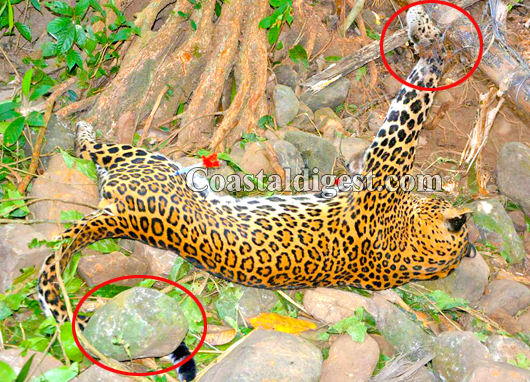
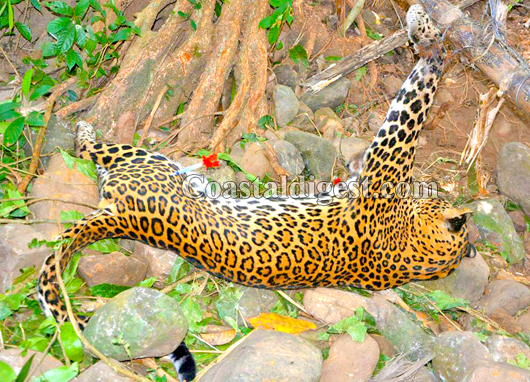
Belthangady, Nov 13: A leopard that had its front paw trapped in a tree joint in an estate in Mucchiradka-Hemaje in Shishila village in Belthangady taluk from Tuesday night, returned to its habitat after being freed by forest department officials.

The eight-year-old male leopard had gotten its front paw trapped in a tree joint in the estate of Shivanna Gowda on Tuesday night. When the owner of the estate discovered the trapped leopard on Wednesday morning, he immediately informed the forest department officials.

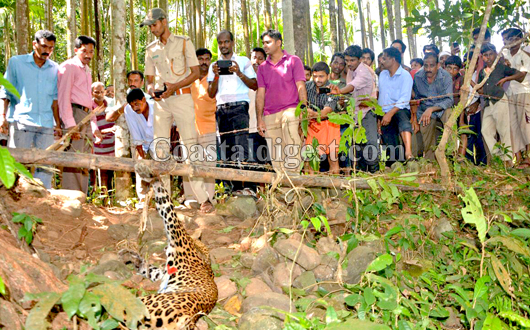
Immediately, Uppinangady zonal forest officer Harsha arrived at the spot and controlled the people gathered.

Anesthetist Dr Vikranth and Dinesh were summoned to tranquilise the leopard. Having successfully tranquilised the leopard on the fourth attempt, it was freed from the joint and shifted to a cage with the assistance of Snake expert Snake Joy who also arrived at the scene.

Once it was safely inside the cage, the forest officials took the wild animal to the dense forest region near Gundya and set it free after it regained consciousness.

Chirate 2

Chirate 1

Chirate 3

Chirate 4

Comments

Sunny Arya
 - 
Tuesday, 8 Nov 2016

What a beautiful Leopard..

Merrill
 - 
Tuesday, 9 Feb 2016

Por un lado, ahora hay un porno más dirigido a las mujeres:
el female pleasant, donde se prioriza el orgasmo de la mujer.

Feel free to surf to my homepage :: videos putas gratis: http://www.muremature.com/recent/

Emerson
 - 
Wednesday, 3 Feb 2016

A great rule to check out for that amount of water you'll need every day is drinking half the body weight in ounces of water each day.
the key's simply to nourish one's body in doing what it has to ensure that it stays
healthy and balanced. There are very many strategies and tips on the market
you're certain to get confused.

Look at my webpage; weight loss tips from around the
world: http://www.dalet.com/users/selmawragge420080955

Add new comment

  • Coastaldigest.com reserves the right to delete or block any comments.
  • Coastaldigset.com is not responsible for its readers’ comments.
  • Comments that are abusive, incendiary or irrelevant are strictly prohibited.
  • Please use a genuine email ID and provide your name to avoid reject.
News Network
August 9,2020

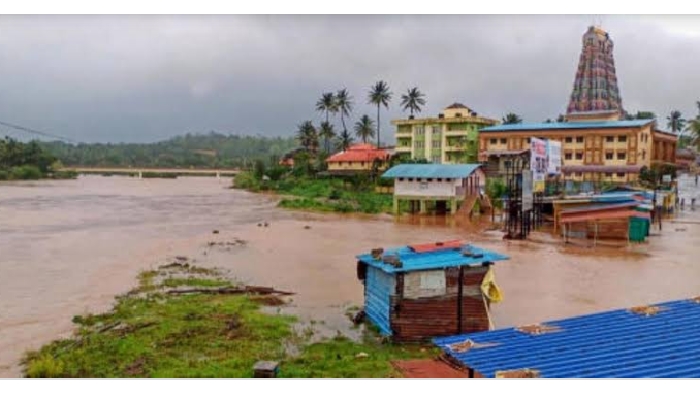
Bengaluru, Aug 9: Swollen rivers and flood-like situation continue to threaten lives and property in several parts of Karnataka that have been ravaged by torrential rains over the last few days.

Though there has been a respite from the downpour in some parts, rivers continue to flow above the danger mark, inundating low lying areas in several parts of Malnad, coastal and interior Karnataka.

There are also reports of continued landslides in hilly areas of Kodagu and Chikkamagaluru.

In Dakshina Kannada, heavy rains have submerged several areas in Bantwala and Belthangady, among others, with the Netravati river overflowing and also water being released from nearby dams.

Officials said incessant rains in Cauvery river catchment areas have led to increased inflow in the Krishna Raja Sagara dam in Mandya district. Water is being released from it and people living in low lying areas have been warned, they said.

There is also a flood-like situation in Najanagudu and nearby areas of Mysuru as the swollen Kapila river has inundated roads connecting Ooty in neighbouring Tamil Nadu, with water being released from Kabini dam.

There has been some respite from heavy rains in certain parts of Kodagu, which has been ravaged by floods and landslides. However, several areas of the district continue to be in deluge with the Cauvery and Lakshmana Tirtha rivers overflowing due to rains in the hilly areas.

There are also reports of landslides in some parts of the district.

Meanwhile, continuing rains are hampering the search operation by NDRF and authorities to locate five people, including the priest at Talacauvery, the origin of the river Cauvery, who had gone missing due to massive landslides at Bramhagiri hills on Wednesday night.

There are also reports of landslides at a few places in Charmadi ghat region of Chikkamagaluru and the road connecting to Dakshina Kannada has been closed temporarily.

Though Belagavi district has had some respite from the heavy rains, flood like situation continues to persist as the Krishna river and its tributaries are swollen due to continued inflows because of rains in neighbouring Maharashtra.

Inflow has also increased to the Tungabhadra dam of Ballari district due to rains in the catchment areas of Shivamogga and Chikkamagaluru.

Authorities have alerted people living in low lying areas about opening dam gates to release water anytime with rising inflow.

There is a similar flood like situation in parts of Yadgir, Raichur and Bagalkote districts with water being released from various dams.

The state government has released ₹ 50 crore for emergency relief and has announced ₹ 10,000 as immediate relief each to affected families.

An amount of ₹ 5 lakh has been announced for completely damaged houses, while in the case of partially damaged ones, relief will be distributed considering the extent of damage.


Comments

Add new comment

  • Coastaldigest.com reserves the right to delete or block any comments.
  • Coastaldigset.com is not responsible for its readers’ comments.
  • Comments that are abusive, incendiary or irrelevant are strictly prohibited.
  • Please use a genuine email ID and provide your name to avoid reject.
News Network
January 12,2020

 Bengaluru, Jan 12: Two pilgrims from Bengaluru, who were siblings, drowned in sea off Auro Beach in Puducherry today.

The deceased have been identified as V Gauthman, 22, and his brother Vivek, 20.

Gauthman and Vivek were among a group of around 150 devotees from Bengaluru to the Adhiparasakhi temple at Melmaruvathur in Kancheepuram district of Tamil Nadu. They started their journey from Bengaluru in three buses on Friday.

After offering special puja at Adhiparasakthi temple and worshipping at a few other temples, they reached Auro Beach on Sunday afternoon. 

While they were having lunch on the beach, Gauthman entered the sea. He was caught in a huge wave.

Vivek, who tried to rescue his brother, too was caught in the wave.

Other pilgrims and fishermen began to search for them in fishing boats.

After an hour, their bodies were washed ashore, around two km from the spot.

The Auroville police retrieved the bodies and sent them for postmortem.

Comments

Add new comment

  • Coastaldigest.com reserves the right to delete or block any comments.
  • Coastaldigset.com is not responsible for its readers’ comments.
  • Comments that are abusive, incendiary or irrelevant are strictly prohibited.
  • Please use a genuine email ID and provide your name to avoid reject.
News Network
April 2,2020

The current physical distancing guidelines provided by the World Health Organisation (WHO) and by the US Centers for Disease Control and Prevention (CDC) may not be adequate to curb the coronavirus spread, according to a research which says the gas cloud from a cough or sneeze may help virus particles travel up to 8 metres. The research, published in the Journal of the American Medical Association, noted that the the current guidelines issued by the WHO and CDC are based on outdated models from the 1930s of how gas clouds from a cough, sneeze, or exhalation spread.

Study author, MIT associate professor Lydia Bourouiba, warned that droplets of all sizes can travel 23 to 27 feet, or 7-8 metres, carrying the pathogen.

According to Bourouiba, the current guidelines are based on "arbitrary" assumptions of droplet size, "overly simplified", and "may limit the effectiveness of the proposed interventions" against the deadly pandemic.

 She explained that the old guidelines assume droplets to be one of two categories, small or large, taking short-range semi-ballistic trajectories when a person exhales, coughs, or sneezes.

However based on more recent discoveries, the MIT scientist said, sneezes and coughs are made of a puff cloud that carries ambient air, transporting within it clusters of droplets of a wide range of sizes.

Bourouiba warned that this puff cloud, with ambient air entrapped in it, can offer the droplets moisture and warmth that can prevent it from evaporation in the outer environment.

"The locally moist and warm atmosphere within the turbulent gas cloud allows the contained droplets to evade evaporation for much longer than occurs with isolated droplets," she said.

"Under these conditions, the lifetime of a droplet could be considerably extended by a factor of up to 1000, from a fraction of a second to minutes," the researcher explained in the study.

The MIT scientist, who has researched the dynamics of coughs and sneezes for years, added that these droplets settle along the trajectory of a cough or sneeze contaminating surfaces, with their residues staying suspended in the air for hours.

"Even when maximum containment policies were enforced, the rapid international spread of COVID-19 suggests that using arbitrary droplet size cutoffs may not accurately reflect what actually occurs with respiratory emissions, possibly contributing to the ineffectiveness of some procedures used to limit the spread of respiratory disease," Bourouiba wrote in the study

Comments

Add new comment

  • Coastaldigest.com reserves the right to delete or block any comments.
  • Coastaldigset.com is not responsible for its readers’ comments.
  • Comments that are abusive, incendiary or irrelevant are strictly prohibited.
  • Please use a genuine email ID and provide your name to avoid reject.