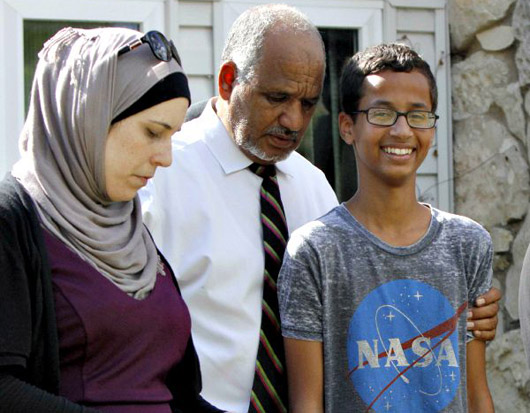
US Muslim teen arrested over clock moving to Qatar for studies

October 22, 2015

Houston, Oct 22: A Muslim teenager arrested in the US for bringing to school a homemade clock that was mistaken for a bomb is moving to Qatar for studies, his family has said, a day after he met President Barack Obama.

teen

Ahmed Mohamed, 14, a ninth-grader who became an Internet sensation after the incident, has accepted an offer from the Qatar Foundation to study at its Young Innovators Programme.

"This means, that we, as a family, will relocate to Qatar where Ahmed will receive a full scholarship for secondary and undergraduate education," his family said in a statement.

Ahmed's family said the foundation would fund his high school and undergraduate education.

"I really enjoyed my time at Education City, where I met other kids like me who are part of the Young Innovators Program," Ahmed said in a statement about time he spent in Qatar this month.

"Qatar was a cool place to visit. I loved the city of Doha because it's so modern. I saw so many amazing schools there, many of them campuses of famous American universities.

"The teachers were great. I think I will learn a lot and have fun, too."

Ahmed's family said announced its decision to move to Qatar a few hours after Ahmed visited the White House for an astronomy night hosted by Obama.

The Texas boy was arrested on September 14 when he showed a teacher at his school his homemade clock, which the teacher feared was a bomb.

No charges were filed, but his detention provoked widespread accusations of racial profiling, sparking a larger discussion of Islam, immigration and ethnicity.

Comments

Add new comment

  • Coastaldigest.com reserves the right to delete or block any comments.
  • Coastaldigset.com is not responsible for its readers’ comments.
  • Comments that are abusive, incendiary or irrelevant are strictly prohibited.
  • Please use a genuine email ID and provide your name to avoid reject.
News Network
June 5,2020

Bantwal, Jun 5: A very rare white python, which had entered a house at Kavalakatte in Bantwal taluk of Dakshina Kannada, was caught by snake catcher Snake Kiran on Friday handed over to the authorities of Pilikula Nisargadhama.

This extremely rare white coloured python known as Albino was seen in the house of one Naushad.

The occupants of the house as well as residents of the area were panicky over seeing it. 

Later a friend of Naushad informed Snake Kiran who caught it and handed over to the care of Pilikula as per the advice of forest officer Sridhar.

Comments

Add new comment

  • Coastaldigest.com reserves the right to delete or block any comments.
  • Coastaldigset.com is not responsible for its readers’ comments.
  • Comments that are abusive, incendiary or irrelevant are strictly prohibited.
  • Please use a genuine email ID and provide your name to avoid reject.
News Network
June 10,2020

Mangaluru, Jun 10: A youth, who staged suicide drama at Netravati River Bridge near Thokkottu on the outskirts of the city, reportedly found alive in Shivamogga today.

Praveen Saphalya a 28-year-old man from Kurnad village in Bantwal taluk was missing since yesterday. His motorbike was found abandoned on the Netravati bridge at around 7:30 p.m. on Tuesday (June 9).

It was suspected that he had committed suicide by jumping off the bridge. Hence, police and fire fighters had launched a search operation for his body in the river with the help of divers on Wednesday morning.

Meanwhile, the missing person reportedly surfaced in Shivamogga this morning.

According to sources, Saphalya was working as salesman for SLRK Limited, is reportedly deep in debt. Unable to face the harassment of his creditors, he had parked the bike on the bridge and left the city, sources said. Local police are probing the matter.

Also Read: Mangaluru: 33-year-old man found dead on Netravati river bank

Comments

Add new comment

  • Coastaldigest.com reserves the right to delete or block any comments.
  • Coastaldigset.com is not responsible for its readers’ comments.
  • Comments that are abusive, incendiary or irrelevant are strictly prohibited.
  • Please use a genuine email ID and provide your name to avoid reject.
Agencies
July 5,2020

The deadly coronavirus that entered India while there was still nip in the air has beaten rising mercury, humid conditions, unique Indian genome and has entered monsoon season with more potency as fresh cases are only breaking all records in the country.

India recorded a single-day spike of record 24,850 new coronavirus cases on Sunday, taking its total tally to 6.73 lakh corona-positive cases.

Top Indian microbiologists were hopeful in March that after the 21-day lockdown, as summer approaches, the rise in temperature would play an important role in preventing the drastic spread of COVID-19 virus in India.

Several virologists hinted that by June this year, the impact of COVID-19 would be less than what it appeared in March-April.

The claims have fallen flat as the virus is mutating fast, becoming more potent than ever.

According to experts, the novel coronavirus is a new virus whose seasonality and response to hot humid weather was never fully understood.

"The theory was based on the fact that high temperatures can kill the virus as in sterilisation techniques used in healthcare. But these are controlled environment conditions. There are many other factors besides temperature, humidity which influence the transmission rate among humans," Dr Anu Gupta, Head, Microbiologist and Infection Control, Fortis Escorts Heart Institute, told IANS.

There is no built-up immunity to COVID-19 in humans.

"Also, asymptomatic people might be passing it to many others unknowingly. New viruses tend not to follow the seasonal trend in their first year," Gupta emphasized.

Globally, as several countries are now experiencing hot weather, the World Health Organization (WHO) reported a record hike in the number of coronavirus cases, with the total rising by 2,12,326 in 24 hours in the highest single-day increase since COVID-19 broke out.

So far over 11 million people worldwide have tested positive for the disease which has led to over 5,25,000 deaths, according to data from Johns Hopkins University. The US remained the worst-hit country with over 28 lakh cases, followed by Brazil with 15.8 lakh.

According to Sandeep Nayar, Senior Consultant and HOD, Respiratory Medicine, Allergy & Sleep Disorders, BLK Super Speciality Hospital in New Delhi, whether temperature plays a role in COVID-19 infection is highly debated.

One school of thought said in the tropical regions of South Asia, the virus might not thrive longer.

"On the other hand, another school of thought has found that novel Coronavirus can survive in a hot and humid environment and tropical climate does not make a difference to the virus. According to them, this is what distinguishes the novel coronavirus from other common viruses, which usually wane in hot weather," stressed Nayar.

Not much has been studied in the past and no definite treatment or vaccine is available to date.

"Every day, new properties and manifestation of the disease come up. As of now, the only way to prevent this monster is by taking appropriate precautions. Hand hygiene, social distancing, cough etiquette and face masks definitely reduce spread of COVID-19 infection," Nayar told IANS.

Not just top Indian health experts, even Indian-American scientists had this theory in mind that sunshine and summer may ebb the spread of the coronavirus.

Ravi Godse, Director of Discharge Planning, UPMC Shadyside Pennsylvania in the US told IANS in April: "In the summer, the humidity can go up as well, meaning more water drops in the air. If the air is saturated with water and somebody sneezes virus droplets into such air, it is likely that the droplets will fall to the ground quicker, making them less infectious. So the short answer is yes, summer/sunshine could be bettera.

According to Dr Puneet Khanna, Head of Respiratory Medicine and Pulmonology, Manipal Hospital, Delhi, COVID-19 death rates are not too different in tropical countries but since the disease affected them late it was yet to show its peak in these areas.

"The virus can survive well in hot and humid countries and this is proven now," he stressed.

Comments

Add new comment

  • Coastaldigest.com reserves the right to delete or block any comments.
  • Coastaldigset.com is not responsible for its readers’ comments.
  • Comments that are abusive, incendiary or irrelevant are strictly prohibited.
  • Please use a genuine email ID and provide your name to avoid reject.