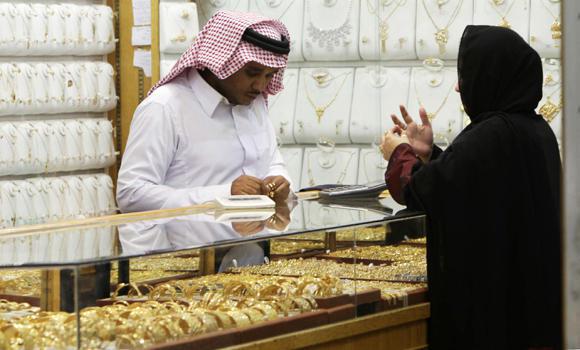
Rising gold prices threaten some factories with closure

August 12, 2013

Rising_gold_pricesJeddah, Aug 12: The rising prices of gold during the past two weeks caused stagnation in the Saudi market, and pushed gold merchants to activate sales because factories didn’t halt their production, according to the National Committee for Precious Metals.

The price of the precious metal has registered the second weekly decline, while the dollar has recovered from its lowest value since seven weeks ago.

Speculation about the US Federal Reserve to reduce the bonds purchase program with a value of $85 billion a month was triggered by the low price of gold, which reached its lowest levels this week.

“Gold merchants didn’t lose because of the declining world prices, because most of them deal with gold as physical balance, and most merchants have sufficient gold accounts,” said Ahmad Al-Sharif, member of the National Committee for Precious Metals.

Gold prices declined by 0.2 percent, to $1,308 per ounce, and the market is about to close at 0.25 percent. Delayed US gold contracts, which will be delivered in December declined by $2, to $1,307.90 per ounce.

Silver prices stabilized at $20.19 per ounce, while platinum gained 0.1 percent to $1,488 per ounce. Palladium rose 0.1 percent to $736.97 per ounce.

Meanwhile, the National Committee for Precious Metals is attempting to ferret out illegal gold sellers, which had controlled as much as one-quarter of the gold market.

“Workshops have been organized, which held unknown names in the gold trade, or operated from places that didn’t have defined headquarters contained products with ambiguous origins were combated,” said Al-Sharif. “We are working on a mechanism to combat violating workshops, and educate consumers and merchants who deal with such workshops. We advise merchants, and gold market clients to buy gold from approved individuals.”

He pointed to the existence of “workshops alien to the market” that had a large share before prices rose, which control 25 percent of the market.

“After the rising prices a large number of these workshops sold their stocks and changed their activities because they were illegal dealers,” he said. “After strict controls and the correction of labor status these violating workshops will be eliminated, because most of them are illegal workers who practice their business in un licensed areas.”

“At the present time, and because of the strict control of the Passport Department and the Ministry of Labor, these workshops have 10 percent of the market share,” he said.

Comments

Add new comment

  • Coastaldigest.com reserves the right to delete or block any comments.
  • Coastaldigset.com is not responsible for its readers’ comments.
  • Comments that are abusive, incendiary or irrelevant are strictly prohibited.
  • Please use a genuine email ID and provide your name to avoid reject.
News Network
May 19,2020

Abu Dhabi: The United Arab Emirates today reported 873 new coronavirus cases, pushing the total number of COVID-19 infections in the country to 25,063.

Three more people have died from the virus, bringing the total death toll to 227, the ministry revealed, adding that a total of 1,214 COVID-19 patients have made full recovery, which takes the overall number of patients recovered to 10,791.

The latest coronavirus patients, all of whom are in a stable condition and receiving the necessary care, were identified after conducting more than 38,000 additional COVID-19 tests among UAE citizens and residents over the past few days, the ministry said.

It expressed its sincere condolences to the families of the deceased and wished a speedy recovery to all patients, calling on the public to cooperate with health authorities and comply with all precautionary measures, particularly social distancing protocols, to ensure the safety and protection of the public.

Comments

Add new comment

  • Coastaldigest.com reserves the right to delete or block any comments.
  • Coastaldigset.com is not responsible for its readers’ comments.
  • Comments that are abusive, incendiary or irrelevant are strictly prohibited.
  • Please use a genuine email ID and provide your name to avoid reject.
News Network
June 20,2020

Riyadh, Jun 20:  Speaking at an exclusive webinar organized by the London Business School’s (LBS) Riyadh Chapter, Saudi Arabia’s first sports minister Prince Abdulaziz Bin Turki Al Faisal proudly reflected back on his nation’s sports achievements over the last few years.

Attended by over 170 people, the highest record set at an LBS webinar, various topics were discussed including the Kingdom’s sports strategy, investment opportunities, role of the media and advantages of hosting international sporting events, among other things.

Saudi Arabia has recently presented itself as one of the major players in the global sports industry thanks to its transformative Vision 2030, which aims to diversify the economy and create a more vibrant society.

Recognizing the importance of the vision, Prince Abdulaziz said: “Vision 2030 is something we all believe in. Everywhere you go within the Kingdom, you feel that people are passionate about the vision and its targets. Sport is part of it, and it has a big role in it.”

At the heart of the newly created Ministry of Sport’s strategy is increasing mass participation across all types of sports and preparing the next generation of elite athletes capable of competing on the international stage.

The ambitious prince asserted, “We want to make sure that we create an ecosystem that is sustainable, creates jobs, income and provides a lot of opportunities for everyone. We are creating academies around the Kingdom for kids to get into sports to make sure we have a base for them to start off from.”

Over 50 questions were addressed during the open and transparent webinar, a reflection of the attitude and culture the prince is creating at the Ministry. He admitted that while Saudi Arabia is a nation bound by a love and passion for sport, until recently sports has been looked at as a tool for entertainment rather than an important industry.

One of his key goals is to shift this mentality. Hosting major sports events has greatly contributed in doing so, he is a strong believer of their long-lasting impact and legacy.

“These events will shed light on enlightening people about certain sports and making sure they get attracted by it and enjoy it. From these events that we hosted, we found out there’s interest for tennis, golf, and boxing.”

“We will continue to host these events to make sure that people enjoy them as entertainment but to also make sure that people are passionate about these sports get to watch them live in the Kingdom and hopefully from that get someone passionate enough to participate,” he explained.

A former professional motorsports racer, Prince Abdulaziz was appointed chairman of the then-General Sports Authority at the start of 2019 after holding the position of vice chairman for the previous two years. Under his leadership, the Ministry of Sport doubled the number of its ever-growing sports federations and invested heavily at the grassroots level.

When asked about the significance of such investments, he said: “We give them [athletes] an opportunity to compete under the name of the Kingdom, to shine and make sure there’s a future for them. Today we look at a holistic view of sports. We use it to change certain mindsets and restrictions within the Kingdom to make sure we can evolve within the industry and complete against leading countries.”

The Riyadh Chapter of the London Business School aims to increase engagement and opportunities for LBS alumni in the Kingdom and to develop stronger ties that help build a better future for the business community.

Co-presidents Majed Al Hugail and Faris Al Shareef expressed their delight in hosting Prince Abdulaziz for the first time by saying: “The webinar was very insightful to the elite group of LBS alumni both locally and internationally. It helped them further understand how the Ministry is reshaping the sports sector as part of Vision 2030.

“The session left many of the attendees with a great sense of appreciation of the Ministry’s support to the community, an area where stronger partnerships can potentially be explored for the country and region’s benefits.”

In line with new progressive government policies, a lot of attention and investment has geared towards the inclusion of women in sports on both the elite and amateur levels.

When asked by an audience member about this matter, the sports leader proudly replied by saying: “We’ve seen an increase of active women participation in sports by about 149% from 2015 till today. Only five years ago, women were not allowed to participate in the street but it’s a completely different ball game today.”

A testament to this great progress is the participation of 22 women’s national teams in competitive regional games across a wide range of sports in recent years, in addition to newly incepted Women’s Football League.

Among the topics discussed during the 1-hour long webinar was the Ministry’s journey towards the privatization of some of its assets.

Highlighting the significant role that the private sector contributes towards future growth and development, the Minister said: “The private sector is a fundamental aspect for the evolution of sports within the Kingdom and anywhere else in the world. We have to make sure that the platform is open for the private sector to come in and play its role in increasing the number of participants and to add the number of clubs within the Kingdom.”

He continued: “It is our role to provide the right regulatory process. Today we are ready with a platform to make sure that we can deliver on this for the private sector and for the public. This will add towards the evolvement and the development of sports within the Kingdom.”

Saudi Arabia’s successful hosting of high-profile sports events attracted thousands of locals and visitors; it now has bigger plans to cement its strong position in the global sports industry. Among these plans include bids for two of the continent’s most sought after competitions, the 2027 AFC Asian Cup and 2030 Asian Games.

When asked about the reason behind them, he was confident in his response highlighting that Saudi Arabia has celebrated multiples trophies and medals in the past, but this is the first time that they’re aiming to host the events.

“It is time to do so. It’s unheard of that you win a competition but don’t host it. Saudi should host these events and we are capable of hosting them as a nation. It is something that our people are very passionate about, they love it and follow it. It will showcase what Saudi can do on the Asian front.”

Prince Abdulaziz recognizes Saudi Arabia’s recent sporting achievements, but he remains humble on his mission to use sports as a tool to tell his country’s story to the world and build a healthier, more vibrant society capable of nurturing athletes who can compete on the elite level for many years to come.


Comments

Add new comment

  • Coastaldigest.com reserves the right to delete or block any comments.
  • Coastaldigset.com is not responsible for its readers’ comments.
  • Comments that are abusive, incendiary or irrelevant are strictly prohibited.
  • Please use a genuine email ID and provide your name to avoid reject.
News Network
May 11,2020

May 11: Saudi Arabia will triple its value-added tax rate and suspend a cost of living allowance for state workers, it said on Monday, seeking to shield finances hit by low oil prices and a slump in demand for its lifeline export worsened by the new coronavirus.

Historic oil output cuts agreed by Riyadh and other major producers have given only limited support to prices after they sank on oversupply caused by a war for petroleum market share between the kingdom and its fellow oil titan Russia.

Saudi Arabia, the world's largest oil exporter, is also being hit hard by measures to fight the new coronavirus, which are likely to curb the pace and scale of economic reforms launched by Crown Prince Mohammed bin Salman.

"The cost of living allowance will be suspended as of June 1, and the value added tax will be increased to 15% from 5% as of July 1," Finance Minister Mohammed al-Jadaan said in a statement reported by the state news agency. "These measures are painful but necessary to maintain financial and economic stability over the medium to long term...and to overcome the unprecedented coronavirus crisis with the least damage possible."

The austerity measures come after the kingdom posted a $9 billion budget deficit in the first quarter.

The minister said non-oil revenues were affected by the suspension and decline in economic activity, while spending had risen due to unplanned strains on the healthcare sector and the initiatives taken to support the economy.

"All these challenges have cut state revenues, pressured public finances to a level that is hard to deal with going forward without affecting the overall economy in the medium to long term, which requires more spending cuts and measures to support non-oil revenues stability," he added.

The government has cancelled and put on hold some operating and capital expenditures for some government agencies, and cut allocations for some reform initiatives and projects worth a total 100 billion riyals ($26.6 billion), the statement said.

Central bank foreign reserves fell in March at their fastest rate in at least 20 years and to their lowest since 2011, while oil revenues in the first three months of the year fell 24% from a year earlier to $34 billion, pulling total revenues down 22%.

"The reforms are positive from a fiscal side as greater adjustment is essential. However, the tripling of VAT is unlikely to help that much in 2020 revenue wise with the expected fall in consumption," said Monica Malik, chief economist at Abu Dhabi Commercial Bank.

She said she kept unchanged her deficit forecast of 16.3% of GDP for this year, which already factors in a greater than previously announced spending cut.

About 1.5 million Saudis are employed in the government sector, according to official figures released in December.

In 2018, Saudi Arabia's King Salman ordered a monthly payment of 1,000 riyals ($267) to every state employee to compensate them for the rising living costs after the government hiked domestic gas prices and introduced value-added tax.

DIFFICULT TIMES

A committee has been formed to study all financial benefits paid to public sector employees and contractors, and will submit recommendations within 30 days, the statement said.

In late 2015, when oil prices fell from record highs, the kingdom slashed lavish bonuses, overtime payments and other benefits once considered routine perks in the public sector.

In a country without elections and with political legitimacy resting partly on distribution of oil revenue, the ability of citizens to adapt to such reforms is crucial for stability.

"Tripling the VAT will test the limits of the balance between revenues and consumption as the economy dives into a deep recession. The move will impact consumption and could also lower the expected revenues," said John Sfakianakis, a Gulf expert at the University of Cambridge.

"These are pro-austerity and pro-revenue moves rather than pro-growth ones," he said.

Hasnain Malik, head of equity strategy at Tellimer, said the VAT rise could bring about $24-$26.5 billion in additional non-oil fiscal revenue. The rise would hit consumer spending further but was a needed step towards fiscal sustainability, he said.

Comments

Add new comment

  • Coastaldigest.com reserves the right to delete or block any comments.
  • Coastaldigset.com is not responsible for its readers’ comments.
  • Comments that are abusive, incendiary or irrelevant are strictly prohibited.
  • Please use a genuine email ID and provide your name to avoid reject.