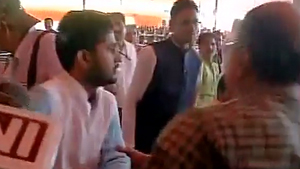
Student attacked for raising slogans at Modi's event in Banaras Hindu varsity

February 22, 2016

studentVaranasi, Feb 22: A student was on Monday slapped by an unidentified person during the centenary year convocation at the Banaras Hindu University (BHU) where Prime Minister Narendra Modi was also present.

The student named Ashutosh Singh was raising slogans, demanding the revival of students union when some unknown person slapped him.

"The students union has been prohibited since 1997. The students here are suppressed and not allowed to raise their voice," he said.

Last month, during a convocation ceremony at the Babasaheb Bhimrao Ambedkar University in Lucknow, a student stood up from the audience and raised slogans against Modi.


Comments

Rikaz
 - 
Monday, 22 Feb 2016

Modi already promised Ache din...this is part of that dins...if he tells you something...he mean it....

did he give you 15 lakhs rupees...no right...forget it...guys...

amjad
 - 
Monday, 22 Feb 2016

yes intolerance in india coz. of this goon bjp goverment.

Mani
 - 
Monday, 22 Feb 2016

We are with You Singh......we will bring back glory of Mahathma Gandhiji

Add new comment

  • Coastaldigest.com reserves the right to delete or block any comments.
  • Coastaldigset.com is not responsible for its readers’ comments.
  • Comments that are abusive, incendiary or irrelevant are strictly prohibited.
  • Please use a genuine email ID and provide your name to avoid reject.
Ram Puniyani
February 22,2020

This January 2020, it is thirty years since the Kashmiri Pundits’ exodus from the Kashmir valley took place. They had suffered grave injustices, violence and humiliation prior to the migration away from the place of their social and cultural roots in Kashmir Valley. The phenomenon of this exodus had been due to the communalization of militancy in Kashmir in the decade of 1980s. While no ruling Government has applied itself enough to ‘solve’ this uprooting of pundits from their roots, there are communal elements who have been aggressively using ‘what about Kashmiri Pundits?’, every time liberal, human rights defenders talk about the plight of Muslim minority in India. This minority is now facing an overall erosion of their citizenship rights.

Time and over again in the aftermath of communal violence in particular, the human rights groups have been trying to put forward the demands for justice and rehabilitation of the victim minority. Instead of being listened to those particularly from Hindu nationalist combine, as a matter of routine shout back, where were you when Kashmiri Pundits were driven away from the Valley? In a way the tragedy being heaped on one minority is being justified in the name of suffering of Pundits and in the process violence is being normalized. This sounds as if two wrongs make a right, as if the suffering Muslim minority or those who are trying to talk in defense of minority rights have been responsible for the pain of Kashmiri Pundits.

During these three, many political formations have come to power, including BJP, Congress, third front and what have you. To begin with when the exodus took place Kashmir was under President’s rule and V. P. Singh Government was in power at the center. This Government had the external support of BJP at that time. Later BJP led NDA came to power for close to six years from 1998, under the leadership of Atal Bihari Vajpayee. Then from 2014 it is BJP, with Narerda Modi as PM, with BJP brute majority is in power. Other components of NDA are there to enjoy some spoils of power without any say in the policies being pursued by the Government. Modi is having absolute power with Amit Shah occasionally presenting Modi’s viewpoints.

Those blurting, ‘what about Kashmiri Pundits?’ are using it as a mere rhetoric to hide their communal color. The matters of Kashmir are very disturbing and cannot be attributed to be the making of Indian Muslims as it is being projected in an overt and subtle manner. Today, of course the steps taken by the Modi Government, that of abrogation of Article 370, abolition of clause 35 A, downgrading the status of Kashmir from a state to union territory have created a situation where the return of Kashmiri Pundits may have become more difficult, as the local atmosphere is more stifling and the leaders with democratic potential have been slapped with Public Safety Act, where they can be interned for long time without any answerability to the Courts. The internet had been suspended, communication being stifled in an atmosphere where democratic freedoms are curtailed which makes solution of any problem more difficult.

Kashmir has been a vexed issue where the suppression of the clause of autonomy, leading to alienation led to rise of militancy. This was duly supported by Pakistan. The entry of Al Qaeda elements, who having played their role against Russian army in 1980s entered into Kashmir and communalized the situation in Kashmir. The initial Kashmir militancy was on the grounds of Kashmiriyat. Kashmiriyat is not Islam, it is synthesis of teachings of Buddha, values of Vedant and preaching’s of Sufi Islam. The tormenting of Kashmiri Pundits begins with these elements entering Kashmir.

Also the pundits, who have been the integral part of Kashmir Valley, were urged upon by Goodwill mission to stay on, with local Muslims promising to counter the anti Pundit atmosphere. Jagmohan, the Governor, who later became a minister in NDA Government, instead of providing security to the Pundits thought, is fit to provide facilities for their mass migration. He could have intensified counter militancy and protected the vulnerable Pundit community. Why this was not done?

Today, ‘What about Kashmiri Pundits?’ needs to be given a serious thought away from the blame game or using it as a hammer to beat the ‘Muslims of India’ or human rights defenders? The previous NDA regime (2014) had thought of setting up enclosures of Pundits in the Valley. Is that a solution? Solution lies in giving justice to them. There is a need for judicial commission to identify the culprits and legal measures to reassure the Pundit community. Will they like to return if the high handed stifling atmosphere, with large number of military being present in the area? The cultural and religious spaces of Pundits need to be revived and Kashmiryat has to be made the base of any reconciliation process.

Surely, the Al Qaeda type elements do not represent the alienation of local Kashmiris, who need to be drawn into the process of dialogue for a peaceful Kashmir, which is the best guarantee for progress in this ex-state, now a Union territory. Communal amity, the hallmark of Kashmir cannot be brought in by changing the demographic composition by settling outsiders in the Valley. A true introspection is needed for this troubled area. Democracy is the only path for solving the emigration of Pundits and also of large numbers of Muslims, who also had to leave the valley due to the intimidating militancy and presence of armed forces in large numbers. One recalls Times of India report of 5th February 1992 which states that militants killed 1585 people from January 1990 to October 1992 out of which 982 were Muslims and 218 Hindus.

We have been taking a path where democratic norms are being stifled, and the promises of autonomy which were part of treaty of accession being ignored. Can it solve the problem of Pundits?

Comments

Add new comment

  • Coastaldigest.com reserves the right to delete or block any comments.
  • Coastaldigset.com is not responsible for its readers’ comments.
  • Comments that are abusive, incendiary or irrelevant are strictly prohibited.
  • Please use a genuine email ID and provide your name to avoid reject.
News Network
July 21,2020

Bengaluru, Jul 21: A man was arrested on Tuesday for riding his high-end bike up to a speed of almost 300 km per hour on a flyover here during ongoing lockdown, police said. After a selfie video of the man's reckless ride went viral on social media, police arrested him for putting his life and that of others at risk and seized his 1000 CC bike.

Identified by police as Muniyappa, he rode his bike on the nearly 10-km long Electronic City flyover, accelerating almost to 300 KMPH as he whizzed past some vehicles, including cars autorickshaws and trucks that were moving in both directions.

"This video made viral by the rider...going at a dangerous speed of almost 300 kmph at Ecity flyover putting his own & others life at risk..CCB traced the rider & seized bike Yamaha 1000 CC.. handed over to traffic (police)," Bengaluru Joint Commissioner of Police Sandeep Patil tweeted, tagging the video.

A case of reckless driving has been registered against him, police said. They said the incident occurred during the week-long lockdown in force in the city and outskirts till Wednesday morning to contain the spread of coronavirus, leaving most roads deserted as people remained indoors. However, it was not known when exactly he undertook the ride. A fortnight ago, three youths who were doing wheelies on the city roads met with a ghastly mishap and lost their lives.

Click here for video

Comments

Add new comment

  • Coastaldigest.com reserves the right to delete or block any comments.
  • Coastaldigset.com is not responsible for its readers’ comments.
  • Comments that are abusive, incendiary or irrelevant are strictly prohibited.
  • Please use a genuine email ID and provide your name to avoid reject.
News Network
February 19,2020

Feb 19: Bavaguthu Raghuram Shetty was once a typical billionaire with a taste for the high-life.

He splurged on a private jet, vintage cars and two entire floors of the Burj Khalifa, the world’s tallest skyscraper. His website shows him hobnobbing with politicians, Bill Gates and Bollywood royalty.

“The thrill of speed and freedom makes me love cars,” Shetty, 77, told local reporters last year.

Shetty had more than enough money -- at least on paper -- to afford such a lifestyle from companies he helped found, including hospital operator NMC Health Plc and financial services firm Finablr Plc. On Dec. 10, his stakes in the public companies were valued at $2.4 billion, making up the bulk of a fortune spanning education, hospitality and one of the world’s oldest tea companies.

Then, a week later, Carson Block came along.

Block’s investment firm, Muddy Waters, issued a report criticizing NMC’s accounts and disclosing a short position. Since then, Muddy Waters’s scrutiny has snowballed into a troubling scenario for Shetty that sheds light on his complex share arrangements and casts doubts about his net worth. His holdings in Finablr and NMC are worth $885 million, but Shetty’s fortune may now be just a fraction of that, depending on the size of his borrowings.

Filings this month show that Shetty pledged a quarter of his NMC stake against loans with First Abu Dhabi Bank and Zurich-based Falcon Private Bank. Two other shareholders may own half of his reported stake. Another lender -- Al Salam Bank Bahrain -- has already sold some of those shares to enforce security over a loan for Shetty, and NMC said Tuesday that First Abu Dhabi Bank sold another chunk earlier this month.

The situation “seems to have gone beyond some of the issues that Muddy Waters focused on initially,“ said Gavin Launder, a fund manager at Legal & General Investment Management, who owned shares in NMC until October. “The increased scrutiny has unearthed other issues.”

Law firm Herbert Smith Freehills has launched a review of Shetty’s holdings at his request, a spokesperson for the Indian-born businessman said, declining to comment further until the analysis is completed. Shetty resigned Sunday as NMC’s chairman.

In its Dec. 17 report on NMC, Muddy Waters hinted at potential overpayment for assets, inflated cash balances and understated debt. Shares of the United Arab Emirates’ biggest private health-care provider have since plunged 67%, and the firm is now the focus of takeover speculation. The sell-off also spread to Finablr, whose stock has tumbled 64% in that span.

NMC has disputed Muddy Waters’s claims, and the company hired former FBI Director Louis Freeh to conduct an independent review of the short seller’s allegations. Meanwhile, local regulators “are making inquiries with the relevant parties,” a spokesperson for the U.K.’s Financial Conduct Authority said.

Shetty is hardly the only ultra-wealthy person to leverage his assets. Elon Musk has used his shares in Tesla Inc. to obtain personal loans, while Oracle Corp. Chairman Larry Ellison has put up millions of the company’s shares to fund a lavish lifestyle that includes trophy properties, America’s Cup teams and the Indian Wells tennis facility in California.

But such deals can also sour, as demonstrated by Shetty’s lenders selling shares his investment firm pledged. He and his advisers are investigating details of the sales as part of their legal review, according to filings.

To complicate matters, Shetty pledged another batch of NMC stock in 2018 as part of a so-called equity collar arrangement with Goldman Sachs Group Inc. that uses options to limit the impact from share moves. Last month, he also pledged most of his stake in Finablr to refinance a loan from the company’s takeover of foreign-exchange firm Travelex for about $1.2 billion.

BRS Ventures Investment, the UAE-based holding company for most of Shetty’s assets, doesn’t report consolidated financials, preventing a complete analysis of his net worth. His other assets include a catering company, a waste-management firm and pharmaceutical business Neopharma, which four months ago was in the early stages of planning for an initial public offering.

Block, 43, earned his reputation as a short seller a decade ago through targeting U.S.-listed Chinese companies that he claimed were frauds. More recently, his San Francisco-based firm focused on British litigation-finance firm Burford Capital Ltd. and Japanese biotech stock PeptiDream Inc. Short sellers seek to benefit from a decline in a company’s share price.

Shetty founded NMC in 1975 after moving to Abu Dhabi from his native India. He created Finablr two years ago to consolidate his financial brands before listing it on the London Stock Exchange in 2019.

Block said he didn’t anticipate NMC’s shareholding drama.

“I wouldn’t have been able to predict that we’d get these bizarre disclosures about unclear share ownership coming out of the company,” he said in a Feb. 13 phone interview. “This has been obviously a more dramatic unraveling than we usually see.”


Comments

Add new comment

  • Coastaldigest.com reserves the right to delete or block any comments.
  • Coastaldigset.com is not responsible for its readers’ comments.
  • Comments that are abusive, incendiary or irrelevant are strictly prohibited.
  • Please use a genuine email ID and provide your name to avoid reject.