



Lord, Why Am I Banned from your Abode?

[email protected] (Ram Puniyani)
February 17, 2016

One is witnessing strange incidents where the women from Muslim and Hindu community are facing similar obstacles. This relates to the issue of entry into places of worship. While the women from Bhumata Brigade are struggling to get entry into Shani Shingnapur temple (Ahmadnagar Mahrashtra), the Muslim women are fighting a legal battle to restore their access to mazar of Haji Ali dargah in Mumbai. In yet another incident the women are trying to get the right of worship in Sabrimala temple. The Hindu women in an act of brave initiative landed up in many buses to the Shani Shingnapur temple, where they were denied the entry while police had to resort to some force to prevent their entry.
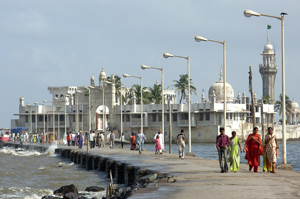
haji ali dargahIn case of Shani Shingnapur while men are allowed to the Chabutara (raised platform) it is believed that going to the Chabutara will be of bad omen for women as Lord Shani (Saturn) will cast an evil eye. So it is claimed that prohibiting women to enter is a matter of spiritual science. Sanatan Prabhat, the rightwing daily says that the movement of women must be prevented to save the Hindu traditions. In response to the agitation led by Trupti Deasai of Bhumata Brigade the spiritual Guru Sri Sri Ravishankar of Art of Living tried to mediate between the women’s group and the temple trustees. Interestingly he advised that neither women nor men should be allowed to the Chabutara. The matter is being negotiated; solution does not to be near the sight. Also the RSS mouth piece Organiser opines that while initiating any move to amend the existing regulations care should be taken to preserve tradition and prestige of these places.

In case of Sabrimala shrine, the argument is that Lord is a celibate and the women in menstrual age group will be distracting him. One recalls that one IAS officer, who happened to be a woman had visited the shrine for overseeing the arrangements in readiness for the pilgrimage in her official capacity. She was also denied entrance on the ground of her being a woman. In case of Haji Ali in Mumbai the local women’s group Bhartiya Muslim Mahila Andolan has filed a writ in the court demanding the entry of women to the mazar be restored. The women’s groups have cited different clauses of the Constitution where one have equality before the law and that one cannot be discriminated against on the grounds of gender. The argument of Dargah trustees is on the ground of security of women, which to say the least is ridiculous. In case of Sabrimala the earlier argument that the path to the shrine is difficult for women on the grounds of security was later was clarified by the Devswom Board Travancore by stating the ‘real’ reason for denying entry to women is celibacy of Lord Ayappa.

Muslim women have a varying degree of access to the mosques, much lesser in South Asian Countries than in countries like Turkey for example. In Hindu temples the entry is again not uniform; there are different pretexts to prevent their full access to the places of worship. While in many countries the law for equality is very much there, the traditions and the controllers of these places have been preventing the women from having full access to the holy deity. The patriarchal control over access top places of worship is there in various degrees.

This does not apply to Churches in general, where access is not the issue, what is talked there is as to why women do not have the right to be on the higher levels of priest hood. In Hindu temples, Muslim mosques and shrines the women priests are practically not there, some claims of such positions will be more as an exception than as a rule or norm.

In case of India where the equality is guaranteed by law, these laws of equality don’t have entry into the places controlled by the conservative trusts. The controllers of institutions of religion are generally exclusively male bastion, the degree of control and its expression is varying though. In Hindu fold there is an additional factor is that is that of caste. One understands there is ‘caste in the practice’ of Muslims and Christians also, but so far as the places of worship are concerned they are accessible to all, irrespective of caste. One recalls the struggles of Babasaheb Ambedkar for temple entry, the Kalaram Temple agitation, before he decided to renounce Hinduism calling it as being Brahminic theology. As such most religions do have the hierarchical structure in-built into the institution of religion.

Talking of South Asia as a whole the Mosques, Dargahs and temples have lot of rigid rules as far as women are concerned. These are the norms which are imposed by traditions. Thus we see a bit of variation in different religions, different religions as far as treating women is concerned. As such it the differential treatment and this depends on the degree of secularization of the particular institution and particular country and region. By secularization we mean the extent of erosion of hold of landlord-clergy combine on the society. No uniform pattern is discernible but at the core there is the understanding which regards women as inferior beings, secondary to the men, being regarded as property of men so to say.

Earlier it was regarded that their secondary position is purely due to biological functions, with time and with the impact of women’s movement, it is clear that the gender roles are psychological and social, determined by time and location. In early matriarchal societies women had a predominant role in the family and social affairs. With the rise of slave society and later the feudal society, women’s subservient role came to be the norm. Again with Industrial revolution and the values of Liberty, Equality and Fraternity gaining political ground, women started entering into social space and the social equations started changing towards those of equality. As degree of secularization is different the degree of success of women towards equality is different. The nations which saw Industrial revolutions, the path to women’s equality were paved by the underlining slogan of revolutions or social transformations. Still the equality of women has not been automatic, there is a path of struggle through which women expressed their aspiration; longings and struggled for new equations towards equality.

The movement for gender equality again has highs and lows; ups and downs. Currently one understands that the politics in the name of any religion, fundamentalism-communalism, is a politics of status quo to begin with and then it aims to throw back the society to the earlier feudal values of caste and gender hierarchy. Talking of recent times world witnessed this first in the form of rise of Christian fundamentalism in America in the decade of 1920, in the face of the rise of industrial society with modern education and industrialization coming to the fore. In the societies which had to undergo the painful experience of Fascism, Nazism, there also the role of women were defined to be in the confines of ‘Kitchen Church and Children’ by the political ideology, which can be regarded as the close cousin of religious nationalism. With coming of Islamic fundamentalism again the attempt was made to further subjugate the women to lower positions in society. The cover of Islam was used for this social-political agenda. Afghanistan, Iran, Pakistan are few examples of that.

Here in India we saw the rise of majoritarian and minoritarian communalism. Both these again try to push back the women, to restrict their social space, all in the name of religion. With the rise of religious nationalism in India, various issues came up which gave a glimpse of the attitude towards women. Many of these are not the fully blown up pictures, but they have in root the goal of subjugation of women, in the language of Sharia or a sophisticated version of Manu Smriti. In India while the secularization process; the overthrow of the hold of landlord-clergy combine; remained half way through. With the assertion of religious nationalism primarily Hindutva, the striving of women for equality is being countered strongly.

In the ideology of dominating Hindutva the subordination and secondary position of women is asserted by invoking the noble traditions. In literature from Gita Press Gorakhpur, the major publication promoting traditional conservative values amongst Hindus which is generally the base of Hindutva politics, one can see millions of books being distributed which advise the home making role, the ideal of Sati (women being burnt on the funeral pyre of their husband), the stree dharma(duties of women as ordained by their religion) are propounded. Instructions to women about dress code and choice of life partner are handed down. One of the major agenda of the divisive love jihad campaign is to restrain the Hindu girls, to do away with their choice in matters of life and choice of life partner.

Overall the role of religious institutions has been to maintain the social status quo, And the issues related to priesthood in holy places, the entry to these shrines do reflect the same in varying degrees. It seems that despite the obstacles, the women from different religious communities are making their statement loud and clear that their march towards equality cannot be halted by these institutions, and that’s is the portent of these moves for entry to the abodes of the Lord!

Comments

shaji
 - 
Tuesday, 23 Feb 2016

I could not understand why few Muslim women who are tryng to be moderate are so eager to visit tombs and Masjids whereas it is not preffered as per the religion. For a woman, her home is more sacred than Masjid. Woman is given facility by the Creator and they are not willing to take it and wish to show their beauty on the road. Few woman are trying to mislead the others. May i ask such women if they would like a man also to deliver baby. Why are these women wasting their time and trying to be more religious in public. they have to be practical first.

Add new comment

  • Coastaldigest.com reserves the right to delete or block any comments.
  • Coastaldigset.com is not responsible for its readers’ comments.
  • Comments that are abusive, incendiary or irrelevant are strictly prohibited.
  • Please use a genuine email ID and provide your name to avoid reject.
Ram Puniyani
January 14,2020

In the beginning of January 2020 two very disturbing events were reported from Pakistan. One was the attack on Nankana Sahib, the holy shrine where Sant Guru Nanak was born. While one report said that the place has been desecrated, the other stated that it was a fight between two Muslim groups. Prime Minister of Pakistan Imran Khan condemned the incident and the main accused Imran Chisti was arrested. The matter related to abduction and conversion of a Sikh girl Jagjit Kaur, daughter of Pathi (One who reads Holy Guru Granth Sahib in Gurudwara) of the Gurudwara. In another incident one Sikh youth Ravinder Singh, who was out on shopping for his marriage, was shot dead in Peshawar.

While these condemnable attacks took place on the Sikh minority in Pakistan, BJP was quick enough to jump to state that it is events like this which justify the Citizenship Amendment Act (CAA). Incidentally CAA is the Act which is discriminatory and relates to citizenship with Religion, which is not as per the norms of Indian constitution. There are constant debates and propaganda that population of Hindus has come down drastically in Pakistan and Bangla Desh. Amit Shah, the Home minister stated that in Pakistan the population of Hindus has come down from 23% at the time of partition to 3.7% at present. And in Bangla Desh it has come down from 22% to present 8%.

While not denying the fact that the religious minorities are getting a rough deal in both these countries, the figures which are presented are totally off the mark. These figures don’t take into consideration the painful migrations, which took place at the time of partition and formation of Bangla Desh later. Pakistan census figures tell a different tale. Their first census was held in 1951. As per this census the overall percentage of Non Muslim in Pakistan (East and West together) was 14.2%, of this in West Pakistan (Now Pakistan) it was 3.44 and in Eat Pakistan it was 23.2. In the census held in Pakistan 1998 it became 3.72%. As far as Bangla Desh is concerned the share of Non Muslims has gone down from 23.2 (1951) to 9.6% in 2011.

The largest minority of Pakistan is Ahmadis, (https://minorityrights.org/country/pakistan/) who are close to 4 Million and are not recognised as Muslims in Pakistan. In Bangla Desh the major migrations of Hindus from Bangla Desh took place in the backdrop of Pakistan army’s atrocities in the then East Pakistan.

As far as UN data on refugees in India it went up by 17% between 2016-2019 and largest numbers were from Tibet and Sri Lanka.  (https://www.un.org/en/development/desa/population/migration/publication…)

The state of minorities is in a way the index of strength of democracy. Most South Asian Countries have not been able to sustain democratic values properly. In Pakistan, the Republic began with Jinnah’s classic speech where secularism was to be central credo of Pakistan. This 11th August speech was in a way what the state policy should be, as per which people of all faiths are free to practice their religion. Soon enough the logic of ‘Two Nation theory” and formation of Pakistan, a separate state for Muslim took over. Army stepped in and dictatorship was to reign there intermittently. Democratic elements were suppressed and the worst came when Zia Ul Haq Islamized the state in collusion with Maulanas. The army was already a strong presence in Pakistan. The popular formulation for Pakistan was that it is ruled by three A’s, Army, America and Allah (Mullah).

Bangla Desh had a different trajectory. Its very formation was a nail in the coffin of ‘two nation theory’; that religion can be the basis of a state. Bangla Desh did begin as a secular republic but communal forces and secular forces kept struggling for their dominance and in 1988 it also became Islamic republic. At another level Myanmar, in the grip of military dictatorship, with democratic elements trying to retain their presence is also seeing a hard battle. Democracy or not, the army and Sanghas (Buddhist Sang has) are strong, in Myanmar as well. The most visible result is persecution of Rohingya Muslims.

Similar phenomenon is dominating in Sri Lanka also where Budhhist Sanghas and army have strong say in the political affairs, irrespective of which Government is ruling. Muslim and Christian minorities are a big victim there, while Tamils (Hindus, Christians etc.) suffered the biggest damage as ethnic and religious minorities. India had the best prospect of democracy, pluralism and secularism flourishing here. The secular constitution, the outcome of India’s freedom struggle, the leadership of Gandhi and Nehru did ensure the rooting of democracy and secularism in a strong way.

India so far had best democratic credentials amongst all the south Asian countries. Despite that though the population of minorities rose mainly due to poverty and illiteracy, their overall marginalisation was order of the day, it went on worsening with the rise of communal forces, with communal forces resorting to identity issues, and indulging in propaganda against minorities.

While other South Asian countries should had followed India to focus more on infrastructure and political culture of liberalism, today India is following the footsteps of Pakistan. The retrograde march of India is most visible in the issues which have dominated the political space during last few years. Issues like Ram Temple, Ghar Wapasi, Love Jihad, Beef-Cow are now finding their peak in CAA.

India’s reversal towards a polity with religion’s identity dominating the political scene was nicely presented by the late Pakistani poetess Fahmida Riaz in her poem, Tum bhi Hum Jaise Nikle (You also turned out to be like us). While trying to resist communal forces has been an arduous task, it is becoming more difficult by the day. This phenomenon has been variously called, Fundamentalism, Communalism or religious nationalism among others. Surely it has nothing to do with the religion as practiced by the great Saint and Sufi traditions of India; it resorts mainly to political mobilization by using religion as a tool.

Comments

Ashi
 - 
Tuesday, 14 Jan 2020

If Malaysia implement similar NRC/CAA, India and China are the loser.

Add new comment

  • Coastaldigest.com reserves the right to delete or block any comments.
  • Coastaldigset.com is not responsible for its readers’ comments.
  • Comments that are abusive, incendiary or irrelevant are strictly prohibited.
  • Please use a genuine email ID and provide your name to avoid reject.
Ram Puniyani
February 10,2020

Noam Chomsky is one of the leading peace workers in the world. In the wake of America’s attack on Vietnam, he brought out his classic formulation, ‘manufacturing consent’. The phrase explains the state manipulating public opinion to have the public approve of it policies—in this case, the attack of the American state on Vietnam, which was then struggling to free itself from French colonial rule.

In India, we are witness to manufactured hate against religious minorities. This hatred serves to enhance polarisation in society, which undermines India’s democracy and Constitution and promotes support for a Hindu nation. Hate is being manufactured through multiple mechanisms. For example, it manifests in violence against religious minorities. Some recent ghastly expressions of this manufactured hate was the massive communal violence witnessed in Mumbai (1992-93), Gujarat (2002), Kandhamal (2008) and Muzaffarnagar (2013). Its other manifestation was in the form of lynching of those accused of having killed a cow or consumed beef. A parallel phenomenon is the brutal flogging, often to death, of Dalits who deal with animal carcasses or leather.

Yet another form of this was seen when Shambhulal Regar, indoctrinated by the propaganda of Hindu nationalists, burned alive Afrazul Khan and shot the video of the heinous act. For his brutality, he was praised by many. Regar was incited into the act by the propaganda around love jihad. Lately, we have the same phenomenon of manufactured hate taking on even more dastardly proportions as youth related to Hindu nationalist organisations have been caught using pistols, while police authorities look on.

Anurag Thakur, a BJP minster in the central government recently incited a crowd in Delhi to complete his chant of what should happen to ‘traitors of the country...” with a “they should be shot”. Just two days later, a youth brought a pistol to the site of a protest at Jamia Millia Islamia university and shouted “take Azaadi!” and fired it. One bullet hit a student of Jamia. This happened on 30 January, the day Nathuram Godse had shot Mahatma Gandhi in 1948. A few days later, another youth fired near the site of protests against the CAA and NRC at Shaheen Bagh. Soon after, he said that in India, “only Hindus will rule”.

What is very obvious is that the shootings by those associated with Hindu nationalist organisations are the culmination of a long campaign of spreading hate against religious minorities in India in general and against Muslims in particular. The present phase is the outcome of a long and sustained hate campaign, the beginning of which lies in nationalism in the name of religion; Muslim nationalism and Hindu nationalism. This sectarian nationalism picked up the communal view of history and the communal historiography which the British introduced in order to pursue their ‘divide and rule’ policy.

In India what became part of “social common sense” was that Muslim kings had destroyed Hindu temples, that Islam was spread by force, and that it is a foreign religion, and so on. Campaigns, such as the one for a temple dedicated to the Hindu god Rama to be built at the site where the Babri masjid once stood, further deepened the idea of a Muslim as a “temple-destroyer”. Aurangzeb, Tipu Sultan and other Muslim kings were tarnished as the ones who spread Islam by force in the subcontinent. The tragic Partition, which was primarily due to British policies, and was well-supported by communal streams also, was entirely attributed to Muslims. The Kashmir conflict, which is the outcome of regional, ethnic and other historical issues, coupled with the American policy of supporting Pakistan’s ambitions of regional hegemony, (which also fostered the birth of Al-Qaeda), was also attributed to the Muslims.

With recurring incidents of communal violence, these falsehoods went on going deeper into the social thinking. Violence itself led to ghettoisation of Muslims and further broke inter-community social bonds. On the one hand, a ghettoised community is cut off from others and on the other hand the victims come to be presented as culprits. The percolation of this hate through word-of-mouth propaganda, media and re-writing of school curricula, had a strong impact on social attitudes towards the minorities.

In the last couple of decades, the process of manufacturing hate has been intensified by the social media platforms which are being cleverly used by the communal forces. Swati Chaturvedi’s book, I Am a Troll: Inside the Secret World of the BJP’s Digital Army, tells us how the BJP used social media to spread hate. Whatapp University became the source of understanding for large sections of society and hate for the ‘Other’, went up by leaps and bounds. To add on to this process, the phenomenon of fake news was shrewdly deployed to intensify divisiveness.

Currently, the Shaheen Bagh movement is a big uniting force for the country; but it is being demonised as a gathering of ‘anti-nationals’. Another BJP leader has said that these protesters will indulge in crimes like rape. This has intensified the prevalent hate.

While there is a general dominance of hate, the likes of Shambhulal Regar and the Jamia shooter do get taken in by the incitement and act out the violence that is constantly hinted at. The deeper issue involved is the prevalence of hate, misconceptions and biases, which have become the part of social thinking.

These misconceptions are undoing the amity between different religious communities which was built during the freedom movement. They are undoing the fraternity which emerged with the process of India as a nation in the making. The processes which brought these communities together broadly drew from Gandhi, Bhagat Singh and Ambedkar. It is these values which need to be rooted again in the society. The communal forces have resorted to false propaganda against the minorities, and that needs to be undone with sincerity.

Combating those foundational misconceptions which create hatred is a massive task which needs to be taken up by the social organisations and political parties which have faith in the Indian Constitution and values of freedom movement. It needs to be done right away as a priority issue in with a focus on cultivating Indian fraternity yet again.

Comments

Add new comment

  • Coastaldigest.com reserves the right to delete or block any comments.
  • Coastaldigset.com is not responsible for its readers’ comments.
  • Comments that are abusive, incendiary or irrelevant are strictly prohibited.
  • Please use a genuine email ID and provide your name to avoid reject.
Ram Puniyani
February 13,2020

Forthcoming Census and RSS campaign

Currently massive protests are going on against NPR, NCR and CAA. At the same time we are going to begin the process of decadal census in 2021. Already RSS is active in promoting NPR, NCR and CAA. At the same time RSS wants that Adivasis should register themselves as Hindus rather than ticking the column of ‘Others’. As per their spokesperson in the 2011 census many Adivasis groups ticked that column because of which the population of Hindus came down to by 0.7 percent point to come down to 79.8 %. This has sent signals to this Hindu nationalist organization and is planning to ensures that Adivasis tick the column of Hindus in this census.

As such RSS has a very clever attitude in defining the term Hindu. The first formulation was by Savakakar who said that all those who regard the land east of Indus as their Holy land and Father land are Hindus. This left out Muslims and Christians, and brought all others in the ambit of Hindu fold. From the decade of 1980s due to electoral compulsions they have been trying to articulate that all those who are living in India are Hindus. Murli Manohar Joshi stated that Muslims are Ahmadiya Hindus and Christians are Christi Hindus. Recently there was a controversy when they restated that Sikhs are not a separate religion but are a sect of Hinduism. Many Sikh organizations stood up to say that Sikhism is a religion by itself and recalled the book of Kahan Singh Nabha, “Hum Hindu Nahin”

As far as Adivasis are concerned in contrast to what is being planned by Hindu nationalist RSS, many Adivasis groups have been meeting from last couple of years to demand just the contrary. As per them there should be a column where they can tick their identity of Adivasis.  There are active campaigns among Adivasis groups to uphold their Adivasi identity in Census. As per them in the first census which was conducted in Independent India, the column, Aborigines, was there, which was later removed forcing them to club themselves with other religions.

After 1951 in addition to Hindu, Muslim, Sikh, Christian, Jain and Buddha, the column ‘others’ was also there which was removed in 2011. Even during British period if you look at the censuses of the British era (from 1871 to 1931); there was provision for tribes to choose Aborigine as an option. There are nearly 83 religious practices being followed by Adivasis. Few major of these are Sarna, Gondi, Punem, Adi, and Koya. What they share in common is that they are animists, worship nature and spirit of ancestors; do not have priestly class or Holy Scriptures and Gods and Goddesses characteristic of the broad Hindu pantheon.

RSS as per its political agenda of Hindu Nation regards them as Vanvasi. They pontificate that they have been part of Hindu society who were driven away to forests to escape the forcible conversion being done by the Muslim invaders. This concoction is contrary to the interpretations based on the studies from population genetics. The Hindu nationalist argues that Aryans have been the original inhabitants of the country from where they spread to other parts of the World. The book by Tony Joseph, ‘Early Indians’ tells us that away from the race theory, we are all mixed up. The first inhabitants in our land were the ones who emigrated from South Asia over Sixty thousand years ago.

The Indo-Aryans came here nearly three thousand years ago and they pushed the aborigines to the forests and hills and that’s what constitutes the Adivasi community of India.

Hindu Nationalists like all the nationalists who construct their nationalism around their religion claim to be the most original inhabitants of the land, and their interpretations of past are molded according to that. RSS right from beginning has not been using the word Adivasi, it calls them Vanvasi. As per its agenda it wants them to be part of Hindu fold, despite Adivasis themselves saying that they are not Hindus, they have beliefs and practices which are far away from Hinduism in whatever form.

To enhance its political reach from the decades of 1980s in particular its work in Adivasis areas has been intensified. While ‘Vanvasis Kalyan Ashram’, part of RSS Combine which was formed much earlier, it was in the decades of 1980s that their work was jacked up by sending more Pracharaks in Adivasi areas. We see that in Gujarat, Dangs and nearby area, Swami Aseemanand, in MP, centered around Jhabua-the followers of Asaram Bapu and in Orissa Swami Laxmananad stationed them. They saw Christian missionaries working in the field of education and health as an obstacle to Hinduization of Adivasis. Their propaganda against Christian missionaries led to the ghastly murder of Pastor Graham Stains. It was this propaganda which led to anti Christian violence in various forms, the most horrific being the Kandhamal violence of 2008.

In order to culturally co-opt them into the fold of Hinduism they began series of religious congregations, Kumbhs. Shabri Kumbh in Dangs and many other Adivasis predominant areas created an atmosphere of fear, Adivasis were asked to be part of it, saffron flags were distributed and they were made to put it in their houses. Two religious icons were popularized in these areas, one was Shabri and other was Hanuman. To cap it all, Ekal Vidyalayas, started spreading RSS’s interpretation of history in these areas. The other angle of the whole thing is that Adivasis are living in the areas rich in minerals, which the BJP supporter Corporate World wants to take over.

World over aborigines have similar pattern. They are animists and what they practice is a culture as such. Many have converted to other religions out of their choice for sure, but finally in these matters what is important is the self perception. Hemant Soren the Chief Minister of Jharkhand pointed out that “Adivasis are not Hindus. ”Keeping that in mind; the column of Aborigines needs to find its place in our census forms.

Comments

Add new comment

  • Coastaldigest.com reserves the right to delete or block any comments.
  • Coastaldigset.com is not responsible for its readers’ comments.
  • Comments that are abusive, incendiary or irrelevant are strictly prohibited.
  • Please use a genuine email ID and provide your name to avoid reject.