


King Salman’s team takes charge in Saudi Arabia

February 2, 2015

Jeddah, Feb 2: Saudi Arabia is all set for a new era under Custodian of the Two Holy Mosques King Salman as the newly appointed ministers and regional governors took oath of office in front of the king at Al-Yamamah Palace on Sunday.
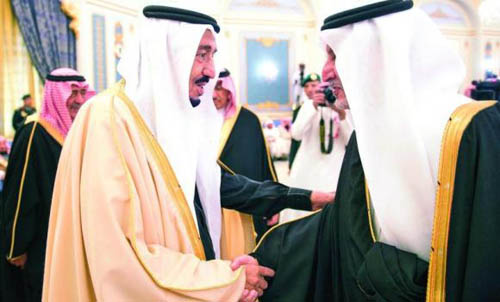
team

King Salman urged the new governors and ministers to give top priority for the welfare and prosperity of citizens. “May Allah help us all to serve our religion, nation and people,” the king said in a brief speech.

He expressed his confidence in the new governors and ministers who took oath of office on Sunday, describing them as “the roots of this country founded by King Abdul Aziz.”

He highlighted Saudi Arabia’s position as the heart of the Muslim world and the cradle of Islam.

King Salman called upon Saudis to strengthen their unity and solidarity to bolster the Kingdom’s security and stability. He noted the great contributions made by previous kings.

“King Abdullah always advised me to give top priority for our citizens and our religion,” the king said.

Makkah Gov. Prince Khaled Al-Faisal, Riyadh Gov. Prince Faisal bin Bandar, State Minister Prince Mansour bin Miteb, National Guard Minister Prince Miteb bin Abdullah, Defense Minister Prince Mohammed bin Salman, and Islamic Affairs Minister Saleh Al-Asheikh, Education Minister Azzam Al-Dakhil and Culture and Information Minister Adel Al-Toraifi were sworn in during the ceremony. They swore separately: “In the name of Allah, the most gracious, the most merciful, I swear by Allah Almighty to be loyal to my religion, king and country, and not to divulge the state secrets, to maintain its interests and regulations, and to perform my duties sincerely, honestly and faithfully.”

Other ministers who took oath were: Justice Minister Walid Al-Samaani, State Minister Matlab Al-Nafeesa, State Minister Musaed Al-Aiban, Petroleum and Mineral Resources Minister Ali Al-Naimi, Finance Minister Ibrahim Al-Assaf, Water and Electricity Minister Abdullah Al-Hussayen and Labor Minister Adel Fakeih.

Housing Minister Shuwaish Al-Dhuwaihi; Haj Minister Bandar Hajjar; Economy and Planning Minister Mohammed Al-Jasser, Minister of Commerce and Industry Tawfiq Al-Rabiah, Minister of State for Shoura Affairs Mohammed Abusaq, Minister of State Essam bin Saeed; Minister of Transport Abdullah Al-Muqbil, Minister of Communications and Information Technology Mohammed Al-Suwaiyel; Minister of Social Affairs Majed Al-Qassabi, Minister of State Saad Al-Jabri, Minister of State Mohammed Al-Asheikh; Minister of Municipal and Rural Affairs Abdul Latif Al-Asheikh; Minister of Health Dr. Ahmed Al-Khateeb; Minister of Civil Service Khaled Al-Araj, Minister of Agriculture Abdul Rahman Al-Fadli, and Assistant Shoura President Yahya Al-Samaan.

In a statement after taking oath, Al-Toraifi thanked King Salman for the appointment. “I thank the king for the trust bestowed on me. I value this trust and I am proud of it. I hope that I will live up to the expectations.”

Abdul Rahman Al-Zamil, president of the Council of Saudi Chambers, said he expected a new era of cooperation between the public and private sectors during King Salman’s era.

“There has been high optimism in business circles after King Salman ascended the throne,” he said.

Al-Zamil commended King Salman’s open-door policy that gave an opportunity for citizens to present their complaints to government departments. “We know King Salman for the last 50 years as governor of Riyadh,” he said while praising his efforts to make Riyadh a world-class city.

Samira Al-Suwayegh, chairperson of the Executive Council for Businesswomen at Asharqia Chamber, said the new decisions issued by the king would help achieve sustainable development. “It will also open new horizons of progress in the economic sector and open the door for women to participate in economic and investment ventures inside and outside the Kingdom,” she said.

Rima Al-Shahrani, a businesswoman, said King Salman’s programs would have a positive impact on the national economy and create more job opportunities for Saudi men and women. “It will also improve the living condition of citizens across the country,” she added.

Comments

MURUGAN RAMASAMY
 - 
Wednesday, 24 Feb 2016

Dear king of Saudi..

I am murugan Ramasamy from tamilnadu in India. Now I am very difficult situation so please help me in my features.. Now money is world. So life us big war .. We are victory of our sosaity . please donated some money. I will Expectations yous help. Thank you.

Add new comment

  • Coastaldigest.com reserves the right to delete or block any comments.
  • Coastaldigset.com is not responsible for its readers’ comments.
  • Comments that are abusive, incendiary or irrelevant are strictly prohibited.
  • Please use a genuine email ID and provide your name to avoid reject.
News Network
July 23,2020

Beirut, Jul 23: The pandemic will exact a heavy toll on Arab countries, causing an economic contraction of 5.7% this year, pushing millions into poverty and compounding the suffering of those affected by armed conflict, a U.N. report said Thursday.

The U.N.'s Economic and Social Commission for Western Asia expects some Arab economies to shrink by up to 13%, amounting to an overall loss for the region of $152 billion.

Another 14.3 million people are expected to be pushed into poverty, raising the total number to 115 million — a quarter of the total Arab population, it said. More than 55 million people in the region relied on humanitarian aid before the COVID-19 crisis, including 26 million who were forcibly displaced.

Arab countries moved quickly to contain the virus in March by imposing stay-at-home orders, restricting travel and banning large gatherings, including religious pilgrimages.

Arab countries as a whole have reported more than 830,000 cases and at least 14,717 deaths. That equates to an infection rate of 1.9 per 1,000 people and 17.6 deaths per 1,000 cases, less than half the global average of 42.6 deaths, according to the U.N.

But the restrictions exacted a heavy economic toll, and authorities have been forced to ease them in recent weeks. That has led to a surge in cases in some countries, including Lebanon, Iraq and the Palestinian territories.

Wealthy Gulf countries were hit by the pandemic at a time of low oil prices, putting added strain on already overstretched budgets. Middle-income countries like Jordan and Egypt have seen tourism vanish overnight and a drop in remittances from citizens working abroad.

War-torn Libya and Syria have thus far reported relatively small outbreaks. But in Yemen, where five years of civil war had already generated the world's worst humanitarian crisis, the virus is running rampant in the government-controlled south while rebels in the north conceal its toll.

Rola Dashti, the head of the U.N. commission, said Arab countries need to “turn this crisis into an opportunity” and address longstanding issues, including weak public institutions, economic inequality and over-reliance on fossil fuels.

“We need to invest in survival, survival of people and survival of businesses,” she said.

Comments

Add new comment

  • Coastaldigest.com reserves the right to delete or block any comments.
  • Coastaldigset.com is not responsible for its readers’ comments.
  • Comments that are abusive, incendiary or irrelevant are strictly prohibited.
  • Please use a genuine email ID and provide your name to avoid reject.
News Network
May 19,2020

Dubai, May 19: The UAE announced 832 new Covid-19 cases on Monday following 37,844 additional tests, taking the total tally of coronavirus infections in the country to 24,190.

The Ministry of Health and Prevention also reported four additional deaths, taking the death toll to 224. Meanwhile 1,065 patients also recovered after receiving the necessary treatment, taking the total number of recoveries to 9,577, the ministry said.

“We see a daily increase in cases due to the irresponsible behaviour of some people who are not aware of the consequences of not adhering to health guidelines,” said Dr Amna Al Dahak Al Shamsi, official spokesperson of the UAE government.

“The widening circle of infections requires no more than a few violations by just one or two people to completely infect families with the coronavirus,” she said.

“The decision to partially ease restrictions is aimed at achieving a balance between meeting the needs of a segment of society, whose source of income is linked to the commodity trade sector, and between continuing to adhere to the recommended health guidelines, and hence many restrictions and conditions have to be followed.”

However, she also appreciated the citizens and residents adhering to the precautionary measures.

“It is heartening for us to see many families committed to avoiding family gatherings,” she said. “As we prepare for Eid Al-Fitr, we are confident that citizens and residents will continue to adhere to health and preventive guidelines, and serve as role models to the world,” she added.

Change in disinfection programme timings

Officials also announced that the UAE’s National Disinfection Programme will now be in place from 8pm to 6am, starting Wednesday, May 20, until further notice. The scheme currently runs from 10pm until 6am.

Dr Saif Al Dhaheri, spokesman of the National Authority for Emergency, Crisis and Disaster Management said the amendment comes in light of the “increased number of Covid-19 cases, and the leniency of some members of society and their indifference to preventive measures”.

Food outlets, cooperative societies, groceries, supermarkets, and pharmacies will continue to operate 24 hours a day, seven days a week during the sterilisation programme period.

Meanwhile meat and vegetable shops and outlets selling fruits, toasters, mills, slaughterhouses, fish, coffee and tea, in addition to shops selling nuts, sweets and chocolate, can operate from 6am until 8pm.

Shopping centres and malls can stay open from 9am to 7pm starting Wednesday, May 20, officials added.

“We stress the importance of all stores and those authorised to operate to adhere to the applicable health and safety procedures, which include ensuring that the percentage of shoppers does not exceed 30 per cent of the total capacity,” said Al Dhaheri.

He also confirmed that children under 12 and those over 60 will not be permitted to enter malls and shopping centres.

“We warn visitors to the centres that the shopping period should not exceed two hours in order to reduce the crowding of shoppers, and to maintain the 30 per cent capacity.”

Eid restrictions

Al Dhaheri urged the public to avoid family visits and gatherings during Eid Al Fitr this year and to instead communicate using online means or by phone. He also stressed that people should refrain from distributing ‘Eid’ money to children.

“With regard to Eid prayers, we stress the importance of adhering to what was mentioned by the Emirates Legal Fatwa Council, which is to pray at home and to take health protection reasons as a legal obligation, a necessity of life, and a national commitment,” he added.

Heftier fines

Officials also announced heftier fines to ensure that the regulations are being adhered to.

“It was clear to us, in light of the follow-up, that there was reckless behaviour from some individuals, along with the insistence of some to commit a certain type of violation as well as indifference,” said Salem Al-Zaabi, acting head of the Public Prosecution for Emergencies, Crisis and Disasters.

The Public Prosecution has decided to update the list of previously announced violations and fines and administrative penalties to “suit the current situation”, he said.

Some of the new fines include:

– Dhs50,000 on educational institutions, cinemas, gym, stores, parks, beaches, pools or supermarkets that do not adhere to coronavirus measures

– Dhs50,000 fine on those who don’t adhere to quarantine restrictions

– Dhs10,000 for organising gatherings with participants also fined Dhs5,000 each

– Dhs5000 for refusing to do a Covid-19 test

– Dhs3,000 for not wearing a mask in public

– Dhs3,000 if more than three people are travelling in one car

– Dhs3,000 for companies failing to adhere to the 30 per cent limit on workforce at office

– Dhs3,000 for not adhering to social distancing

– Dhs3,000 fine for violating restrictions during the disinfection period

Repeat offenders will be referred to the Public Prosecution and can face a criminal trial with the possibility of imprisonment for a period not exceeding six months and/or a fine of at least Dhs100,000.

“The pictures and names of violators will be published in newspapers and media upon the decision of the Public Prosecutor if he deems it necessary,” added Al Zaabi.

Comments

Add new comment

  • Coastaldigest.com reserves the right to delete or block any comments.
  • Coastaldigset.com is not responsible for its readers’ comments.
  • Comments that are abusive, incendiary or irrelevant are strictly prohibited.
  • Please use a genuine email ID and provide your name to avoid reject.
News Network
May 5,2020

Abu Dhabi, May 5: The overall real GDP (gross domestic product) of the United Arab Emirates is estimated to have grown by 1.7 percent in 2019, the country’s central bank said in a statement on Monday carried by WAM.

"The UAE hydrocarbon sector is estimated to have exhibited a growth of 3.4 percent in 2019. However, non-oil activities advanced at a softer pace growing by 1.0 percent. As a result, overall real GDP is estimated by FCSA (Federal Competitiveness and Statistics Authority) to have grown by 1.7 percent in 2019," said the financial regulator in its Annual Report 2019.

"The spread of COVID-19 is expected to impact trade and supply chain movements, coupled with travel restrictions which paves way for high volatility in capital markets and commodity prices. While the outbreak is expected to negatively affect the global and domestic economies, it is still early to gauge the scale of the economic fallout," the report added.

The report noted that the higher hydrocarbon output, as well as growth in non-hydrocarbon economic activity, supported the pace of the country's overall economic growth in 2019.

"Meanwhile, the fading effect of VAT, the appreciating Dirham, lower energy prices and decline in rents pushed inflation in negative territory. However, the employment rate registered a steady rebound. Looking ahead, the economic outlook for 2020 remains uncertain owing to the COVID-19 outbreak," the report elaborated.

Comments

Add new comment

  • Coastaldigest.com reserves the right to delete or block any comments.
  • Coastaldigset.com is not responsible for its readers’ comments.
  • Comments that are abusive, incendiary or irrelevant are strictly prohibited.
  • Please use a genuine email ID and provide your name to avoid reject.