


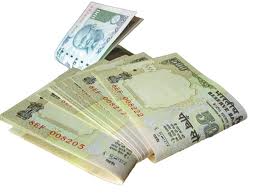
Currency notes issued before to 2005 to be withdrawn

January 22, 2014

New Delhi, Jan 22: The Reserve Bank of India (RBI) on Wednesday decided to withdraw all currency notes issued prior to 2005, including Rs 500 and Rs 1,000 denominations, after March 31 in a move apparently aimed at curbing black money and fake currencies.

currency

"After March 31, 2014, it (RBI) will completely withdraw from circulation all bank notes issued prior to 2005. From April 1, 2014, the public will be required to approach banks for exchanging these notes," the RBI said in a statement.

The public can easily distinguish the currency notes issued before 2005 as they do not have the year of printing on reverse side. The year of printing in a small font is visible at the middle of the bottom row in notes issued after 2005.

Asking people not to panic and cooperate in the withdrawal process, the RBI said old notes will continue to be legal and can be exchanged in any bank after April 1.

"From April 1, 2014, the public will be required to approach banks for exchanging these notes. Banks will provide exchange facility for these notes until further communication," the RBI said.

From July 1, 2014, persons seeking exchange of more than 10 pieces of Rs 500 and Rs 1,000 notes will have to furnish proof of identity and residence to the bank.

Although the RBI did not give any reason for withdrawal of pre-2005 currency notes, the move is expected to unearth black money held in cash.

As the new currency notes have added security features, they would help in curbing the menace of fake currency.

At present, currency notes in denominations of Rs 5, Rs 10, Rs 20, Rs 50, Rs 100, Rs 500 and Rs 1,000 are issued.

Comments

Add new comment

  • Coastaldigest.com reserves the right to delete or block any comments.
  • Coastaldigset.com is not responsible for its readers’ comments.
  • Comments that are abusive, incendiary or irrelevant are strictly prohibited.
  • Please use a genuine email ID and provide your name to avoid reject.
coastaldigest.com news network
February 5,2020

Bengaluru, Jan 5: B S Yediyurappa-led Karnataka cabinet has finally decided to resume supply of subsidised rice and wheat to students of welfare institutions and hostels including those run by religious mutts under the Dasoha Scheme’s welfare programme. The supply was stopped over two months ago.

“Cabinet has decided to continue supply of subsidised foodgrains (rice and wheat) for the benefit of 37,700 children under the Dasoha scheme in 351 welfare institutions for the next one year at the cost of Rs 18 crore,” said J C Madhuswamy, Law and Parliamentary Affairs Minister. Under this scheme, institutions that provide free accommodation and food for students are entitled to avail 10 kg rice and 5 kg wheat per student every month at subsidised rates. But following a central government directive in November, the state government had stopped supply to private institutions since December.

Hours before the cabinet meeting, Khader addressed a press conference and said, “This government is snatching away food from children by stalling the supply of foodgrains. Institutions like Suttur Mutt, Siddaganga Mutt that have worldwide fame for their service are being inconvenienced by this,” Khader said.

Finding itself in a fix, especially in a matter that involves mutts, the cabinet was quick to restore the supply. “Foodgrains were being supplied to 183 government-run institutions and 281 institutions run by private entities. As per a central government directive, supply to private institutions was stopped but the decision was made by the previous government,” Shashikala Jolle, Women and Child Development Minister, said.

Comments

Add new comment

  • Coastaldigest.com reserves the right to delete or block any comments.
  • Coastaldigset.com is not responsible for its readers’ comments.
  • Comments that are abusive, incendiary or irrelevant are strictly prohibited.
  • Please use a genuine email ID and provide your name to avoid reject.
coastaldigest.com news network
July 2,2020

Mangaluru, Jul 2: A frontline covid-19 warrior who was working in the Wenlock Covid hospital in the city has been tested positive for the coronavirus. 

Sources said that he was a pathologist working in covid testing laboratory of the Wenlock Covid hospital.

A few days ago, a senior health official had tested positive for the covid-19.

Dakshina Kannada has so far recorded deaths of 18 covid-19 patients. A total of 14,137 samples have been tested, out of which 13,040 have turned out negative, and 833 positive, including 10 persons from other districts. 372 cases are currently active.

Comments

Add new comment

  • Coastaldigest.com reserves the right to delete or block any comments.
  • Coastaldigset.com is not responsible for its readers’ comments.
  • Comments that are abusive, incendiary or irrelevant are strictly prohibited.
  • Please use a genuine email ID and provide your name to avoid reject.
News Network
March 8,2020

Bengaluru, Mar 8: The economic slowdown in the country had a cascading effect on Karnataka, as its growth rate for outgoing fiscal 2019-20 is projected to be 6.8 per cent against 7.8 per cent in the last fiscal (2018-19), a senior official said on Saturday.

"The Gross State Domestic Product (GSDP) is estimated to be 1 per cent less at 6.8 per cent for this fiscal from 7.8 per cent in the last fiscal due to slowdown in manufacturing (industry) and services sectors," an official of the state finance department told media.

Though the agriculture sector has revived from 1.6 per dent in the drought-hit last fiscal (2018-19) to register 3.9 per cent this fiscal, growth rates of industries and services will be 4.8 per cent and 7.9 per cent for 2019-20 against 5.6 per cent and 9.8 per cent respectively in 2018-19.

"The GSDP is projected to grow at 6.3 per cent in the ensuing fiscal of 2020-21 due to continued slowdown in the national economy," the official hinted.

According to the state's economic survey for 2019-20, the farm sector grew more than double to 3.9 per cent from 1.6 per cent a year ago due to increase in the production of foodgrains, dairy products and fish catch.

Foodgrain production across the state rose to 136 lakh tonnes from 128 lakh tonnes a year ago, the survey revealed.

"In line with the national Gross Domestic Product (GDP) growth rate decline, Karnataka's GSDP has declined from a high of 13.3 per cent in 2016-17 to a low of 6.8 per cent in 2019-20.

"The GSDP has declined from a double-digit growth of 10.8 per cent in 2017-18 to 7.8 per cent in 2018-19 and 6.8 per cent in 2019-20," the survey pointed out.

The survey has adopted the all-India growth rate for the services sector growth in the state, which reflects the impact of slowdown in the key sector.

At current prices, the southern state's GSDP is expected to be Rs 16,99,115 crore (budget estimates) with a 10 per cent growth rate in the next fiscal (2020-21).

"Real estate, professional services and ownership of dwellings contributed 35.31 per cent to the GSDP in 2019-20, followed by manufacturing with 15.32 per cent, trade and repair services 9.51 per cent and crops 7.44 per cent," said the survey findings.

Per capital income in the state at current prices is estimated to be Rs 2,31,246 in 2019-20, an increase of 8.8 per cent from Rs 2,12,477 in 2018-19.

"The per capita income in the state is 58.4 per cent more than that of all-India rate at Rs 1,35,050 in this fiscal," the survey added.

Comments

Add new comment

  • Coastaldigest.com reserves the right to delete or block any comments.
  • Coastaldigset.com is not responsible for its readers’ comments.
  • Comments that are abusive, incendiary or irrelevant are strictly prohibited.
  • Please use a genuine email ID and provide your name to avoid reject.