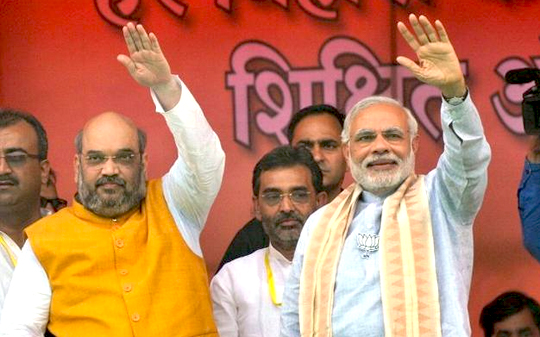
BJP to promotes Hindu unity; aims at reaching out to Dalits ahead of polls

March 5, 2016

New Delhi, Mar 5: Reeling from the fallout of the suicide of Dalit scholar Rohith Vemula and blowback from rural India because of two years of successive drought, the BJP has charted out a series of programmes to address these issues.

hinduunity

According to top sources in the party, at a meeting of party general secretaries held in Delhi and presided over by BJP president Amit Shah last week, it was decided that a week-long programme, commemorating Constitution framer Dr. Bhimrao Ambedkar be held starting from April 14, his birth anniversary.

“There is a growing feeling that Dalits who had in the General Elections of 2014 voted in large numbers for the BJP are not likely to do so in the Uttar Pradesh elections of 2017, where we are seeing a resurgent Bahujan Samaja Party,” said a general secretary who was present at the meeting.

The programme would be about the RSS' concept of “samajik samarasta” or social harmony that had first been articulated in the 1980s by then sarsanghchalak, Balasaheb Deoras.

A booklet, prepared by the RSS, titled Sabhi Hindu Sahodar Hain (all Hindus are brothers and sisters) will also be distributed.

The booklet praises Dr. Ambedkar, and contains the lectures of the late Deoras and Golwalkar denouncing untouchability.

The second set of programmes will start on May 1, when the party intends to launch a series of seminars on the panchayati raj and how best to deal with the impression (after the agitation against the Land Ordinance) that the party was against farmers.

The Union Budget, and its rural focus will also be selling point at these seminars.

“The Uttar Pradesh polls are looming in 2017, and we need to begin work on the ground to counter all this propaganda against us,” said the general secretary.

Comments

A. Mangalore
 - 
Saturday, 5 Mar 2016

First you give Azaadi for Untouchability.
People are started Azaadi from RSS gangs.
Count your days Mr. Shah, this is not encounter.

mr frank
 - 
Saturday, 5 Mar 2016

You cannot fool people of india,but people can fool same as they done in Delhi and Bihar

rikaz
 - 
Saturday, 5 Mar 2016

BJP, please dont bring disunity amongst Indians....we dont need your teaching.....all are well knowledgeable....try to hoist flag in RSS headquarter...if you really love India...

suresh
 - 
Saturday, 5 Mar 2016

What about Mr. Rohit vemula case. Can u arrest the culprits that is then u talk abt unity. First give the justice to them.

AK
 - 
Saturday, 5 Mar 2016

A old plan implementation to fool the Sleeping hindus... I think we should watch what kanaihya speaks after his release in youtu

Add new comment

  • Coastaldigest.com reserves the right to delete or block any comments.
  • Coastaldigset.com is not responsible for its readers’ comments.
  • Comments that are abusive, incendiary or irrelevant are strictly prohibited.
  • Please use a genuine email ID and provide your name to avoid reject.
Agencies
May 8,2020

Washington D.C., May 8: The prime time for brain development in a child's life is the first year, where the infant spends most of the time asleep. It is the time when neural connections form and sensory memories are encoded.

However, when sleep is disrupted, as occurs more often among children with autism, brain development may be affected, too.

New research led by the University of Washington finds that sleep problems in a baby's first 12 months may not only precede an autism diagnosis but also may be associated with altered growth trajectory in a key part of the brain, the hippocampus.

The study, which was published in the American Journal of Psychiatry, researchers report that in a sample of more than 400 taken of 6- to 12-month-old infants, those who were later diagnosed with autism were more likely to have had difficulty falling asleep.

It also states that this sleep difficulty was associated with altered growth trajectories in the hippocampus.

"The hippocampus is critical for learning and memory, and changes in the size of the hippocampus have been associated with poor sleep in adults and older children.

As many as 80 per cent of the children with autism spectrum disorder have sleep problems," said Annette Estes, director of the UW Autism Center and senior author of the study.

"In our clinical experience, parents have a lot of concerns about their children's sleep, and in our work on early autism intervention, we observed that sleep problems were holding children and families back," added Estes, who is also a UW professor of speech and hearing sciences.

"It could be that altered sleep is part-and-parcel of autism for some children. One clue is that behavioural interventions to improve sleep don't work for all children with autism, even when their parents are doing everything just right. This suggests that there may be a biological component to sleep problems for some children with autism," said Estes.

To consider links among sleep, brain development, and autism, researchers at the IBIS Network looked at MRI scans of 432 infants, surveyed parents about sleep patterns, and measured cognitive functioning using a standardized assessment.

At the outset of the study, infants were classified according to their risk for developing autism: Those who were at higher risk of developing autism -- about two-thirds of the study sample -- had an older sibling who had already been diagnosed.

Infant siblings of children with autism have a 20 per cent chance of developing autism spectrum disorder -- a much higher risk than children in the general population.

In the current study, 127 of the 432 infants were identified as "low risk" at the time the MRI scans were taken because they had no family history of autism.

They later evaluated all the participants at 24 months of age to determine whether they had developed autism. Of the roughly 300 children originally considered "high familial risk," 71 were diagnosed with autism spectrum disorder at that age.

Problems with sleep were more common among the infants later diagnosed with an autism spectrum disorder, as were larger hippocampi. No other subcortical brain structures were affected, including the amygdala, which is responsible for certain emotions and aspects of memory, or the thalamus, a signal transmitter from the spinal cord to the cerebral cortex.

The authors note that while parents reported more sleep difficulties among infants who developed autism compared to those who did not, the differences were very subtle and only observed when looking at group averages across hundreds of infants.

Sleep patterns in the first years of life change rapidly as infants transition from sleeping around the clock to a more adult-like sleep/wake cycle. Until further research is completed, Estes said, it is not possible to interpret challenges with sleep as an early sign of increased risk for autism.


Comments

Add new comment

  • Coastaldigest.com reserves the right to delete or block any comments.
  • Coastaldigset.com is not responsible for its readers’ comments.
  • Comments that are abusive, incendiary or irrelevant are strictly prohibited.
  • Please use a genuine email ID and provide your name to avoid reject.
coastaldigest.com news network
April 2,2020

Newsroom, Apr 2: Mohammad Sirajul Hasan, former chief (ameer) of Jamaat-e-Islami Hind, passed away today at a private hospital in Karnataka’s Raichur. 

The 87-year-old was suffering from old age related diseases for past few years and he was staying with his elder son in Raichur. 

He was the Karnataka (then Mysuru) unit chief of the JIH from 1st August,1958 to 6th April, 1984. Afterwards, he was appointed as the national secretary of the organization and held this post till he elected ameer for the term 1990-94. Previously, he also served the Jamaat as its Acting Ameer for about half a year. He was re-elected Ameer of the Jamaat for the terms 1995-99 and 2000-04. 

He had also served as the vice president of the All India Muslim Personal Law Board for several years.

An orator and scholar, Sirajul Hasan was known for his scholarly lectures in Urdu and Hindi.

Comments

Add new comment

  • Coastaldigest.com reserves the right to delete or block any comments.
  • Coastaldigset.com is not responsible for its readers’ comments.
  • Comments that are abusive, incendiary or irrelevant are strictly prohibited.
  • Please use a genuine email ID and provide your name to avoid reject.
News Network
July 22,2020

Bengaluru, Jul 22: Karnataka's Covid-19 task force on Tuesday decided that the state government will regulate the supply of Remdesivir, the drug used in the treatment of coronavirus infected patients, to private hospitals to check black marketing and hoarding.

"Remdesivir which is currently available in the government hospitals will be supplied to private hospitals through the government.

This will help curb black marketing of this drug," Medical Education Minister K Sudhakar's office said in a release.

Along with Sudhakar, other task force members, including Health Minister Sriramulu, Deputy Chief Minister C N Ashwath Narayan and Chief Secretary T M Vijay Bhaskar attended the meeting. However, Home Minister Basavaraj Bommai was not part of it as he was out of Bengaluru.

At the meeting, the government has also fixed the rate for Covid-19 tests in private labs- Rs 2,000 for government referred cases and 3,000 for self-reporting cases.

It was also decided to purchase 4 lakh antigen test kits and 5 lakh swab test kits to ramp up testing, the release said, adding that approvals have also been given for additional drugs for the treatment of Covid-19 patients.

The decisions also included increasing monthly salary for Ayush doctors to 48,000, MBBS doctors to 80,000 and nurses to get 30,000 for next 6 months.

The task force also made it clear that private hospitals have to reserve 50 percent beds for the government for Covid-19 treatment. The remaining 50 percent can be used by the private hospitals for Covid-19 and non-Covid-19 treatment.

Private hospitals provide treatment under Ayushman Bharat scheme (ABARK) for Covid-19 patients.

Those cases in which treatment does not cover under the scheme can be charged as per the user charges, the release said.

A committee will be formed to supervise and recommend the purchase of equipment and medicines for Covid-19 treatment, which will be headed by ACS, ITBT Department.

Approval has been given for the procurement of N-95 masks and lakh PPE kits for the safety of healthcare workers. The decision also has been taken to connect oxygen pipeline to 4,736 beds in 17 government medical colleges, which will enable high flow oxygen for these beds besides being beneficial for future use as well.

According to the release, 16 RTPCR and 15 Automated RNA extraction units will be established to ramp up testing and this will help achieve the target of 50,000 tests per day. "On the whole approvals given for purchase of equipment and upgradation of existing facilities at government hospitals is estimated to be about Rs 500 Crore," it added.

Comments

Add new comment

  • Coastaldigest.com reserves the right to delete or block any comments.
  • Coastaldigset.com is not responsible for its readers’ comments.
  • Comments that are abusive, incendiary or irrelevant are strictly prohibited.
  • Please use a genuine email ID and provide your name to avoid reject.