


BJP to promotes Hindu unity; aims at reaching out to Dalits ahead of polls

March 5, 2016

New Delhi, Mar 5: Reeling from the fallout of the suicide of Dalit scholar Rohith Vemula and blowback from rural India because of two years of successive drought, the BJP has charted out a series of programmes to address these issues.
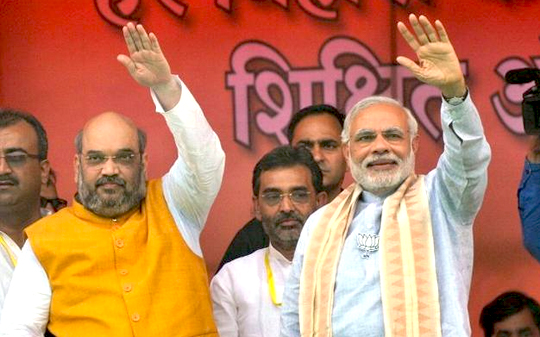
hinduunity

According to top sources in the party, at a meeting of party general secretaries held in Delhi and presided over by BJP president Amit Shah last week, it was decided that a week-long programme, commemorating Constitution framer Dr. Bhimrao Ambedkar be held starting from April 14, his birth anniversary.

“There is a growing feeling that Dalits who had in the General Elections of 2014 voted in large numbers for the BJP are not likely to do so in the Uttar Pradesh elections of 2017, where we are seeing a resurgent Bahujan Samaja Party,” said a general secretary who was present at the meeting.

The programme would be about the RSS' concept of “samajik samarasta” or social harmony that had first been articulated in the 1980s by then sarsanghchalak, Balasaheb Deoras.

A booklet, prepared by the RSS, titled Sabhi Hindu Sahodar Hain (all Hindus are brothers and sisters) will also be distributed.

The booklet praises Dr. Ambedkar, and contains the lectures of the late Deoras and Golwalkar denouncing untouchability.

The second set of programmes will start on May 1, when the party intends to launch a series of seminars on the panchayati raj and how best to deal with the impression (after the agitation against the Land Ordinance) that the party was against farmers.

The Union Budget, and its rural focus will also be selling point at these seminars.

“The Uttar Pradesh polls are looming in 2017, and we need to begin work on the ground to counter all this propaganda against us,” said the general secretary.

Comments

A. Mangalore
 - 
Saturday, 5 Mar 2016

First you give Azaadi for Untouchability.
People are started Azaadi from RSS gangs.
Count your days Mr. Shah, this is not encounter.

mr frank
 - 
Saturday, 5 Mar 2016

You cannot fool people of india,but people can fool same as they done in Delhi and Bihar

rikaz
 - 
Saturday, 5 Mar 2016

BJP, please dont bring disunity amongst Indians....we dont need your teaching.....all are well knowledgeable....try to hoist flag in RSS headquarter...if you really love India...

suresh
 - 
Saturday, 5 Mar 2016

What about Mr. Rohit vemula case. Can u arrest the culprits that is then u talk abt unity. First give the justice to them.

AK
 - 
Saturday, 5 Mar 2016

A old plan implementation to fool the Sleeping hindus... I think we should watch what kanaihya speaks after his release in youtu

Add new comment

  • Coastaldigest.com reserves the right to delete or block any comments.
  • Coastaldigset.com is not responsible for its readers’ comments.
  • Comments that are abusive, incendiary or irrelevant are strictly prohibited.
  • Please use a genuine email ID and provide your name to avoid reject.
News Network
March 28,2020

Bengaluru, Mar 28: Sun Tsu, in 'The Art of War' speaks of a skilful general who can subdue his enemy without any fighting. This constitutes the ultimate triumph which is referred to as stratagem. Today, we would need one such when we are faced with the '21-day corona challenge' for India.
Nearly four weeks back, Dr Jyothsna Rao, Dr Gururaj Rao and I sat across the OPD in the afternoon at HCG Bengaluru discussing our ongoing cancer immunology research. While on this topic, we drifted into the discussion on the coronavirus. During this engaging discussion, we wondered the similarity of the enigma between the virus and cancer. I paused to ask Dr Jyothsna and Dr Guru - how we wish we could do something against this virus.
Dr Jyothsna is a PhD from NCBS and had worked under Dr Ralph Steinman, physician and researcher from Rockefeller University, who won the Nobel Prize for his discovery of the dendritic cell and its role in adaptive immunity in 2011. Dr Gururaj is a molecular and cell biologist who did his PhD at the Chapel Hill, University of North Carolina and is the Director of iCrest.
Jyothsna while hearing our perplexing conversation on the covid intervened, "Yes, surely. I think we should take a break from cancer and focus on the innate and adaptive immunity role in COVID-19."
Thus began this sincere attempt to relook the human immune system from the eyes of the COVID-19.
We have 10 types of immune cells at the least which are widely dispersed in millions across the body. When our body is invaded by a foreign organism (bacteria, fungi or virus), these cells work with each other to destroy the invader.
Now, the question is - how do the immune cells talk to each other? They use small-molecule substances called cytokines (cyto means cells; kine means movement). There are many cytokines that are involved in work on the immune system. The most relevant for viruses are interferons.
Interferons (IFN) as the name reflects have an ability to interfere with the viral activity and stop their multiplication. These specialised signal proteins are released by our cells in response to a viral attack to forewarn other cells. They help build the antiviral proteins within the cells to kill the virus as it tries to invade the new cells.
Historically, interferons are a group of cytokines known to be potent antiviral agents against viruses and a hallmark cytokine induced by the host upon viral infections. Interferons possess unique immunoregulatory activities and are signature cytokines released by (TH1) T immune cells, which are crucial in viral infections.
As the outbreak of COVID-19 grapples us, an urgent need for finding strategies to combat the virus is growing. Coronaviruses (CoVs) are a group of RNA viruses. In patients infected with coronavirus, it was indicated that the activation of the IFN does not occur until 48 hours post-infection. Thus the delayed IFN-related antiviral response by the healthy cells leads to coronavirus evade the immune response.
Numerous studies have presented the success in defeating CoVs by the direct administration of IFNs. In a combination as a concoction, it was shown to synergistically inhibit the virus replication in vitro.
Moreover, it is understood that the earlier induction of IFNs in children although they have a less developed immune system could be the reason behind the children being least affected.
The key to success in reducing the disease fatality might be the stimulation of the immune responses to trigger IFN production at the very early stages of the disease, which might be done through the administration of IFN. Despite the evidence for the efficacy of IFNs in treating CoV-induced infections, the proper dosing and ideal timing for such interventions needs to be verified in clinical trials.
For the later stages of the diseases in advance stages where patients are on ventilator and have developed respiratory distress, we propose to utilise the mesenchymal cells derived from donor bone marrow that have been known to treat acute respiratory syndrome. Mesenchymal cells are known to possess anti-inflammatory activity and thus used often in autoimmune diseases.
With this scientific background, we have activated T cells from healthy donors, in a cGMP facility at iCrest - HCG hospital with an enriched cocktail of cytokines rich in Interferons. Injections of this cocktail we believe will result in a surge of cytokines in the body of the infected person and will boost his ability to fight the virus in the early phases. We are in the initial phases of this study and hope to be ready in the coming weeks with meaningful data on its potential utility.
Currently, it awaits government approvals (Union and state) and we have applied to central drugs authority for their initial evaluation and further directions.
As my Guru often expounded the philosophy of 'Seva' - the goal of education is knowledge, the end goal of knowledge is service. In this attempt to serve our fellow humans at this brink of unprecedented crisis, medical fraternity stands with you and promises to do our best for your safety.
We assure to exhaust every bit of our spirit in this fight against coronavirus. We have lost the sight of shores and travelled thus far, but that is the mandatory first step to cross the ocean. Are we going to succeed in this battle, is something only time will answer. 

Comments

Add new comment

  • Coastaldigest.com reserves the right to delete or block any comments.
  • Coastaldigset.com is not responsible for its readers’ comments.
  • Comments that are abusive, incendiary or irrelevant are strictly prohibited.
  • Please use a genuine email ID and provide your name to avoid reject.
coastaldigest.com news network
May 20,2020

Bengaluru, May 20: An Air India flight from Dammam in Saudi Arabia landed here with 161 passengers, including 85 for Karnataka and 76 to Hyderabad, an official said on Wednesday. Among Karnataka passengers there were both Bengalureans and Mangalureans.

"AIC-1910 (Airbus A321-211) landed at the city airport at 8.45 p.m. and 85 passengers, including 9 women and one infant alighted here, while 76 will fly to Hyderabad," the airline official said. 

The flight was 45 minutes behind schedule to Bengaluru.

The airline staff and the state government officials received the returnees in the arrival terminal and gave them masks to wear and sanitizer to wash hands.

All the passengers would be screened with thermal device to read their body temperature though only asymptomatic were flown back.

After completing formalities, including immigration check and filling the self-declaration form, the returnees were taken in state-run buses in batches for 14-day institutional quarantine in hotels and resorts across the city.

Passengers have to download the mandatory Quarantine app on their mobile phone before leaving the airport for contact tracing later.

Another evacuation flight from Kuala Lampur in Malaysia to Bengaluru has been cancelled due to Amphan cyclone over the Bay of Bengal that hit the Odisha and West Bengal on the east coast.

The service was the fourth to the southern state in the second phase of Vande Bharat Mission, the national carrier and its Express arm are operating to repatriate thousands of Indians, including distressed workers, migrants, students, senior citizens and tourists, stranded overseas since the government suspended international flights on March 23 and enforced an extended lockdown on March 25 to combat Covid-19 spread.

The first flight in the second phase landed on Monday night at Mangaluru on the state's west coast, with 177 passengers from Dubai in the UAE.

The second flight to the southern state from Kuala Lumpur in Malaysia landed here (Bengaluru) on Tuesday evening, with 94 passengers.

The third flight from Muscat in Oman landed here at 6.31 p.m. on Wednesday evening and at Mangaluru on the state's west coast at 8.01 p.m.

The remaining flights to Karnataka will land in Bengaluru and Mangaluru over the next 13 days till June 3 from 12 more destinations the world over.

In the first phase of the mission from May 7-17, the airline and its arm flew 6 flights to the state from May 11-15, bringing in 800 passengers, including 623 to Bengaluru and 177 to Mangaluru from London, Singapore, San Francisco and Dubai.

Comments

Add new comment

  • Coastaldigest.com reserves the right to delete or block any comments.
  • Coastaldigset.com is not responsible for its readers’ comments.
  • Comments that are abusive, incendiary or irrelevant are strictly prohibited.
  • Please use a genuine email ID and provide your name to avoid reject.
News Network
May 10,2020

Gadag, May 9: It is the month of April, and the season of mangoes is very much here. However, the mango farmers of Gadag are suffering huge losses amid the coronavirus lockdown due to the absence of transportation facilities along with several other issues that have been impacting their business adversely.

Speaking to media persons, Vishwanath Odugowdar, a mango farmer said, "Due to transportation problems we are not being able to export mangoes to different countries. We are trying to sell them in nearby markets."

"We are not in a situation to pack, transport and export the mangoes to different countries as we did earlier especially 
when it comes to Alphonso mangoes which is one of the most loved varieties. So, we are packing mangoes at our place. Somehow this year we have got very good quality of mangoes," he added.

Farmers here are incurring huge losses as mandis and markets across the country are shut while the transport of Alphonso mangoes has also come to a halt owing to the lockdown.

The small and medium scale farmers in places like Gadag, Dharwad, Bagalkote in north Karnataka have started packing the mangoes themselves in their farms in a bid to sell the fruit themselves.

Comments

Add new comment

  • Coastaldigest.com reserves the right to delete or block any comments.
  • Coastaldigset.com is not responsible for its readers’ comments.
  • Comments that are abusive, incendiary or irrelevant are strictly prohibited.
  • Please use a genuine email ID and provide your name to avoid reject.