


Terror alert in Gujarat: Security heightened, NSG teams on standby; raids in Kutch

March 6, 2016

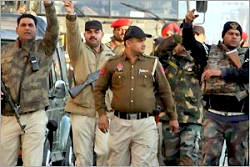
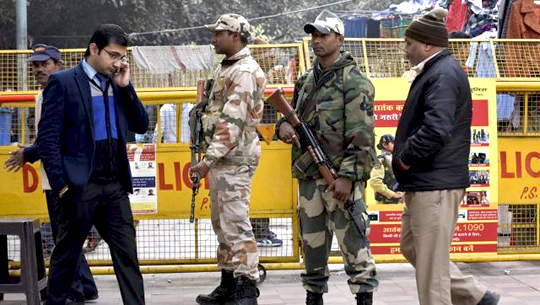
Gujarat Ahmedabad, Mar 6: Gujarat was on high alert on Sunday following intelligence inputs that terrorists have sneaked into the state, with raids being conducted at Kutch and other places, security beefed up at vital installations and sensitive areas and NSG teams on standby.

The leave of all police personnel, including officers, has been cancelled and the state government has increased security at all the main temples of the state for 'Maha Shivaratri' festival tomorrow.

A massive security operation has been launched and raids were conducted by a police team, led by South Kutch Superintendent of Police Makrand Chauhan, early this morning in Varnora village of Bhuj taluka in Kutch district bordering Pakistan, police sources said.

The Kutch police also raided Noorani Mahel hotel and Muslim Jamat Khana in Bhuj, they said.

"The state government received a serious information from central government on Saturday that terrorists have entered Gujarat. We held a meeting where it was discussed that all measures will be taken to ensure no untoward incident takes place," Gujarat Minister of State for Home Rajni Patel said.
alert

With 'Maha Shivaratri' festival tomorrow, the state government has also increased security at all the main temples.

"Especially during Maha Shivratri, lakhs of pilgrims visit temples in Junagadh, Somnath and other temples. So we have issued high alert for security of these temples too," Patel said.

Two National Security Guard (NSG) teams comprising nearly 200 personnel have been sent from Delhi to Gujarat to meet any eventuality, official sources said.

Policemen were seen patrolling the highways since early morning. Security of all the Air Force and Army bases has also been ramped up.

"The Centre has offered all help and NSG task-force has arrived here which is currently being briefed about the various (vital and sensitive) locations," he said.

"We have alerted coastal as well as border police near Kutch to take all necessary steps to beef-up security. In Kutch, we have asked the local police to remain in co-ordination with Border Security Force (BSF)," he said.

"Till now, we have not found any suspicious person. However, whatever information is received by us is serious and we are taking all necessary steps about it," Patel said.

State Director General of Police P C Thakur, who issued orders late last night cancelling leave of all policemen, said they were prepared to deal with any situation.

"We are on high alert and prepared to deal with any situation. We have started combing operations across various locations. We have also sensitised places that see high rate of footfall," Thakur said.

"We are taking all precautions. Security across coastal areas and other vital installations has been increased. If required, NSG team will be deployed as per their protocol," he said.

On reports claiming that Pakistan alerted Indian authorities about the possible infiltration of terrorists in Gujarat, state Director General of Police (IB & CID) Pramod Kumar said the state Intelligence Bureau received information from the Central IB.

"We don't know anything about Pakistan's role in providing this information. We received this information from Central IB. I don't know anything more than that," said Kumar.

Tight vigil is being kept at railway stations and airports.

Notably, a Pakistani fishing boat was seized on Friday by a BSF patrol party after its occupants fled upon seeing the border security personnel in the Koteshwar creek area off the Kutch coast along the Indo-Pakistan border.

BSF officials had said that nothing suspicious was found in the boat.

Comments

Rikaz
 - 
Sunday, 6 Mar 2016

Indians should stop fishing for the time being in the western coastal area so that Pakistani boats with terrorists can be identified easily....our fishermen should be compensated for taking off from work as they will have to feed their families too....

ali
 - 
Sunday, 6 Mar 2016

Real Terrorist are hiding in BJP or RSS headquarters.
Just an political publicity to attract voters towards them.
If there was real threat, then officials used to work and solves secretly but now a days these politicians make statement in media to show people about their actions for nothing.
Like film stars appears in reality show for the promotion of their films, now BJP Jumla Govt. is using same kind of trend in different way.

Meghana
 - 
Sunday, 6 Mar 2016

go to hell !!! your type of people just dont want to c the growing india,

Mohan Poojary
 - 
Sunday, 6 Mar 2016

Good plan to retain image from Rohit Vemula and JNU row.... Plan to catch some beared muslims.........!!! Just be alert and wait for some unexpected feku operation...

Add new comment

  • Coastaldigest.com reserves the right to delete or block any comments.
  • Coastaldigset.com is not responsible for its readers’ comments.
  • Comments that are abusive, incendiary or irrelevant are strictly prohibited.
  • Please use a genuine email ID and provide your name to avoid reject.
News Network
April 8,2020

New Delhi, Apr 8: The number of confirmed coronavirus cases in the country have continued to rise even on the 15th day of the lockdown, and reached 5,274 cases on Wednesday evening, according to the Ministry of Health and Family Welfare.

The tally includes 4,714 active, 411, cured/discharged and migrated cases as well as deaths. A total of 149 deaths have been reported due to the infection so far in the country.

Maharashtra with 1,018 confirmed cases has the highest number of COVID-19 patients in the country, while Tamil Nadu (690) and Delhi (576) are the two next most affected regions.

Fresh cases were reported on Wednesday from Telangana, Tamil Nadu, West Bengal, Maharashtra, Rajasthan and the union territory of Andaman and Nicobar Islands, among other states and UTs.

Meanwhile, in an interaction between Prime Minister Narendra Modi and floor leaders of several parties held today via video conferencing, discussions were held on extending the lockdown even further after the 21-day period.

The 21-day lockdown was announced on March 24 by Prime Minister Narendra Modi.
At the regular media briefing at 4 pm, Lav Aggarwal, Joint Secretary in the Health Ministry said that the government has ensured that there is no shortage of hydroxychloroquine in the country at present as well as in the future.

In the wake of COVID-19 outbreak, the Ministry of Human Resource and Development (MHRD) has launched 'Integrated Government Online Training Portal' wherein required resources will be provided for capacity building of the frontline workers.

"MHRD's training portal will provide required resources to the doctors, paramedics, nurse, technicians and ANMs and state government officials and civil defence officials, volunteers of National Cadet Corps (NCC), National Surveillance teams, Red Cross society and other organisations to have a large skill workforce to combat the coronavirus outbreak," said Aggarwal at a press conference here.

Speaking on government's preparedness on dealing with the patients having mild, very mild and serious conditions, Aggarwal said, "For people who have mild or very mild symptoms we have temporary hospitals, ie COVID care hospitals. Work is now being done to develop the field level infrastructure to take care of the mild and very mild symptomatic patients.

Similarly, for serious patients, we have dedicated healthcare centre and dedicated hospitals."

With fresh COVID-19 cases being reported across the country, several states and union territories, including Uttar Pradesh and Chandigarh, on Wednesday made it compulsory for people to use masks while venturing out of their houses.

Here's a quick read on the COVID-19 related updates:

1. Prime Minister Narendra Modi hinted that the lockdown might be extended after the completion of the 21-day period.
2. Floor party leaders of various political parties from both the Rajya and Lok Sabha assured the government of their full support in the decisions needed to be taken in the coming days and also suggested taking various measures to help the people.
3. According to the Indian Council of Medical Research (ICMR), a total of 1,21,271 tests have been conducted in the country.
4. The Uttar Pradesh government has decided to strictly implement 100 per cent lockdown in hotspots located across 15 districts in the state till the morning of April 15. These areas will be completely cordoned off and civilian passes will stay suspended while essentials would be delivered to citizens at their doorsteps.
5. The Supreme Court suggested that all tests to identify coronavirus positive patients should be conducted free of cost in the identified private laboratories and said that the court will pass appropriate order on the matter. The SC bench also asked the central government to look into creating a mechanism for providing reimbursement for the same.
6. Prime Minister Narendra Modi urged people to take the responsibility of a poor family, at least till the COVID-19 crisis persists if they wanted to honour him.
7. Union Home Ministry announced that Rs 3000 crores have been distributed among two crore registered construction workers till now, according to Saheli Ghosh Roy, Joint Secretary.
8. The MHA official said that the Home Secretary has written to the state Chief Secretaries to ensure a continuous supply of essential commodities under the Essential Commodities Act, 1955. The states can use measures like fixing stock limits, capping of price and checking bank accounts of the dealers.
9. The Health Ministry has assured that there will be no shortage of Hydroxychloroquine in the country. This came after India lifted the ban on the export of the anti-malarial drug being sued to treat COVID-19
10. The Maharashtra government too has issued an order to compulsorily wear masks while entering any government offices in Mumbai Metropolitan Region and Pune Metropolitan Region.

Comments

Add new comment

  • Coastaldigest.com reserves the right to delete or block any comments.
  • Coastaldigset.com is not responsible for its readers’ comments.
  • Comments that are abusive, incendiary or irrelevant are strictly prohibited.
  • Please use a genuine email ID and provide your name to avoid reject.
News Network
February 11,2020

New Delhi, Feb 11: AAP leader Sanjay Singh on Tuesday said his party will register a "massive win" in the high-stakes Delhi Assembly election, counting for which began amid tight security at various centres set up to carry out the exercise.

Initial trends suggested the ruling Aam Aadmi Party marching ahead, but the Bharatiya Janata Party leaders maintained that their party would win.

The counting began at 8 am and will be held in multiple rounds, Delhi Chief Electoral Officer Ranbir Singh said.

Comments

Add new comment

  • Coastaldigest.com reserves the right to delete or block any comments.
  • Coastaldigset.com is not responsible for its readers’ comments.
  • Comments that are abusive, incendiary or irrelevant are strictly prohibited.
  • Please use a genuine email ID and provide your name to avoid reject.
Agencies
May 23,2020

New Delhi, May 23: The nationwide lockdown will no longer help India in its fight against COVID-19, and in its place community-driven containment, isolation and quarantine strategies have to be brought into play, leading virologist Shahid Jameel said.

The recipient of Shanti Swarup Bhatnagar Prize for Science and Technology also stressed that testing should be carried out vigorously to identify coronavirus hotspots and isolate those areas.

"Our current testing rate at 1,744 tests per million population is one of the lowest in the world. We should deploy both antibody tests and confirmatory PCR tests. This will tell us about pockets of ongoing infection and past (recovered) infection. This will provide data to open up gradually and let economic activity resume," Jameel told PTI in an interview.

He stressed that testing has to be dynamic to continuously monitor red, orange and green zones and change these based on that data.

About community transmission of COVID-19 in India, Jameel said the country reached that stage long ago.

"We reached community transmission a long time ago. It's just that the health authorities are not admitting it. Even ICMR's own study of SARI (severe acute respiratory illness) showed that about 40 per cent of those who tested positive for SARS-CoV-2 did not have any history of overseas travel or contact to a known case. If this is not community transmission, then what is?" he posed.

Lockdown bought India time in its fight against coronavirus, but continuing it is unlikely to yield any further dividend, Jameel said.

"Instead, community-driven local lockdowns, isolations and quarantines have to come into play. Building trust is most important so that people follow rules. A public health problem cannot be dealt with as a law-and-order problem."

The nationwide lockdown, initially imposed from March 25 to April 14, has been extended thrice and will continue at least till May 31. The virus has claimed 3,720 lives and infected over 1.25 lakh people in the country so far.

Jameel has expertise in the fields of molecular biology, infectious diseases, and biotechnology. He is the CEO of Wellcome Trust/Department of Biotechnology's India Alliance and is best known for extensive research in Hepatitis E virus and HIV.

He said COVID-19 will eventually be controlled through herd immunity, which is acquired in two ways – when a sufficient fraction of the population gets infected and recovers, and with vaccination.

"It is estimated that for SARS-CoV-2 at least 60 per cent of the population would have to be infected and recovered, or vaccinated. This will happen over the course of the next few years," Jameel said.

Herd immunity is reached when the majority of a population becomes immune to an infectious disease, either because they have become infected and recovered, or through vaccination. When that happens, the disease is less likely to spread to people who aren't immune, because there just aren't enough infectious carriers.

"India has 1.38 billion people, a population density of about 400/sq km and a healthcare system ranked at 143 in the world. If we allow 60 per cent people to get infected quickly in the hopes of herd immunity, that would mean 830 million infections," Jameel said.

"If 15 per cent need hospitalization that means about 125 million isolation beds (we have 0.3 million). If five per cent need oxygen and ventilatory support, this amounts to about 42 million oxygen support and ICU beds; we have 0.1 million oxygen support beds and 34,000 ICU beds. This would overwhelm the healthcare system causing mayhem," he said.

Jameel said if the population level mortality is 0.5 per cent that would mean 40 lakh deaths. "Are we prepared to pay this price for herd immunity in the short term? Clearly not," he said.

He said it is unlikely that a vaccine would be available by the end of the year.

"Even then, we don't know yet how long it would give protection – weeks, months, one year, a few years? I don't think we will return to pre-coronavirus days for at least the next 3-5 years. This is also a chance to evaluate if we want to return to those unsustainable, environment-damaging ways. COVID-19 is a timely warning to reform our way of living," he said.

Jameel said it is hard to predict but plausible that COVID-19 would return in second or third wave.

"Later waves come when we don't understand the disease and become lax. A comparison to Spanish Flu is not entirely valid because in 1918 no one knew what caused it. No one had seen a virus till the mid-1930s as the electron microscope needed to view those was invented in 1931," he said.

"Today we know a lot more about the pathogen, its genetic makeup, how it transmits and how to prevent it. We need to be sensible and follow expert advice," he said.

If there is any scientific evidence linking deforestation, rapid urbanisation, climate change with pandemics like COVID-19, he said zoonotic viruses -- those that jump from animals to humans -- happen so when wild animal–human contacts increase.

"Deforestation destroys animal habitats bringing them closer to humans. When you cut forests, bats come to roost on trees closer to human habitations. Their viruses in secretions/stool get transmitted to domestic animals and on to humans. This happened clearly with Nipah virus outbreak in Malaysia in 1997-98 from fruit bats to pigs to humans," he said.

"COVID-19 possibly arose in wet animal markets due to dietary habits that bring all kinds of live and dead wild animals in close contact with humans," Jameel added.

Comments

Add new comment

  • Coastaldigest.com reserves the right to delete or block any comments.
  • Coastaldigset.com is not responsible for its readers’ comments.
  • Comments that are abusive, incendiary or irrelevant are strictly prohibited.
  • Please use a genuine email ID and provide your name to avoid reject.