


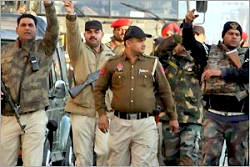
Terror alert in Gujarat: Security heightened, NSG teams on standby; raids in Kutch

March 6, 2016

Gujarat Ahmedabad, Mar 6: Gujarat was on high alert on Sunday following intelligence inputs that terrorists have sneaked into the state, with raids being conducted at Kutch and other places, security beefed up at vital installations and sensitive areas and NSG teams on standby.

The leave of all police personnel, including officers, has been cancelled and the state government has increased security at all the main temples of the state for 'Maha Shivaratri' festival tomorrow.

A massive security operation has been launched and raids were conducted by a police team, led by South Kutch Superintendent of Police Makrand Chauhan, early this morning in Varnora village of Bhuj taluka in Kutch district bordering Pakistan, police sources said.

The Kutch police also raided Noorani Mahel hotel and Muslim Jamat Khana in Bhuj, they said.

"The state government received a serious information from central government on Saturday that terrorists have entered Gujarat. We held a meeting where it was discussed that all measures will be taken to ensure no untoward incident takes place," Gujarat Minister of State for Home Rajni Patel said.
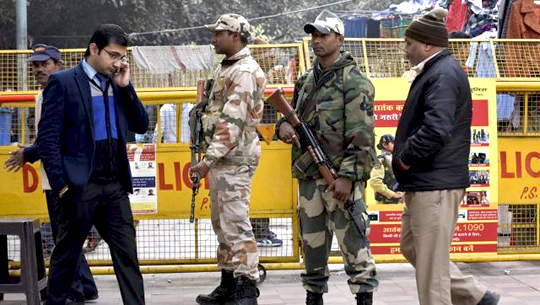
alert

With 'Maha Shivaratri' festival tomorrow, the state government has also increased security at all the main temples.

"Especially during Maha Shivratri, lakhs of pilgrims visit temples in Junagadh, Somnath and other temples. So we have issued high alert for security of these temples too," Patel said.

Two National Security Guard (NSG) teams comprising nearly 200 personnel have been sent from Delhi to Gujarat to meet any eventuality, official sources said.

Policemen were seen patrolling the highways since early morning. Security of all the Air Force and Army bases has also been ramped up.

"The Centre has offered all help and NSG task-force has arrived here which is currently being briefed about the various (vital and sensitive) locations," he said.

"We have alerted coastal as well as border police near Kutch to take all necessary steps to beef-up security. In Kutch, we have asked the local police to remain in co-ordination with Border Security Force (BSF)," he said.

"Till now, we have not found any suspicious person. However, whatever information is received by us is serious and we are taking all necessary steps about it," Patel said.

State Director General of Police P C Thakur, who issued orders late last night cancelling leave of all policemen, said they were prepared to deal with any situation.

"We are on high alert and prepared to deal with any situation. We have started combing operations across various locations. We have also sensitised places that see high rate of footfall," Thakur said.

"We are taking all precautions. Security across coastal areas and other vital installations has been increased. If required, NSG team will be deployed as per their protocol," he said.

On reports claiming that Pakistan alerted Indian authorities about the possible infiltration of terrorists in Gujarat, state Director General of Police (IB & CID) Pramod Kumar said the state Intelligence Bureau received information from the Central IB.

"We don't know anything about Pakistan's role in providing this information. We received this information from Central IB. I don't know anything more than that," said Kumar.

Tight vigil is being kept at railway stations and airports.

Notably, a Pakistani fishing boat was seized on Friday by a BSF patrol party after its occupants fled upon seeing the border security personnel in the Koteshwar creek area off the Kutch coast along the Indo-Pakistan border.

BSF officials had said that nothing suspicious was found in the boat.

Comments

Rikaz
 - 
Sunday, 6 Mar 2016

Indians should stop fishing for the time being in the western coastal area so that Pakistani boats with terrorists can be identified easily....our fishermen should be compensated for taking off from work as they will have to feed their families too....

ali
 - 
Sunday, 6 Mar 2016

Real Terrorist are hiding in BJP or RSS headquarters.
Just an political publicity to attract voters towards them.
If there was real threat, then officials used to work and solves secretly but now a days these politicians make statement in media to show people about their actions for nothing.
Like film stars appears in reality show for the promotion of their films, now BJP Jumla Govt. is using same kind of trend in different way.

Meghana
 - 
Sunday, 6 Mar 2016

go to hell !!! your type of people just dont want to c the growing india,

Mohan Poojary
 - 
Sunday, 6 Mar 2016

Good plan to retain image from Rohit Vemula and JNU row.... Plan to catch some beared muslims.........!!! Just be alert and wait for some unexpected feku operation...

Add new comment

  • Coastaldigest.com reserves the right to delete or block any comments.
  • Coastaldigset.com is not responsible for its readers’ comments.
  • Comments that are abusive, incendiary or irrelevant are strictly prohibited.
  • Please use a genuine email ID and provide your name to avoid reject.
Agencies
January 24,2020

New Delhi, Jan 24: The Election Commission of India on Friday told the Supreme Court that its 2018 direction asking poll candidates to declare their criminal antecedents in electronic and print media has not helped curb criminalisation of politics. The poll panel suggested that instead of asking candidates to declare criminal antecedents in the media, political parties should be asked not to give tickets to candidates with criminal background.

A bench of Justices R F Nariman and S Ravindra Bhat asked the ECI to come up with a framework within one week which can help curb criminalisation of politics in nation's interest.

The top court asked the petitioner BJP leader and advocate Ashiwini Upadhyay and the poll panel to sit together and come up with suggestions which would help him in curbing criminalisation of politics.

In September 2018, a five-judge Constitution bench had unanimously held that all candidates will have to declare their criminal antecedents to the Election Commission before contesting polls and had called for a wider publicity, through print and electronic media about antecedents of candidates.

Comments

Satya Vishwasi
 - 
Saturday, 25 Jan 2020

What about those criminals who were already in parliament and vidahan sabhas? shall the ECI cancel their positions?

Add new comment

  • Coastaldigest.com reserves the right to delete or block any comments.
  • Coastaldigset.com is not responsible for its readers’ comments.
  • Comments that are abusive, incendiary or irrelevant are strictly prohibited.
  • Please use a genuine email ID and provide your name to avoid reject.
News Network
June 9,2020

Jun 9: Prime Minister Narendra Modi wants all 1.3 billion Indians to be “vocal for local” — meaning, to not just use domestically made products but also to promote them. As an overseas citizen living in Hong Kong, I’m doing my bit by very vocally demanding Indian mangoes on every trip to the grocery. But half the summer is gone, and not a single slice so far.

My loss is due to India’s COVID-19 lockdown, which has severely pinched logistics, a perennial challenge in the huge, infrastructure-starved country. But more worrying than the disruption is the fruity political response to it. Rather than being a wake-up call for fixing supply chains, the pandemic seems to be putting India on an isolationist course. Why?

Granted that the liberal view that trade is good and autarky bad isn’t exactly fashionable anywhere right now. What makes India’s lurch troublesome is that the pace and direction of economic nationalism may be set by domestic business interests. The Indian liberals, many of whom are Western-trained academics, authors and — at least until a few years ago — policy makers, want a more competitive economy. They will be powerless to prevent the slide.

Modi’s call for a self-reliant India has been echoed by Home Minister Amit Shah, the cabinet’s unofficial No. 2, in a television interview. If Indians don’t buy foreign-made goods, the economy will see a jump, he said. The strategy — although it’s too nebulous yet to call it that — has a geopolitical element. A military standoff with China is under way, apparently triggered by India’s completion of a road and bridge near the common border in the tense Himalayan region of Ladakh. It’s very expensive to fight even a limited war there. With India’s economy flattened by COVID, New Delhi may be looking for ways to restore the status quo and send Beijing a signal.

Economic boycotts, such as Chinese consumers’ rejection of Japanese goods over territorial disputes in the East China Sea, are well understood as statecraft. In these times, it’s not even necessary to name an enemy. An undercurrent of popular anger against China, the source of both the virus and India’s biggest bilateral trade deficit, is supposed to do the job. But is it ever that easy?

A hastily introduced policy to stock only local goods in police and paramilitary canteens became a farcical exercise after the list of banned items ended up including products by the local units of Colgate-Palmolive Co., Nestle SA, and Unilever NV, which have had significant Indian operations for between 60 and 90 years, as well as Dabur India Ltd., a New Delhi-based maker of Ayurveda brands. The since-withdrawn list demonstrates the practical difficulty of bureaucrats trying to find things in a globalized world that are 100% indigenous.

Free-trade champions fret that the prime minister, whom they saw as being on their side six years ago, is acting against their advice to dismantle statist controls on land, labor and capital to help make the country more competitive. Engage with the world more, not less, they caution. But Modi also has to satisfy the Rashtriya Swayamsevak Sangh, the umbrella Hindu organisation that gets him votes. Its backbone of small traders, builders and businessmen — the RSS admits only men — was losing patience with the anemic economy even before the pandemic. Now, they’re in deep trouble, because India’s broken financial system won’t deliver even state-guaranteed loans to them.

The U.S.-China tensions — over trade, intellectual property, COVID responsibility and Hong Kong’s autonomy — offer a perfect backdrop. A dire domestic economy and trouble at the border provide the foreground. Big business will dial economic nationalism up and down to hit a trifecta of goals: Block competition from the People's Republic; make Western rivals fall in line and do joint ventures; and tap deep overseas capital markets. The first goal is being achieved with newly placed restrictions on investment from any country that shares a land border with India. The second aim is to be realized by corporate lobbying to influence India's whimsical economic policies. As for the third objective, with the regulatory environment becoming tougher for U.S.-listed Chinese companies like Alibaba Group Holding Ltd., an opportunity may open up for Indian firms.

All this may bring India Shenzhen-style enclaves of manufacturing and trade, but it will concentrate economic power in fewer hands, something that worries liberals. They’re moved by the suffering of India’s low-wage workers, who have borne the brunt of the COVID shutdown. But when their vision of a more just society and fairer income distribution prompts them to make common cause with the ideological Left, they’re quickly repelled by the Marxist voodoo that all cash, property, bonds and real estate held by citizens or within the nation “must be treated as national resources available during this crisis.” Who will invest in a country that does that instead of just printing money?

At the same time, when liberals look to the business class, they see a sudden swelling of support for ideas like a universal basic income. They wonder if this isn’t a ploy by industry to outsource part of the cost of labor to the taxpayer. Slogans like Modi’s vocal-for-local stir the pot and thicken the confusion. The value-conscious Indian consumer couldn’t give two hoots for calls to buy Indian, but large firms will know how to exploit economic nationalism. One day soon, I’ll get my mangoes — from them.

Comments

Add new comment

  • Coastaldigest.com reserves the right to delete or block any comments.
  • Coastaldigset.com is not responsible for its readers’ comments.
  • Comments that are abusive, incendiary or irrelevant are strictly prohibited.
  • Please use a genuine email ID and provide your name to avoid reject.
Agencies
May 19,2020

New Delhi, May 19: Former Union Minister P Chidambaram said that as the fourth phase of the nationwide lockdown amid the coronavirus scare began from Monday, his thoughts were with the people of Kashmir who were in a "terrible lockdown within a lockdown."

The senior Congress leader said that at least now, the people in the rest of India will understand that he dubbed the "enormity of the injustice" done to those who were detained in Kashmir and those still under detention" immediately before and after the abrogation of Article 370 of the Indian Constitution on August 5, 2019.

Chidambaram said that former Jammu and Kashmir Chief Minister Mehbooba Mufti was the "worst sufferer" of preventive detention and even courts had shirked their constitutional duty with respect to detainees.

"The worst sufferers are Mehbooba Mufti and her senior party colleagues who are still in custody in a locked-down state in a locked-down country. They are deprived of every human right," he said in a statement.

"I cannot believe that for nearly 10 months, the courts will shirk their constitutional duty to protect the human rights of citizens," he added.

The detention on Mehbooba Mufti under the Public Safety Act (PSA) had been extended for three more months on May 5. Booked under the stringent PSA, she was initially kept at the Hari Niwas guesthouse in Srinagar but later shifted to a Tourism Department hut in the Chashma Shahi area.

She was shifted to her Gupkar Road official residence on April 7.

Besides Mehbooba Mufti, two other former Chief Ministers -- Omar Abdullah and his father Farooq Abdullah -- were also detained under the PSA but later released.

Comments

Add new comment

  • Coastaldigest.com reserves the right to delete or block any comments.
  • Coastaldigset.com is not responsible for its readers’ comments.
  • Comments that are abusive, incendiary or irrelevant are strictly prohibited.
  • Please use a genuine email ID and provide your name to avoid reject.