


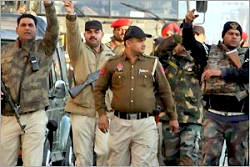
Terror alert in Gujarat: Security heightened, NSG teams on standby; raids in Kutch

March 6, 2016

Gujarat Ahmedabad, Mar 6: Gujarat was on high alert on Sunday following intelligence inputs that terrorists have sneaked into the state, with raids being conducted at Kutch and other places, security beefed up at vital installations and sensitive areas and NSG teams on standby.

The leave of all police personnel, including officers, has been cancelled and the state government has increased security at all the main temples of the state for 'Maha Shivaratri' festival tomorrow.

A massive security operation has been launched and raids were conducted by a police team, led by South Kutch Superintendent of Police Makrand Chauhan, early this morning in Varnora village of Bhuj taluka in Kutch district bordering Pakistan, police sources said.

The Kutch police also raided Noorani Mahel hotel and Muslim Jamat Khana in Bhuj, they said.

"The state government received a serious information from central government on Saturday that terrorists have entered Gujarat. We held a meeting where it was discussed that all measures will be taken to ensure no untoward incident takes place," Gujarat Minister of State for Home Rajni Patel said.
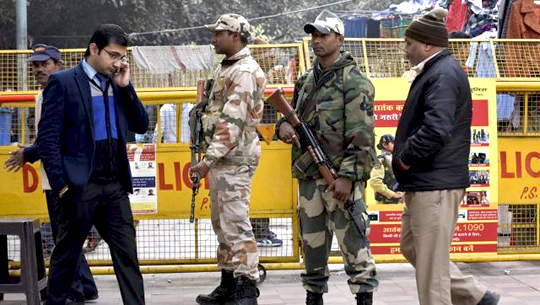
alert

With 'Maha Shivaratri' festival tomorrow, the state government has also increased security at all the main temples.

"Especially during Maha Shivratri, lakhs of pilgrims visit temples in Junagadh, Somnath and other temples. So we have issued high alert for security of these temples too," Patel said.

Two National Security Guard (NSG) teams comprising nearly 200 personnel have been sent from Delhi to Gujarat to meet any eventuality, official sources said.

Policemen were seen patrolling the highways since early morning. Security of all the Air Force and Army bases has also been ramped up.

"The Centre has offered all help and NSG task-force has arrived here which is currently being briefed about the various (vital and sensitive) locations," he said.

"We have alerted coastal as well as border police near Kutch to take all necessary steps to beef-up security. In Kutch, we have asked the local police to remain in co-ordination with Border Security Force (BSF)," he said.

"Till now, we have not found any suspicious person. However, whatever information is received by us is serious and we are taking all necessary steps about it," Patel said.

State Director General of Police P C Thakur, who issued orders late last night cancelling leave of all policemen, said they were prepared to deal with any situation.

"We are on high alert and prepared to deal with any situation. We have started combing operations across various locations. We have also sensitised places that see high rate of footfall," Thakur said.

"We are taking all precautions. Security across coastal areas and other vital installations has been increased. If required, NSG team will be deployed as per their protocol," he said.

On reports claiming that Pakistan alerted Indian authorities about the possible infiltration of terrorists in Gujarat, state Director General of Police (IB & CID) Pramod Kumar said the state Intelligence Bureau received information from the Central IB.

"We don't know anything about Pakistan's role in providing this information. We received this information from Central IB. I don't know anything more than that," said Kumar.

Tight vigil is being kept at railway stations and airports.

Notably, a Pakistani fishing boat was seized on Friday by a BSF patrol party after its occupants fled upon seeing the border security personnel in the Koteshwar creek area off the Kutch coast along the Indo-Pakistan border.

BSF officials had said that nothing suspicious was found in the boat.

Comments

Rikaz
 - 
Sunday, 6 Mar 2016

Indians should stop fishing for the time being in the western coastal area so that Pakistani boats with terrorists can be identified easily....our fishermen should be compensated for taking off from work as they will have to feed their families too....

ali
 - 
Sunday, 6 Mar 2016

Real Terrorist are hiding in BJP or RSS headquarters.
Just an political publicity to attract voters towards them.
If there was real threat, then officials used to work and solves secretly but now a days these politicians make statement in media to show people about their actions for nothing.
Like film stars appears in reality show for the promotion of their films, now BJP Jumla Govt. is using same kind of trend in different way.

Meghana
 - 
Sunday, 6 Mar 2016

go to hell !!! your type of people just dont want to c the growing india,

Mohan Poojary
 - 
Sunday, 6 Mar 2016

Good plan to retain image from Rohit Vemula and JNU row.... Plan to catch some beared muslims.........!!! Just be alert and wait for some unexpected feku operation...

Add new comment

  • Coastaldigest.com reserves the right to delete or block any comments.
  • Coastaldigset.com is not responsible for its readers’ comments.
  • Comments that are abusive, incendiary or irrelevant are strictly prohibited.
  • Please use a genuine email ID and provide your name to avoid reject.
News Network
March 7,2020

Mumbai, Mar 7: Maharashtra Chief Minister and Shiv Sena president Uddhav Thackeray visited Ayodhya on Saturday to commemorate 100 days in office and pledged Rs 1 crore towards the building of the Ram Temple.

Taking a dig at BJP, Uddhav said his party had separated from its erstwhile ally but not Hindutva.

Recollecting the contribution of his father Balasaheb Thackeray, uddhav said he was forced to skip the Sarayu River 'aarti' due to Coronavirus fears but he would continue visiting Ayodhya.

Earlier in the day, the Sena, which heads the tripartite dispensation in the state, said there was no change in its ideology.

Launching a veiled attack on BJP, an editorial in the Sena mouthpiece 'Saamana' also said that Lord Ram and Hindutva is not the sole property of any single political party.

The Sena also said the Maha Vikas Aghadi (MVA) government — which also comprises the NCP and the Congress — has completed 100 days, much to the chagrin of those who were claiming that the new dispensation will not survive more than 100 hours.

“Those whose government lasted for 80 hours were claiming that the Thackeray regime will not last for even 100 hours. But this MVA government not only thrived but has instilled trust in the minds of people during this period with its performance,” the editorial said.

The Sena was apparently referring to the second inning of the erstwhile Devendra Fadnavis government which lasted for only 80 hours in November last year.

"Hence, CM Thackeray's visit to Ayodhya has to be welcomed as he is offering the flowers of works (done by the government) at the feet of Lord Shriram," it said.

The Sena said Thackeray's visit to the temple town is out of devotion for Lord Shriram. "The government in Maharashtra comprising three ideologically different parties is working as per Constitution and Thackeray is leading such government," it said.

The edit said on this background various questions were raised over Thackeray's visit to Ayodhya by his political opponents. "The government maybe backed by anyone, but Uddhav Thackeray and the Shiv Sena remain the same from within and outside. There is no change in the ideology. Lord Shriram and Hindutva is not the property of any single party," it stated.

Referring to senior RSS leader Suresh 'Bhaiyyaji' Joshi's remark that the Hindu community is not synonymous with the BJP and that opposing the BJP does not amount to opposing Hindus, the Sena said similarly Ayodhya belongs to all.

"The political and cultural battle in Ayodhya is now over. The Supreme Court cannot be thanked enough for this (for its verdict in the Ram Janmabhoomi-Babri Masjid dispute case that allowed construction of the Ram temple)," it said.

Hailing the Supreme Court's November, 2019 verdict, the Sena said the country had to fight a big battle to prove that Ayodhya belonged to Lord Shriram.

"In that battle, several (people) were unmasked. But only (late) Shiv Sena president Balasaheb Thackeray stood behind the Ayodhya (temple) campaigners like a mountain," it said.

Bal Thackeray created trust among Hindus from across the world about the creation of the temple, the Sena said. The party further said late Thackeray's assertion that he was proud if the Babri mosque was razed by Sena workers and that the temple of Lord Ram would come up in Ayodhya was akin to the thunder of "thousands of lightnings" in the sky.

"The Hindu culture got lit up in the glow of that lightning. The resplendent rays showed the path of power to the Hindu community. Hence, no one can deny the contribution of the 'Hinduhridaysamrat' (Bal Thackeray) as good as that of Lord Shriram, in creating the current political order in the country," the Sena said.

"We have experienced several times that Balasaheb lives in the mind of Ayodhya. Now Uddhav Thackeray himself is going there with the same faith. He had gone there when not in power. He is going there now after becoming chief minister with the same humility. Lord Shriram is of everyone," the Sena said.

The party said Maharashtra is being run on the path shown by Lord Shriram and Chhatrapati Shivaji Maharaj. "A Ram Rajya entails fulfilling promises made to the people. This is precisely what Mahatma Gandhi wanted, and the government following this ideology is in place in Maharashtra. It will continue work on that line. Ultimately, Lord Shriram is there to support it," the Sena said.

Thackeray completed 100 days in the office on Friday. He had assumed office as the chief minister of the Sena-led Maha Vikas Aghadi (MVA) government on November 28 last year, after the Sena joined hands with the NCP and the Congress.

Senior Sena leader Sanjay Raut had said that Thackeray will not take part in the 'aarti' programme on the banks of river Sarayu in the temple town.

Comments

Add new comment

  • Coastaldigest.com reserves the right to delete or block any comments.
  • Coastaldigset.com is not responsible for its readers’ comments.
  • Comments that are abusive, incendiary or irrelevant are strictly prohibited.
  • Please use a genuine email ID and provide your name to avoid reject.
News Network
January 31,2020

New Delhi, Jan 31: Substantial competition and low tariff rates by telecom operators since 2016 have led to a financial stress in the sector, the Economic Survey said on Friday.

The data price in the country came down by over 99 per cent during 2016-2019, making it among the lowest tariff in the world, according to the survey.

"Since 2016, the sector has witnessed substantial competition and price cutting by the telecom service providers (TSPs), creating financial stress in the sector. As a result, the sector is experiencing consolidation. While some operators have filed for bankruptcy, others have merged, in their quest to improve viability," the survey report said.

In April-June 2019, the price of data was Rs 7.7 per gigabyte (GB) as compared to Rs 200 per GB in June 2016, it added.

"The Average Revenue Per User (ARPU) for GSM based mobile services has also gone down substantially from Rs 126 in June 2016 to Rs 74.30 in June 2019," the survey said.

The tariff war started in the market with entry of new telecom operator Reliance Jio in September 2016.

"BSNL and MTNL are also affected by the tariff war that has impacted their cash flow resulting in mounting losses," the survey said.

The financial health of the public sector telecom firms plummeted to a level where they have been finding hard to pay employees salaries in time.

The government has drawn up a plan to revive these PSUs which is still in works.

The revival plan consists of several measures, including reduction of staff cost through voluntary retirement scheme, allotment of spectrum for 4G services, monetisation of land and building, tower and fibre assets of BSNL and MTNL, debt restructuring through sovereign guarantee bonds and ''in-principle'' approval for merger of BSNL and MTNL.

The survey said that the wireless telephony now constitutes 98.27 per cent of all subscriptions whereas share of landline telephones now stands at only 1.73 per cent where market share is dominated by private sector players.

"The overall tele-density in India stands at 90.45 per cent, the rural tele-density being 57.35 per cent and urban teledensity being 160.71 per cent at the end of September 2019. The private sector dominates with a share of 88.81 per cent (106.06 crore connections) at the end of September, 2019 while the share of public sector was 11.19 per cent (13.36 crore connections)," the survey said.

The lower price of data has also lead in surge of broadband connections and average consumption of the internet.

Total broadband connections increased by about ten times, from 6.1 crore in 2014 to 59.46 crore in June 2019, the survey said.

The number of internet subscribers (both broadband and narrowband put together) stood at 66.53 crore at the end of June 2019 as compared to 25.16 crore in 2014.

The number of mobile internet subscribers was 64.36 lakh at the end of June 2019 while the number of wireline internet subscribers was 2.17 crore.

"India is now the global leader in monthly data consumption, with average consumption per subscriber per month increasing 157 times from 62 MB in 2014 to 9.8 GB in June 2019. The cost of data has also reduced substantially, enabling affordable internet access for millions of citizens," the survey said.

Comments

Add new comment

  • Coastaldigest.com reserves the right to delete or block any comments.
  • Coastaldigset.com is not responsible for its readers’ comments.
  • Comments that are abusive, incendiary or irrelevant are strictly prohibited.
  • Please use a genuine email ID and provide your name to avoid reject.
News Network
January 13,2020

Jan 13: For the first time in years, the government of India’s Prime Minister Narendra Modi is playing defense. Protests have sprung up across the country against an amendment to India’s laws — which came into effect on Friday — that makes it easier for members of some religions to become citizens of India. The government claims this is simply an attempt to protect religious minorities in the Muslim-majority countries that border India; but protesters see it as the first step toward a formal repudiation of India’s constitutionally guaranteed secularism — and one that must be resisted.

Modi was re-elected prime minister last year with an enhanced majority; his hold over the country’s politics is absolute. The formal opposition is weak, discredited and disorganized. Yet, somehow, the anti-Citizenship Act protests have taken hold. No political party is behind them; they are generally arranged by student unions, neighborhood associations and the like.

Yet this aspect of their character is precisely what will worry Modi and his right-hand man, Home Minister Amit Shah. They know how to mock and delegitimize opposition parties with ruthless efficiency. Yet creating a narrative that paints large, flag-waving crowds as traitors is not quite that easy.

For that is how these protests look: large groups of young people, many carrying witty signs and the national flag. They meet and read the preamble to India’s Constitution, into which the promise of secularism was written in the 1970’s.

They carry photographs of the Constitution’s drafter, the Columbia University-trained economist and lawyer B. R. Ambedkar. These are not the mobs the government wanted. They hoped for angry Muslims rampaging through the streets of India’s cities, whom they could point to and say: “See? We must protect you from them.” But, in spite of sometimes brutal repression, the protests have largely been nonviolent.

One, in Shaheen Bagh in a Muslim-dominated sector of New Delhi, began simply as a set of local women in a square, armed with hot tea and blankets against the chill Delhi winter. It has now become the focal point of a very different sort of resistance than what the government expected. Nothing could cure the delusions of India’s Hindu middle class, trained to see India’s Muslims as dangerous threats, as effectively as a group of otherwise clearly apolitical women sipping sweet tea and sharing their fears and food with anyone who will listen.

Modi was re-elected less than a year ago; what could have changed in India since then? Not much, I suspect, in most places that voted for him and his party — particularly the vast rural hinterland of northern India. But urban India was also possibly never quite as content as electoral results suggested. India’s growth dipped below 5% in recent quarters; demand has crashed, and uncertainty about the future is widespread. Worse, the government’s response to the protests was clearly ill-judged. University campuses were attacked, in one case by the police and later by masked men almost certainly connected to the ruling party.

Protesters were harassed and detained with little cause. The courts seemed uninterested. And, slowly, anger began to grow on social media — not just on Twitter, but also on Instagram, previously the preserve of pretty bowls of salad. Instagram is the one social medium over which Modi’s party does not have a stranglehold; and it is where these protests, with their photogenic signs and flags, have found a natural home. As a result, people across urban India who would never previously have gone to a demonstration or a political rally have been slowly politicized.

India is, in fact, becoming more like a normal democracy. “Normal,” that is, for the 2020’s. Liberal democracies across the world are politically divided, often between more liberal urban centers and coasts, and angrier, “left-behind” hinterlands. Modi’s political secret was that he was that rare populist who could unite both the hopeful cities and the resentful countryside. Yet this once magic formula seems to have become ineffective. Five of India’s six largest cities are not ruled by Modi’s Bharatiya Janata Party in any case — the financial hub of Mumbai changed hands recently. The BJP has set its sights on winning state elections in Delhi in a few weeks. Which way the capital’s voters will go is uncertain. But that itself is revealing — last year, Modi swept all seven parliamentary seats in Delhi.

In the end, the Citizenship Amendment Act is now law, the BJP might manage to win Delhi, and the protests might die down as the days get unmanageably hot and state repression increases. But urban India has put Modi on notice. His days of being India’s unifier are over: From now on, like all the other populists, he will have to keep one eye on the streets of his country’s cities.

Comments

Add new comment

  • Coastaldigest.com reserves the right to delete or block any comments.
  • Coastaldigset.com is not responsible for its readers’ comments.
  • Comments that are abusive, incendiary or irrelevant are strictly prohibited.
  • Please use a genuine email ID and provide your name to avoid reject.