Sena hits out at BJP for 'free publicity' to Kanhaiya

March 7, 2016

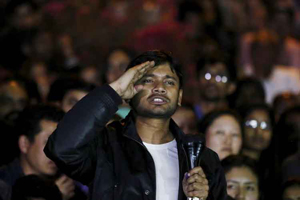
Mumbai, Mar 7: In a veiled attack on the BJP for letting JNUSU President Kanhaiya Kumar get "free publicity", ally Shiv Sena today sought to know how he got bail in such a short span of time when others charged with 'sedition' are still languishing in jails.

kanhaiyyaaa"(Union Minister) Venkaiah Naidu said Kanhaiya Kumar is getting free publicity. If that is so, who is responsible for letting him get free publicity? Today, nothing comes for free," the Sena said in an edit in its mouthpiece 'Saamana'.

"A price has to be paid for even the smallest of things. Working class people, labourers who used to save money in PF, will now be taxed on their earnings. In short, the government has only shown people nothing will be given for free," it said.

It said that Hardik Patel, who led the Patel agitation demanding reservation for his community in Gujarat is still behind bars after being charged with 'sedition' and so are people like Colonel Purohit and Sadhvi Pragya.

"Then how did Kanhaiya get bail so easily? Was it that keeping him behind bars was becoming a problem for the government and that it had to answer too many questions?" the Sena asked.

"If Naidu says Kanhaiya is getting free publicity, then our system and administration is responsible for it. He has become a hero because people are announcing reward for attack on Kanhaiya," it said, referring to BJP leader Kuldeep Varshnay announcing Rs 5 lakh prize money for cutting off the tongue of Kanhaiya, who he had alleged, was speaking against BJP and PM Narendra Modi after being released on bail.

A poster announcing Rs 11 lakh prize money to anyone "shooting down" Kumar was also spotted in Delhi.

The Sena further said that the sole aim (of politicians) is to win elections and form a government.

"Promises made before elections vanish into the air and farmers, labourers, working class and students are made victims. If this continues, there would be human bombs made within the country. These youngsters will be exploited for political games," the Sena warned.

Kumar, who was arrested on February 12 on sedition charges, was released from Tihar jail on March 3 after the Delhi High Court granted him interim bail for six months.

Comments

Rikaz
 - 
Monday, 7 Mar 2016

Of course he has become a household name around the world....he simply raised his voice against PEKU....great job....

Add new comment

  • Coastaldigest.com reserves the right to delete or block any comments.
  • Coastaldigset.com is not responsible for its readers’ comments.
  • Comments that are abusive, incendiary or irrelevant are strictly prohibited.
  • Please use a genuine email ID and provide your name to avoid reject.
News Network
April 24,2020

New Delhi, Apr 24: The trajectory of COVID-19 cases could have plateaued and might even fall for some weeks after the lockdown is lifted but India is likely to see a second wave in late July or August with a surge in the number of cases during the monsoon, say scientists.

The timing of the peak will depend on how India is able to control physical distancing and on the level of infection spreads after restrictions are relaxed, they said.

It looks apparent that the trajectory of daily new cases has reached a plateau and eventually it will take a downward fall, maybe for some weeks or even months, Samit Bhattacharya, associate professor at the Department of Mathematics, Shiv Nadar University, said.

Still, we may get a surge of new cases of the same coronavirus and this will be considered a second wave, Bhattacharya explained.

The second epidemic may come back in late July or August in the monsoon, although the peak timing will depend on how we control social distancing during that time, he said.

Rajesh Sundaresan, professor at Bengaluru's Indian Institute of Science (IISc), agreed.

“Once we return to normal activity levels, there is a chance that infection may begin to rise again. China is seeing this to some extent post easing of some restrictions on travel,” Sundaresan, corresponding author of a working paper by researchers at IISc and the Tata Institute of Fundamental Research (TIFR) in Mumbai, said.

On March 25, when the number of coronavirus cases was 618 with 13 deaths, the government announced a nationwide lockdown that was later extended to May 3.

On Friday, the death toll due to COVID-19 rose to 718 and the number of cases to 23,077, according to the Union Health Ministry.

In good news, officials said this week that the doubling rate of cases has slowed down in the period, going from 3.4 days before lockdown to 7.5 days, with 18 states doing better than the national average. The recovery rate has also almost doubled in the last 10 days.

"Looking at the new cases in the past few days, it seems the growth of new daily infection is much slower than earlier. This apparently indicates that we might have reached at the plateau of the growth curve, Bhattacharya said.

He noted that recent studies in China and Europe observed that the infection might relapse in those people who have already recovered from earlier phases.

So, there is no evidence that the earlier infection may help acquire immunity against the second infection. And in that way, the entire population may be vulnerable to the second wave to some extent, said the scientist.

In their study unveiled this week, IISc and TIFR researchers analysed the impact of strategies such as case isolation, home quarantine, social distancing and various post-lockdown restrictions on COVID-19 that might remain in force for some time.

The study modelled on Bengaluru and Mumbai suggests the infection is likely to have a second wave and the public health threat will remain, unless steps are taken to aggressively trace, localise, isolate the cases, and prevent influx of new infections.

The new levels and the peaking times for healthcare demand depend on the levels of infection spreads in each city at the time of relaxation of restrictions, they said.

The lockdown is currently upon us. It has given us valuable time. Let us test, trace, quarantine, isolate, practice better hygiene, search for a vaccine, etc. We should do these anyway, and these are being done. When and how to lift the lockdown is going to be a difficult decision to make, said Sundaresan.

It's clear that it's going to be phased. What our team is focusing on is to come up with tools to help the decision makers assess the public health impact of various choices, he said.

According to the experts, infectious diseases spread via contact between infectious and susceptible people. In the absence of any control measures, an outbreak will grow as long as the average number of people infected by each infectious person is more than one.

Once enough people are immune there will be fewer people susceptible to the infection and the outbreak will die.

However, when an outbreak is brought under control by social distancing and other interventions, it is possible only a small proportion of the population will have been infected and gained immunity, they said.

This means enough susceptible people may remain to fuel a second wave if controls are relaxed and infection is reintroduced.

Until the vaccine comes on the market, we have to remain alert Once sporadic cases occur here and there in the country, we immediately need to implement quarantine or social distancing locally for the people in that region, and also need to perform tests to identify positive cases irrespective of showing symptoms, Bhattacharya explained.

Note that these monsoon months are also flu season in many places of India. So, we should not ignore the early signs of the flu symptoms. Irrespective of symptoms, we need to increase tests in the hotspots to identify people and contain the surge, he said.

Sundaresan added that the timeline for a second wave will depend on a lot of circumstances which may change as the time passes.

Significant testing may have been underway, there may be behavioural changes with people becoming more careful about their hygiene, wearing masks may become more common, etc. All these responses may help restrict the second wave, he said.

A study published in The Lancet journal earlier this month modelled the potential adverse consequences of premature relaxation of interventions, and found it might lead to a second wave of infections.

The finding is critical to governments globally, because it warns against premature relaxation of strict interventions, the researchers said.

While interventions to control the spread of SARS-CoV-2 are in place, countries will need to work toward returning to normalcy; thus, knowledge of the effect of each intervention is urgently required, they said in the study.

According to a recent analysis by the Harvard Chan School of Public Health, the best strategy to ease the critical care burden and loss of life from COVID-19 might be on-again, off-again social distancing.

In the absence of such interventions, surveillance and intermittent distancing may need to be maintained into 2022, which would present a substantial social and economic burden, the researchers wrote.p


Comments

Add new comment

  • Coastaldigest.com reserves the right to delete or block any comments.
  • Coastaldigset.com is not responsible for its readers’ comments.
  • Comments that are abusive, incendiary or irrelevant are strictly prohibited.
  • Please use a genuine email ID and provide your name to avoid reject.
News Network
June 20,2020

Bhopal, Jun 20: A senior BJP MLA in Madhya Pradesh tested COVID-19 positive hours after he cast his vote for the Rajya Sabha polls in the state and attended party meetings, an official said on Saturday. The legislator's wife has also tested positive for the infection, he said.

Voting for three Rajya Sabha seats in the state took place on Friday.

The couple's test reports came on Friday night and the news of the MLA's infection triggered panic among other MLAs with some of them reaching hospitals to get themselves tested.

"The MLA and his wife were found infected with COVID- 19 in the tests conducted by a private laboratory. We are examining their condition and making a decision whether they need to be hospitalised or home quarantined," a health department official told.

He said that the MLA's contact tracing has been initiated.

"Further tests are also being conducted," he said.

He is the second legislator in Madhya Pradesh, who was tested coronavirus positive.

Earlier, a Congress MLA was found infected. He had voted for the Rajya Sabha polls on Friday after reaching the state assembly complex wearing a PPE suit.

Talking to , a member of the BJP MLA's family said that the medical team was called on Friday afternoon for the COVID-19 test after the legislator's wife complained of uneasiness.

"The MLA and his wife gave the samples to the medical team for the COVID-19 tests on Friday afternoon and they were told at night that both of them have tested positive for the infection," he said.

After the news of BJP MLA testing positive spread, a senior BJP MLA from Mandsaur, Yashpal Singh Sisodiya, reached government-run J P Hospital here along with two other party MLAs.

Talking to reporters, Sisodiya said, "I came here along with two other MLAs from our division- Dilip Makwana (Ratlam Rural) and Devilal Dhakad (Garoth)- after we came to know through media and social media that one of the MLAs from our division has tested positive for COVID-19."

"We don't have any symptoms, but came to test for COVID-19 as a precautionary measure," he said.

Dhakad said that he came for testing as he had dined with the MLA two days back.

Talking to , Madhya Pradesh State Assembly's Principal Secretary A P Singh said that all the precautionary measures were taken during the Rajya Sabha polling.

"All employees were in safety gears during the Rajya Sabha election process. The assembly campus was being sanitised every 15-20 minutes during the polling process...We are now going through the CCTV footage to trace those who had come in his contact," he said.

Congress MLA and former minister P C Sharma said that those who came in contact with the BJP legislator should be traced and quarantined.

"The employees and MLAs who came in contact with him during the voting process should be tested," Sharma said.

Comments

Add new comment

  • Coastaldigest.com reserves the right to delete or block any comments.
  • Coastaldigset.com is not responsible for its readers’ comments.
  • Comments that are abusive, incendiary or irrelevant are strictly prohibited.
  • Please use a genuine email ID and provide your name to avoid reject.
Agencies
May 14,2020

Mumbai, May 14: The Shiv Sena on Thursday raised questions over the Centre's Rs 20 lakh crore stimulus package announced to revive the COVID-hit economy, and asked if India is not a "self-reliant" country at present.

An editorial in Sena mouthpiece 'Saamana' wondered how Rs 20 lakh crore will be raised, and opined that an environment needs to be created where industrialists, trade and business sectors are encouraged to invest.

On the path of new self-reliance, India cannot afford industrialists running away, and for that "political institutions like the ED and CBI need to be put in lockdown for some time," it said.

Prime Minister Narendra Modi on Tuesday announced new financial incentives on top of the previously announced packages for a combined stimulus of Rs 20 lakh crore, saying the COVID-19 crisis has provided India an opportunity to become self-reliant and emerge as the best in the world.

The Sena said the country is being told that the package will be beneficial for MSMEs (micro, small and medium enterprises), poor labourers, farmers and the tax-paying middle class.

"The package (as per the Centre) will reach 130 crore Indians and the country will become self-reliant. Does this mean India is not a self-reliant country at present?" the Marathi daily asked.

It is good that PPE kits and N95 masks are now being manufactured in India, it said.

"Any country progresses ahead while learning from crisis and through struggle. Before Independence, not even a needle was manufactured in India but in 60 years, India became self-reliant in science, technology, agro business, defence, manufacturing and atomic science," it said.

An institution like the Indian Council of Medical Research (ICMR), which is helping in the manufacturing of PPE kits, is part of the self-reliant India, it noted.

Wondering how Rs 20 lakh crore, as announced in the central package, will be raised, the Sena said an "environment needs to be created where industrialists, trade and business sectors will be encouraged to invest".

"India, on path of new self-reliance, cannot afford industrialists running away, and for that political institutions like the Enforcement Directorate (ED) and the Central Bureau of Investigation (CBI) need to be put in lockdown for some time," the paper said.

Despite announcing the 'lockdown-4' and the economic package, why its impact has not been reflected in the share market? it asked.

"Investors are in a dilemma. The prime minister and chief ministers must show them trust and support," it said.

"Earlier it was Pandit Nehru and now it is Modi. If (former prime minister) Rajiv Gandhi had not laid the foundation of a digital India, there wouldn't be video conference of PM, CMs and bureaucracy in times of coronavirus," the Uddhav Thackeray-led party said.

It agreed with Modi that coronavirus will stay for long, and lives need not revolve around it.

"We need to get back on our feet again," the Sena said.

Comments

Add new comment

  • Coastaldigest.com reserves the right to delete or block any comments.
  • Coastaldigset.com is not responsible for its readers’ comments.
  • Comments that are abusive, incendiary or irrelevant are strictly prohibited.
  • Please use a genuine email ID and provide your name to avoid reject.