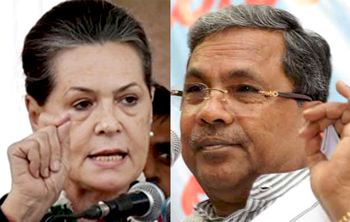
'Sonia annoyed at the way Karnataka Cong leaders handled CM watch row'

March 10, 2016

New Delhi, Mar 10: Karnataka Congress unit chief G Parameshwara on Wednesday met party president Sonia Gandhi and explained the reasons for its “average” performance in the recently held zilla and taluk panchayat elections in Karnataka, according to sources.

soniaDuring the meeting, Sonia expressed her unhappiness over the manner in which the State party leaders handled the controversy over Chief Minister Siddaramaiah's expensive wristwatch, the sources said.

Sonia was upset that Rahman Sharief, Congress candidate and grandson of former Union minister C K Jaffer Sharief, had lost the Assembly bypoll from the Hebbal constituency in Bengaluru.

She was also said to be “very annoyed” at senior leaders failing to contain the damage caused to the party's image due the wristwatch row. Party sources said the Congress president was not satisfied with G Parameshwara's explanation of the strategy adopted by him and other leaders.

Parameshwara reportedly admitted that the watch controversy was also a reason for the party's average performance in the local body polls.

Comments

Zahoor Ahmed
 - 
Thursday, 10 Mar 2016

Remove both siddu and parameshwar from their respective positions. Allow new faces otherwise congress in the state will repeat the same result in state which happened with congress in the central. Siddu is responsible for Hebbal loss.

Abu Muhammad
 - 
Thursday, 10 Mar 2016

Well said Ibrahim, no need opposition party to Siddu/Cong when Parameshwar is there. Most Congis are more than Sanghis only diff is CHEDDI is covered in white Lungi/Pyjama.

ayes p
 - 
Thursday, 10 Mar 2016

G Parameshwara is unfit for any post.

IBRAHIM.HUSSAIN
 - 
Thursday, 10 Mar 2016

Dr. Parameshwar is playing petty politics within Congress as he is eying on the CM post. Instead of his intentions of removing Sidda Ramayya, he should be removed from KPCC president post and Home ministry, as he handled MP Ananthkumar case very badly. His silence on Ananthkumar's rhetoric against Islam indicates that he is very soft to RSS/Saffron thugs.

The KPCC president should be without any ministerial portfolio and best candidate will be MLC Ugrappa. High command should take necessary steps and all vacant posts of Chairmanships and other to be filled with honest congressmen as soon as possible.

Add new comment

  • Coastaldigest.com reserves the right to delete or block any comments.
  • Coastaldigset.com is not responsible for its readers’ comments.
  • Comments that are abusive, incendiary or irrelevant are strictly prohibited.
  • Please use a genuine email ID and provide your name to avoid reject.
News Network
February 29,2020

New Delhi, Feb 29: The arsonists, who were allegedly hired by the pro-CAA politicians in Delhi to unleash violence against Muslims, did not even spare the residence of Border Security Force personnel Mohammed Anees.

While the jawan, who has spent three years guarding the borders along Jammu and Kashmir, had hoped that his job profile mentioned on the nameplate hung outside their two-storey house would discourage the vandals, he was proved wrong. 

The nameplate on house number 76 in Khas Khajuri Gali clearly mentioned it was the property of a security force personnel who protects India’s borders from foreign invasions. Yet, it was burned down on the afternoon of February 25.

First, the ruthless goons set the vehicles parked outside the jawan’s house on fire, then they torched his home. Stones were also pelted at his house amid slogans of “idhar aa Pakistani, tujhe naagarikta dete hai” (Come here Pakistani, get your citizenship). 

Apart from Anees, his father Mohammed Moonis, 55, uncle Mohd Ahmed, 59, and 18-year-old cousin Niha Parveen were in the house. Sensing what was about to go down next, they all escaped from the house, and were helped by paramilitary troops.

Charred remains of the house now stand where the house was till three days ago. In the two lanes of Khajuri Khas near Anees’s house, 35 houses were set on fire. 

The loss suffered by the BSF soldier’s family was perhaps greater as they had kept all their life’s savings inside: two weddings in the family were to take place in the next three months.

Niha Parveen was to get married in April and Anees himself was to get married the following month. “All the things we collected all our life, jewellery – two gold necklaces, silver jewellery, it is all gone,” the family said.

“We used to buy jewellery on instalments… used to give money every month and collected this jewellery,” they said. Rs 3 lakh in cash for the wedding arrangements also got burnt along with other valuables and all their belongings.

Khajuri Khas is a Hindu-majority area, but Anees’s family says no neighbour of theirs was involved in the attack. “People came from outside.” Instead, their Hindu neighbours were asking the rioters to leave. They requested them to leave and helped douse the vehicles on fire.

Comments

Angry Indian
 - 
Sunday, 1 Mar 2020

India now divided into 3 section..

GOOD Hindus, Muslim & Evil Hindutva.


we Good hindus and muslim must unite to save the great india.


from now onwards every good hindu and muslim must keep weapon in his home like petrol, sword, sharp knife, hammer etc..


when the evil hindutva terror enter your house you shoul fight till death...these dogs only attack in number...if few they run..


before you die atleast kill one hindutva terror dog..


Add new comment

  • Coastaldigest.com reserves the right to delete or block any comments.
  • Coastaldigset.com is not responsible for its readers’ comments.
  • Comments that are abusive, incendiary or irrelevant are strictly prohibited.
  • Please use a genuine email ID and provide your name to avoid reject.
News Network
July 14,2020

Bengaluru, July 14: Ahead of the week-long lockdown in Bengaluru starting from Tuesday night, around 35,000 people have left the city and grocery stores and liquor shops are witnessing a rush with customers thronging to stock up on for the shutdown.

According to transport department officials, labourers from other parts of the state migrated in good numbers from Bengaluru ahead of the lockdown fearing that they would have to face similar challenges as they had to confront during the previous shuttering. 

"Yesterday 35,000 passengers left Bengaluru. The number is big given the fact that we are allowing a limited number of passengers in the buses to maintain social distancing," a KSRTC official said.

Tipplers made a beeline for liquor shops and a senior State Excise official said liquor worth Rs 230 crore was sold on Monday alone.

"There was apparently a mad rush yesterday.India Made Foreign Liquor worth Rs 215.55 crore and 14.83 crore worth beer was sold...," the officer said.

In view of the rising coronavirus cases in the city at an alarming proportion, the government decided to impose lockdown from Tuesday 8 pm till 5 am on July 22.

Later, Dharwad and Dakshina Kannada districts too decided to impose a lockdown for nine days and seven days respectively from Wednesday.

"For the past two days there is an unusual rush of customers in our store," an executive of the Metro Cash and Carry said.

According to him, people are buying grocery items and vegetables with long shelf life such as onion, potato, radish, carrot and beetroot.

A salesperson at the Star Bazaar too said people were thronging the store for the past two to three days.

During the Sunday curfew, Home Minister Basavaraj Bommai said the week-long lockdown will be stringent one and government has made all arrangements to address all concerns ahead of the shutdown.

As many as 19,702 people in Bengaluru have tested positive, of which there are 15,052 active cases, while 4,328 have been discharged.

The number of fatalities as of Monday is 321.

Across Karnataka, 41,581 people have tested positive for coronavirus including 24,572 active cases, 16,248 discharges and 757 deaths since the outbreak of the pandemic in the state.
 

Comments

Add new comment

  • Coastaldigest.com reserves the right to delete or block any comments.
  • Coastaldigset.com is not responsible for its readers’ comments.
  • Comments that are abusive, incendiary or irrelevant are strictly prohibited.
  • Please use a genuine email ID and provide your name to avoid reject.
Media Release
February 14,2020

Veteran journalist P. Sainath has said that the nation is in a crisis. And this crisis is not limited to just the rural area. It has become a national crisis at various areas such as agriculture, education, economy, job creation etc.

He was delivering the endowment lecture on the topic ‘Indian democracy at the post-liberalization and post-truth era’ at Media Manthan 2020 organized by the PG department of journalism and mass communication at St Aloysius College (Autonomous). 

Mr Sainath said that the many policies adopted in the 90s led to India becoming unusually unequal. Referring to the speech Ambedkar had made at the Constituent Assembly while handing over the draft of the Constitution, Mr Sainath said, “Ambedkar had warned about the weakness of Indian democracy that liberty without equality allows the supremacy of a few over the multitude. Liberty, equality and fraternity must be kept together as we cannot have one without the other.” 

Mr Sainath stated that the agrarian crisis was no longer about the loss of productivity, employment or about farmer suicide; it was a societal, civilizational crisis. Commenting on the lopsided policies such as cow-slaughter ban, he explained how cow slaughter ban had adversely affected many industries due to their interdependency. While Muslims who slaughtered cows were rendered helpless, the cattle traders who were mostly OBCs lost their earnings as the cattle prices crashed. An important industry like Kolhapur sandals industry in Maharashtra went bankrupt as a result of the cow slaughter ban in Maharashtra. He said the policymakers had no idea how the rural industries were interconnected. Demonetisation too devastated the rural economy as 98 percent of rural transactions happen through cash. 

Mr Sainath also spoke about the crisis of inequality which affects the Dalits and the Adivasis far more than anyone else as 90 percent of the rural households take home less than Rs 10,000/- per month. “Women are yet another group whose labour is never counted in the gross domestic product. Women and girls globally do unpaid work which amounts to about 12.5 billion working hours per year. Monetarily speaking, this is worth 10.8 trillion dollars,” Mr Sainath added. 

Speaking about the crisis of jobs Mr Sainath said that major companies were laying off employees just to create more profits for the investors and the adoption of artificial intelligence in the industry would further destroy millions of jobs.

Rector of St Aloysius College Institutions Fr Dionysius Vaz SJ, Principal Dr (Fr) Praveen Martis SJ, HOD of Journalism and Mass Communication department Dr (Fr) Melwyn Pinto SJ were present.

‘Veerappan and Vijay Mallya’s business models are interesting!’

Addressing the gathering during his endowment lecture on Friday, Mr Sainath made an interesting comment on the so called ‘revenue model’. “Whenever I visit IIMs and IITs for lectures on my PARI project, the students there ask me what my revenue model for my project is. I tell them that I do not have a revenue model. In fact, journalism does not begin with a revenue model. Gandhiji, Ambedkar, Bhagat Singh were all great journalists. But they did not have a revenue model,” Mr Sainath said.

On a lighter note, he said that the best revenue model that he liked was that of forest brigand Veerappan and liquor baron Vijay Mallya. “Veerappan ruled the forest for forty years and from the top ministers to the villagers he could dictate terms and liver royally. Similarly, Mallya’s revenue model was to steal the banks and run away abroad and live like a king,” Mr Sainath added.

Journalism is not and can never be a business. It is a calling, he opined. While newspaper can be a business, television can be a business, journalism per se cannot be reduced to a business. “Unfortunately today, journalists are recruited on a contract basis and they have no bargaining power; and there are no unions to fight for their cause. Hence, they are at the mercy of the corporate media houses for their survival and are made to write stories that cannot be called journalism,” Mr Sainath said.

Answering a question as to the pressures he faced as a journalist, he said that external pressures from the government or others could be very well handled. It is the internal pressures from once own media house that journalists find it difficult to manage.


 

Comments

Add new comment

  • Coastaldigest.com reserves the right to delete or block any comments.
  • Coastaldigset.com is not responsible for its readers’ comments.
  • Comments that are abusive, incendiary or irrelevant are strictly prohibited.
  • Please use a genuine email ID and provide your name to avoid reject.