


Govt should check anti-nationals in universities: RSS

March 11, 2016

Nagpur, Mar 11: The RSS on Friday condemned the raising of anti-national slogans in JNU, saying “subversive” elements have made universities the centre of their activities for long and should be checked by governments, as its top brass on Friday began a three-day brainstorming session in Nagpur.
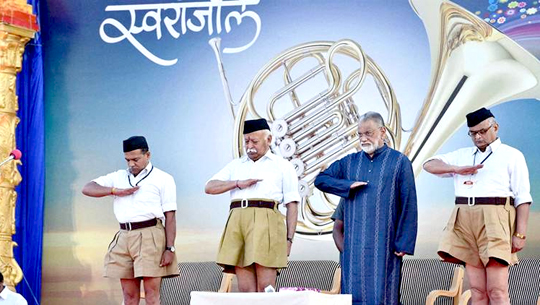
rss

Referring to Malda episode, the Sangh fountainhead also voiced concern over instances of violence and decried attempts to create “atmosphere of fear” as it asked political parties to give up their “policy of appeasement” and take such incidents seriously.

“We expect the central and state governments to deal strictly with such anti-national and antisocial forces and ensure the sanctity and cultural atmosphere by not allowing our educational institutions to become centres of political activities,” RSS said in its annual report presented at the meeting of Akhil Bhartiya Pratinidhi Sabha, the top decision making body, that began in Nagpur on Friday amid tight security.

The RSS has said the meeting will focus on issues like education system, eradicating caste-based discrimination and social harmony, while deciding on steps like changing the uniform of its members “to keep up with the times”.

The meet of BJP's idealogical mentor assumes importance in the backdrop of Narendra Modi government facing flak over handling of JNU row, dalit student's suicide in Hyderabad, allegations of saffronisation of education and the debate over intolerance ahead of crucial assembly elections.

Rashtriya Swayamsewak Sangh Chief Mohan Bhagwat offered floral tributes at the portrait of Bharat Mata' in the presence of BJP President Amit Shah at the start of the three-day meet.

“Reports about anti-national activities in certain universities have become a matter of concern for the patriotic people. In the name of freedom of expression, how can the slogans calling for breaking up and destruction of the nation be tolerated and how can the guilty, who had hatched the conspiracy to blow up Parliament, be honoured as martyr?” the RSS report presented by Sar-Karywah Suresh Joshi said.

The RSS said that those who do such things have no faith in the Constitution, judiciary and Parliament and “such subversive elements have made these universities the centres of their activities for long”.

“When they find certain political parties supporting such anti-national elements, the concern (of patriotic persons) grows further,” the report said.

“Incidents of violence and terror attacks have become a matter of grave concern. Under the pretext of small and big issues, people armed with weapon take to the roads creating atmosphere of fear, as has happened in Malda, and it has become endemic nowadays. Destruction of public and private properties, looting and burning business establishment specially those run by Hinuds, has taken place. Political parties, giving up their policy of appeasement, should take such incidents seriously and cooperate to restore the law and order situation and peace,” the RSS said.

The saffron outfit said it will be possible only when parties “shed their petty and parochial political interests”.

“Political parties should make a combined effort in the right direction. No political party or person is more important than national security. “It is the responsibility of an efficient and strong government to instill confidence in the people about their security,” the report said.

Krishna Gopal, Sah-Sar Karyawah of the RSS, said issues of education, medical and health, and social harmony were on top of the agenda, but reservations and construction of Ram temple in Ayodhya could be discussed if they are raised at the meeting.

“We have three main issues on the agenda — education, medical and health, and social harmony. Beyond that, only if any such issue comes, we may look into that,” he told reporters when asked whether issues of Ram Temple and reservations will also be discussed.

“Reservation has its own place. Constitution has given its nod. It is sanvidhan-sammat' and the country has accepted it.

“If anything comes, we would discuss,” he said. He evaded questions on Ram temple construction and only said, “We will look into it if such a thing comes.”

He said the body will issue a resolution on the issue of social harmony. “Caste based discrimination exist in the country and it should be ended,” he said.

On the issue of change in uniform, he said that there were several proposals and will be discussed in the meeting.

“Discussions are on. Any decision will be taken as per the requirement of the present time,” he said.

The RSS is likely to replace khaki knickers with trousers and the colour may also see a change. Gopal said that improving the accessibility and affordability of quality education, medical and health facilities and abolishment of untouchability and improving social harmony are the key issues.

“Education should be of good quality and every common man should have access to quality education,” Gopal said.

Similarly, good medical and health facilities should be available to all.

“Health facilities are getting costlier and the common man is suffering. What should be done to provide relief to people will be discussed in the meeting.

“In the annual meeting, representatives discuss progress, new initiatives and other related issues,” he said. Close to 1,300 members are expected to participate in the meeting being held nearly 230 km from state capital Jaipur.

Comments

Bopanna
 - 
Sunday, 13 Mar 2016

Kashmiris and Muslims are the most ungrateful of all people I met.
His thali mein hate ho Isi mein chedd dale ho. You lot are fit to be beggars only - now begging in Europe. Wait for them to kick you lot out. Best if no Muslim is given a chance to enter any Induan UNis. Christians Sikhs Jains Buddhists and Hindus are all that India needs. You lot get lost to Arabia.

suresh
 - 
Saturday, 12 Mar 2016

Dear danish,

Can you give us one instance where RSS worked for country? Every one knows how they are struggling to divide the communities. Who killed Mahatma Gandhi? Who killed Indira and Rajeev? Who is responsible for Malegao and mecca masjid blasts? Is this prepared for unity? Talking for unity, until now you people are not ready eat and drink with Dalits. You never give food to them in your house. Do you eat the food with Dalit? Until we can not abolish mentality, we can not expect improvement.

ali
 - 
Saturday, 12 Mar 2016

Many RSS people were arrested by Anti-Terrorist groups for Bomb Blast case. Incident shows that RSS is an anti-national group, and they have no rights to speak about national.

Ahmed
 - 
Saturday, 12 Mar 2016

Joke of the year.... As we all aware ..in JNU campus anti slogan raised by ABVP member not any student of JNU...now cheddis trying to hide their real face by condiment anti national slogan.. Its seems RSS is the one who ruling India not BJP..this anti national .. anti human ...anti culture group dont have any rights to talk about Indian national issue or Education ....

PK
 - 
Saturday, 12 Mar 2016

Cheddi members should start quiting the membership.. All their deceptions are coming out... Start suppporting the TRUTH and dont blindly follow the aggressors...

UMMAR
 - 
Saturday, 12 Mar 2016

RSS IS AN ANTI NATIONAL GROUP ,, ANTI NATIONAL GROUP GIVING THE SUGGESTION HAHHAA MODHIJI U ROCKS..... HEHEHEHE

Dean
 - 
Friday, 11 Mar 2016

Loose chaddi spotted in the picture

kirikiri
 - 
Friday, 11 Mar 2016

Change chaddi to dotti and belt to rope.

Rikaz
 - 
Friday, 11 Mar 2016

The day you killed our beloved Gandhiji, you became anti-nationals....

Add new comment

  • Coastaldigest.com reserves the right to delete or block any comments.
  • Coastaldigset.com is not responsible for its readers’ comments.
  • Comments that are abusive, incendiary or irrelevant are strictly prohibited.
  • Please use a genuine email ID and provide your name to avoid reject.
Ram Puniyani
July 20,2020

As Covid 19 has created havoc all rounds, the rulers of certain countries are using it to further intensify their set agendas. The democratic freedoms are being curtailed in certain forms, the reaction to which has come in America in the form of a campaign, which is opposing “stifling” cultural climate that is imposing “ideological conformity” and weakening “norms of open debate and toleration of differences”. In India similar intimidations have been intensified. In addition the occasion has been used by the sectarian forces first to link the spread of Corona to Muslim community and now in the name of reducing the burden of curriculum certain chapters on core concepts related to Indian nationalism are being deleted from the text books.

It has been reported that chapters on federalism, citizenship, nationalism, secularism, Human Rights, Legal Aid and Local Self Government and the like are being dropped. Education has been an important area for communal forces and they constantly keep saying that leftists have dominated the curriculum content, it suffers from the impact of Macaulay, Marx and Mohammad and so needs to be Indianized. The first such attempt was done when BJP came to power in 1998 as NDA and had Murli Manohar Joshi as the MHRD minister. He brought the changes which were termed as ‘saffronization of education’. Their focus is more on social science. Some of the highlights of this were introduction of subjects like Astrology and Paurohitya, and chapters defending caste system, nationalism of the type of Hitler was praised.

With defeat of NDA in 2004, the UPA did try to rectify some of these distortions. Again after 2014 the RSS affiliates working in the area of education have been active, interacting with MHRD officials to impress upon them the need to change the curriculum matching with their Hindu nationalist agenda. Its ‘Shiksha Sanskriti Utthan Nyas’ has been asking for removal of English, Urdu words in the texts. It has asked for removal of thoughts of Rabindranath Tagore on Nationalism, extracts of autobiography of M F Husain, references to benevolence of Muslim rulers, references to BJP being Hindu party, apology of Dr. Manmohan Singh for anti Sikh pogrom of 1984, the reference to killings of Gujarat carnage in 2002 among others. This they call as Bhartiykaran of syllabus.

As RSS is a multithreaded hydra one of its pracharak Dinanath Batra has set up ‘Shiksha Bachao Abhiyan Samiti’ which has been pressurizing various publishers to drop the books which are not conforming to their ideology. One recalls their pressuring withdrawal of Wendy Doniger’s ‘The Hindus’, as it does present the ancient India through the concerns of dalits and women. Mr. Batra has already come out with a set of nine books for school curriculum, giving the RSS view of the past and RSS understanding of social sciences. These have already been translated into Gujarati and thousands of the sets of these books are being used in Gujarat Schools.

The present step of deleting parts of curriculum which gives the basics of Indian Nationalism, secularism and human rights is a further step in the same direction. These are the topics which have made the Hindu nationalists uncomfortable during last few years. They have been defaming secularism. They removed it from the preamble of Indian constitution, when they put out an ad on the eve of Republic day in 2015. From last few decades since the Ram Temple movement was brought up, simultaneously the secular ethos of India’s freedom movement and secular values of Indian constitution have been constantly criticized. Many an RSS ideologues and BJP leaders have been asking for change of Indian Constitution for this very reason.

Secularism is part of the concept of Indian nationalism. In the name of religious nationalism, sectarian divisive nationalism they have been attacking various student leaders in particular. When we study Nationalism, the very genesis of Indian nationalism tells us the plurality of our freedom movement with its anti colonial roots. The struggle was for Indian nationalism and so the Muslims and Hindu communalists kept aloof from this great struggle against colonial masters, it was this struggle which built the Indian nation with all its diversity.

Similarly as we have equal rights as citizens the chapters on citizenship are being dropped. Federalism has been the core part of India’s administrative and political structure. As the dictatorial tendencies are becoming stronger, federalism is bound to suffer and that explains the dropping of this subject. Democracy is decentralization of power. Power reaching the lowermost part of the system, the villages and average citizens. This got reflected in Local self Government. The power is distributed among villages, cities, state and center. By removing chapters on federalism and local self government, the indications of the ideology of ruling party are on display.

While we are not dealing with all the portents of the planned omissions, one more aspect that related to dropping of chapter on Human rights needs our attention. The concept of Human rights and dignity are interlinked. This concept of Human rights also has international ramifications. India is signatory to many an UN covenants related to Human rights. The indications are clear that now rights will be for the few elite and ‘duties’ for the large deprived sections will be put on the forefront.

In a way this incidental ‘Corona gifted opportunity’ to the ruling Government is being fully used to enhance the agenda of ruling party in the arena of Educational Curriculum. The part of curriculum with which the ruling party is uncomfortable is being removed. This act of omission does supplement their other acts of commission in changing the shape of educational curriculum, which are reflected in RSS affiliates’ suggestions to MHRD regarding Bhartiyakaran of contents of syllabus. As per this the things like regarding the great epics like Ramayana and Mahabharata as History, the things like India having all the stem cell technology, plastic surgery, aviation science etc. will have a place in the changes planned by communal forces!

Comments

Add new comment

  • Coastaldigest.com reserves the right to delete or block any comments.
  • Coastaldigset.com is not responsible for its readers’ comments.
  • Comments that are abusive, incendiary or irrelevant are strictly prohibited.
  • Please use a genuine email ID and provide your name to avoid reject.
Agencies
January 1,2020

For many Indian tycoons, 2019 turned woeful as lenders -- empowered by the nation’s recent bankruptcy law and desperate to clean up soured debt from their books -- started seizing assets of delinquent firms or dragged them into insolvency.

Indian banks wrote off a record $39 billion of loans in the 18 months through September in a bid to repair their balance sheets as they battled the world’s worst bad debt pile. Making matters worse, a shadow banking crisis led to a funding squeeze, crushing debt-laden businesses that were critically dependent on rollover financing.

“Life has come a full circle for tycoons that had enjoyed debt-fueled growth,” said Nirmal Gangwal, founder of distress and debt restructuring advisory firm Brescon & Allied Partners LLP. “Many firms collapsed like a house of cards. The downfall was rather unprecedented.”
The government has also been cracking down on economic crime to assuage public anger over absconding businessmen. It’s even barred some from traveling overseas if they were deemed a flight risk.

Here are some of the country’s biggest and most-storied businessmen who saw their fortunes fade. Spokespersons for none of these tycoons, except Essar, immediately replied to emails and text messages seeking comments.

Anil Ambani

The chairman of Reliance Group, which makes movies to metro lines, had a close shave with jail time in March before his elder brother and Asia’s richest man, Mukesh Ambani, bailed him out at the last minute. The woes of the ex-billionaire came to the fore when India’s top court asked him to pay Ericsson AB’s India unit about $77 million of past dues or go to jail since Anil Ambani, 60, had given a personal guarantee. His telecom carrier slipped into insolvency this year, while unprofitable Reliance Naval & Engineering Ltd. faced a cash crunch. Reliance Capital Ltd. is selling assets to pare debt. Ambani is also fending off Chinese lenders in a London court.

Malvinder & Shivinder Singh

Karma caught up with ex-billionaires and brothers Malvinder Singh, 47, and Shivinder Singh, 44, and how. Scions of a prominent business family, they once helmed India’s top drug maker and second-largest hospital chain. In October, the two were arrested on charges of fraudulently diverting nearly $337 million from a lender they controlled. India’s market regulator found in 2018 that the brothers had defrauded their hospital company of about $56 million. The collapse of the $2 billion empire turned brother against brother, prompting their mother to broker a peace deal that was short-lived. In February, Malvinder accused Shivinder and their spiritual guru of fraud.

Shashikant & Ravikant Ruia

After a hard-fought battle to keep their flagship steel mill, the first-generation entrepreneurs finally saw the bankrupt Essar Steel India Ltd. pass on to ArcelorMittal last month. The $5.9 billion takeover was almost two years in the making with multiple legal wrangles. The group, controlled by Shashikant Ruia, 76, and Ravikant Ruia, 70, were also reprimanded by a U.K. judge in March this year for concealing documents. Started in 1969 as a construction firm, Essar Group diversified, investing about $18 billion between 2008 and 2012, and piled on debt. In 2017, the group had sold another prized asset, Essar Oil.

Selling an asset to pare a liability shouldn’t be seen as a “lost asset,” an Essar spokesman said, adding that the group remains a diversified conglomerate.

VG Siddhartha

Before jumping off a bridge into a river in July in an apparent suicide, the founder of India’s biggest coffee chain Cafe Coffee Day had penned a letter that spoke of pressure from lenders, a private equity firm and harassment by tax officials. He had spent much of the last two years pledging ever more of Coffee Day Enterprises Ltd. shares to refinance loans for ever shorter periods, at ever higher interest rates. “I would like to say I gave it my all,” V.G. Siddhartha, 60, wrote in the letter. “I fought for a long time but today I gave up.”

Naresh Goyal

The former ticketing agent who built India’s largest airline by value, stepped down as chairman of Jet Airways India Ltd. in March, caving in to pressure from banks who took over the company. Cut-throat price wars and surging costs pushed Jet deeper into loss. The airline stopped flying in April and went into bankruptcy two months later as lenders failed to find a buyer. In July, an Indian court barred Naresh Goyal from flying overseas after the government said it was investigating an alleged $2.6 billion fraud involving Jet Airways.

Rana Kapoor

The founder of Yes Bank Ltd., which became India’s fourth-largest non-state lender, tweeted in September 2018 that his shares were invaluable and requested his children never to sell them upon inheritance. But trouble was brewing. The nation’s banking regulator, which found the lender had repeatedly under-reported its bad loans, refused to extend his tenure as chief executive officer. This forced Rana Kapoor, 62, to step down by end-January. Kapoor, who has pledged some of his Yes Bank shares in July, sold almost his entire stake in the lender by October.

Subhash Chandra

The rice trader-turned-media mogul, 69, who brought cable television into Indian homes in the early 1990s with his ZEE TV, resigned as chairman of Zee Entertainment Enterprises Ltd. in November and lost control of his crown jewel. Subhash Chandra has been selling stake in Zee Entertainment in the past few months to repay group’s debt.

Gautam Thapar

A default by Gautam Thapar, founder of the paper mill-to-power transmission Avantha Group, on pledged shares made Yes Bank Ltd. the biggest shareholder in CG Power and Industrial Solutions Ltd. In August, the firm was hit by an accounting scandal forcing the board to remove Thapar, 59, from the chairman’s post. A month later, the market regulator ordered a forensic audit of the firm and barred Thapar from accessing securities market.

Comments

Add new comment

  • Coastaldigest.com reserves the right to delete or block any comments.
  • Coastaldigset.com is not responsible for its readers’ comments.
  • Comments that are abusive, incendiary or irrelevant are strictly prohibited.
  • Please use a genuine email ID and provide your name to avoid reject.
News Network
February 14,2020

Bengaluru, Feb 14: After the swearing-in of ten former JDS and Congress MLAs, political boundaries seem to have become more fluid, with little clarity on who is on whose side. When Honnali BJP MLA Renukacharya visited senior Congressman DK Shivakumar at the latter’s residence, many eyebrows were raised over the reason behind the meeting. There was speculation over why Renukacharya would be meeting a man who is, in all likelihood, slated to be the next KPCC president.

Renukacharya reacted to the rumours by making the meet sound purely professional. He said, “We have a three-day Krushi Sammlan in Honnali, and I went to invite him (DKS) for it.’’   Shivakumar also remained tight-lipped over the real reason behind the meeting, and corroborated Renukacharya’s story. However, insiders claim that the two discussed other issues too. It may be recalled that Renukacharya had openly rebelled against Yediyurappa in 2009.

Comments

Add new comment

  • Coastaldigest.com reserves the right to delete or block any comments.
  • Coastaldigset.com is not responsible for its readers’ comments.
  • Comments that are abusive, incendiary or irrelevant are strictly prohibited.
  • Please use a genuine email ID and provide your name to avoid reject.