


Soldiers are actually dying because of politicians: Shehla Rashid

[email protected] (CD Network)
March 12, 2016

Bengaluru: Mar 12: Who is responsible for the death of brave soldiers like Lance Naik Hanmanthappa, asked Shehla Rashid Shora, vice-president, JNU Students Union, who was in the City on?Friday.
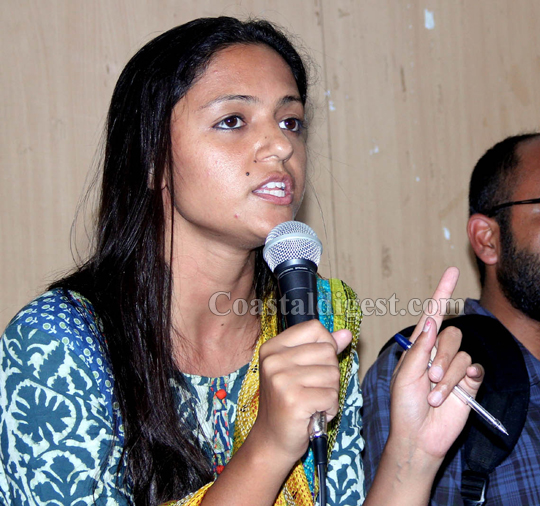
jnu1“Soldiers think they are dying for the country but they are actually dying for politicians. Border disputes are kept alive. Politicians and bureaucrats talk to each other in top hotels. All this is a farce,” Shehla, who was here on an invitation from the Journalists' Study Centre, Karnataka, said.

Shehla became the first Kashmiri to win the JNU elections that were held last year. An engineering graduate, she has also done a short course on “India-Women Leadership” from the Indian Institute of Management, Bangalore. She now studies at the Centre for the Study of Law and Governance, JNU.

Even as JNU?president Kanhaiya Kumar stoked fresh controversy with his comments about the army raping women in Kashmir, Shehla reiterated that JNUSU supported soldiers.

The argument, she however said, was much more than that. “We are with the soldiers and any pro-soldier approach is anti-war. However, we need to rethink a number of issues such as the way the arms trade is being conducted and the defence budget is being reduced,” she said, implying that this endangered soldiers' lives. At the same time, JNUSU does not shy away from raising slogans against long-standing issues involving the army such as the Armed Forces Special Powers Act (AFSPA) and custodial rapes, she added.

Shehla, who affiliates herself with the Communist Party of India (Marxist–Leninist) Liberation, said she did have political aspirations, but for the moment there were “broader challenges”. “We contest elections and many of our members have been contesting elections from Bihar. At the moment, we are about saving the ideals of the Constitution. This government has been anti-dalit, anti-women and anti-poor. It is trying to wipe out any opposition as evident even in the FTII,” she said.

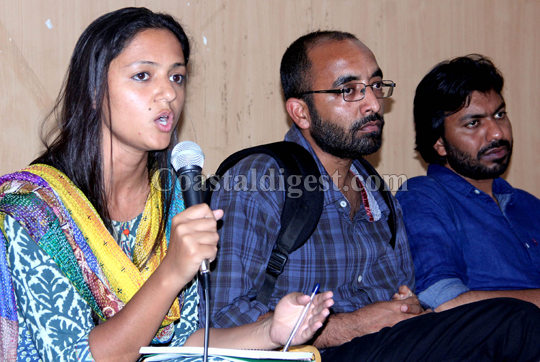
While everyone was busy hounding students from the JNU for their “anti-national” slogans, Akbar Chaudhry, another student leader highlighted the part played by JNU students in a number of recent movements. “During the Nirbhaya protests, we were at the forefront. At the Occupy UGC (University Grants Commission)' movement, we protested for 100 days. Even during the Rohith Vemula's incident, we were on a hunger strike,” he said.

jnu2

Comments

IBRAHIM.HUSSAIN
 - 
Sunday, 13 Mar 2016

Just Ms. Shehla is connected with CPM, she cannot be criticized. Khaunhein Bangalore, you cannot issue diktats to this lady as she is free person.

If you have guts, you should have attended her press briefing and countered her, instead writing in this forum.

Khaunehain
 - 
Saturday, 12 Mar 2016

for what u have joined jnu do that first, u need not to worry about soldier, if u have that much guts join army and study their situation and protest, u dont know anything and your khaunhain(khanhaiya)

One of indian
 - 
Saturday, 12 Mar 2016

You are 100% correct. No doubt at all.

Add new comment

  • Coastaldigest.com reserves the right to delete or block any comments.
  • Coastaldigset.com is not responsible for its readers’ comments.
  • Comments that are abusive, incendiary or irrelevant are strictly prohibited.
  • Please use a genuine email ID and provide your name to avoid reject.
coastaldigest.com news network
May 15,2020

Mangaluru, May 15: Mohammed Kana, son of late Ismail Kana and grandson of late Dr M S Bapanad Mulki passed away in Riyadh, Saudi Arabia due to heart attack on Thursday. He was 57.

Hailing from Mangaluru, Mohammed Kana was working in Saudi Arabia for past 30 years. He is survived by his wife, son and a daughter.

He was involved in various social and welfare activities in India and Saudi Arabia. His tragic demise has left huge vacuum in his family and community at large.

Comments

Ahmed Ali Kulai
 - 
Sunday, 17 May 2020

Inna Lillahi Wa Inna Ilaihi Rajihoon

Add new comment

  • Coastaldigest.com reserves the right to delete or block any comments.
  • Coastaldigset.com is not responsible for its readers’ comments.
  • Comments that are abusive, incendiary or irrelevant are strictly prohibited.
  • Please use a genuine email ID and provide your name to avoid reject.
News Network
May 20,2020

Bengaluru, May 20: Karnataka Congress leaders held a protest against the state government against amending of APMC Act, at the premises of Vidhan Soudha here.

Few days ago, Karnataka Chief Minister BS Yediyurappa had said that the new amendment in the Agricultural Produce Marketing Committee (APMC) Act will substantially aid the farmers in getting remunerative price for their produce.

"Amendment will not dilute the powers of the work of the APMCs. All these marketing activities will be monitored by the Directorate of State APMC. This new amendment Act will benefit farmers in improving their income & suffering from losses due to market fluctuations," the Karnataka CM tweeted.

Yediyurappa further said that the amendment will indirectly help farmers in doubling their income by 2022.

"This amendment will indirectly help farmers in doubling their income by 2022. I want to clarify that we have not removed the APMC Act, we are only amending 2 sections of the APMC Act which enable farmers to sell their produce at the markets where they intend to," he tweeted.

Comments

Add new comment

  • Coastaldigest.com reserves the right to delete or block any comments.
  • Coastaldigset.com is not responsible for its readers’ comments.
  • Comments that are abusive, incendiary or irrelevant are strictly prohibited.
  • Please use a genuine email ID and provide your name to avoid reject.
Wafa Sultana
April 4,2020

Over the last couple of days when the world was occupied with unifying efforts to fight the deadly Covid19 pandemic, sections of Indian media provided viewers a familiar scapegoat – the Indian Muslims – who are often stereotyped as a community being constantly at loggerheads with the citizenry and the State. Biased media channels were quick to resort to blaming the entire Muslim community for the spread of the disease in the country, thanks to an ill-timed Tablighi Jamaat gathering at its international headquarters in Delhi’s Nizamuddin. Unsurprisingly, the opprobrium was also marked by a sudden spike in WhatsApp forwards of videos with people wearing skullcaps licking spoons and performing Sufi breathing rituals, suggesting some sort of wild conspiracy on the part of the community to spread the virus.  Some media channels were quick to formulate, hypothesize and provide loose definitions of a newly discovered form of Jihad i.e. ‘Corona Jihad ’ thereby vilifying the Islamic faith and its followers.

While the investigation on the culpability of the organizers of the Nizamuddin event is still ongoing, there is enough information to suggest that the meeting was held before any lockdown was in force, and the problem began when there was no way of getting people out once the curfew was announced. Be that as it may, there is little doubt that organizing a meet of such a scale when there is a global pandemic smacks of gross misjudgment, and definitely the organizers should be held accountable if laws or public orders were defied. Attendees who attempt to defy quarantine measures must be dealt with strictly. However, what is alarming is that the focus and narrative have now shifted from the unfortunate event at Nizamuddin to the Tablighi Jamaat itself.

For those not familiar with the Tablighi Jamaat, the organization was founded in 1926 in Mewat by scholar Maulana Mohammad Ilyas. The Jamaat’s main objective was to get Muslim youth to learn and practice pristine Islam shorn of external influences. This is achieved through individuals dedicating time for moral and spiritual upliftment secluded from the rest of the world for a brief period of time. There is no formal membership process. More senior and experienced participants typically travel from one mosque to other delivering talks on religious topics, inviting local youth to attend and then volunteer for a spiritual retreat for a fixed number of days to a mosque in a nearby town or village to present the message to their co-religionists. Contrary to ongoing Islamophobic rhetoric, the movement does not actively proselytize. The focus is rather on getting Muslims to learn the teachings and practices of Islam.  This grassroots India-based movement has now grown to almost all countries with substantial Muslim populations. Its annual meets, or ‘ijtemas’ are among the largest Islamic congregations in the world after the annual Haj. One of the reasons for its popularity and wide network in the subcontinent and wordwide is the fact that it has eschewed the need for scholarly intervention, focusing on peer learning of fundamental beliefs and practice rather than high-falutin ideological debates. The Tablighi Jamaat also distinguishes itself from other Islamic movements through its strictly apolitical nature, with a focus on individual self-improvement rather than political mobilization. Hardships and difficulty in the world are expected to be face through ‘sabr’ (patience) and ‘dua’ (supplication),  than through quest for political power or influence. In terms of ideology, it is very much based on mainstream Sunni Islamic principles derived from the Deobandi school.

So, why is all this background important in the current context? While biased media entities have expectedly brought out their Islamophobic paraphernalia out for full display, more neutral commentators have tried to paint the Tablighi Jamaat as a fringe group and have tried to distance it from 'mainstream Muslims'. While the intent is no doubt innocent, this is a trap we must not fall into. This narrative, unfortunately, is also gaining ground due to apathy some Muslims have for the group, accusing it of being “disconnected from the realities of the world”. Unlike other Muslim organizations and movements, the Tablighi Jamat, by virtue of its political indifference, does not boast of high-profile advocates and savvy spokespersons who can defend it in mainstream or social media.  The use of adjectives such as 'outdated' and 'orthodox' by liberal columnists to describe the Jamaat feeds into the malignant attempt to change the narrative from the control of the spread of the pandemic due to the Nizamuddin gathering to 'raison d'etre' of the organization itself.

A large mainstream religious group like the Tablighi Jamaat with nearly a hundred-year history, normally considered to be peaceful, apolitical and minding its own business is now suddenly being villainized owing to unfortunate circumstances. Biased media reactions filled with disgust and hate seem to feed the Indian public conscience with a danngerous misconception - to be a nominal Muslim is okay but being a practicing one is not.  For those committed to the truth and fighting the spread of Islamophobia, the temptation to throw the entire Tablighi Jamaat under the bus must be resisted.

The writer is a lawyer and research scholar at Qatar University. Her research interests include Islamic law and politics.

Comments

zahoorahmed
 - 
Saturday, 4 Apr 2020

great article! provides a great perspective on tableeg jamat

Add new comment

  • Coastaldigest.com reserves the right to delete or block any comments.
  • Coastaldigset.com is not responsible for its readers’ comments.
  • Comments that are abusive, incendiary or irrelevant are strictly prohibited.
  • Please use a genuine email ID and provide your name to avoid reject.