Tempo overloaded with cattle causes accident, 32 cows seized

[email protected] (CD Network, Photos by Suresh Vamanjoor)
July 12, 2014

Bejai Cow siezed1

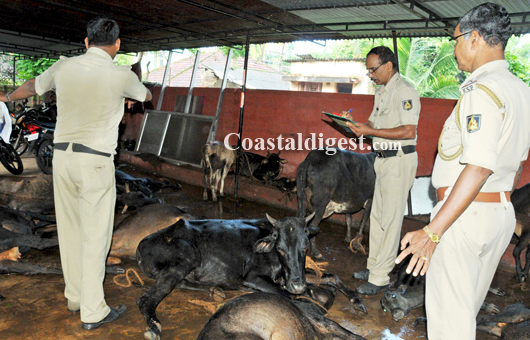
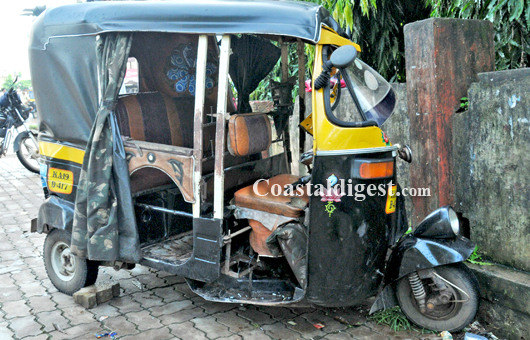
Mangalore, Jul 12: More than 30 cows were seized in Mangalore after a 407 tempo, in which they were being transported, hit into an auto rickshaw, a car and an electric pole.

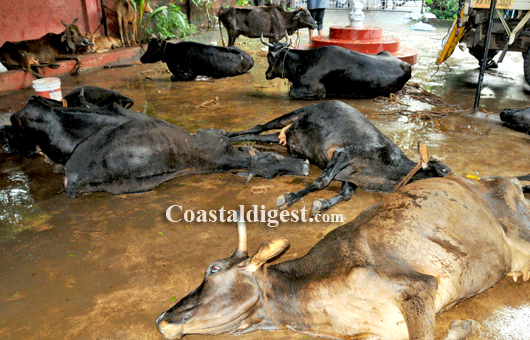
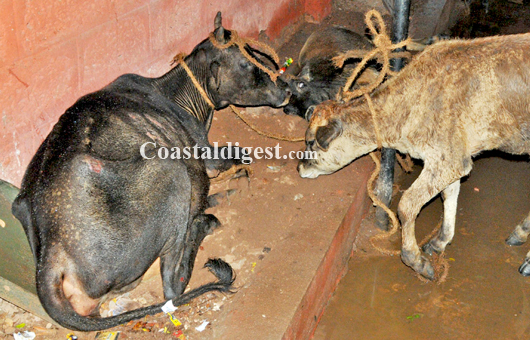
Police seized the tempo and 32 cattle which were tied up in cruel manner, eyewitnesses said. The animals were bruised due to overcrowding and had suffered serious injuries. They hardly had enough space to sit or stand freely, sources said.

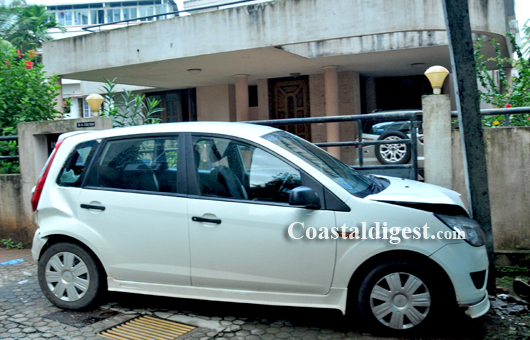
They said that tempo driver lost control and hit the rickshaw near KSRTC bus stand in the city. While he was trying to speed away from the spot, he again rammed into a Ford Figo and an electric pole.

Though locals tried to catch hold of the culprits they managed to flee from the spot.

Unconfirmed sources said some of the cows died while being transported.

A case has been registered at Barke police station.

Bejai Cow siezed2

Bejai Cow siezed3

Bejai Cow siezed4

Bejai Cow siezed5

Bejai Cow siezed6

Ford Figo

Comments

Wilda
 - 
Saturday, 12 Mar 2016

I've been surfing online more than 4 hours today, yet I never found any interesting
article like yours. It is pretty worth enough for me. Personally, if all
website owners and bloggers made good content as you did, the
net will be a lot more useful than ever before.

Here is my weblog: sklep mayoral: http://www.changshengruikang.com/comment/html/?5895.html&page=

Add new comment

  • Coastaldigest.com reserves the right to delete or block any comments.
  • Coastaldigset.com is not responsible for its readers’ comments.
  • Comments that are abusive, incendiary or irrelevant are strictly prohibited.
  • Please use a genuine email ID and provide your name to avoid reject.
News Network
May 27,2020

In a development which highlights the diversity in the United Kingdom’s legal system, a 40-year-old Muslim woman has become the first hijab-wearing judge in the country.

Raffia Arshad, a barrister, was appointed a deputy district judge on the Midlands circuit last week after 17-year career in law.  

She said her promotion was great news for diversity in the world’s most respected legal system. She hopes to be an inspiration to young Muslims.

Ms Arshad, who grew up in Yorkshire, north England, has wanted to work in law since she was 11.

Ms Arshad said the judicial office was looking to promote diversity, but when they appointed her they did not know that she wore the hijab.

‘It’s definitely bigger than me,” she told Metro newspaper. "I know this is not about me.

"It’s important for all women, not just Muslim women, but it is particularly important for Muslim women."

Ms Arshad, a mother of three, has been practising private law dealing with children, forced marriage, female genital mutilation and other cases involving Islamic law for the past 17 years.

She was the first in her family to go to university and has also written a leading text on Islamic family law.

Although the promotion by the Lord Chief Justice was welcome news for her, Ms Arshad said the happiness from other people sharing the news was “far greater”.

“I’ve had so many emails from people, men and women," she said.

"It’s the ones from women that stand out, saying that they wear a hijab and thought they wouldn’t even be able to become a barrister, let alone a judge."

Ms Arshad is regularly the subject of discrimination in the courtroom because of her choice to wear the hijab.

She is sometimes mistaken for a court worker or a client.

Ms Arshad said that recently she was asked by an usher whether she was a client, an interpreter, and even if she were on work experience.

“I have nothing against the usher who said that but it reflects that as a society, even for somebody who works in the courts, there is still this prejudicial view that professionals at the top end don’t look like me,” she said.

A family member once advised her to not wear a hijab at an interview for a scholarship at the Inns of Court School of Law in 2001, warning that it would affect her chances of landing the role.

“I decided that I was going to wear my headscarf because for me it’s so important to accept the person for who they are," Ms Arshad said.

"And if I had to become a different person to pursue my profession, it’s not something I wanted.”

The joint heads of St Mary’s Family Law Chambers said they were “delighted” to hear the news of her appointment.

“Raffia has led the way for Muslim women to succeed in the law and at the bar, and has worked tirelessly to promote equality and diversity in the profession,” Vickie Hodges and Judy Claxton said.

“It is an appointment richly deserved and entirely on merit, and all at St Mary’s are proud of her and wish her every success.”

Comments

Add new comment

  • Coastaldigest.com reserves the right to delete or block any comments.
  • Coastaldigset.com is not responsible for its readers’ comments.
  • Comments that are abusive, incendiary or irrelevant are strictly prohibited.
  • Please use a genuine email ID and provide your name to avoid reject.
Agencies
February 23,2020

Bengaluru, Feb 23: Bolstered by the Supreme Court's interim nod for the gazette notification of the Mahadayi Water Dispute Tribunal award by the Central government, Karnataka decided to allot funds for the drinking water project in the state's northwest region, an official said on Saturday.

"Funds will be allotted in the state budget for fiscal 2020-21 to complete the Kalasa-Banduri project across the Mahadayi river for supplying drinking water to the four drought-prone northern districts in the state," the official of the water resources department told media on anonymity.

As Chief Minister B.S. Yediyurappa also holds the finance portfolio, he has agreed to allocate funds for the project, held up for years in the legal battle with the neighbouring Goa and Maharashtra over the sharing of the river water among the three coastal states.

Yediyurappa is slated to present the state budget for the ensuing fiscal in the legislative assembly on March 2.

"We will resume the project work once the Centre notifies the award though it will be binding on the final outcome of the apex court's hearing the review petitions of Goa and Maharashtra against the Tribunal award," the official noted.

A division bench of Justice D.Y. Chandrachud and Justice Hemant Gupta on Thursday passed an interim order on the Tribunal award, allowing the central water resources ministry to notify it for implementation and posted the case for final hearing in July.

The Tribunal on August 14, 2018 allocated 13.42 thousand million cubic feet (tmcft) of the river water to the southern state for irrigation and drinking water supply to towns and villages across Bagalkot, Belagavi, Dharwad and Gadag districts, which are in the arid region of the Deccan plateau.

The four districts are about 400-550 km northwest of Bengaluru in the southern state.

Of the 13.42 tmcft water, 5.5 tmcft will be used in the river basin and for diversion into the depleted Malaprabha reservoir while the balance 7.92 tmcft will be utilized for hydel power generation instead of allowing the water to go into the Arabian Sea on the state's west coast through Goa.

Goa, which opposed Karnataka's demand for 36.66 tmcft, was allocated 24 tmcft, while Maharashtra got 1.3 tmcft.

The Tribunal assessed that 188.06 tmc feet water is available at 75 per cent dependability.

The three-member Tribunal is headed by Chairman Justice J.M. Panchal, Justice Viney Mittal and Justice P.S. Naayana.

The Union government had set up the inter-state Tribunal on November 16, 2010 for the djudication of the Mahadayi basin water allocation among the three riparian and contiguous states.

Goa and Maharashtra claimed 122.6 tmc feet and 6.35 tmc feet of the river water respectively.

The Tribunal, which commenced sittings on September 6, 2012, held 1,209 sittings for over 6 years.

Supreme Court senior counsel F.S. Nariman represented the state before the Tribunal to present its case.

The Tribunal's chairman and two members inspected the river basin area across the three coastal states from December 12-24, 2013.

The 77km-long Mahadayi or Mandovi river originates at Bhimgad in the Western Ghats in Belagavi district and flows into the neighbouring Goa through Maharashtra and joins the Arabian Sea off the west coast.

Though the river flows 29 km in Karnataka and 52 km in Goa, its catchment area is spread over 2,032 km in the southern state as against 1,580 km in the western state (Goa).

Comments

Add new comment

  • Coastaldigest.com reserves the right to delete or block any comments.
  • Coastaldigset.com is not responsible for its readers’ comments.
  • Comments that are abusive, incendiary or irrelevant are strictly prohibited.
  • Please use a genuine email ID and provide your name to avoid reject.
Agencies
February 6,2020

Even more than three years after demonetisation and all-out efforts to make most transactions through electronic, cash is still king, as it thrives in a digital India, said fintech start-up Paytm founder Vijay Sekhar Sharma.

"While cashless economy is not possible in India, less cash economy will be in the future. Less cash is the only solution, not the elimination of cash," Sharma told IANS in an interview after unveiling an all-in-one payment gateway on Tuesday.

Asserting that it would take 5-10 years for India to make the transition to digital payments from the traditional mode of cash, Sharma, 41, said the e-payment industry benefitted more from the November 8, 2016 note ban and withdrawal of old Rs 1,000 and Rs 500 denominations.

"I think it (demonetisation) helped the industry despite lack of specific help. But the world has changed since then. It is about the scale of distribution of merchants that is what is propelling digital payments," said Sharma.

Most of the cash not only came back into circulation, but also remains as the mode of payment for the majority due to its convenience for the people used to such transactions.

Expounding Paytm's zero service charge, Sharma said the strategy is sustainable as it leads to acquiring more customers and merchants, enabling newer business opportunities.

Paytm also does not levy a service charge to small merchants for its payments services, unlike organised players like Uber.

"Though there is a monetisation model, the merchants who are small shopkeepers, become our financial services customers as they open a bank account, which is profitable."

Paytm secured a Payments Bank license from the Reserve Bank of India to offer a savings bank account, Rupay debit card and money transfer services.

"We are banking on payment services acquiring customers and merchants who avail banking, lending, insurance, wealth and software services like billing software and business ledger software services eventually," Sharma noted.

The mobile first bank services include zero balance and zero digital transaction charge accounts.

"Basically, payments, cloud, commerce and financial services are a cohort we follow. So, payments is our customer as well as merchant acquisition. If it breaks even, we are happy because other line items make more money, he affirmed.

Noting that in a market like India, one cannot price services at a premium unlike in a developed country like the US, the billionaire businessman said a consumer in a developing country would not be able to afford such a hefty charge.

Forbes ranked Sharma as India's youngest billionaire in 2017, with a net worth of $2.1 billion.

While several countries operate on the model of higher service charges, Sharma said newer business models have to be discovered in India, as customer lifecycle value is accounted for more stages than in other nations.

Asked about an upscale retailer like Zara not giving a wallet payment option during its recent end of season sale in Bengaluru, Sharma said Paytm was addressing such hiccups with its all-in-one payment solutions.

"It's an opportunity, because if the retailer has our all-in-one point of sale machine, where in they enter the amount, it shows both the Quick Response code (QR) and card payment options," he observed.

Sharma compared older swiping payment machine to feature phones and modern ones to feature-rich smartphones.

"If you notice, they look like feature phones and the modern day card machine is more a smartphone like. You can add the smatphone components, which can add the features," reiterated Sharma.

Though Paytm's all-in-one QR point of sale machine integrates the billing system, its chief executive said it was not ideal to have an independent QR feature.

Paytm has 16 million strong merchant user base, which Sharma aims to raise to 26 million base in the next one year.

Sharma has launched in this tech city an all-in-one payment gateway and Paytm Business Payments solution, which enable digital payments through multiple methods for small and medium enterprises (SMEs) and an Android point of sale machine.

With the new gateway solution, collecting digital payments through multiple methods can be achieved seamlessly while Paytm Business Payments solution enables automated vendor payments, including employee salaries and customer refunds among others.

The One97 Communications-owned Paytm aims to help SMEs streamline and digitise their business activities using its new solutions, which enhance the overall efficiency of both accepting and making payments.

Paytm has a data bank of over 200 million saved cards and bank accounts, a feature which enables partner apps to shorten transaction times and propel faster conversions while using the all-in-one payment gateway.

Complementing the two solutions, Sharma also launched an all-in-one Android point of sale machine, which can accept payments through all forms such as cards, wallets, UPI apps and even cash.

The device has a QR code that supports all contact and contactless payments, coming with integrated billing software customized solutions for different sectors such as catering, ticketing, parking and others.

The handheld Android device is equipped with an in-built printer, scanner and can also generate bills.

Valued at $16 billion, Paytm is not alone in the fiercely competitive Indian fintech space where a dozen players like PhonePe, MobiKwik, Kotak 811 and deep pocketed international giants Google Pay and Amazon Pay are in the fray.


Comments

Add new comment

  • Coastaldigest.com reserves the right to delete or block any comments.
  • Coastaldigset.com is not responsible for its readers’ comments.
  • Comments that are abusive, incendiary or irrelevant are strictly prohibited.
  • Please use a genuine email ID and provide your name to avoid reject.