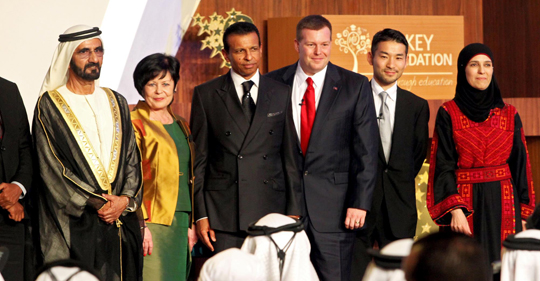
Palestinian who grew up in refugee camp wins $1m Global Teacher Prize

[email protected] (CD Network)
March 14, 2016

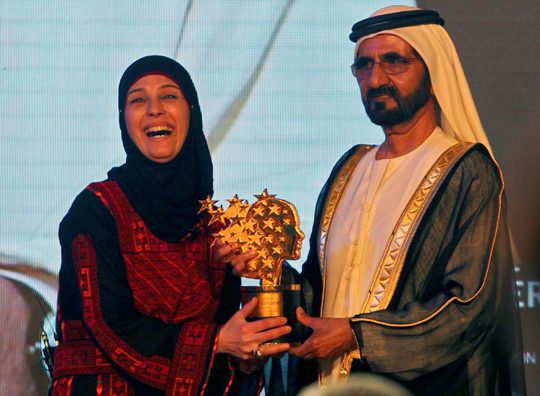
Dubai, Mar 14: "I did it ... Palestine won," shouted Palestinian teacher Hanan Al Hroub after Pope Francis announced her name in a televised statement at the Global Teacher Prize award in Dubai on Sunday. The national flag of Palestine rose high and proud after the winner was announced.

teacher 2

The Global Teacher Prize, hosted by the Varkey Foundation, awarded $1 million to Hanan, the second person until now to get the best teacher title.

Hanan, who grew up in a Palestinian refugee camp and now is a teacher of refugees, specialises in supporting children who have been traumatised by violence.

His Highness Shaikh Mohammed bin Rashid Al Maktoum, Vice-President and Prime Minister of UAE and Ruler of Dubai, presented the award to a very emotional Hanan after a star-studded event, which was also attended by Shaikh Hamdan bin Mohammed bin Rashid Al Maktoum, Crown Prince of Dubai.

With special televised messages from Joe Biden, Vice-President of the US; Bill Clinton, former president of the US; Prince William, Duke of Cambridge; and physicist Stephen Hawking, the event marked a historic moment towards the appreciation of teachers.

Hanan was one among the 10 finalists for the Global Teacher Prize. She took the opportunity to congratulate all her co-nominees and said that as teachers "(we) can build the morals of young minds to ensure a fair world, a more beautiful world and a more free world."

Hanan also took the opportunity to highlight the state of violence in her home country and how only education can change mindsets and bring about a positive change for the future. "There is no doubt that we live in unnatural conditions. Violence and Israeli occupation surrounds us from all sides ... Our task as teachers is complicated as we see daily the suffering in the eyes of our students and our teachers."

In an earlier interview, she said that she faces severe shortages and infrastructural limitations in her classrooms. "Sometimes there are 35 to 40 children in one class and many of the teaching tools we have are outdated ... We have very little infrastructure. With the winning, I intend to change that," said Hanan. "I want to invest more in the education and psychological betterment of students."

Joe Biden said he was impressed to see how the UAE is paving the way for education via a televised statement. He said: "Education is the key to future opportunity and the key to unlocking a life-long journey of learning is a teacher."

Prince William said teaching is an incredible responsibility and that the Royal Foundation of the Duke and Duchess of Cambridge and Prince Harry "is honoured" to be partnering with the Varkey Foundation on various schemes that celebrates teachers.

Reem Ibrahim Al Hashimi, Minister of State for International Cooperation, said: "Great teachers are also great artists; they are possibly the greatest because their canvas is the human mind."

She said teachers are the true architects of the future.

Vikas Pota, CEO of Varkey Foundation, said: "Without teachers there is no progress."

Actors Salma Hayek, Matthew Mcconaughey, Abhishek Bacchan, Parineeti Chopra, and Akshay Kumar also made announcements at the prize ceremony.

teacher 4

teacher 1

teacher 3

Comments

abdullah
 - 
Tuesday, 15 Mar 2016

congrats dear sister ...

Bopanna
 - 
Monday, 14 Mar 2016

Just because she is Muslim she is given an award. Appeasement at its best

Tiger Beary
 - 
Monday, 14 Mar 2016

Hey khaki cheddi naren..
sorry sorry, brown pants naren..
where the hell were you these days???
we badly miss u man!!
We love u so much machcha...

Pokar
 - 
Monday, 14 Mar 2016

thanks for the joke. also thank for mentioning in the beginning of the comment that you are going to present a joke..

Naren kotian
 - 
Monday, 14 Mar 2016

hahaha good joke ... is she a good teacher ? to fund Hamas and islamic jihad , arab milk shakes gives this type of bounty ,just like hawala... may be she was doing her best to create intifada in our israel and judea samaria ( our dearest and beloved friend ),. hahaha ... jai ho israel ... jai bharath mata ... jai indo- isarel relationship ....narendra modiji ki jai ... benjamin netanyahu zindabad ...hahaha

S.M. Nawaz Kuk…
 - 
Monday, 14 Mar 2016

Congrats Sister

Add new comment

  • Coastaldigest.com reserves the right to delete or block any comments.
  • Coastaldigset.com is not responsible for its readers’ comments.
  • Comments that are abusive, incendiary or irrelevant are strictly prohibited.
  • Please use a genuine email ID and provide your name to avoid reject.
News Network
July 28,2020

Hounde, Jul 28: Coronavirus and its restrictions are pushing already hungry communities over the edge, killing an estimated 10,000 more young children a month as meager farms are cut off from markets and villages are isolated from food and medical aid, the United Nations warned Monday.

In the call to action shared with The Associated Press ahead of publication, four UN agencies warned that growing malnutrition would have long-term consequences, transforming individual tragedies into a generational catastrophe.

Hunger is already stalking Haboue Solange Boue, an infant from Burkina Faso who lost half her former body weight of 5.5 pounds (2.5 kilograms) in just a month. Coronavirus restrictions closed the markets, and her family sold fewer vegetables. Her mother was too malnourished to nurse.

“My child,” Danssanin Lanizou whispered, choking back tears as she unwrapped a blanket to reveal her baby's protruding ribs.

More than 550,000 additional children each month are being struck by what is called wasting, according to the UN — malnutrition that manifests in spindly limbs and distended bellies. Over a year, that's up 6.7 million from last year's total of 47 million. Wasting and stunting can permanently damage children physically and mentally.

“The food security effects of the COVID crisis are going to reflect many years from now,” said Dr. Francesco Branca, the WHO head of nutrition. “There is going to be a societal effect.”

From Latin America to South Asia to sub-Saharan Africa, more poor families than ever are staring down a future without enough food.

In April, World Food Program head David Beasley warned that the coronavirus economy would cause global famines “of biblical proportions” this year. There are different stages of what is known as food insecurity; famine is officially declared when, along with other measures, 30% of the population suffers from wasting.

The World Food Program estimated in February that one Venezuelan in three was already going hungry, as inflation rendered salaries nearly worthless and forced millions to flee abroad. Then the virus arrived.

“Every day we receive a malnourished child,” said Dr. Francisco Nieto, who works in a hospital in the border state of Tachira.

In May, Nieto recalled, after two months of quarantine, 18-month-old twins arrived with bodies bloated from malnutrition. The children's mother was jobless and living with her own mother. She told the doctor she fed them only a simple drink made with boiled bananas.

“Not even a cracker? Some chicken?” he asked.

“Nothing,” the children's grandmother responded. By the time the doctor saw them, it was too late: One boy died eight days later.

The leaders of four international agencies — the World Health Organization, UNICEF, the World Food Program and the Food and Agriculture Organization — have called for at least dollar 2.4 billion immediately to address global hunger.

But even more than lack of money, restrictions on movement have prevented families from seeking treatment, said Victor Aguayo, the head of UNICEF's nutrition program.

“By having schools closed, by having primary health care services disrupted, by having nutritional programs dysfunctional, we are also creating harm,” Aguayo said. He cited as an example the near-global suspension of Vitamin A supplements, which are a crucial way to bolster developing immune systems.

In Afghanistan, movement restrictions prevent families from bringing their malnourished children to hospitals for food and aid just when they need it most. The Indira Gandhi hospital in the capital, Kabul, has seen only three or four malnourished children, said specialist Nematullah Amiri. Last year, there were 10 times as many.

Because the children don't come in, there's no way to know for certain the scale of the problem, but a recent study by Johns Hopkins University indicated an additional 13,000 Afghans younger than 5 could die.

Afghanistan is now in a red zone of hunger, with severe childhood malnutrition spiking from 690,000 in January to 780,000 — a 13% increase, according to UNICEF.

In Yemen, restrictions on movement have blocked aid distribution, along with the stalling of salaries and price hikes. The Arab world's poorest country is suffering further from a fall in remittances and a drop in funding from humanitarian agencies.

Yemen is now on the brink of famine, according to the Famine Early Warning Systems Network, which uses surveys, satellite data and weather mapping to pinpoint places most in need.

Some of the worst hunger still occurs in sub-Saharan Africa. In Sudan, 9.6 million people live from one meal to the next — a 65% increase from the same time last year.

Lockdowns across Sudanese provinces, as around the world, have dried up work and incomes for millions. With inflation hitting 136%, prices for basic goods have more than tripled.

“It has never been easy but now we are starving, eating grass, weeds, just plants from the earth,” said Ibrahim Youssef, director of the Kalma camp for internally displaced people in war-ravaged south Darfur.

Adam Haroun, an official in the Krinding camp in west Darfur, recorded nine deaths linked with malnutrition, otherwise a rare occurrence, over the past two months — five newborns and four older adults, he said.

Before the pandemic and lockdown, the Abdullah family ate three meals a day, sometimes with bread, or they'd add butter to porridge. Now they are down to just one meal of “millet porridge” — water mixed with grain. Zakaria Yehia Abdullah, a farmer now at Krinding, said the hunger is showing “in my children's faces.”

“I don't have the basics I need to survive,” said the 67-year-old, who who hasn't worked the fields since April. “That means the 10 people counting on me can't survive either.”

Comments

Add new comment

  • Coastaldigest.com reserves the right to delete or block any comments.
  • Coastaldigset.com is not responsible for its readers’ comments.
  • Comments that are abusive, incendiary or irrelevant are strictly prohibited.
  • Please use a genuine email ID and provide your name to avoid reject.
News Network
January 12,2020

Bengaluru, Jan 12: Chief Justice of India, Sharad Arvind Bobde on Saturday hinted at the possibility of Artificial Intelligence being developed for the court system while making it clear that it will never replace human discretion.

Speaking at an event here, Bobde said, "We have a possibility of developing Artificial Intelligence for the court system. Only for the purpose of ensuring that the undue delay in justice is prevented."

"I must make it clear at the outset as there are times when even judges have asked this. AI is not going to replace human judges or human discretion", he added.

Sharing more details of his vision, he stated, "It is only the repetitive, mathematical and mechanical parts of the judgments for which help can be taken from the system...we are exploring the possibility of implementing it."

Bobde stressed on the requirement of developing AI for judiciary while outlining the number of pending cases in different courts.

"Some people are in jail for 10-15 years and we are not in position to deal with their appeals. The high court's and Supreme Court take so long and ultimately the courts feel that it is just to release them on bail", he said.

Bobde also endorsed employing every talent and skill to ensure delivery of justice in a reasonable time.

"We must employ every talent, every skill we possess to ensure that justice is received within reasonable time. Delay in justice can't be a reason for anybody to take law into their hands. But it's very important for us as courts to ensure there's no undue delay in justice", he said.

CJI Bobde also highlighted the need for pre-litigation mediation and said, "Pre-litigation mediation is the need of the hour especially in the backdrop of a significant pendency that the courts are tackling with. There are innumerable areas where pre-litigation mediation could solve the problem."

He also stressed that the position of a judge is very unique under the constitution and they have to deal with a variety of problems.

"The foundation of civilisation rests on the law. Judicial officers have to deal with a variety of problems...Judges without adequate knowledge, skills and experience may cause distortion, delay and miscarriage of justice", he said.

Earlier in the day, Chief Justice of India Bobde inaugurated the phase-1 of the new building of the Karnataka Judicial Academy on Crescent Road in Bengaluru.

The new building has three floors, besides, the ground floor and two basement floors.

Comments

Add new comment

  • Coastaldigest.com reserves the right to delete or block any comments.
  • Coastaldigset.com is not responsible for its readers’ comments.
  • Comments that are abusive, incendiary or irrelevant are strictly prohibited.
  • Please use a genuine email ID and provide your name to avoid reject.
coastaldigest.com web desk
July 2,2020

When the black and white photos of the ‘London to Calcutta (Kolkata) bus service’ went viral on social media recently, the response of some of the netizens was “stop spreading fake news!” But, it isn’t a fake news. The late 1950s indeed offered people a lavish bus trip from London to Kolkata. 

While one of the viral images shows passengers at the Victoria Coach Station, London, boarding 'Albert', the other image show the same bus travelling through a valley. In another image the bus is stationed at a tourist spot. All these photos were captured during the bus’ maiden international journey in 1957.  

An image of the bus ticket is also making rounds on social media, that shows the route of the bus — London, Belgium, West Germany, Austria,Yugoslavia, Bulgaria, Turkey, Iran, Afghanistan, West Pakistan, India. The route in India followed Delhi, Agra, Allahabad, Banaras and finally Calcutta.

The ticket shows that a one side travel cost 145 pounds (13,644 Rupees at the present day) back then, and it was inclusive of all the luxury provided during the run.

The luxurious bus provided the facilities of reading, individual sleeping bunks, radio/taped music for parties and pleasure and fan heaters, among other things. The brochure reads, "Your complete home while you travel."

Some of the tour highlights included Banaras on the Ganges, The Taj Mahal, The Raj Path, The Rhine Valley and The Peacock Throne. Passengers reportedly got free shopping days in New Delhi, Tehran, Salzburg, Kabul, Istanbul and Vienna.

Comments

Add new comment

  • Coastaldigest.com reserves the right to delete or block any comments.
  • Coastaldigset.com is not responsible for its readers’ comments.
  • Comments that are abusive, incendiary or irrelevant are strictly prohibited.
  • Please use a genuine email ID and provide your name to avoid reject.