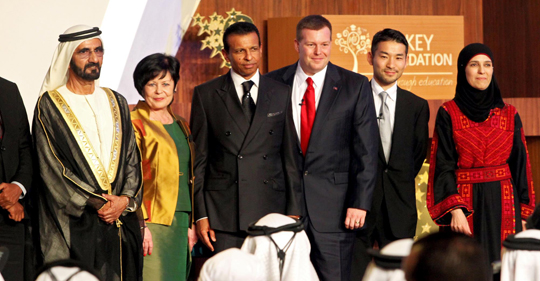
Palestinian who grew up in refugee camp wins $1m Global Teacher Prize

[email protected] (CD Network)
March 14, 2016

Dubai, Mar 14: "I did it ... Palestine won," shouted Palestinian teacher Hanan Al Hroub after Pope Francis announced her name in a televised statement at the Global Teacher Prize award in Dubai on Sunday. The national flag of Palestine rose high and proud after the winner was announced.
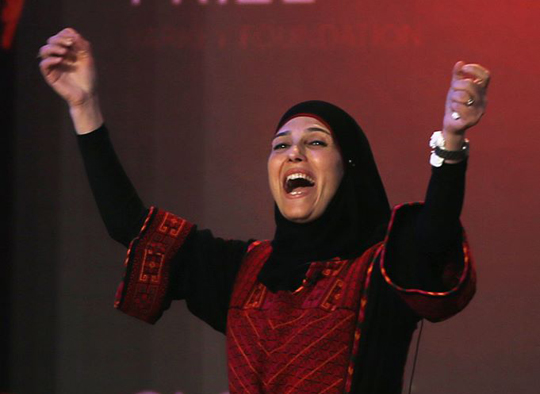
teacher 2

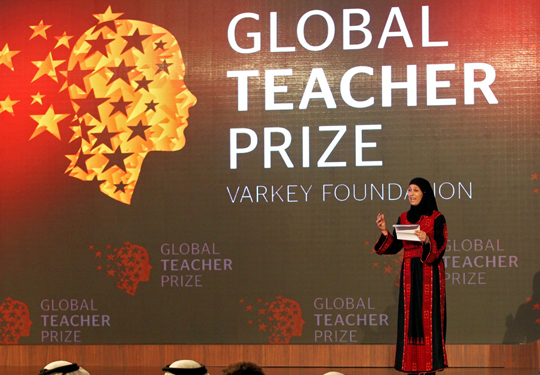
The Global Teacher Prize, hosted by the Varkey Foundation, awarded $1 million to Hanan, the second person until now to get the best teacher title.

Hanan, who grew up in a Palestinian refugee camp and now is a teacher of refugees, specialises in supporting children who have been traumatised by violence.

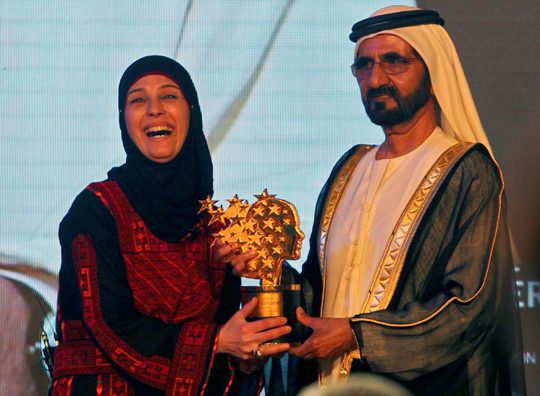
His Highness Shaikh Mohammed bin Rashid Al Maktoum, Vice-President and Prime Minister of UAE and Ruler of Dubai, presented the award to a very emotional Hanan after a star-studded event, which was also attended by Shaikh Hamdan bin Mohammed bin Rashid Al Maktoum, Crown Prince of Dubai.

With special televised messages from Joe Biden, Vice-President of the US; Bill Clinton, former president of the US; Prince William, Duke of Cambridge; and physicist Stephen Hawking, the event marked a historic moment towards the appreciation of teachers.

Hanan was one among the 10 finalists for the Global Teacher Prize. She took the opportunity to congratulate all her co-nominees and said that as teachers "(we) can build the morals of young minds to ensure a fair world, a more beautiful world and a more free world."

Hanan also took the opportunity to highlight the state of violence in her home country and how only education can change mindsets and bring about a positive change for the future. "There is no doubt that we live in unnatural conditions. Violence and Israeli occupation surrounds us from all sides ... Our task as teachers is complicated as we see daily the suffering in the eyes of our students and our teachers."

In an earlier interview, she said that she faces severe shortages and infrastructural limitations in her classrooms. "Sometimes there are 35 to 40 children in one class and many of the teaching tools we have are outdated ... We have very little infrastructure. With the winning, I intend to change that," said Hanan. "I want to invest more in the education and psychological betterment of students."

Joe Biden said he was impressed to see how the UAE is paving the way for education via a televised statement. He said: "Education is the key to future opportunity and the key to unlocking a life-long journey of learning is a teacher."

Prince William said teaching is an incredible responsibility and that the Royal Foundation of the Duke and Duchess of Cambridge and Prince Harry "is honoured" to be partnering with the Varkey Foundation on various schemes that celebrates teachers.

Reem Ibrahim Al Hashimi, Minister of State for International Cooperation, said: "Great teachers are also great artists; they are possibly the greatest because their canvas is the human mind."

She said teachers are the true architects of the future.

Vikas Pota, CEO of Varkey Foundation, said: "Without teachers there is no progress."

Actors Salma Hayek, Matthew Mcconaughey, Abhishek Bacchan, Parineeti Chopra, and Akshay Kumar also made announcements at the prize ceremony.
teacher 4

teacher 1

teacher 3

Comments

abdullah
 - 
Tuesday, 15 Mar 2016

congrats dear sister ...

Bopanna
 - 
Monday, 14 Mar 2016

Just because she is Muslim she is given an award. Appeasement at its best

Tiger Beary
 - 
Monday, 14 Mar 2016

Hey khaki cheddi naren..
sorry sorry, brown pants naren..
where the hell were you these days???
we badly miss u man!!
We love u so much machcha...

Pokar
 - 
Monday, 14 Mar 2016

thanks for the joke. also thank for mentioning in the beginning of the comment that you are going to present a joke..

Naren kotian
 - 
Monday, 14 Mar 2016

hahaha good joke ... is she a good teacher ? to fund Hamas and islamic jihad , arab milk shakes gives this type of bounty ,just like hawala... may be she was doing her best to create intifada in our israel and judea samaria ( our dearest and beloved friend ),. hahaha ... jai ho israel ... jai bharath mata ... jai indo- isarel relationship ....narendra modiji ki jai ... benjamin netanyahu zindabad ...hahaha

S.M. Nawaz Kuk…
 - 
Monday, 14 Mar 2016

Congrats Sister

Add new comment

  • Coastaldigest.com reserves the right to delete or block any comments.
  • Coastaldigset.com is not responsible for its readers’ comments.
  • Comments that are abusive, incendiary or irrelevant are strictly prohibited.
  • Please use a genuine email ID and provide your name to avoid reject.
Agencies
May 8,2020

Washington D.C., May 8: The prime time for brain development in a child's life is the first year, where the infant spends most of the time asleep. It is the time when neural connections form and sensory memories are encoded.

However, when sleep is disrupted, as occurs more often among children with autism, brain development may be affected, too.

New research led by the University of Washington finds that sleep problems in a baby's first 12 months may not only precede an autism diagnosis but also may be associated with altered growth trajectory in a key part of the brain, the hippocampus.

The study, which was published in the American Journal of Psychiatry, researchers report that in a sample of more than 400 taken of 6- to 12-month-old infants, those who were later diagnosed with autism were more likely to have had difficulty falling asleep.

It also states that this sleep difficulty was associated with altered growth trajectories in the hippocampus.

"The hippocampus is critical for learning and memory, and changes in the size of the hippocampus have been associated with poor sleep in adults and older children.

As many as 80 per cent of the children with autism spectrum disorder have sleep problems," said Annette Estes, director of the UW Autism Center and senior author of the study.

"In our clinical experience, parents have a lot of concerns about their children's sleep, and in our work on early autism intervention, we observed that sleep problems were holding children and families back," added Estes, who is also a UW professor of speech and hearing sciences.

"It could be that altered sleep is part-and-parcel of autism for some children. One clue is that behavioural interventions to improve sleep don't work for all children with autism, even when their parents are doing everything just right. This suggests that there may be a biological component to sleep problems for some children with autism," said Estes.

To consider links among sleep, brain development, and autism, researchers at the IBIS Network looked at MRI scans of 432 infants, surveyed parents about sleep patterns, and measured cognitive functioning using a standardized assessment.

At the outset of the study, infants were classified according to their risk for developing autism: Those who were at higher risk of developing autism -- about two-thirds of the study sample -- had an older sibling who had already been diagnosed.

Infant siblings of children with autism have a 20 per cent chance of developing autism spectrum disorder -- a much higher risk than children in the general population.

In the current study, 127 of the 432 infants were identified as "low risk" at the time the MRI scans were taken because they had no family history of autism.

They later evaluated all the participants at 24 months of age to determine whether they had developed autism. Of the roughly 300 children originally considered "high familial risk," 71 were diagnosed with autism spectrum disorder at that age.

Problems with sleep were more common among the infants later diagnosed with an autism spectrum disorder, as were larger hippocampi. No other subcortical brain structures were affected, including the amygdala, which is responsible for certain emotions and aspects of memory, or the thalamus, a signal transmitter from the spinal cord to the cerebral cortex.

The authors note that while parents reported more sleep difficulties among infants who developed autism compared to those who did not, the differences were very subtle and only observed when looking at group averages across hundreds of infants.

Sleep patterns in the first years of life change rapidly as infants transition from sleeping around the clock to a more adult-like sleep/wake cycle. Until further research is completed, Estes said, it is not possible to interpret challenges with sleep as an early sign of increased risk for autism.

Comments

Add new comment

  • Coastaldigest.com reserves the right to delete or block any comments.
  • Coastaldigset.com is not responsible for its readers’ comments.
  • Comments that are abusive, incendiary or irrelevant are strictly prohibited.
  • Please use a genuine email ID and provide your name to avoid reject.
News Network
February 28,2020

Suhaana shuddered with fear as she heard violent banging on her door on Sunday. The atmosphere was charged with communal tension after thousands of ruthless goons supporting contentious Citizens Amendment Act (CAA) launched a bloody onslaught against Muslims in the capital of India.

The family consists of Suhaana (name changed), her partially paralysed husband and two daughters. They are the only Muslim family in Madhuban mohalla of North Ghonda locality in north-east Delhi.

Hearts pounded louder than pounding of the door. Then the banging stopped and noises of men talking loudly came.

"I peeped out from a small window near the kitchen and saw our neighbours standing outside our entrance and arguing with 10-15 unknown people," Suhaana said.

It was the first day of the communal violence, worst in the decades, that fanned out to the entire north-east Delhi over the next three days and claimed at least 42 lives, left over 200 injured and properties worth crores destroyed. The death toll is feared to go up.

Later in the night Suhaana's family moved to one of their Hindu neighbour's house. There are about 30 Hindu households in the mohalla who kept vigil as the atmosphere deteriorated.

The next day, the violence escalated. The neighbours decided to shift Suhaana 's family to Gautampuri for their safety.

Suhaana recounted, "Our neighbours assured us that they are with us but as things were deteriorating, they said they wouldn't be able to protect us if a big mob of hundreds came. They advised us to move to the nearby Gautampuri locality and come back only after things become normal."

Rajkumar Bharadwaj brought the family to Gautampuri in the early hours on February 25.

Anil Gupta, 49, said, "It was tough to rescue them. We were asked by the rioters as to why we were saving the Muslims. But we had to, it is the people of my country who are suffering. It cannot be Hindus or Muslims."

Rajkumar Bharadwaj said, "Their youngest clung to me throughout. After I brought them here at Gautampuri, I felt good. Situation till then was not okay."

On Saturday, some semblance of normalcy returned to parts of north-east Delhi with some people opening their shops amid heavy police presence.

Meanwhile, the morbid sight outside GTB Hospital's mortuary, agonising groans in the hospital wards burnt down houses and shops remind Suhaana and others what they have been spared of.

Comments

Add new comment

  • Coastaldigest.com reserves the right to delete or block any comments.
  • Coastaldigset.com is not responsible for its readers’ comments.
  • Comments that are abusive, incendiary or irrelevant are strictly prohibited.
  • Please use a genuine email ID and provide your name to avoid reject.
News Network
July 7,2020

Bengaluru, Jul 7: There seems no impact of Covid-19 on kharif crop sowing in Karnataka with the current year actually being ahead of previous years, according to an official here on Monday.

"In agriculture, as far as sowing is concerned, there is no impact of COVID-19," Agriculture Commissioner Brijesh Kumar Dikshit told IANS. One of the reasons, according to Dikshit, is that people in rural areas are aware, but not scared of the pandemic.

"In rural India, coronavirus is there. People are aware, not scared. They are taking precautions, but don't have any phobia," he said.

Another reason was that by June the number of infections in Karnataka was not as high as other states, when a lot of sowing was done, he said.

By the end of June, Karnataka saw 15,242 Covid-19 cases. Of that, 7,074 were active.

The sowing is ahead of previous year as it's mostly dependent on weather. "It's ahead of previous years. Agriculture is directed by weather and rains had been slightly earlier this year," he said.

According to Karnataka State Natural Disaster Monitoring Centre, at 185 mm the state received 14 mm less rain in June against the normal 199 mm. "It's like a normal year, or slightly a good year," he said.

Some crops will be sown in the last fortnight of July and few more will extend up to August 15. "The last two weeks will be critical and on July 31 we should be able to tell whether we are short or ahead," he said.

According to preliminary indications, the Commissioner said the area under agriculture is increasing this year, which could also be because that labourers might have come back.

Comments

Add new comment

  • Coastaldigest.com reserves the right to delete or block any comments.
  • Coastaldigset.com is not responsible for its readers’ comments.
  • Comments that are abusive, incendiary or irrelevant are strictly prohibited.
  • Please use a genuine email ID and provide your name to avoid reject.