



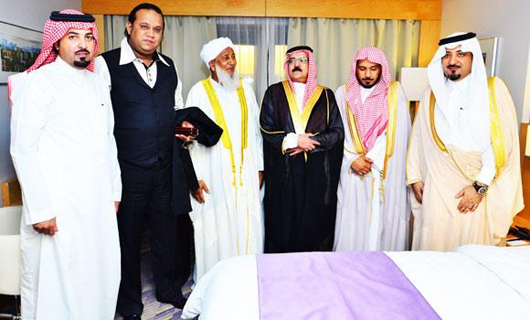
Prince Saud upbeat on Saudi-Indian ties

July 15, 2014

Prince Saud

Jeddah, Jul 15: Prince Saud bin Musaed bin Abdul Aziz, president of the Gammon Group, has highlighted the strong relationship between Saudi Arabia and India.

“We hope the Saudi-Indian relations would reach greater heights in the coming years,” he said while addressing an iftar party organized by the group.

He said many major Indian companies are interested in doing business in Saudi Arabia to make use of the growing investment opportunities in the Kingdom.

“Last year, more than 35,000 Saudis visited India for education and medical treatment,” the prince said, while commending the role played by Indian expatriate workers in boosting the Kingdom’s development in various sectors.

Shaikh Mohammed Rafik, chairman of Gammon Group, said more than 20 international companies, including those from India, Canada, Australia, Malaysia and China, have agreed to establish their plants in the new industrial city being developed by Gammon in Jazan.

“We are looking for investors in areas required by the Kingdom, including automobiles. We are in talks with a South Korean company to establish an automobile plant in Jazan,” Rafik told Arab News.

The new industrial city is expected to draw investments worth SR75 billion, the chairman said, adding that it would create about 100,000 jobs. He commended Prince Turki bin Mohammed bin Nasser, director of international trade at the Ministry of Commerce and Industry, for his efforts to speed up establishment of the industrial city.

He added that Prince Turki has been authorized by the government to develop the city by bringing in foreign investors to build the city’s entire infrastructure facilities, such as roads, bridges, commercial centers, power plants, water treatment plants, oil refinery and petrochemical plants.

“If major companies are ready to invest and transfer their technology, the government will pay them 75 percent of their project cost in soft loans for 20 years,” Rafik told Arab News.

The iftar party was attended by prominent personalities, including Indian Consul General B.S. Mubarak, British Consul General Mohammed Shaukat, South African Consul General Ebrahim Edries, Khaled Almaeena, former editor in chief of Saudi Gazette, Tariq Mishkhas, editor in chief of Urdu News and Malayalam News, Dr. Faiz Al-Abideen, CEO of Gammon Group, A.P. Abubacker Musliyar, general secretary of All-India Jameyat Al-Ulema, and Syed Bashirali Shihab Thangal.

Comments

Dorthea
 - 
Saturday, 19 Mar 2016

Right here is the right web site for everyone
who wishes to find out about this topic. You realize a whole lot its almost hard to argue with you (not that I actually will
need to…HaHa). You certainly put a new spin on a topic which has
been discussed for decades. Great stuff, just wonderful!

My web page; Lettie Bouley: http://gdzieulokowacoszczednosci.medicsen.eu

Add new comment

  • Coastaldigest.com reserves the right to delete or block any comments.
  • Coastaldigset.com is not responsible for its readers’ comments.
  • Comments that are abusive, incendiary or irrelevant are strictly prohibited.
  • Please use a genuine email ID and provide your name to avoid reject.
News Network
April 20,2020

Apr 20: Eight Indians, including two engineers, have died due to the novel coronavirus in Saudi Arabia, according to a media report on Sunday.

Mohammed Aslam Khan, an electrical engineer in Makkah, and Azmatullah Khan, an engineer at the Makkah Haram power station, have died due to the COVID-19, Saudi Gazette reported.

Aslam Khan, aged 51, who hailed from Meerut in Uttar Pradesh, was admitted to King Faisal Hospital, Makkah on April 3, following worsening of his condition after being infected with fever and throat pain.

He had been on ventilator for more than two weeks and breathed his last on Saturday night, the paper said.

Khan is survived by wife and a daughter and a son. His wife and children are under self-imposed home quarantine.

Azmatullah Khan, from Telangana, died of coronavirus on Friday.

Mujeeb Pukkottoor, a prominent Indian social worker and general secretary of Makkah chapter of Kerala Muslim Cultural Center, told the paper that the body of Khan was buried in Makkah on Sunday.

Khan, aged 65, had been working with Saudi Binladin Group for the last 32 years.

Fakre Alam, an employee at the Haram Project of Saudi Binladin Group in Makkah, died on Sunday due to infection, the paper said.

Barkt Ali Abdullatif Fakir, an electrical technician working in Medina, also died of coronavirus, it said.

According to the Saudi Ministry of Health’s daily report published on April 14, the number of coronavirus infected cases among workers of Saudi Binladin Group in various parts of the Kingdom stood at 117, and these included 70 cases in Makkah.

The first two Indian fatalities were reported from Medina and Riyadh earlier this month with the death of Shebnaz Pala Kandiyil (29) and Safvan Nadamal (41), both from Kerala.

Mohammed Sadiq, from Hyderabad, working in Jeddah and Suleman Sayyid Junaid (Maharashtra) are other Indians who died due to COVID-19 in the Gulf kingdom, the paper said.

Shebnaz from Panoor in Kannoor district died on April 3 and his body was buried in Medina on April 7. He came back to the Kingdom March 3 after his marriage in January.

Safvan, a taxi driver from Chemmad in Malappuram district, died on April 2 and was buried in Riyadh on April 8.

Comments

Add new comment

  • Coastaldigest.com reserves the right to delete or block any comments.
  • Coastaldigset.com is not responsible for its readers’ comments.
  • Comments that are abusive, incendiary or irrelevant are strictly prohibited.
  • Please use a genuine email ID and provide your name to avoid reject.
News Network
July 1,2020

Riyadh, Jul 1: Saudis braced Wednesday for a tripling in value added tax, another unpopular austerity measure after the twin shocks of coronavirus and an oil price slump triggered the kingdom's worst economic decline in decades.

Retailers in the country reported a sharp uptick in sales this week of everything from gold and electronics to cars and building materials, as shoppers sought to stock up before VAT is raised to 15 percent.

The hike could stir public resentment as it weighs on household incomes, pushing up inflation and depressing consumer spending as the kingdom emerges from a three-month coronavirus lockdown.

"Cuts, cuts, cuts everywhere," a Saudi teacher in Riyadh told AFP, bemoaning vanishing subsidies as salaries remain stagnant.

"Air conditioner, television, electronic items," he said, rattling off a list of items he bought last week ahead of the VAT hike.

"I can't afford these things from Wednesday."

With its vast oil wealth funding the Arab world's biggest economy, the kingdom had for decades been able to fund massive spending with no taxes at all.

It only introduced VAT in 2018, as part of a push to reduce its dependence on crude revenues.

Then, seeking to shore up state finances battered by sliding oil prices and the coronavirus crisis, it announced in May that it would triple VAT and halt a cost-of-living monthly allowance to citizens.

The austerity push underscores how Saudi Arabia's once-lavish spending is becoming a thing of the past, with the erosion of the welfare system leaving a mostly young population to cope with reduced incomes and a lifestyle downgrade.

That could pile strain on a decades-old social contract whereby citizens were given generous subsidies and handouts in exchange for loyalty to the absolute monarchy.

The rising cost of living may prompt many to ask why state funds are being lavished on multi-billion-dollar projects and overseas assets, including the proposed purchase of English football club Newcastle United.

Shopping malls in the kingdom have drawn large crowds in recent days as retailers offered "pre-VAT sales" and discounts before the hike kicks in.

A gold shop in Riyadh told AFP it saw a 70 percent jump in sales in recent weeks, while a car dealership saw them tick up by 15 percent.

Once the new rate is in place, businesses are predicting depressed sales of everything from cars to cosmetics and home appliances.

Capital Economics forecast inflation will jump up to six percent year-on-year in July, from 1.1 percent in May, as a result.

"The government ended the country's lockdown (in June) and there are signs that economic activity has started to recover," Capital Economics said in a report.

"Nonetheless, we expect the recovery to be slow-going as fiscal austerity measures bite."

The kingdom also risks losing its edge against other Gulf states, including its principal ally the United Arab Emirates, which introduced VAT at the same time but has so far refrained from raising it beyond five percent.

"Saudi Arabia is taking massive risks with contractionary fiscal policies," said Tarek Fadlallah, chief executive officer of the Middle East unit of Nomura Asset Management.

But the kingdom has few choices as oil revenue declines.

Its finances have taken another blow as authorities massively scaled back this year's hajj pilgrimage, from 2.5 million pilgrims last year to around a thousand already inside the country, and suspended the lesser umrah because of coronavirus.

Together the rites rake in some $12 billion annually.

The International Monetary Fund warned the kingdom's GDP will shrink by 6.8 percent this year -- its worst performance since the 1980s oil glut.

The austerity drive would boost state coffers by 100 billion riyals ($26.6 billion), according to state media.

But the measures are unlikely to plug the kingdom's huge budget deficit.

The Saudi Jadwa Investment group forecasts the shortfall will rise to a record $112 billion this year.

Comments

Add new comment

  • Coastaldigest.com reserves the right to delete or block any comments.
  • Coastaldigset.com is not responsible for its readers’ comments.
  • Comments that are abusive, incendiary or irrelevant are strictly prohibited.
  • Please use a genuine email ID and provide your name to avoid reject.
News Network
April 2,2020

Dubai, Apr 2: A senior Saudi official urged more than 1 million Muslims intending to perform the hajj to delay making plans this year in comments suggesting the pilgrimage could be cancelled due to the new coronavirus pandemic.

In February, the kingdom took the extraordinary decision to close off the holy cities of Mecca and Medina to foreigners over the virus, a step which wasn’t taken even during the 1918 flu epidemic that killed tens of millions worldwide.

Restrictions have tightened in the kingdom as it grapples with over 1,500 confirmed cases of the new virus. The kingdom has reported 10 deaths so far. The Middle East has more than 71,000 confirmed cases of the virus, most of those in Iran, and over 3,300 deaths.

“The kingdom of Saudi Arabia is prepared to secure the safety of all Muslims and nationals,” Saudi Hajj and Umrah Minister Muhammad Saleh bin Taher Banten told state television. “That’s why we have requested from all Muslims around the world to hold onto signing any agreements (with tour operators) until we have a clear vision.”

Saudi Arabia has barred people from entering or exiting three major cities, including Mecca and Medina, and imposed a nighttime curfew across the country. Like other countries around the world and in the Middle East, Saudi Arabia has suspended all inbound and outbound commercial flights.

Each year, up to 2 million Muslims perform the hajj, a physically demanding and often costly pilgrimage that draws the faithful from around the world. The hajj, required of all able-bodied Muslims to perform once in their lifetime, is seen as a chance to wipe clean past sins and bring about greater humility and unity among Muslims.

Standing in Mecca in front of the cube-shaped Kaaba that Muslims pray toward five times daily, Banten also said the kingdom was already providing care for 1,200 pilgrims stuck in the holy city due to global travel restrictions. A number of them are being quarantined in hotels in Mecca, he said.

Comments

Add new comment

  • Coastaldigest.com reserves the right to delete or block any comments.
  • Coastaldigset.com is not responsible for its readers’ comments.
  • Comments that are abusive, incendiary or irrelevant are strictly prohibited.
  • Please use a genuine email ID and provide your name to avoid reject.