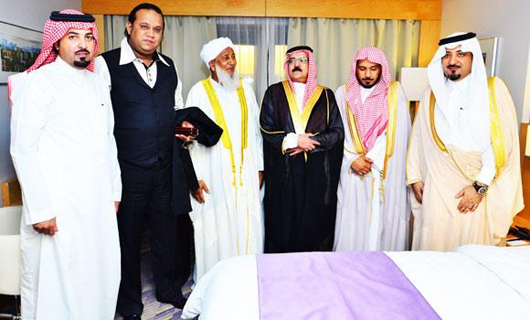
Prince Saud upbeat on Saudi-Indian ties

July 15, 2014

Prince Saud

Jeddah, Jul 15: Prince Saud bin Musaed bin Abdul Aziz, president of the Gammon Group, has highlighted the strong relationship between Saudi Arabia and India.

“We hope the Saudi-Indian relations would reach greater heights in the coming years,” he said while addressing an iftar party organized by the group.

He said many major Indian companies are interested in doing business in Saudi Arabia to make use of the growing investment opportunities in the Kingdom.

“Last year, more than 35,000 Saudis visited India for education and medical treatment,” the prince said, while commending the role played by Indian expatriate workers in boosting the Kingdom’s development in various sectors.

Shaikh Mohammed Rafik, chairman of Gammon Group, said more than 20 international companies, including those from India, Canada, Australia, Malaysia and China, have agreed to establish their plants in the new industrial city being developed by Gammon in Jazan.

“We are looking for investors in areas required by the Kingdom, including automobiles. We are in talks with a South Korean company to establish an automobile plant in Jazan,” Rafik told Arab News.

The new industrial city is expected to draw investments worth SR75 billion, the chairman said, adding that it would create about 100,000 jobs. He commended Prince Turki bin Mohammed bin Nasser, director of international trade at the Ministry of Commerce and Industry, for his efforts to speed up establishment of the industrial city.

He added that Prince Turki has been authorized by the government to develop the city by bringing in foreign investors to build the city’s entire infrastructure facilities, such as roads, bridges, commercial centers, power plants, water treatment plants, oil refinery and petrochemical plants.

“If major companies are ready to invest and transfer their technology, the government will pay them 75 percent of their project cost in soft loans for 20 years,” Rafik told Arab News.

The iftar party was attended by prominent personalities, including Indian Consul General B.S. Mubarak, British Consul General Mohammed Shaukat, South African Consul General Ebrahim Edries, Khaled Almaeena, former editor in chief of Saudi Gazette, Tariq Mishkhas, editor in chief of Urdu News and Malayalam News, Dr. Faiz Al-Abideen, CEO of Gammon Group, A.P. Abubacker Musliyar, general secretary of All-India Jameyat Al-Ulema, and Syed Bashirali Shihab Thangal.

Comments

Dorthea
 - 
Saturday, 19 Mar 2016

Right here is the right web site for everyone
who wishes to find out about this topic. You realize a whole lot its almost hard to argue with you (not that I actually will
need to…HaHa). You certainly put a new spin on a topic which has
been discussed for decades. Great stuff, just wonderful!

My web page; Lettie Bouley: http://gdzieulokowacoszczednosci.medicsen.eu

Add new comment

  • Coastaldigest.com reserves the right to delete or block any comments.
  • Coastaldigset.com is not responsible for its readers’ comments.
  • Comments that are abusive, incendiary or irrelevant are strictly prohibited.
  • Please use a genuine email ID and provide your name to avoid reject.
Agencies
January 11,2020

Muscat, Jan 11: Oman's Sultan Qaboos bin Said has died, Aljazeera reported citing state television on Friday.

Qaboos was 79-year-old and was ill for a long time. He has served as the ruler of Oman since 1970 when he ousted his father in a bloodless coup.

Qaboos had no children and has not publicly named his successor.

Sultan Qaboos travelled to Belgium for a week in December for what was described then as "medical checks." He returned to Oman but speculations of his deteriorating health were rife.

Comments

Add new comment

  • Coastaldigest.com reserves the right to delete or block any comments.
  • Coastaldigset.com is not responsible for its readers’ comments.
  • Comments that are abusive, incendiary or irrelevant are strictly prohibited.
  • Please use a genuine email ID and provide your name to avoid reject.
coastaldigest.com web desk
May 21,2020

The Tawakkalna application developed by Saudi Arabia's National Information Centre to processes requests for movement permits during the curfew to curb the spread of the virus has become a major helplnine for past few weeks. 

The application developed through the close cooperation between the Ministry of Health and the Saudi Data and Artificial Intelligence Authority (SDAIA) was launched on May 4.

According to Saudi Telecom Group, it handles 20,000 calls daily through the Tawakkalna platform by dedicating a call centre of 600 employees through its Contact Centre Company (CCC). 

The Tawakkalna app can be used to issue e-permits for a selected group of government and private sector employees who were exempted from the curfew, and individuals who have medical appointments as well as couriers.

Tawakkalna has features for the service of citizens and residents, for ensuring their safety and comfort that would contribute to facilitating the access of authorized persons to travel permits.

The official page about Tawakkalna on Twitter, says: “You must always keep in mind that pinpointing your exact location of residence is the only way for you to benefit from the app’s range of services and permits.”

The app will also provide the latest alerts and medical news issued by the Ministry of Health about the virus as well as about its spread, ways to prevent it and movement permits.

Tawakkalna can be used for self-disclosure for people who show signs of coronavirus infection and for requesting ambulance service and other important services for the community.

Through the app users can apply for a one-hour permit for a walk in the neighborhood on a daily basis, thereby encouraging walking during this period of lockdown.

Comments

muhammad Sheheryar
 - 
Sunday, 14 Jun 2020

sir,


i am facing problem for receiving OTP code during registration for my family. i am unable to get OTP code.

please assist. 

Abdulrazaq Yousef
 - 
Thursday, 4 Jun 2020

Entering date of birth is the big problem is the big problem of this app. 


Malik asif
 - 
Tuesday, 26 May 2020

Dob entering problem 

Thomas Philipose
 - 
Monday, 25 May 2020

Hi,

I am trying to register in the Tawakkalna app, but it keeps on throwing error. Any idea?


thanx


Add new comment

  • Coastaldigest.com reserves the right to delete or block any comments.
  • Coastaldigset.com is not responsible for its readers’ comments.
  • Comments that are abusive, incendiary or irrelevant are strictly prohibited.
  • Please use a genuine email ID and provide your name to avoid reject.
News Network
June 12,2020

Beirut, Jun 12: Angry Lebanese protesters blocked roads across the country with burning tyres, debris and their vehicles, incensed over the local currency's depreciation by more than 25 percent in just two days.

The demonstrations from northern Akkar and Tripoli to central Zouk, the eastern Bekaa Valley, Beirut and southern Tyre and Nabatieh on Thursday were some of the most widespread in months of upheaval over a calamitous economic and financial crisis.

Protesters set ablaze a branch of the Central Bank, vandalised several private banks and clashed with security forces in several areas. At least 41 people were injured in Tripoli alone, according to the Lebanese Red Cross.

"I'm really pissed off, that's all. If politicians think they can burn our hearts like this the fire is going to reach them too," unemployed computer engineer Ali Qassem, 26, told Al Jazeera after pouring fuel onto smouldering tyres on a main Beirut thoroughfare.

Tens of thousands of Lebanese have lost jobs in the past six months and hundreds of businesses have shuttered as a dollar shortage led the Lebanese pound to slide from 1,500 to $1 last summer - where it was pegged for 23 years - to roughly 4,000 for each US dollar last month.

But the slide turned into a freefall between Wednesday and Thursday when the pound plummeted to roughly 5,000 to $1 on black markets, which have become a main source of hard currency. There was widespread speculation the rate hit 6,000 or even 7,000 pounds to the dollar, though most markets stopped trading.

Protesters began amassing on streets across the country before sunset and increased into the thousands across the country as the night fell.

Prime Minister Hassan Diab cancelled all meetings scheduled for Friday to hold an emergency cabinet session at 9:30am and another at 3pm at the presidential palace to be headed by President Michel Aoun.

The pound's collapse is the perhaps the biggest challenge yet for Diab's young cabinet, which gained confidence in February after former prime minister Saad Hariri's government was toppled by an unprecedented October uprising that had the country's economic crisis at its core.

Economy Minister Raoul Nehme told Al Jazeera that there was "disinformation" being circulated about the exchange rate on social media and said he was investigating possible currency manipulation.

"I don't understand how the exchange rate increased by so much in two days," he said.

Many protesters have pitted blame on Central Bank governor Riad Salameh, nominally in charge of  keeping the currency stable. But they have also called on the government to resign.

"If people want reform between dawn and dusk, that's not going to work, and if someone thinks they can do a better job then please come forward," Nehme said.

"But what we can't have is a power vacuum - then the exchange rate won't be 5000, it'll be a catastrophe."

'Everyone paying the price'

When protesters set a large fire in Beirut's Riad al-Solh Square, which lies at the foot of a grand Ottoman-era building that serves as the seat of government, firefighters did not intervene to extinguish it.

It later became clear why: Civil Defence told local news channel LBCI they had run out of diesel to fuel their firetrucks.

Basic imports such as fuel have been hit hard by the currency crisis, making already-weak state services increasingly feeble.

A half-dozen or so police officers with Lebanon's Internal Security Forces observed the scene unfolding in front of them in the square.

"Why do you destroy shops and things and attack us security forces - do you think we're happy? Go and f****** break that wall or go to the politicians' houses," one police officer told Al Jazeera, referring to a large concrete barrier separating protesters from the seat of government.

"In the end we are with you and we want the country to change. Don't you dare think we're happy. My salary is now worth $130," the officer said.

The currency's spectacular fall seems to have pushed many Lebanese to put common interests above their differences.

Large convoys of men on motorbikes from Shia-majority areas of southern Beirut joined the demonstrations on Thursday, though they have clashed with protesters many times before - including at a protest on Saturday.

Some chanted sectarian insults, leading to brief clashes in areas that were formerly front lines during the country's devastating 15-year civil war.

Instead, the motorbike-riding demonstrators on Thursday chanted: "Shia, Sunni, F*ck sectarianism."

"We are Shia, and Sunnis and Christian are our brothers," Hisham Houri, 39, told Al Jazeera, perched on a moped with his fiancee behind him just a few metres from a pile of burning tyres.

The blaze sent thick black smoke into the sky towards an iconic blue-domed mosque and church in downtown Beirut.

"Politicians play on these sectarian issues and sometimes succeed, but in the end, they'll fail because all the people have been hurt," he said. "The dollar isn't just worth 6,000 for Shias or for Sunnis, everyone is paying that price."


Comments

Add new comment

  • Coastaldigest.com reserves the right to delete or block any comments.
  • Coastaldigset.com is not responsible for its readers’ comments.
  • Comments that are abusive, incendiary or irrelevant are strictly prohibited.
  • Please use a genuine email ID and provide your name to avoid reject.