Prince Saud upbeat on Saudi-Indian ties

July 15, 2014

Prince Saud

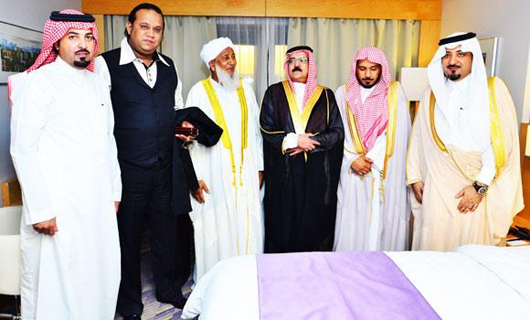
Jeddah, Jul 15: Prince Saud bin Musaed bin Abdul Aziz, president of the Gammon Group, has highlighted the strong relationship between Saudi Arabia and India.

“We hope the Saudi-Indian relations would reach greater heights in the coming years,” he said while addressing an iftar party organized by the group.

He said many major Indian companies are interested in doing business in Saudi Arabia to make use of the growing investment opportunities in the Kingdom.

“Last year, more than 35,000 Saudis visited India for education and medical treatment,” the prince said, while commending the role played by Indian expatriate workers in boosting the Kingdom’s development in various sectors.

Shaikh Mohammed Rafik, chairman of Gammon Group, said more than 20 international companies, including those from India, Canada, Australia, Malaysia and China, have agreed to establish their plants in the new industrial city being developed by Gammon in Jazan.

“We are looking for investors in areas required by the Kingdom, including automobiles. We are in talks with a South Korean company to establish an automobile plant in Jazan,” Rafik told Arab News.

The new industrial city is expected to draw investments worth SR75 billion, the chairman said, adding that it would create about 100,000 jobs. He commended Prince Turki bin Mohammed bin Nasser, director of international trade at the Ministry of Commerce and Industry, for his efforts to speed up establishment of the industrial city.

He added that Prince Turki has been authorized by the government to develop the city by bringing in foreign investors to build the city’s entire infrastructure facilities, such as roads, bridges, commercial centers, power plants, water treatment plants, oil refinery and petrochemical plants.

“If major companies are ready to invest and transfer their technology, the government will pay them 75 percent of their project cost in soft loans for 20 years,” Rafik told Arab News.

The iftar party was attended by prominent personalities, including Indian Consul General B.S. Mubarak, British Consul General Mohammed Shaukat, South African Consul General Ebrahim Edries, Khaled Almaeena, former editor in chief of Saudi Gazette, Tariq Mishkhas, editor in chief of Urdu News and Malayalam News, Dr. Faiz Al-Abideen, CEO of Gammon Group, A.P. Abubacker Musliyar, general secretary of All-India Jameyat Al-Ulema, and Syed Bashirali Shihab Thangal.

Comments

Dorthea
 - 
Saturday, 19 Mar 2016

Right here is the right web site for everyone
who wishes to find out about this topic. You realize a whole lot its almost hard to argue with you (not that I actually will
need to…HaHa). You certainly put a new spin on a topic which has
been discussed for decades. Great stuff, just wonderful!

My web page; Lettie Bouley: http://gdzieulokowacoszczednosci.medicsen.eu

Add new comment

  • Coastaldigest.com reserves the right to delete or block any comments.
  • Coastaldigset.com is not responsible for its readers’ comments.
  • Comments that are abusive, incendiary or irrelevant are strictly prohibited.
  • Please use a genuine email ID and provide your name to avoid reject.
News Network
January 6,2020

Dubai, Jan 6: Iran announced a further rollback of its commitments to the troubled international nuclear accord Sunday amid anger over the US killing of a top commander which also prompted Iraq's parliament to demand the departure of American troops.

While vast crowds gathered in Iran's second city of Mashhad as Qasem Soleimani's remains were returned home, the Tehran government said it would forego the "limit on the number of centrifuges" it had pledged to honour in the 2015 agreement which was already in deep trouble.

The announcement was yet another sign of the fallout from Friday's killing of Soleimani in Baghdad in a drone strike ordered by President Donald Trump, which has inflamed US-Iraqi relations and among the rival camps in Washington.

Iran's 2015 nuclear accord with the United Nations Security Council's five permanent members -- Britain, China, France, Russia and the United States -- plus Germany has been hanging by a thread since the US withdrew unilaterally from it two years ago.

European countries have been pushing for talks with Iran to salvage the deal, inviting Iranian Foreign Minister Mohammed Javad Zarif to Brussels for talks, but the prospect of progress seemed remote after the government's statement on Sunday night.

"Iran's nuclear programme no longer faces any limitation in the operational field", said the statement.

This extends to Iran's capacity for enriching uranium, the level of enrichment carried out, the amount enriched, and other research and development, it said.

"As of now Iran's nuclear programme will continue solely based on its technical needs," it added.

Europe urges Iran to rethink

Until now, Iran has said it needs to enrich uranium up to a level of five percent to produce fuel for electricity generation in nuclear power plants.

Tehran said it would continue cooperating "as before" with the International Atomic Energy Agency but the leaders of Germany, France and Britain reacted by urging Iran to rethink its announcement.

"We call on Iran to withdraw all measures that are not in line with the nuclear agreement," Chancellor Angela Merkel, President Emmanuel Macron and Prime Minister Boris Johnson said in a joint statement.

The European leaders also urged Iran to refrain from taking "further violent actions or support for them."

"It is crucial now to de-escalate. We call on all the players involved to show utmost restraint and responsibility."

The Europeans have been among the chorus of voices urging restraint in the aftermath of the drone strike which killed Soleimani, the veteran commander of the Revolutionary Guards' foreign operations.

But as his remains were paraded through the streets of Mashhad, cries of "Revenge, Revenge" echoed through the streets while mourners threw scarves onto the roof of the truck carrying his coffin.

Soleimani's remains had been returned before dawn to the southwestern city of Ahvaz, where the air resonated with Shiite chants and shouts of "Death to America".

Some 5,200 US soldiers are currently stationed across Iraqi bases to support local troops preventing a resurgence of the Islamic State jihadist group.

But the government could be poised to demand they leave after a vote in the Baghdad parliament where caretaker prime minister Adel Abdel Mahdi joined 168 lawmakers -- just enough for quorum -- to discuss a motion to force US troops.

"The parliament has voted to commit the Iraqi government to cancel its request to the international coalition for help to fight IS," speaker Mohammed Halbusi announced.

The cabinet would have to approve any decision but the premier indicated support for an ouster in his speech.

'Iraqi people want the US'

US Secretary of State Mike Pompeo reacted by saying he would "take a look at what we do when the Iraqi leadership and government makes a decision" but indicated that he felt American troops were still welcome.

"We are confident that the Iraqi people want the United States to continue to be there to fight the counterterror campaign," Pompeo said on Fox News.

Two rockets hit near the US embassy in Baghdad late Sunday, the second night in a row that the Green Zone was hit and the 14th time over the last two months that US installations have been targeted.

Pompeo defended the decision to kill Soleimani while insisting that any further US military action against Iran would conform to international law.

Trump triggered accusations that he had threatening a war crime by declaring cultural sites as potential targets in a Tweet on Saturday night.

Zarif drew parallels with the Islamic State group's destruction of the Middle East's cultural heritage following Trump's tweets that sites which were "important to... Iranian culture" were on a list of 52 potential US targets.

"We'll behave lawfully," Pompeo told the ABC network.

House Speaker Nancy Pelosi has been leading the backlash against the Soleimani strike, an operation that Trump only officially informed Congress about after the event.

But Trump made light of the calls for him to get Congressional approval in the future, saying such notice was "not required" -- and then saying his tweet would serve as prior notification if he did decide to strike against Iran again.

"These Media Posts will serve as notification to the United States Congress that should Iran strike any US person or target, the United States will quickly & fully strike back, & perhaps in a disproportionate manner," Trump wrote.


Comments

Add new comment

  • Coastaldigest.com reserves the right to delete or block any comments.
  • Coastaldigset.com is not responsible for its readers’ comments.
  • Comments that are abusive, incendiary or irrelevant are strictly prohibited.
  • Please use a genuine email ID and provide your name to avoid reject.
News Network
April 26,2020

Abu Dhabi, Apr 26: Indian Ambassador to the UAE Pavan Kapoor says he is appalled after the bodies of three Indians flown back to India were returned to Abu Dhabi on Friday.

The three deceased Indian nationals had died of non-coronavirus causes and were flown to Delhi on Thursday but were promptly returned by authorities there.

“We are appalled at what has happened,” Kapoor told Gulf News. “We do not know if the bodies were returned because of coronavirus-related restrictions, but we are obviously not sending the remains of people [who have passed away from COVID-19],” he added.

“[As we understand], it happened because of new protocols at the airport and we are trying to sort it out,” he said.

Sent back a few hours later

“The remains were not offloaded from the plane, and were sent back a few hours later,” Kapoor explained.

The deceased were Kamlesh Bhatt, who passed away on April 17, and Sanjeev Kumar and Jagsir Singh who both died on April 13.

According to reports in Indian media, Kamlesh Bhat was 23 years old, and hailed from Tehri Garhwal district. He allegedly died of cardiac arrest. Along with the remains Kumar and Singh, Bhatt’s body was initially repatriated on an Etihad Airways flight, then sent back, even though his relatives had been on their way to collect them.

Kapoor explained the procedure through which remains are normally returned to family members back home, saying that the worker’s employer typically makes arrangements with cargo companies to repatriate bodies on cargo aircraft.

The employer applies for a No Objection Certificate from the Indian Embassy, which is granted once the Embassy ensures that all local formalities have been completed. The cargo company then applies for airport clearance, and the airline obtains approvals from the receiving airport.

“If airport protocols have changed, it means cargo companies have to be more careful about the clearance they’re getting,” Kapoor advised.

Additional costs
The ambassador added there may eventually be additional costs to repatriate the bodies but that it is first necessary to sort out the concerns.

The global coronavirus outbreak has spawned difficulties in repatriating mortal remains as a result of the travel restrictions imposed by countries. Remains of people dying from COVID-19 are not being sent back, but the caution surrounding the handling of bodies often affects the repatriation of those who succumb to other causes.

As Gulf News reported, Kerala chief minister Pinarayi Vijayan reached out to Indian Prime Minister Narendra Modi on Friday for intervention in bringing back the bodies of Keralites who have died in the Gulf from non-COVID-19 causes.

“I would like to draw your attention to the grievances received from Non-resident Keralites Associations (NRKs) in the Gulf Cooperation Council (GCC) countries on the delay caused in bringing home the mortal remains of NRKs who had expired due to reasons other than the COVID-19 infection,” read the letter by the CM.

“It is learnt that a ‘clearance certificate’ from the Indian Embassies is required to process the application of bringing home the mortal remains of the dead. The Embassies are [further] insisting on the production of a no-objection certificate from the Ministry of Home Affairs (MHA), New Delhi. To enable to bring back the bodies of the NRIs whose deaths occurred due to reasons other than COVID-19 infection, without necessary procedural hassles, I request your kind intervention,” Vijayan has requested.

Comments

Add new comment

  • Coastaldigest.com reserves the right to delete or block any comments.
  • Coastaldigset.com is not responsible for its readers’ comments.
  • Comments that are abusive, incendiary or irrelevant are strictly prohibited.
  • Please use a genuine email ID and provide your name to avoid reject.
Agencies
July 31,2020

Mount Arafat, July 30: Muslim pilgrims converged Thursday on Saudi Arabia's Mount Arafat for the climax of this year's hajj, the smallest in modern times and a sharp contrast to the massive crowds of previous years.

A tight security cordon has been erected all around the foot of the rocky hill outside Mecca, also known as Jabal al-Rahma or Mount of Mercy.

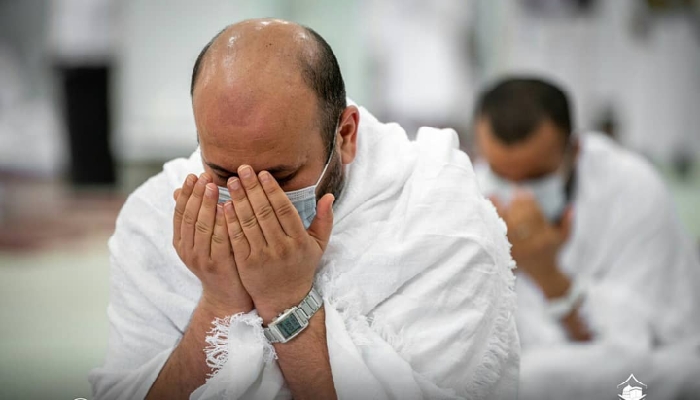
Pilgrims, donning masks and observing social distancing, were brought in buses from neighbouring Mina, state television showed, as Saudi authorities impose measures to prevent a coronavirus outbreak.

They were subject to temperature checks and attended a sermon -- which state media said was translated into 10 languages -- before they set off on the climb to the summit for hours of Koran recitals and prayers to atone for their sins.

The scene was strikingly different to last year's ritual when a sea of pilgrims ascended Mount Arafat, marshalled by tens of thousands of stewards in a bid to prevent any crushes.

After sunset prayers, pilgrims will make their way down Mount Arafat to Muzdalifah, another holy site where they will sleep under the stars to prepare for the final stage of hajj, the symbolic "stoning of the devil".

It takes place on Friday and also marks the beginning of Eid al-Adha, the festival of sacrifice.

The hajj, one of the five pillars of Islam and a must for able-bodied Muslims at least once in their lifetime, is usually one of the world's largest religious gatherings.

But only up to 10,000 people already residing in the kingdom will participate in this year's ritual, compared with 2019's gathering of some 2.5 million from around the world.

"You are not our guests but those of God, the custodian of the two holy mosques (Saudi Arabia's King Salman) and the nation," Hajj Minister Mohammad Benten said in a video released by the media ministry on Wednesday.

Security cordon

A security cordon has been thrown around the holy sites to prevent any security breaches, an interior ministry spokesman said.

Riyadh faced strong criticism in 2015 when some 2,300 worshippers were killed in the deadliest stampede in the gathering's history.

But this year, those risks are greatly reduced by the much smaller crowd.

The pilgrims have all been tested for the virus, and foreign journalists were barred from this year's hajj, usually a huge global media event.

As part of the rites completed over five days in the holy city of Mecca and its surroundings, the pilgrims converged on Mount Arafat after spending the night in Mina.

A district of Mecca, Mina sits in a narrow valley surrounded by rocky mountains, and is transformed each year into a vast encampment for pilgrims.

They began the hajj on Wednesday with their first "tawaf", the circumambulation of the Kaaba, a large structure in Mecca’s Grand Mosque towards which Muslims around the world pray.

The Kaaba is draped in a black cloth embroidered in gold with Koranic verses and known as the kiswa, which is changed each year during the pilgrimage.

Pilgrims were brought inside the mosque in small batches, walking along paths marked on the floor, in sharp contrast to the normal sea of humanity that swirls around the Kaaba during hajj.

Comments

Add new comment

  • Coastaldigest.com reserves the right to delete or block any comments.
  • Coastaldigset.com is not responsible for its readers’ comments.
  • Comments that are abusive, incendiary or irrelevant are strictly prohibited.
  • Please use a genuine email ID and provide your name to avoid reject.