


The Bollywood story through film posters, lobby cards

January 2, 2014

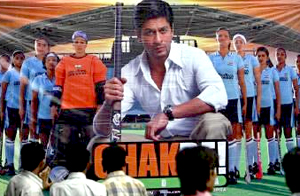
BollywoodNew Delhi, Jan 2: Bollywood's unseen and lesser known stills capturing action, affection, portraiture and villainy through decades-old film memorabilia like cinema lobby and show cards is now put on show.

Curated by photographer Rahaab Allana as a tribute to 100 years of cinema, these curios are showing at an exhibition he has titled "Filmy Jagat: Shared Universe of Indian Cinema" at the Art Heritage Gallery here.

"The visual culture in India is vast. It was the end of the centenary and I felt in the end, we should talk about sub cultures rather than the mainstream activities going on all the time," Allana told PTI in an interview at the the opening of the exhibition.

The exhibition, says the photographer is an attempt by his team to bring to fore the sub culture of photography that existed in Hindi movies for four decades from 1940 to 1980s but still unknown to the masses.

"For instance, the lobby cards and show cards that would have originally been pinned up in cinema theatres, are some of the most acknowledged forms of photography. We have made them part of the exhibition," he says.

The focal point of the exhibition is a scrap book titled "Filmy Jagat" scribbled in hand on the cover.

Acquired by Allana a year ago, the pre-independence book paved the way for the exhibition. "Working around the streets of Mumbai and picking up material, I came upon this scrap book and I realize that a scrap book is an important sub-culture of photography. I realized that I would like to research it and found out that there was no publication or history around scrapbook so I thought to do one," he says.

Divided into different tropes and styles, the show highlights such film stills dating from a later period in Indian cinema, namely the 1960s-80s, an era that gave way to a global audience for Hindi films. Action, Affection, Portraiture and Villainy are therefore some of the recurring moments that were captured throughout film photography.

The curator of Alkazi Foundation for the Arts. Allana says he had no plans of putting up a show when he acquired the archives. "I had no thought while going for the archives. I acquired them I because liked them," he says.

Allana admits it was a challenging task to acquire all the archives. "It was challenging. Easy as everyone was dedicated to it but difficult for obvious reasons," the curator says.

He hopes that people visit the exhibition and they start "responding to it in their own capacity." Another reason which Allana had for putting up this exhibition was to show his support for offbeat cinema. "If we want to make that kind of cinema supporting this type of exhibition is good," he said.

The exhibition preempts a publication specific to the scrapbook, titled Filmi Jagat Scrapbook: Shared Universe of Indian Cinema, by Niyogi Books with a introduction by Shyam Benegal which will be released early next year. "Yes, we hope to release it in the first quarter of the year," says Allana.

Along with this a parallel exhibition titled Contemporary Artworks, where artists have responded to the "dynamic presence of Bollywood".

M F Husain's "Culture of the Streets", a portfolio of 20 signed photographs printed on Kodak C-Print with foil on photo paper shot in the 1980s, makes it clear that for Husain, the streets of Chennai with their enormous hoardings of South Indian movie stars were a part of the contemporary urban landscape and a part of the artist's visual vocabulary.

Younger artists like Bharti Verma's otherwise vacant streets and homes of New Delhi are dominated by a historic legacy of film posters that are suspended like a giant, silent backdrop in the distance. Sharmistha Dutta creates collages of 1970's film posters pasted on ruined, blood-splattered city walls, against which she arranges interesting and vivid portraits of the common man.

Comments

Pedro
 - 
Sunday, 20 Mar 2016

Thanks for the marvelous posting! I genuinely enjoyed reading it,
you may be a great author. I will ensure that I bookmark your blog and definitely will come back someday.
I want to encourage you to ultimately continue your great work,
have a nice holiday weekend!

Have a look at my web blog :: majaas: http://kaajmaaja.com

Add new comment

  • Coastaldigest.com reserves the right to delete or block any comments.
  • Coastaldigset.com is not responsible for its readers’ comments.
  • Comments that are abusive, incendiary or irrelevant are strictly prohibited.
  • Please use a genuine email ID and provide your name to avoid reject.
News Network
June 16,2020

Mumbai, Jun 16: Filmmaker Dibakar Banerjee remembers Sushant Singh Rajput as a dance loving 'chhokra' from an engineering college who, having made it in Bollywood, was “enthused, sincere and totally focused” on his craft.

Banerjeee said the actor always had “a book or two” with him and took pride in the fact that he had an “inner intellectual life away from the shallower aspects of showbiz”.

Rajput was found dead in his Bandra apartment on Sunday at the age of 34, leaving his friends, colleagues and collaborators in a state of shock.

The Patna-born actor and the director worked together in 2015 film "Detective Byomkesh Bakshy!" when Rajput was a relative newcomer in the industry. Banerjee says it was Rajput's vulnerability and willingness to do different that made him stand out for the role.

In an interview with news agency, the filmmaker looks back at Rajput's sincerity, his love for science and astronomy and how an outsider has to work harder than a "mediocre, unmotivated and entitled establishment elite" to succeed in Bollywood.

Excerpts:

You worked with Sushant when he was less than two-year-old in the film industry. What struck you the most in him to cast as Detective Byomkesh Bakshy?

Banerjee: His vulnerability and intensity and the ambition to do different things than the usual Bollywood stuff.

What were your memories of Sushant- the actor and the person?

Banerjee: As an actor he would tense himself up for the scene and then completely plunge in take after take. He would put a lot of value on preparation. He would be up the previous night of the shoot, reading the scene and making notes and land up on the sets all raring to go.

He would be on, ready and give his hundred per cent throughout the shoot of Byomkesh - no matter how hard or long the day. The unit did not really have to worry about him - considering he was the star. That's what I remember - a total pro, enthused, sincere and totally focused.

As a person, he seemed to me a happy dance loving 'chhokra' from an engineering college who had made it in showbiz and now was serious about acting. He was deeply nostalgic about his carefree student days in Delhi. We used to laugh a lot - I remember that quite clearly.

Sushant's friends say that he spoke more about books and his love for astronomy than films and their fate, which is rare for an actor in the industry. Do you also remember him that way?

Banerjee: Totally true. He was a science and astronomy nut. Always had a book or two with him - and was proud of the fact that he had an inner intellectual life away from the shallower aspects of showbiz. I recognized it as a reflex, protective action to prevent the Bollywood swamp sucking him in totally. And also an identity he wanted to protect and project.

Sushant's death has brought to the fore the struggles of outsiders and the alienation they often face from the nepotistic culture of the industry. Did you feel that Sushant was also fighting this battle despite being a successful actor?

Banerjee: We all fight it, day in and out - whether successful or failing. But the trick is to define that success and failure ourselves and not let the narrative constantly forced by the establishment to get to you. Those who know this weather the storm and ultimately survive and thrive.

The biggest unfairness in all this is that it takes double the talent, energy and hard work for an outsider to convince the audience and the industry that he or she is as safe a box office bet as a mediocre, unmotivated and entitled establishment elite.

The media colludes in this by wallowing in family, coterie and celebrity worship. This leads to deep anger and frustration. Those who can let this slide survive. Those who can't - those who hurt a little more or are vulnerable and impressionable - they are at risk.

Comments

Add new comment

  • Coastaldigest.com reserves the right to delete or block any comments.
  • Coastaldigset.com is not responsible for its readers’ comments.
  • Comments that are abusive, incendiary or irrelevant are strictly prohibited.
  • Please use a genuine email ID and provide your name to avoid reject.
News Network
June 16,2020

Mumbai, Jun 16: In the wake of Sushant Singh Rajput's death, veteran actor Deepti Naval has opened up about her struggle with depression and suicidal thoughts in the early 90s.

Naval shared a poem that she wrote during her struggle with depression on her Facebook page after paying tributes to Rajput, who was found hanging in his Bandra apartment on Sunday at the age of 34.

According to a police official, Mumbai Police found out during the probe that the actor was under medication for depression

"Dark days these... So much has been happening - mind has come to a point of stillness... Or rather numbness. Today I feel like sharing a poem I wrote back in the years when I was fighting depression, anxiety, suicidal thoughts - Yes, fighting... and like how," Naval wrote.

The 68-year-old actor made her debut with Shyam Benegal's 1978 "Junoon" and went on to feature in films like "Chashme Buddoor", "Ankahee", "Mirch Masala", Saath Saath among others in the 80s.

Naval's poem, titled "Black Wind", begins by describing how anxiety engulfs a person.

"Anxiety grips me with both hands, spiked claws dig deep into my soul I gasp for breath and stagger around sharp corners of my single bed.."

In the poem, Naval talks about fighting suicidal thoughts and depression, describing it as a "ghoulish lust" she won't succumb to.

"The telephone rings... no, it stops...God damn! Why don't anyone speak? A voice, Just a human voice In this shameless, pitiless Abyss of the night - gloom deepens into darkness, turns purple I feel dark inside."

The actor ends by writing that she will survive the night, its "deathly design" and fight.

"The world's a snake pit, so let it be! I dare the devil to get the better of me! Deepti Naval, Night of July 28, 1991."

In an interview with PTI last year, Naval had mentioned how acting assignments started to thin in the late 90s and as a "serious actor" it was "devastating" to be ignored.

Comments

Add new comment

  • Coastaldigest.com reserves the right to delete or block any comments.
  • Coastaldigset.com is not responsible for its readers’ comments.
  • Comments that are abusive, incendiary or irrelevant are strictly prohibited.
  • Please use a genuine email ID and provide your name to avoid reject.
News Network
June 27,2020

Patna, Jun 27: As Sushant Singh Rajput’s family tries to come to terms with his loss, they have decided to honour his legacy and celebrate his passion for cinema, science and sports.

In an emotional statement shared on Saturday, the Bollywood actor’s family remembered him as a “free-spirited” person who worked hard to turn his dreams into reality.

“He was free-spirited, talkative and incredibly bright. He was curious about just everything. He dreamed without restraints, and chased those dreams with the heart of a lion. He smiled generously. He was the pride and inspiration of the family,” the statement read.

Rajput, 34, known for films like Kai Po Che!, MS Dhoni: The Untold Story and Chhichhore, was found dead in his Bandra apartment on June 14, sending shockwaves in the film industry and elsewhere.

The family said that the actor’s untimely demise has created an irreparable void in their lives.

“We can’t bring ourselves to accept that we wouldn’t get to hear his easy laughs anymore. That we wouldn’t see his sparkling eyes again. That we wouldn’t hear his endless rants about science again. His loss has created a permanent, glaring void in the family that will never be filled.”

Thanking his admirers for being a constant support as they try and recover from the loss, the family added that Rajput, “truly loved and cherished every single one of his fans.”

The actor, who made the storybook transition from Patna boy to television and then the starry lights of the Hindi film industry, was the youngest of five siblings and is survived by his father and four sisters. His mother had passed away in 2002 when he was a young teen.

To honour his memory and legacy, the family has decided to set up Sushant Singh Rajput Foundation (SSRF) that will support young talents in cinema, science and sports.

His childhood home in Rajiv Nagar, Patna, will be turned into a memorial, where all his personal memorabilia and belongings, that include thousands of books, his Meade 14’’ LX-600 telescope, flight-simulator, will be on display for his fans and admirers.

The actor’s family, who used to fondly call him Gulshan, will also maintain his social media accounts as legacy accounts to keep his memories alive.

Rajput started his acting career with television after dropping out from Delhi Technological University in the early 2000s. He was one of the few talents to have made a successful transition to movies.

The actor made his Bollywood debut in 2013 with Kai Po Che!. In past seven years, he had featured in a number of hits including blockbusters Neeraj Pandey’s MS Dhoni: The Untold Story and Chhichhore by Nitesh Tiwari.

Tiwari’s 2019 hit was Rajput’s last theatrical release.

On Thursday, it was announced that Dil Bechara, which is the actor’s last movie he shot for, will premiere on Disney + Hotstar on July 24.

Comments

Add new comment

  • Coastaldigest.com reserves the right to delete or block any comments.
  • Coastaldigset.com is not responsible for its readers’ comments.
  • Comments that are abusive, incendiary or irrelevant are strictly prohibited.
  • Please use a genuine email ID and provide your name to avoid reject.