



No ‘Achhe Din’: PM Modi under fire as middle class hit hard due to rising costs

March 23, 2016

Mumbai/ New Delhi, Mar 23: Sharp rises in education and healthcare costs in the last two years have hit the nation’s burgeoning middle class hard, denting Prime Minister Narendra Modi’s popularity among the relatively well-off ahead of a series of state elections.

Price increases for services deemed a luxury for most Indians could also complicate the central bank’s plans to cut borrowing costs, with decades of low investment in schools and hospitals meaning they will remain expensive for some time.
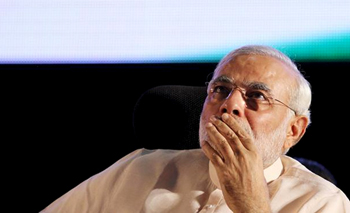
AchheDin“Spending on my son’s education and medicine for the family has gone up sharply,” said Sambuddha Banerjee, a 47-year-old IT professional, who works in Kolkata.

“The government also cut fuel subsidies and tried to impose taxes on our pension savings. This is not acceptable.”

Banerjee is thinking twice about voting for Modi’s ruling Bharatiya Janata Party (BJP) at elections scheduled for 2019.

That view is far from universal, but is already on the radar of a government that swept to power in 2014 with promises of economic reforms and pro-business policies that appealed to aspirational Indians living in big towns and cities.

Modi has already seen support among the huge agriculture sector ebb following several crop failures, so appeasing the middle class, which accounts for about a quarter of the 1.3 billion population, looks increasingly important.

“Rising prices of commodities and services which have a higher weight in the consumption basket of middle class households is an issue that cannot be ignored,” said a senior finance ministry official.

“This is a supply side issue and can’t be addressed in the short term,” he added.

To ease some pressure on middle income earners, the government plans to hike salaries of its nearly 10 million employees by 24 per cent this year.

GOVERNMENT BACKS DOWN

Education costs have risen 13 per cent, housing 10 per cent, healthcare 14 per cent and electricity 8 per cent since Modi took charge in May 2014, time series data on CPI inflation collected by the Ministry of Statistics showed.

That puts a disproportionate strain on middle class incomes, with education costs accounting for 7 per cent of urban households’ monthly spend compared with 3.5 per cent of rural households, data showed.

Food and beverage prices, meanwhile, which account for more than a half of the CPI basket, fell 10.5 per cent since Modi’s election victory, although there, too, items like milk and eggs favoured by middle income Indians have actually risen.

Owners of motorcycles and cars are further upset that the government took away some windfall gains from falling oil prices in the form of taxes, and people across the country are cutting back on discretionary spending as expenses outstrip earnings.

Underlining the government’s sensitivity to a “squeeze” on the middle class, earlier this month it agreed to roll back plans to tax pension fund withdrawals following a backlash from salaried workers.

While national elections are three years away, the BJP’s popularity faces earlier tests, with ballots in states including West Bengal and Assam months away, and the key battleground of Uttar Pradesh due next year.

RATE CUT

A disgruntled middle class also poses problems for Reserve Bank of India (RBI) Governor Raghuram Rajan, who has pledged to bring down consumer price inflation to 5 per cent by March, 2017 and 4 per cent in the medium term.

Headline retail inflation eased to 5.18 per cent in February from 5.69 per cent in January, but core inflation, which strips out food and fuel, rose to 4.9 per cent from 4.75 per cent, mostly due to increases in education, housing and personal care.

The RBI is widely expected to cut its policy interest rate by 25 basis points on April 5, after lowering it by 125 basis points last year thanks in part to easing inflation and the government’s fiscal consolidation roadmap.

“The spare capacity in the economy is not getting reflected in the core inflation number, which means the challenge for monetary policy to control the demand side pressure is much more,” said one senior policymaker, hinting at the difficulty of deep rate cuts beyond April.

That could be a bad news for middle income Indians who are looking to the central bank to bring down their borrowing costs, particularly after deposit rates fell.

The government slashed the federal pension fund rate and deposit rates offered to millions of small savers to align with market rates, triggering protest from opposition parties.

Despite the complaints, many are willing to give Modi more time to address their concerns.

“Our expectations of him were very high, and he needs more time to solve these age-old problems,” said Kundan Mukherjee, a 51-year-old from Jharkhand, who works for a pharmaceutical company.

Comments

UMMAR
 - 
Wednesday, 23 Mar 2016

JOKE OF THE MONTH ACCCHE DIN WHA WHA HA HA HA

Add new comment

  • Coastaldigest.com reserves the right to delete or block any comments.
  • Coastaldigset.com is not responsible for its readers’ comments.
  • Comments that are abusive, incendiary or irrelevant are strictly prohibited.
  • Please use a genuine email ID and provide your name to avoid reject.
News Network
June 20,2020

New Delhi, Jun 20: A rare celestial event, annular solar eclipse, which is popularly known as the "ring of fire" eclipse, will be visible this Sunday in India.

It will be the first solar eclipse of this year takes place on the summer solstice, which is the longest day in the Northern Hemisphere.

While people living along the path annular eclipse passing through Anupgarh, Suratgarh, Sirsa, Jakhal, Kurukshetra, Yamunanagar, Dehradun, Tapowan and Joshimath will be able to see the annular phase, people in rest of India can witness a partial eclipse, said the Ministry of Science and Technology.

When Moon comes between the Sun and Earth, the shadow falls on the surface of the Earth. The Sun is entirely covered by the Moon for a brief period. Those places that are engulfed by the dark, dense umbral shadow of the Moon experience the total solar eclipse. In the regions that plunge into the soft diffused penumbral shadow of the Moon experience the partial eclipse.

"Annular solar eclipse is a particular case of the total solar eclipse. Like the total solar eclipse, the Moon is aligned with the Sun. However, on that day, the apparent size of the Moon happens to be a wee smaller than the Sun. Hence the Moon covers the central part of the Sun, and the rim of the Sun appear like a 'ring of fire' in the sky for a very brief moment" explains Samir Dhurde of The Inter-University Centre for Astronomy and Astrophysics, Pune.

During the solar eclipse, the apparent size of the Moon is smaller than that of the Sun by 1 per cent, the expert said.

Allying rumours that the eclipse will mark the end of coronavirus, Aniket Sule, Chairperson, Public Outreach and Education Committee of the Astronomical Society of India, said: "Solar eclipse is caused when the Moon comes in front of the Sun for a short time. As seen from Earth eclipses occur somewhere in the Earth 2 to 5 times a year. Eclipses do not impact microorganisms on Earth. Likewise there no danger in eating of stepping out during an eclipse. No mysterious rays come out of the Sun during an eclipse."

Comments

Add new comment

  • Coastaldigest.com reserves the right to delete or block any comments.
  • Coastaldigset.com is not responsible for its readers’ comments.
  • Comments that are abusive, incendiary or irrelevant are strictly prohibited.
  • Please use a genuine email ID and provide your name to avoid reject.
Agencies
February 7,2020

Thiruvananthapuram, Feb 7: Kerala Finance Minister T M Thomas Isaac on Friday began presenting the fifth budget of the CPI(M)-led LDF government for the 2020-21 fiscal by making remarks against the Citizenship Amendment Act and the unanimous resolution passed by the state assembly against it.

Stating the amended act was posing a threat to the basic credentials of the Constitution, he said the country was witnessing the biggest protests ever in the post-Independence era.

Students and women are at the forefront of the anti- CAA agitations and the hope of the country lies in the youth who hit the streets vowing they would not let the country down, he said.

Coming down heavily on the BJP-led NDA government at the Centre, Isaac said a communalised government machinery, leaders who talk only about "disgust and hatred" and their party workers who consider violence as their duty was the current reality in the country.

"Generally speaking, it is the present India...The concerns triggered by Citizenship Amendment Act (CAA) and the National Register of Citizens (NRC) are beyond words. The fear of detention centres are hanging above the head of over 19 lakh people of Assam who have lived as Indians till yesterday," he said.

Quoting from a poem 'Fear' by a 15-year old boy from Wayanad Dhruvath Gautham who wrote 'fear is country and silence is an ornament!,' Isaac said "even the imagination of our children is now filled with fear".

Referring to the stringent opposition raised by the Left government in the state against the CAA and NRC, the finance minister lavished praise on the joint protests led by the ruling LDF and opposition UDF against the central act.

Setting aside political differences, the rival fronts in the state had joined hands to protest when the country had faced existential threat which had become a model for other states, he said.

When Chief Minister Pinarayi Vijayan and Leader of the Opposition Ramesh Chennithala jointly protested at the same venue against CAA, Kerala became a model to other states, the senior leader added.

The state showcased the same unity while passing a resolution requesting the centre to repeal the CAA and filing a suit in the apex court against this under the Article 130, he said.

"The country's economy is heading towards a severe economic crisis like that witnessed in 2009," he said.

Earlier, the references to anti-CAA protests had found a place in the Pinarayi Vijayan government's policy address also.

While presenting the policy address in the House, Governor Arif Mohammed Khan had read out references to anti- CAA resolution passed by the house, despite disagreeing with it.

Reading out the the anti-CAA stand of the state government, the Governor said "our citizenship can never be on the basis of religion as this goes against the grain of secularism which is part of the basic structure of our constitution.

Comments

Add new comment

  • Coastaldigest.com reserves the right to delete or block any comments.
  • Coastaldigset.com is not responsible for its readers’ comments.
  • Comments that are abusive, incendiary or irrelevant are strictly prohibited.
  • Please use a genuine email ID and provide your name to avoid reject.
News Network
June 27,2020

New Delhi, Jun 27: Fuel prices were hiked by the oil marketing companies for the 21st day in a row on Saturday. Petrol and diesel will now cost Rs 80.38/litre and Rs 80.40/litre respectively in the national capital.

The price of petrol is increased by Rs 0.25 per litre while that of diesel by Rs 0.21 per litre.
Rates differ from state to state depending on the incidence of value-added tax (VAT).

Notably, oil marketing companies have been adjusting retail rates in line with costs after an 82-day break from rate revision amidst the COVID-19 pandemic. These firms on June 7 restarted revising prices in line with costs.

The Congress party had called the increase in the price of petrol and diesel 'unjust', 'thoughtless' and demanded from the Central government to roll back increase with immediate effect and pass on the benefit of low oil prices directly to the citizens of this country.
In an official statement, the Congress Working Committee (CWC) had said that no government should levy and impose such unacceptable strain on its people.

Before the nation entered the lockdown, the average price of petrol and diesel in Delhi was Rs 69.60 per litre and Rs 62.30 per litre respectively.

Comments

Add new comment

  • Coastaldigest.com reserves the right to delete or block any comments.
  • Coastaldigset.com is not responsible for its readers’ comments.
  • Comments that are abusive, incendiary or irrelevant are strictly prohibited.
  • Please use a genuine email ID and provide your name to avoid reject.