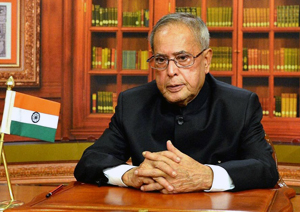
President's rule imposed in Uttarakhand

March 27, 2016

New Delhi, Mar 27: Uttarakhand was today brought under President's rule by the Centre on grounds of "breakdown of governance" in a controversial decision which comes in the wake of a political crisis triggered by a rebellion in the ruling Congress.president

President Pranab Mukherjee signed the proclamation under Art 356 of the Constitution dismissing the Congress government headed by Harish Rawat and placing the Assembly under suspended animation this morning on the recommendation of the Union Cabinet.
The Cabinet had held an emergency meeting here last night presided over by Prime Minister Narendra Modi, who had cut short a visit to Assam to return to the capital for the purpose.

The Cabinet considered several reports received from Governor K K Paul, who had described the political situation as volatile and expressed apprehensions over possible pandemonium during the scheduled trial of strength in the state Assembly tomorrow.

Finance Minister Arun Jaitley is believed to have briefed the President late last night explaining the rationale for the Cabinet's recommendation.

The dismissal of the Rawat government now renders tomorrow's confidence vote infructuous.

It also came amidst reports that Speaker Govind Singh Kunjwal had disqualified 9 rebel Congress MLAs that would have enabled Rawat to sail through in the trust vote.

The Congress denounced the decision calling it a "murder of democracy" and said it showed that BJP did not believe in democracy.

The political crisis in the state arose after the controversial circumstances in which the Appropriation Bill was declared passed in the Assembly by the Speaker with the BJP and the rebel Congress claiming that a division of votes pressed by them was not allowed.

They alleged that the Bill was defeated in the voice vote by a majority of the members present but the Speaker did not test it in a proper division of votes.

The opposition claimed that it had a majority of 35 MLAs, including 9 rebels, in the House that day out of 67 MLAs present. The BJP said the 35 MLAs had written to the Speaker in advance that they would be voting against the bill but the Speaker had refused to take it into his consideration.

Last night, the Union Cabinet met amidst reports that the Speaker had disqualified the rebel Congress MLAs that would would have helped the beleaguered government.

Apprehending imposition of President's rule, the Congress had attacked the BJP saying it was resorting to the extreme step as its earlier moves had failed.

Comments

Abdullah
 - 
Sunday, 27 Mar 2016

The president Pranab Mukerjee working as a RSS agent.

Add new comment

  • Coastaldigest.com reserves the right to delete or block any comments.
  • Coastaldigset.com is not responsible for its readers’ comments.
  • Comments that are abusive, incendiary or irrelevant are strictly prohibited.
  • Please use a genuine email ID and provide your name to avoid reject.
News Network
January 6,2020

Jan 6: Senior Bharatiya Janata Party leader Subramanian Swamy on Sunday said the country's economy is not showing good signs though Prime Minister Narendra Modi has manifested tremendous leadership skills in fighting terror and in social welfare projects.

The fiscal decisions of the government have not yielded the desired results, the Rajya Sabha MP said here.

"Modi had shown tremendous leadership skill in fighting terror, in several social areas, micro areas like bringing toilets to every village home. But the economy is a complex system...," he said while taking part in a discussion.

While every minister is talking about a 5 trillion dollar economy by 2024, but the current GDP growth has to be multiplied in four years to achieve that, the former Union minister said.

He said, if wages are slashed as a measure to cope with the situation, labor will become cheap but that will also cut down the people's purchasing power triggering dip in demand, closing down factories and rise in unemployment.

"This is one problem for which you really need an economist," he said.

Swamy said in jest, "I think Modi has one problem with me. Not only I am an economist but also a politician."

Comments

Add new comment

  • Coastaldigest.com reserves the right to delete or block any comments.
  • Coastaldigset.com is not responsible for its readers’ comments.
  • Comments that are abusive, incendiary or irrelevant are strictly prohibited.
  • Please use a genuine email ID and provide your name to avoid reject.
News Network
January 24,2020

New Delhi, Jan 24: Although India's Ujjwala programme encouraged adoption of liquefied petroleum gas (LPG) for cooking among the poor, households availing the scheme have not shifted away from using highly polluting fuels like firewood, a study reveals.

The researchers, including those from the University of British Columbia (UBC) in Canada, found that additional incentives to encourage regular use of cooking gas are necessary for a complete transition to clean cooking fuel among poor rural households.

They noted that about 2.9 billion people across Asia, Africa, and Latin America burn solid fuels like firewood to meet their cooking energy needs.

This has significant negative implications for public health, the environment, and societal development, according to the researchers.

Through the Pradhan Mantri Ujjwala Yojana (PMUY), India has provided capital cost subsidies to poor women to adopt a clean-burning cooking fuel or LPG.

The researchers explained that within the first 40 months of the scheme, more than 80 million households obtained LPG stoves.

However, the full benefits of LPG adoption depend on near complete replacement of polluting fuels with LPG, according to a research-based policy brief published in the journal Nature Energy.

The scientists said this cannot be assumed solely on the basis of LPG presence in the household.

"Our research shows that Ujjwala was able to attract new consumers rapidly, but those consumers did not start using LPG on a regular basis," Abhishek Kar, a postdoc at Columbia University in the US, told PTI.

The study analysed LPG sales data for over 25,000 consumers, including PMUY beneficiaries, as well as general rural LPG consumers in Koppal district of Karnataka.

The scientists employed data covering all LPG purchases of PMUY beneficiaries through their first year in the programme.

They also assessed the general rural population's purchases during their first five years as consumers to assess the effect of experience on use.

The findings estimate that an average rural family needs to purchase five 14.2 kilogramme-cylinders annually to meet half of their cooking needs.

However, the study said just seven per cent of PMUY beneficiaries in Koppal purchased five or more cylinders annually, suggesting that the beneficiaries seldom use LPG.

The general (nonPMUY) consumers in this region use on average two times more LPG cylinders than PMUY beneficiaries, the researchers noted.

Yet, only 45 per cent of nonPMUY consumers use five or more cylinders per year -- even after several years of experience with LPG, they said.

The team assessed price and seasonal factors affecting LPG use among the general population over a three-year period.

It found that LPG consumers are sensitive to price and seasonality -- LPG cylinder refill rates are lower in the summer when agricultural activity is limited, and cash is scarce.

"There was no scheme incentives to promote use, except general LPG subsidies which is available to all, including the urban middle class," said Kar, who was a Ph.D. scholar at UBC when the research was published.

"If there is no additional income, what cost would a poor family on an already tight budget cut to pay for an extra expense on a regular basis.

"Ujjwala has started the scheme of 5 kg-cylinder in response, but the impact of that on LPG sales is still publicly unknown," he said.

These findings, the researchers noted, suggest the need for additional measures to promote regular LPG use for all rural populations.

Although the finding come from a single district in Southern India, it may also apply to other areas with similar socio-economic conditions, they said.

A more expansive evaluation of PMUY would help design targeted incentives to transform infrequent users to regular users, according to the researchers.

Comments

Add new comment

  • Coastaldigest.com reserves the right to delete or block any comments.
  • Coastaldigset.com is not responsible for its readers’ comments.
  • Comments that are abusive, incendiary or irrelevant are strictly prohibited.
  • Please use a genuine email ID and provide your name to avoid reject.
News Network
March 29,2020

New Delhi, Mar 29 : Notwithstanding the 21-day coronavirus lockdown, the Reserve Bank of India (RBI) has decided to go ahead with the merger plan of ten state-run banks into four larger bank from April 1. The apex bank has issued four separate releases announcing that the branches of merging banks will operate as of the banks in which these have been amalgamated from next month.

RBI's statement comes after Finance Minister Nirmala Sitharaman's clarification on Thursday that the mega bank consolidation plan was very much on track and would take effect from April 1.

The government on March 4 had notified the amalgamation schemes for 10 state owned banks into four as part of its consolidation plan to create bigger size stronger banks in the public sector.

Bank officers' unions, however, earlier this week wrote to the prime minister seeking to defer the merger schemes of lenders due to the lockdown triggered by coronavirus outbreak.

As per the scheme, Oriental Bank of Commerce and United Bank of India will be merged into Punjab National Bank; Syndicate Bank into Canara Bank; Allahabad Bank into Indian Bank; and Andhra and Corporation banks into Union Bank of India.

Under this, the branches of Oriental Bank of Commerce and United Bank of India will operate as branches of Punjab National Bank from April 1, 2020, and branches of Syndicate Bank as that of Canara Bank, the RBI said in a separate releases.

Allahabad Bank branches will operate as those of Indian Bank while the branches of Andhra Bank and Corporation Bank will function as the branches of Union Bank of India from the beginning of next fiscal year 2020-21, the RBI said.

"The Amalgamation of Oriental Bank of Commerce and United Bank of India into Punjab National Bank Scheme, 2020 dated March 4, 2020, issued by the Government of India... The scheme comes into force on the 1st day of April 2020," RBI said.

Customers, including depositors of merging banks will be treated as customers of the banks in which these banks have been merged with effect from April 1, 2020, the RBI noted.

Banking services across the country are impacted due to the effect of COVID-19 as a near shut down is being observed across the country.

In a letter written to the Prime Minister on March 25, the All India Bank Officers'' Confederation (AIBOC) said, "The finance minister yesterday announced a slew of measures in view of the deleterious effect of the contagion. We are also expecting an extension of closing related activities and the revision of the closing date itself from March 31 to June 30, which is the need of the hour."

Comments

Add new comment

  • Coastaldigest.com reserves the right to delete or block any comments.
  • Coastaldigset.com is not responsible for its readers’ comments.
  • Comments that are abusive, incendiary or irrelevant are strictly prohibited.
  • Please use a genuine email ID and provide your name to avoid reject.