


President's rule imposed in Uttarakhand

March 27, 2016

New Delhi, Mar 27: Uttarakhand was today brought under President's rule by the Centre on grounds of "breakdown of governance" in a controversial decision which comes in the wake of a political crisis triggered by a rebellion in the ruling Congress.president
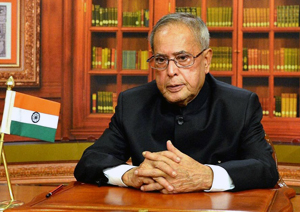
President Pranab Mukherjee signed the proclamation under Art 356 of the Constitution dismissing the Congress government headed by Harish Rawat and placing the Assembly under suspended animation this morning on the recommendation of the Union Cabinet.
The Cabinet had held an emergency meeting here last night presided over by Prime Minister Narendra Modi, who had cut short a visit to Assam to return to the capital for the purpose.

The Cabinet considered several reports received from Governor K K Paul, who had described the political situation as volatile and expressed apprehensions over possible pandemonium during the scheduled trial of strength in the state Assembly tomorrow.

Finance Minister Arun Jaitley is believed to have briefed the President late last night explaining the rationale for the Cabinet's recommendation.

The dismissal of the Rawat government now renders tomorrow's confidence vote infructuous.

It also came amidst reports that Speaker Govind Singh Kunjwal had disqualified 9 rebel Congress MLAs that would have enabled Rawat to sail through in the trust vote.

The Congress denounced the decision calling it a "murder of democracy" and said it showed that BJP did not believe in democracy.

The political crisis in the state arose after the controversial circumstances in which the Appropriation Bill was declared passed in the Assembly by the Speaker with the BJP and the rebel Congress claiming that a division of votes pressed by them was not allowed.

They alleged that the Bill was defeated in the voice vote by a majority of the members present but the Speaker did not test it in a proper division of votes.

The opposition claimed that it had a majority of 35 MLAs, including 9 rebels, in the House that day out of 67 MLAs present. The BJP said the 35 MLAs had written to the Speaker in advance that they would be voting against the bill but the Speaker had refused to take it into his consideration.

Last night, the Union Cabinet met amidst reports that the Speaker had disqualified the rebel Congress MLAs that would would have helped the beleaguered government.

Apprehending imposition of President's rule, the Congress had attacked the BJP saying it was resorting to the extreme step as its earlier moves had failed.

Comments

Abdullah
 - 
Sunday, 27 Mar 2016

The president Pranab Mukerjee working as a RSS agent.

Add new comment

  • Coastaldigest.com reserves the right to delete or block any comments.
  • Coastaldigset.com is not responsible for its readers’ comments.
  • Comments that are abusive, incendiary or irrelevant are strictly prohibited.
  • Please use a genuine email ID and provide your name to avoid reject.
News Network
January 13,2020

Jan 13: For the first time in years, the government of India’s Prime Minister Narendra Modi is playing defense. Protests have sprung up across the country against an amendment to India’s laws — which came into effect on Friday — that makes it easier for members of some religions to become citizens of India. The government claims this is simply an attempt to protect religious minorities in the Muslim-majority countries that border India; but protesters see it as the first step toward a formal repudiation of India’s constitutionally guaranteed secularism — and one that must be resisted.

Modi was re-elected prime minister last year with an enhanced majority; his hold over the country’s politics is absolute. The formal opposition is weak, discredited and disorganized. Yet, somehow, the anti-Citizenship Act protests have taken hold. No political party is behind them; they are generally arranged by student unions, neighborhood associations and the like.

Yet this aspect of their character is precisely what will worry Modi and his right-hand man, Home Minister Amit Shah. They know how to mock and delegitimize opposition parties with ruthless efficiency. Yet creating a narrative that paints large, flag-waving crowds as traitors is not quite that easy.

For that is how these protests look: large groups of young people, many carrying witty signs and the national flag. They meet and read the preamble to India’s Constitution, into which the promise of secularism was written in the 1970’s.

They carry photographs of the Constitution’s drafter, the Columbia University-trained economist and lawyer B. R. Ambedkar. These are not the mobs the government wanted. They hoped for angry Muslims rampaging through the streets of India’s cities, whom they could point to and say: “See? We must protect you from them.” But, in spite of sometimes brutal repression, the protests have largely been nonviolent.

One, in Shaheen Bagh in a Muslim-dominated sector of New Delhi, began simply as a set of local women in a square, armed with hot tea and blankets against the chill Delhi winter. It has now become the focal point of a very different sort of resistance than what the government expected. Nothing could cure the delusions of India’s Hindu middle class, trained to see India’s Muslims as dangerous threats, as effectively as a group of otherwise clearly apolitical women sipping sweet tea and sharing their fears and food with anyone who will listen.

Modi was re-elected less than a year ago; what could have changed in India since then? Not much, I suspect, in most places that voted for him and his party — particularly the vast rural hinterland of northern India. But urban India was also possibly never quite as content as electoral results suggested. India’s growth dipped below 5% in recent quarters; demand has crashed, and uncertainty about the future is widespread. Worse, the government’s response to the protests was clearly ill-judged. University campuses were attacked, in one case by the police and later by masked men almost certainly connected to the ruling party.

Protesters were harassed and detained with little cause. The courts seemed uninterested. And, slowly, anger began to grow on social media — not just on Twitter, but also on Instagram, previously the preserve of pretty bowls of salad. Instagram is the one social medium over which Modi’s party does not have a stranglehold; and it is where these protests, with their photogenic signs and flags, have found a natural home. As a result, people across urban India who would never previously have gone to a demonstration or a political rally have been slowly politicized.

India is, in fact, becoming more like a normal democracy. “Normal,” that is, for the 2020’s. Liberal democracies across the world are politically divided, often between more liberal urban centers and coasts, and angrier, “left-behind” hinterlands. Modi’s political secret was that he was that rare populist who could unite both the hopeful cities and the resentful countryside. Yet this once magic formula seems to have become ineffective. Five of India’s six largest cities are not ruled by Modi’s Bharatiya Janata Party in any case — the financial hub of Mumbai changed hands recently. The BJP has set its sights on winning state elections in Delhi in a few weeks. Which way the capital’s voters will go is uncertain. But that itself is revealing — last year, Modi swept all seven parliamentary seats in Delhi.

In the end, the Citizenship Amendment Act is now law, the BJP might manage to win Delhi, and the protests might die down as the days get unmanageably hot and state repression increases. But urban India has put Modi on notice. His days of being India’s unifier are over: From now on, like all the other populists, he will have to keep one eye on the streets of his country’s cities.

Comments

Add new comment

  • Coastaldigest.com reserves the right to delete or block any comments.
  • Coastaldigset.com is not responsible for its readers’ comments.
  • Comments that are abusive, incendiary or irrelevant are strictly prohibited.
  • Please use a genuine email ID and provide your name to avoid reject.
Agencies
June 2,2020

Lucknow, Jun 2: Bahujan Samaj Party chief Mayawati on Tuesday said protests in the US after the death of George Floyd, an African-American man, is a clear message to the world that a common man's life has value.

She said this is also guaranteed by the India Constitution, but the governments don't follow it, resulting in the current plight of migrants workers.

Floyd, a 46-year-old restaurant worker from Houston, died in Minneapolis on Monday after a white police officer pinned him to the ground. Video footage showed the officer kneeling on Floyd's neck as he gasped for breath, sparking widespread protests across the US.

"Floyd's killing by police and the 'Black lives matter' agitation in the US have given a clear message to the world that a common man's life has value and it should not be taken for granted," Mayawati said in a tweet in Hindi.

"India's constitution guarantees independence, security, self-respect and pride and governments should give special attention to it. If it was followed, crores of migrants labourers would not have to witness such bad days," she added.

She also demanded better coordination between states to check the spread of coronavirus and said Centre should intervene.

"While coronavirus patients are rising, there is lack of coordination between states and with the Centre, and allegation and counter-allegations are going on and sealing of state borders is unjustified and it is weakening the fight against the virus.  The Centre should intervene," she said in a separate tweet.

Comments

Add new comment

  • Coastaldigest.com reserves the right to delete or block any comments.
  • Coastaldigset.com is not responsible for its readers’ comments.
  • Comments that are abusive, incendiary or irrelevant are strictly prohibited.
  • Please use a genuine email ID and provide your name to avoid reject.
News Network
February 6,2020

New Delhi, Feb 6: DMK Lok Sabha member M K Kanimozhi on Wednesday challenged popular actor Rajinikanth to raise his voice for Muslims, saying they have "already been affected" by the Citizenship (Amendment) Act and are protesting on streets against the law.

Reacting to his statements earlier in the day in Chennai that "CAA is no threat to Muslims" and "if they face trouble I will be the first person to raise voice for them," Kanimozhi, daughter of former Tamil Nadu Chief Minister M Karunanidhi, told news agency that "Muslims in India have already been affected due to CAA".

"Let him (Rajinikanth) come forward and raise his voice for the affected Muslims", she said.

She said the members of the community have been protesting as the law leaves out Muslims.,

Asked whether Rajinikanth, through this pro-CAA statement, was moving closer to the BJP, the MP from Tuticorin said, "What he has said is no different from the BJP's narrative which we have been listening in parliament for the last few days".

Under CAA, members of Hindu, Sikh, Buddhist, Jain, Parsi and Christian communities who came to India from Pakistan, Bangladesh and Afghanistan till December 31, 2014, to escape religious persecution there will not be treated as illegal immigrants, and be given Indian citizenship.

Rajinikanth had asserted that the legislation did not pose any threat to Muslims. He wondered as to how Muslims, who chose to stay back in India following Partition will be sent out of the country. Besides, the central government had assured that Indian people will have no issues in view of CAA, he noted.

He charged that some political parties were instigating people against the CAA for their selfish interests.

Comments

Add new comment

  • Coastaldigest.com reserves the right to delete or block any comments.
  • Coastaldigset.com is not responsible for its readers’ comments.
  • Comments that are abusive, incendiary or irrelevant are strictly prohibited.
  • Please use a genuine email ID and provide your name to avoid reject.