Doctor's Benz hits 5 vehicles, crashes into house; biker killed, 4 injured

[email protected] (News Network)
March 28, 2016

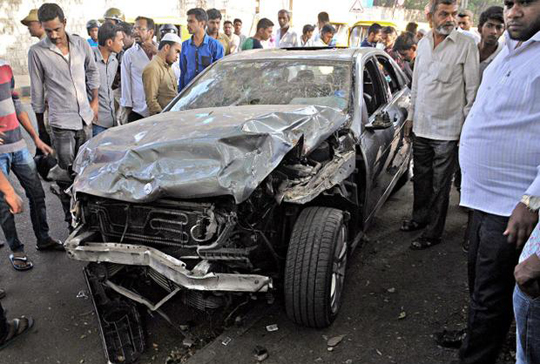
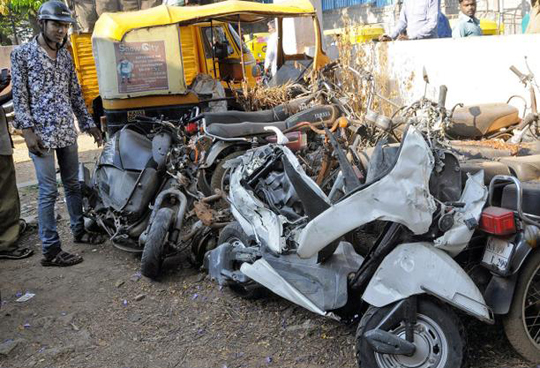
Bengaluru, Mar 28: A speeding luxury car, driven by a 55-year-old doctor, rammed at least five vehicles over a stretch of 1 km and crashed into a house before coming to a halt in Jayanagar on Sunday. A two-wheeler rider was killed and four people were injured in the accident.benz

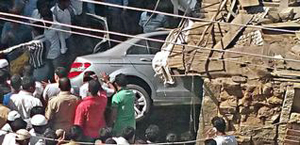
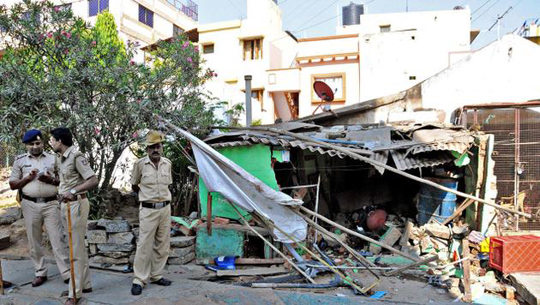
Around 2.15 pm, Dr Shankar N H (55), an Orthopaedician, was driving his high-end car. At Madhavan Park, he brushed past a car. Fearing repercussions, Shankar sped towards Byrasandra main road where his car rammed into a bike and two cars, injuring three people. Dr Shankar then sped ahead and rammed into Rizwan alias Ahmed Khan's (52) bike. The Benz came to a halt only after it ran into a roadside house, damaging it completely. Rizwan was killed on the spot, police said.

Swift action by the police saved orthopaedician Dr Shankar N H, who drove his Mercedes Benz car into three cars and two bikes, between Madhavan Park and Byrasandra in Jayanagar on Sunday afternoon, killing one and injuring three. The police secured Dr Shankar in the nick of time.

Lokesh Kumar, DCP (South), said that the police acted quickly and took away Dr Shankar from the spot and shifted him to a hospital, as he was bleeding from his ears. His domestic help Sarita and her child, who were also in the car, were taken to another hospital for treatment.

Around 20 policemen were sent to the spot to disperse the mob. If the police had reached the spot late even by a few minutes, the mob would have thrashed Dr Shankar and set his car on fire, the policemen told Deccan Herald.

The crowd turned a bit violent when Sarita re-appeared with her child at the scene for reasons unknown. A few of them pushed her, but the police took the woman and child to safety. Sarita told reporters that Dr Shankar had an epilepsy attack and lost control over the vehicle.

The airbags in the car saved the life of Shankar and Sarita. As soon as Shankar crashed his car into the house, the airbags opened up. Sampath Kumar, the owner of a grocery shop, said: “As I was coming from the Ashoka Pillar side, I noticed the driver of the Benz car driving in a reckless manner and thought that he would bang somewhere. When I reached Byrasandra, I noticed the damage.”

Almost a year ago, Shankar was booked under the Domestic Violence Act as his wife had approached the police, saying that he was harassing her for various reasons. The police had booked a case against him and even warned Shankar, said a senior police officer.

Family's fortuitous absence
The residents of the house in Byrasandra which was damaged were lucky that they were away when the accident happened.

Nagalakshmi, the owner of the house, said, “Our relatives Somashekar, his wife Rathnamma and their children reside in the house. On Sunday morning, they went to Mysuru as one of their relatives had delivered a baby. If they were in the house, the situation would have been different. Usually, Somashekar and his wife sell coconuts in front of the house and if they were present today, they may have been killed.”

benzz1

benzz2

benzz3

Comments

Sheldon
 - 
Friday, 1 Apr 2016

Definitely imagine that which you said. Your favourite justification seemed to be at
the web the easiest thing to have in mind of. I say to you, I definitely get irked at the same time as other people consider concerns that they
just do not know about. You managed to hit the nail upon the top and outlined out the whole
thing without having side effect , other people could take a signal.

Will likely be back to get more. Thank you

Also visit my homepage :: http://www.laviagraes.com/como-debo-usar-la-viagra: http://www.laviagraes.com/como-debo-usar-la-viagra

Satyameva jayate
 - 
Monday, 28 Mar 2016

Bas kuch dinon kee baath hai...doctor jaayega gharme ....victims Gaye bhaadme......aisa des hai meraa....
Where is hema malini and smriti Irani..ha haa

Irsa
 - 
Monday, 28 Mar 2016

But the real fact is the POLICE which are 60% were almost releasing the Culprit who was Drunk and Driving despite being Doctor.....but SDPI Corporator Mr.Mujahid Pasha rushed to the scene and stopped his release

Add new comment

  • Coastaldigest.com reserves the right to delete or block any comments.
  • Coastaldigset.com is not responsible for its readers’ comments.
  • Comments that are abusive, incendiary or irrelevant are strictly prohibited.
  • Please use a genuine email ID and provide your name to avoid reject.
Ram Puniyani
February 10,2020

Noam Chomsky is one of the leading peace workers in the world. In the wake of America’s attack on Vietnam, he brought out his classic formulation, ‘manufacturing consent’. The phrase explains the state manipulating public opinion to have the public approve of it policies—in this case, the attack of the American state on Vietnam, which was then struggling to free itself from French colonial rule.

In India, we are witness to manufactured hate against religious minorities. This hatred serves to enhance polarisation in society, which undermines India’s democracy and Constitution and promotes support for a Hindu nation. Hate is being manufactured through multiple mechanisms. For example, it manifests in violence against religious minorities. Some recent ghastly expressions of this manufactured hate was the massive communal violence witnessed in Mumbai (1992-93), Gujarat (2002), Kandhamal (2008) and Muzaffarnagar (2013). Its other manifestation was in the form of lynching of those accused of having killed a cow or consumed beef. A parallel phenomenon is the brutal flogging, often to death, of Dalits who deal with animal carcasses or leather.

Yet another form of this was seen when Shambhulal Regar, indoctrinated by the propaganda of Hindu nationalists, burned alive Afrazul Khan and shot the video of the heinous act. For his brutality, he was praised by many. Regar was incited into the act by the propaganda around love jihad. Lately, we have the same phenomenon of manufactured hate taking on even more dastardly proportions as youth related to Hindu nationalist organisations have been caught using pistols, while police authorities look on.

Anurag Thakur, a BJP minster in the central government recently incited a crowd in Delhi to complete his chant of what should happen to ‘traitors of the country...” with a “they should be shot”. Just two days later, a youth brought a pistol to the site of a protest at Jamia Millia Islamia university and shouted “take Azaadi!” and fired it. One bullet hit a student of Jamia. This happened on 30 January, the day Nathuram Godse had shot Mahatma Gandhi in 1948. A few days later, another youth fired near the site of protests against the CAA and NRC at Shaheen Bagh. Soon after, he said that in India, “only Hindus will rule”.

What is very obvious is that the shootings by those associated with Hindu nationalist organisations are the culmination of a long campaign of spreading hate against religious minorities in India in general and against Muslims in particular. The present phase is the outcome of a long and sustained hate campaign, the beginning of which lies in nationalism in the name of religion; Muslim nationalism and Hindu nationalism. This sectarian nationalism picked up the communal view of history and the communal historiography which the British introduced in order to pursue their ‘divide and rule’ policy.

In India what became part of “social common sense” was that Muslim kings had destroyed Hindu temples, that Islam was spread by force, and that it is a foreign religion, and so on. Campaigns, such as the one for a temple dedicated to the Hindu god Rama to be built at the site where the Babri masjid once stood, further deepened the idea of a Muslim as a “temple-destroyer”. Aurangzeb, Tipu Sultan and other Muslim kings were tarnished as the ones who spread Islam by force in the subcontinent. The tragic Partition, which was primarily due to British policies, and was well-supported by communal streams also, was entirely attributed to Muslims. The Kashmir conflict, which is the outcome of regional, ethnic and other historical issues, coupled with the American policy of supporting Pakistan’s ambitions of regional hegemony, (which also fostered the birth of Al-Qaeda), was also attributed to the Muslims.

With recurring incidents of communal violence, these falsehoods went on going deeper into the social thinking. Violence itself led to ghettoisation of Muslims and further broke inter-community social bonds. On the one hand, a ghettoised community is cut off from others and on the other hand the victims come to be presented as culprits. The percolation of this hate through word-of-mouth propaganda, media and re-writing of school curricula, had a strong impact on social attitudes towards the minorities.

In the last couple of decades, the process of manufacturing hate has been intensified by the social media platforms which are being cleverly used by the communal forces. Swati Chaturvedi’s book, I Am a Troll: Inside the Secret World of the BJP’s Digital Army, tells us how the BJP used social media to spread hate. Whatapp University became the source of understanding for large sections of society and hate for the ‘Other’, went up by leaps and bounds. To add on to this process, the phenomenon of fake news was shrewdly deployed to intensify divisiveness.

Currently, the Shaheen Bagh movement is a big uniting force for the country; but it is being demonised as a gathering of ‘anti-nationals’. Another BJP leader has said that these protesters will indulge in crimes like rape. This has intensified the prevalent hate.

While there is a general dominance of hate, the likes of Shambhulal Regar and the Jamia shooter do get taken in by the incitement and act out the violence that is constantly hinted at. The deeper issue involved is the prevalence of hate, misconceptions and biases, which have become the part of social thinking.

These misconceptions are undoing the amity between different religious communities which was built during the freedom movement. They are undoing the fraternity which emerged with the process of India as a nation in the making. The processes which brought these communities together broadly drew from Gandhi, Bhagat Singh and Ambedkar. It is these values which need to be rooted again in the society. The communal forces have resorted to false propaganda against the minorities, and that needs to be undone with sincerity.

Combating those foundational misconceptions which create hatred is a massive task which needs to be taken up by the social organisations and political parties which have faith in the Indian Constitution and values of freedom movement. It needs to be done right away as a priority issue in with a focus on cultivating Indian fraternity yet again.


Comments

Add new comment

  • Coastaldigest.com reserves the right to delete or block any comments.
  • Coastaldigset.com is not responsible for its readers’ comments.
  • Comments that are abusive, incendiary or irrelevant are strictly prohibited.
  • Please use a genuine email ID and provide your name to avoid reject.
News Network
April 18,2020

Bengaluru, Apr 18: Karnataka Congress president DK Shivakumar on Saturday appealed to Prime Minister Narendra Modi to deposit at least Rs 10,000 in bank accounts of people belonging to the unorganised sector.

"The unorganised sector comprises barbers, dhobi, cooks, carpenters, sweepers, drivers and autorickshaw drivers. Prime Minister Narendra Modi did not mention anything about giving subsistence to these people," Shivakumar, told ANI, referring to the Prime Minister's address earlier this week.

Modi had announced the extension of the ongoing nationwide lockdown till May 3 in order to curb the spread of coronavirus.

"I appeal to Prime Minister Modi to register the members of the unregistered sector under the National Rural Employment Guarantee Act (NREGA) or deposit at least Rs 10,000 to the bank accounts of each of the members of unorganised sector to help them survive the lockdown," he added.

Though the Congress party will continue the central government and state government's fight against coronavirus, he said, both the governments need to help people who are part of the unorganised sector.

"The farmers have told me that due to the lockdown they are ready to sell the vegetables, which once used to be sold at Rs 100 per kg, at even Rs 5 per kg," he said.

Speaking on the suggestions he made to Chief Minister BS Yediyurappa, Shivakumar said, "I requested the Chief Minister to send a team to do a videograph and make an assessment of the on-ground situation. However, till now, no one has gone."

Comments

Add new comment

  • Coastaldigest.com reserves the right to delete or block any comments.
  • Coastaldigset.com is not responsible for its readers’ comments.
  • Comments that are abusive, incendiary or irrelevant are strictly prohibited.
  • Please use a genuine email ID and provide your name to avoid reject.
News Network
February 18,2020

Bengaluru, Feb 18: Deputy chief minister Laxman Savadi was elected to the legislative council on Monday and although it was a done deal that he would win, a vote from across the aisle spiced up the election.

Counting was conducted soon after ballots were cast and Savadi polled 113 of the 120 votes cast, including the vote of disgruntled JD(S) legislator GT Devegowda. Seven votes were declared invalid. Members of the two opposition parties — Congress and JD(S) — abstained from voting.

The election was necessitated following the resignation of Rizwan Arshad of the Congress. Rizwan resigned after he was elected to the legislative assembly from the Shivajinagar constituency in the assembly bypolls held for 15 seats in December last year.

BR Anil Kumar, who was initially promised the support of both Congress and JD(S) was supposed to contest as an independent candidate. However, as both parties refused to support him at the last minute, he withdrew, paving the way for Savadi’s victory.

The BJP has 117 members in the 225-member assembly, but N Mahesh of the BSP and two independents, H Nagesh and Sharath Bachchegowda, besides GT Devegowda also voted, taking the total electorate to 120 (including the speaker). BJP’s SA Ramadas did not turn up because of health reasons.

“I would like to thank all those who were responsible for my victory. Special thanks to leaders of my party and chief minister BS Yediyurappa, who gave me the opportunity to be the BJP candidate,” said Savadi.

Winning this council election was crucial for Savadi to retain his ministry as he was not an elected member of either of the houses. Rules mandate that a non-member must get elected either to the assembly or council within six months after taking over as minister. February 20 was the deadline for Savadi, who had lost 2018 assembly polls from Athani, to get elected.

Officials in the assembly secretariat said seven votes were invalid because voters had wrongly marked their choices on ballot paper. According to norms, a voter has to mark numerical one, two and three against the names of the candidates in order of preference. Marking only numerical one is allowed. However, six ballots had a tick mark, while a voter had registered a cross mark. Since it was a secret ballot, it was not known who the MLAs were whose votes were invalid.

“The ballot papers bear serial numbers and they are randomly distributed. It is virtually impossible to say who a voter cast his or her vote for,” said assembly secretary MK Vishalakashi, the retuning officer for the bypoll.

Comments

Add new comment

  • Coastaldigest.com reserves the right to delete or block any comments.
  • Coastaldigset.com is not responsible for its readers’ comments.
  • Comments that are abusive, incendiary or irrelevant are strictly prohibited.
  • Please use a genuine email ID and provide your name to avoid reject.