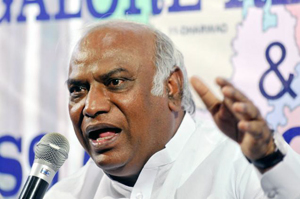
Convene legislature party meet to discuss ACB, Kharge tells Siddu

March 31, 2016

New Delhi, Mar 31: A day after former chief minister S M Krishna's meeting with Congress president Sonia Gandhi and vice-president Rahul Gandhi, senior Congress leader Mallikarjuna Kharge on Wednesday said Chief Minister Siddaramaiah should convene the Congress Legislature Party meeting immediately and take the party's view on the decision to set up the Anti-Corruption Bureau.

KHARGEKharge's statement gains significance as Krishna, at the meeting, cautioned about the decision to set up the ACB.

The chief minister should clarify the doubts about the ACB in the party forum and put an end to the controversy, Kharge told Deccan Herald.

“Congress always favoured a strong Lokpal to fight corruption. This is my stand also,” he said.

The State government has formed the ACB, which exists in 15 states. However, before taking such a decision, the chief minister should have discussed the pros and cons in the party forum, he said.

Dismissing charges that he had supported the move to “weaken” the Lokayukta, Kharge said he had never indulged in such activities.

Neither did he support the ACB nor had he given any suggestions on it, Kharge, Congress party leader in the Lok Sabha, said.

Dismissing media speculations that he had supported the ACB after his recent meeting with the chief minister, Kharge said that he was not at all a party to this controversy.

Earlier, senior Congress leader Janardhana Poojary had suggested the chief minister to reconsider the decision to set up the ACB.

Comments

Pramod
 - 
Thursday, 31 Mar 2016

what to discuss, corrupt govt all they do best to loot the state money as soon as possible, their term will be finishing soon before that they have to loot the money.

Mohan Kulakarni
 - 
Thursday, 31 Mar 2016

everything s fake from congress ruled state, kharge is no 1 Fraudster.

Add new comment

  • Coastaldigest.com reserves the right to delete or block any comments.
  • Coastaldigset.com is not responsible for its readers’ comments.
  • Comments that are abusive, incendiary or irrelevant are strictly prohibited.
  • Please use a genuine email ID and provide your name to avoid reject.
News Network
April 2,2020

Bengaluru, April 2: At least three people have been arrested by police in connection with the attack on ASHA worker Krishnaveni in Bengaluru's Byatarayanapura area.

Earlier in the day, Bengaluru Police Commissioner Bhaskar Rao said that an investigation was initiated into the incident in which ASHA workers were attacked.

"I have appointed Pulikeshi Nagar ACP, Tabarak Fathima, to investigate the matter. A case will be registered and action will be taken. ASHA workers will be protected by the police to carry out their functions," Rao told ANI here.

Earlier, Karnataka Deputy Chief Minister CN Ashwath Narayan visited one of the ASHA workers who was allegedly attacked by unidentified miscreants and termed the incident as "completely demoralising" for the workers.

ASHA workers, who were deployed to spread awareness about coronavirus and identify suspected cases, were allegedly attacked by a group of locals in Byatarayanapura here on Wednesday.

The workers said that the locals did not allow them to work and around 100 people gathered at the spot and harassed them.

This comes as the country is under a 21-day lockdown to prevent the spread of coronavirus.

Comments

Add new comment

  • Coastaldigest.com reserves the right to delete or block any comments.
  • Coastaldigset.com is not responsible for its readers’ comments.
  • Comments that are abusive, incendiary or irrelevant are strictly prohibited.
  • Please use a genuine email ID and provide your name to avoid reject.
News Network
August 4,2020

Bengaluru, Aug 4: Police barricades, yellow banners, walls with a fresh coat of paint and the sounds of bhajan mark parts of Ayodhya as the city awaits its big day Wednesday, when the first brick will be laid for the Ram temple.

Ayodhya is decked up for the bhoomi pujan that will be attended at the Ram Janmabhoomi by 175 people, who figure in a select guest list of seers and politicians topped by Prime Minister Narendra Modi.

Concerned over the spread of coronavirus, the authorities are encouraging others not to come to the temple town, asking them to mark the occasion by celebrating at their homes. The groundbreaking ceremony will be telecast live.

Roads leading to Ayodhya display hoardings with the picture of the proposed Ram temple and of Ram Lalla, the infant Ram, the deity now housed in a makeshift temple.

Around the town’s Hanumangarhi area – named after a well-known temple which Modi will visit on Wednesday – both police sirens and ‘bhajans’ in praise of Ram are heard.

Most of the shops in the locality wear a new look, with their fronts painted in bright yellow. A large number of policemen were deployed there on Tuesday. Some sat in the sweet shops, waiting for their next instructions.

Roads leading into the area are barricaded. Yards of yellow cloth and marigold garlands were being hung on poles.

Even on the day before the event, security checks on vehicles heading to Ayodhya begin from adjoining Barabanki district itself on the Lucknow-Ayodhya road. Policemen take down details, including mobile numbers of the travellers.

Senior Superintendent of Police Deepak Kumar said the focus of the force is on maintaining the Covid-19 protocol.

“So we are not going to allow any outsider to enter Ayodhya city,” he said. Prohibitory orders are also in force and not more than four people will be allowed to gather.

“The markets and shops will remain open but with strict adherence to the Covid protocol,” he said. Outsiders will be stopped from entering the city, but Ayodhya residents will be allowed in if they produce any identification document.

“We are also carrying out random checks on people living in Ayodhya to ensure that no outsiders are staying here,” he said.

The city’s temples and mosques will remain open, but no other religious event – except for the bhoomi pujan – will take place on Wednesday.

Pickets have been set up at sensitive points in the city.

Sub-inspector Ram Chandra Yadav and constables Avnish Kumar and Ankit Chaudhary man the Terhi Bazar Chauraha picket near the Ram Janmabhoomi site.

"We are here for the past some days, and were on duty on the Rakshabandhan day. Duty comes first and only after that come other things in life, like festivals," Yadav said.

Mayank Gupta, who runs a restaurant, was handing out food packets to policemen, his customers.

"For the last two months, I have been providing tiffin to them twice a day. There are around 100 policemen to whom I supply tiffin," Gupta said.

Comments

Add new comment

  • Coastaldigest.com reserves the right to delete or block any comments.
  • Coastaldigset.com is not responsible for its readers’ comments.
  • Comments that are abusive, incendiary or irrelevant are strictly prohibited.
  • Please use a genuine email ID and provide your name to avoid reject.
Agencies
July 5,2020

The deadly coronavirus that entered India while there was still nip in the air has beaten rising mercury, humid conditions, unique Indian genome and has entered monsoon season with more potency as fresh cases are only breaking all records in the country.

India recorded a single-day spike of record 24,850 new coronavirus cases on Sunday, taking its total tally to 6.73 lakh corona-positive cases.

Top Indian microbiologists were hopeful in March that after the 21-day lockdown, as summer approaches, the rise in temperature would play an important role in preventing the drastic spread of COVID-19 virus in India.

Several virologists hinted that by June this year, the impact of COVID-19 would be less than what it appeared in March-April.

The claims have fallen flat as the virus is mutating fast, becoming more potent than ever.

According to experts, the novel coronavirus is a new virus whose seasonality and response to hot humid weather was never fully understood.

"The theory was based on the fact that high temperatures can kill the virus as in sterilisation techniques used in healthcare. But these are controlled environment conditions. There are many other factors besides temperature, humidity which influence the transmission rate among humans," Dr Anu Gupta, Head, Microbiologist and Infection Control, Fortis Escorts Heart Institute, told IANS.

There is no built-up immunity to COVID-19 in humans.

"Also, asymptomatic people might be passing it to many others unknowingly. New viruses tend not to follow the seasonal trend in their first year," Gupta emphasized.

Globally, as several countries are now experiencing hot weather, the World Health Organization (WHO) reported a record hike in the number of coronavirus cases, with the total rising by 2,12,326 in 24 hours in the highest single-day increase since COVID-19 broke out.

So far over 11 million people worldwide have tested positive for the disease which has led to over 5,25,000 deaths, according to data from Johns Hopkins University. The US remained the worst-hit country with over 28 lakh cases, followed by Brazil with 15.8 lakh.

According to Sandeep Nayar, Senior Consultant and HOD, Respiratory Medicine, Allergy & Sleep Disorders, BLK Super Speciality Hospital in New Delhi, whether temperature plays a role in COVID-19 infection is highly debated.

One school of thought said in the tropical regions of South Asia, the virus might not thrive longer.

"On the other hand, another school of thought has found that novel Coronavirus can survive in a hot and humid environment and tropical climate does not make a difference to the virus. According to them, this is what distinguishes the novel coronavirus from other common viruses, which usually wane in hot weather," stressed Nayar.

Not much has been studied in the past and no definite treatment or vaccine is available to date.

"Every day, new properties and manifestation of the disease come up. As of now, the only way to prevent this monster is by taking appropriate precautions. Hand hygiene, social distancing, cough etiquette and face masks definitely reduce spread of COVID-19 infection," Nayar told IANS.

Not just top Indian health experts, even Indian-American scientists had this theory in mind that sunshine and summer may ebb the spread of the coronavirus.

Ravi Godse, Director of Discharge Planning, UPMC Shadyside Pennsylvania in the US told IANS in April: "In the summer, the humidity can go up as well, meaning more water drops in the air. If the air is saturated with water and somebody sneezes virus droplets into such air, it is likely that the droplets will fall to the ground quicker, making them less infectious. So the short answer is yes, summer/sunshine could be bettera.

According to Dr Puneet Khanna, Head of Respiratory Medicine and Pulmonology, Manipal Hospital, Delhi, COVID-19 death rates are not too different in tropical countries but since the disease affected them late it was yet to show its peak in these areas.

"The virus can survive well in hot and humid countries and this is proven now," he stressed.

Comments

Add new comment

  • Coastaldigest.com reserves the right to delete or block any comments.
  • Coastaldigset.com is not responsible for its readers’ comments.
  • Comments that are abusive, incendiary or irrelevant are strictly prohibited.
  • Please use a genuine email ID and provide your name to avoid reject.