


Rise in kidney ailments overload dialysis units

December 16, 2015

Bengalur, Dec 16: The rising number of kidney ailments, due to the increasing cases of non-communicable diseases, has posed a serious challenge to the government. The limited dialysis facilities are witnessing an overload.
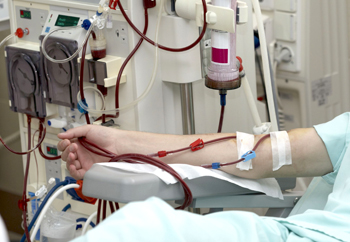
kidneyAt least two lakh people undergo dialysis in the State. Speaking to media persons, Dr Keshavamurthy R, director, Institute of Nephro Urology, said that with non-communicable diseases such as diabetes on the rise, those with kidney ailments are seen in good numbers.

The Institute sees a patient overload most of the time. With 25 units in place, 60 to 65 people undergo dialysis every day, while a good number are asked to await their turn. “No matter how many units are started, they are occupied because patients are seen in growing numbers,” he said.

This Institute sees patients from West Bengal and Odisha as well. “The diagnosis is done and we put them on dialysis.

Later, they are sent back to their respective places unless their condition is serious as a very small number can be treated completely or can undergo a transplant. The rest have to be on dialysis for life,” he said.

Institute expansion

The autonomous institute will undergo expansion soon. A proposal has been sent to the government for construction of a four-storey building on a plot behind the present premises. With this, 45 more beds will be added. If approved, the construction will begin in the next six months.

PPP model

If infrastructure is one challenge, inadequate manpower is another. For a dialysis centre to be functional, at least one nephrologist, a technician and nurses trained in dialysis are a must.

However, with not enough specialists on hand, the department of health and family welfare and that of medical education have resorted to training general physicians to carry out the procedure. One doctor from each taluk is undergoing training by turns at the Institute of Nephro Urology to be able to go back and run dialysis units.

Meanwhile, Dr G Vamadev, director, department of health and family welfare, said that they had sought a report from all districts on the number of dialysis units available and the want of manpower.

“There is a proposal to start dialysis units on a public-private partnership model. The government will provide the infrastructure necessary, while the other party will run the centre with manpower and consumables,” he said.

Comments

Add new comment

  • Coastaldigest.com reserves the right to delete or block any comments.
  • Coastaldigset.com is not responsible for its readers’ comments.
  • Comments that are abusive, incendiary or irrelevant are strictly prohibited.
  • Please use a genuine email ID and provide your name to avoid reject.
News Network
March 29,2020

Bengaluru, Mar 29: There was no shortage of masks and testing kits for detecting coronavirus cases in Karnataka and the government would import them if a need arose, Chief Minister B S Yediyurappa on Sunday said.

Apprising leaders of political parties on measures taken by his government to combat spread of coronavirus, he also told an all-party meeting that the government has decided to provide life insurance cover to police and civil workers and has taken extra precautions to maintain supply of food grains.

"There is no shortage of testing kits, medicines and masks. If there is need, we will import more... We will distribute testing kits to all the district and Taluk hospitals," he was quoted as saying in a government release.

The state has so far reported 76 COVID-19 cases including three deaths and five discharges.

At the meeting held in the Vidhana Soudha here, former chief minister and senior Congress leader Siddaramaiah said there were shortcomings in the screening of passengers coming from abroad and stressed on the need to maintain supply of essentials.

Yediyurappa said supply of foodgrains would be made through Public Distribution System and the government had taken extra precautions to avoiod any difficulties.

He told the leaders that there was no restriction on agriculture activities in the state.

"I have been regularly holding meetings since March 13 regarding the measures taken to contain the transmission of COVID-19," the chief minister said.

Health Minister B Sriramulu, Medical Education Minister Dr K Sudhakar, IT-BT Minister C N Aswath Narayan, Deputy Chief Minister Laxman Savadi, Siddaramaiah, JD(S) MLAs H D Revanna, D K Shivakumar and former speaker K R Ramesh Kumar attended the meeting.

Yediyurappa said a task force comprising of ministers and officials has been formed to oversee the implementation of the government orders in view of the 21-day lockdown.

He highlighted the prevailing situation across the globe saying normal life has been paralysed everywhere.

The chief minister also brifed the leaders about the number of clinics all over the state, availability of medicines and protection gear for the doctors and in quarantine rooms in the state.

Flagging concerns over screening process, Siddaramaiah said around 4,500 people were yet to be tracked, which need to be taken up on a warfooting.

"The government is saying that we have not reached the third stage but in Nanjangud, a person contracted the disease though he does not have any travel history. This must be probed," he said.

The former former chief minister asked the government to make sure that the free distribution of food grains to weaker sections take place without any difficulty from April 1, as announced by the Central government.

He objected to police 'excesses' while enforcing lockdown.

Siddaramaiah also asked government to bring the police personnel under special insurance cover.

Comments

Add new comment

  • Coastaldigest.com reserves the right to delete or block any comments.
  • Coastaldigset.com is not responsible for its readers’ comments.
  • Comments that are abusive, incendiary or irrelevant are strictly prohibited.
  • Please use a genuine email ID and provide your name to avoid reject.
News Network
April 15,2020

Bengaluru, Apr 15: Police on Wednesday conducted surprise raids at nearly 120 shops in Bengaluru following complaints of black marketing and sale of foodgrains above the MRP rate.

Sandip Patil, Joint Commissioner of Police, Crime, Bengaluru in a tweet said that action has been initiated against these shopkeepers.

Though the government has maintained the supply chain of essential items, few shopkeepers have used the lockdown opportunity to charge higher prices for essential items.

Comments

Sharief
 - 
Thursday, 16 Apr 2020

Need tough punishment.

Instead of helping with lesser price, troubling the people. These are cruels.

Add new comment

  • Coastaldigest.com reserves the right to delete or block any comments.
  • Coastaldigset.com is not responsible for its readers’ comments.
  • Comments that are abusive, incendiary or irrelevant are strictly prohibited.
  • Please use a genuine email ID and provide your name to avoid reject.
News Network
March 28,2020

Bengaluru, Mar 28: Sun Tsu, in 'The Art of War' speaks of a skilful general who can subdue his enemy without any fighting. This constitutes the ultimate triumph which is referred to as stratagem. Today, we would need one such when we are faced with the '21-day corona challenge' for India.
Nearly four weeks back, Dr Jyothsna Rao, Dr Gururaj Rao and I sat across the OPD in the afternoon at HCG Bengaluru discussing our ongoing cancer immunology research. While on this topic, we drifted into the discussion on the coronavirus. During this engaging discussion, we wondered the similarity of the enigma between the virus and cancer. I paused to ask Dr Jyothsna and Dr Guru - how we wish we could do something against this virus.
Dr Jyothsna is a PhD from NCBS and had worked under Dr Ralph Steinman, physician and researcher from Rockefeller University, who won the Nobel Prize for his discovery of the dendritic cell and its role in adaptive immunity in 2011. Dr Gururaj is a molecular and cell biologist who did his PhD at the Chapel Hill, University of North Carolina and is the Director of iCrest.
Jyothsna while hearing our perplexing conversation on the covid intervened, "Yes, surely. I think we should take a break from cancer and focus on the innate and adaptive immunity role in COVID-19."
Thus began this sincere attempt to relook the human immune system from the eyes of the COVID-19.
We have 10 types of immune cells at the least which are widely dispersed in millions across the body. When our body is invaded by a foreign organism (bacteria, fungi or virus), these cells work with each other to destroy the invader.
Now, the question is - how do the immune cells talk to each other? They use small-molecule substances called cytokines (cyto means cells; kine means movement). There are many cytokines that are involved in work on the immune system. The most relevant for viruses are interferons.
Interferons (IFN) as the name reflects have an ability to interfere with the viral activity and stop their multiplication. These specialised signal proteins are released by our cells in response to a viral attack to forewarn other cells. They help build the antiviral proteins within the cells to kill the virus as it tries to invade the new cells.
Historically, interferons are a group of cytokines known to be potent antiviral agents against viruses and a hallmark cytokine induced by the host upon viral infections. Interferons possess unique immunoregulatory activities and are signature cytokines released by (TH1) T immune cells, which are crucial in viral infections.
As the outbreak of COVID-19 grapples us, an urgent need for finding strategies to combat the virus is growing. Coronaviruses (CoVs) are a group of RNA viruses. In patients infected with coronavirus, it was indicated that the activation of the IFN does not occur until 48 hours post-infection. Thus the delayed IFN-related antiviral response by the healthy cells leads to coronavirus evade the immune response.
Numerous studies have presented the success in defeating CoVs by the direct administration of IFNs. In a combination as a concoction, it was shown to synergistically inhibit the virus replication in vitro.
Moreover, it is understood that the earlier induction of IFNs in children although they have a less developed immune system could be the reason behind the children being least affected.
The key to success in reducing the disease fatality might be the stimulation of the immune responses to trigger IFN production at the very early stages of the disease, which might be done through the administration of IFN. Despite the evidence for the efficacy of IFNs in treating CoV-induced infections, the proper dosing and ideal timing for such interventions needs to be verified in clinical trials.
For the later stages of the diseases in advance stages where patients are on ventilator and have developed respiratory distress, we propose to utilise the mesenchymal cells derived from donor bone marrow that have been known to treat acute respiratory syndrome. Mesenchymal cells are known to possess anti-inflammatory activity and thus used often in autoimmune diseases.
With this scientific background, we have activated T cells from healthy donors, in a cGMP facility at iCrest - HCG hospital with an enriched cocktail of cytokines rich in Interferons. Injections of this cocktail we believe will result in a surge of cytokines in the body of the infected person and will boost his ability to fight the virus in the early phases. We are in the initial phases of this study and hope to be ready in the coming weeks with meaningful data on its potential utility.
Currently, it awaits government approvals (Union and state) and we have applied to central drugs authority for their initial evaluation and further directions.
As my Guru often expounded the philosophy of 'Seva' - the goal of education is knowledge, the end goal of knowledge is service. In this attempt to serve our fellow humans at this brink of unprecedented crisis, medical fraternity stands with you and promises to do our best for your safety.
We assure to exhaust every bit of our spirit in this fight against coronavirus. We have lost the sight of shores and travelled thus far, but that is the mandatory first step to cross the ocean. Are we going to succeed in this battle, is something only time will answer. 

Comments

Add new comment

  • Coastaldigest.com reserves the right to delete or block any comments.
  • Coastaldigset.com is not responsible for its readers’ comments.
  • Comments that are abusive, incendiary or irrelevant are strictly prohibited.
  • Please use a genuine email ID and provide your name to avoid reject.