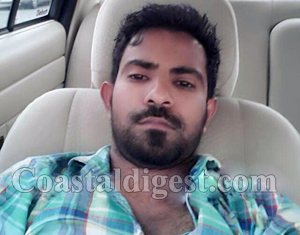
Youth from Uppinangady dies in Saudi Arabia

[email protected] (CD Network)
April 1, 2016

asifattackMangaluru, Apr 1: An Indian expatriate worker hailing from Uppinangady in Dakshina Kannada died of cardiac arrest in Saudi Arabia on Thursday.

Mohammed Asif, Son of Abbas Thekkaru is the deceased. He had flown into Saudi Arabia eight months ago in search of a job. Within a few days he had secured a house driver job in Dammam.

It is learnt that he had planned to visit his hometown within a few days to attend his brother's wedding. The reason for sudden cardiac arrest is not yet known.

He is survived by his parents, five brothers and a sister. His last rites were carried out in Saudi Arabia after obtaining permission from family members.

Comments

shaima umar farooq
 - 
Saturday, 2 Apr 2016

Innalillahi wainnailahi rajihoon. May hi soul rest in peace . may allah grant him jannatul firdous. Ameen yarrabal alameen

Thanzeel
 - 
Saturday, 2 Apr 2016

INNA LILLAHI WA INNA ILAIHI RAAJIOON

Ahmed
 - 
Saturday, 2 Apr 2016

Now a days, too many young people die because of Cardiac arrest. I believe this is happening because of our food intakes, lack of exercises etc., must keep track on cholesterol, BP, Blood glucose etc.,

Add new comment

  • Coastaldigest.com reserves the right to delete or block any comments.
  • Coastaldigset.com is not responsible for its readers’ comments.
  • Comments that are abusive, incendiary or irrelevant are strictly prohibited.
  • Please use a genuine email ID and provide your name to avoid reject.
News Network
April 29,2020

Washington, Apr 29: A US government panel on Tuesday called for India to be put on a religious freedom blacklist over a "drastic" downturn under Prime Minister Narendra Modi, triggering a sharp rebuttal from New Delhi.

The US Commission on International Religious Freedom recommends but does not set policy, and there is virtually no chance the State Department will follow its lead on India, an increasingly close US ally.

In an annual report, the bipartisan panel narrowly agreed that India should join the ranks of "countries of particular concern" that would be subject to sanctions if they do not improve their records.

"In 2019, religious freedom conditions in India experienced a drastic turn downward, with religious minorities under increasing assault," the report said.

It called on the United States to impose punitive measures, including visa bans, on Indian officials believed responsible and grant funding to civil society groups that monitor hate speech.

The commission said that Modi's Hindu nationalist government, which won a convincing election victory last year, "allowed violence against minorities and their houses of worship to continue with impunity, and also engaged in and tolerated hate speech and incitement to violence."

It pointed to comments by Home Minister Amit Shah, who notoriously referred to mostly Muslim migrants as "termites," and to a citizenship law that has triggered nationwide protests.

It also highlighted the revocation of the autonomy of Kashmir, which was India's only Muslim-majority state, and allegations that Delhi police turned a blind eye to mobs who attacked Muslim neighborhoods in February this year.

Coronavirus state-wise India update: Total number of confirmed cases, deaths on April 29

The Indian government, long irritated by the commission's comments, quickly rejected the report.

"Its biased and tendentious comments against India are not new. But on this occasion, its misrepresentation has reached new levels," foreign ministry spokesman Anurag Srivastava said.

"We regard it as an organization of particular concern and will treat it accordingly," he said in a statement.

The State Department designates nine "countries of particular concern" on religious freedom -- China, Eritrea, Iran, Myanmar, North Korea, Pakistan, Saudi Arabia, Tajikistan and Turkmenistan.

The commission asked that all nine countries remain on the list. In addition to India, it sought the inclusion of four more -- Nigeria, Russia, Syria and Vietnam.

Pakistan, India's historic rival, was added by the State Department in 2018 after years of appeals by the commission.

In its latest report, the commission said that Pakistan "continued to trend negatively," voicing alarm at forced conversions of Hindus and other minorities, abuse of blasphemy prosecutions and a ban on the Ahmadi sect calling itself Muslim.

India's citizenship law fast-tracks naturalization for minorities from neighbouring countries -- but not if they are Muslim.

Modi's government says it is not targeting Muslims but rather providing refuge to persecuted people and should be commended.

But critics consider it a watershed move by Modi to define the world's largest democracy as a Hindu nation and chip away at independent India's founding principle of secularism.

Tony Perkins, the commission's chair, called the law a "tipping point" and voiced concern about a registry in the northeastern state of Assam, under which 1.9 million people failed to produce documentation to prove that they were Indian citizens before 1971 when mostly Muslim migrants flowed in during Bangladesh's bloody war of independence.

"The intentions of the national leaders are to bring this about throughout the entire country," Perkins told an online news conference.

"You could potentially have 100 million people, mostly Muslims, left stateless because of their religion. That would be, obviously, an international issue," said Perkins, a Christian activist known for his opposition to gay rights who is close to President Donald Trump's administration.

Three of the nine commissioners dissented -- including another prominent Christian conservative, Gary Bauer, who voiced alarm about India's direction but said the ally could not be likened to non-democracies such as China.

"I am deeply concerned that this public denunciation risks exactly the opposite outcome than the one we all desire," Bauer said.

Trump, who called for a ban on Muslim immigration to the US when he ran for president, hailed Modi on a February visit to New Delhi.


Comments

Add new comment

  • Coastaldigest.com reserves the right to delete or block any comments.
  • Coastaldigset.com is not responsible for its readers’ comments.
  • Comments that are abusive, incendiary or irrelevant are strictly prohibited.
  • Please use a genuine email ID and provide your name to avoid reject.
News Network
July 17,2020

Bengaluru, July 17: A 60-year-old woman who tested positive for Covid-19 allegedly ended her life in the Covid ward at KC General Hospital in the early hours of Friday.

The woman, the fourth Covid positive patient to end her life since April, was a resident of Mariyappanapalya near Jnanabharathi in West Bengaluru. She was found hanging from a window grille in the passage of the Covid ward around 5 am. She had used her sari to hang herself.

The police said that the woman was admitted to the hospital on July 1. She was responding well to the treatment and was almost cured. Her son was infected first and admitted to the same hospital. As she later tested positive and got admitted, her son was discharged on July 11. The police suspect that the woman may have resorted to the extreme step due to depression.

An investigating officer quoted doctors telling the police that they were about to inform the woman about her discharge date on Friday. Doctors were waiting for the report on her latest test before discharging her.

The woman’s body will be subjected to an autopsy as per the Covid standard procedure. The Malleswaram police have taken up a case of unnatural death. Investigations are on. 

On July 11, a 70-year-old man ended his life in the toilet of the Covid ward in Victoria Hospital, while a suicide was reported in the same ward on June 26. A 60-year-old woman also hanged herself in the toilet. Her son, daughter-in-law, and grandson were also admitted to hospital for Covid-19.

Comments

Add new comment

  • Coastaldigest.com reserves the right to delete or block any comments.
  • Coastaldigset.com is not responsible for its readers’ comments.
  • Comments that are abusive, incendiary or irrelevant are strictly prohibited.
  • Please use a genuine email ID and provide your name to avoid reject.
News Network
February 5,2020

Chennai, Feb 5: In order to ensure housing for all, the Madras High Court has proposed ban on non-resident Indians from purchasing houses in India, prohibit speculative sale, and impose 100 per cent extra stamp duty on purchase of second house.

The court on its own impleaded the Union housing and finance ministries as party respondents.

It has directed them to answer a series of questions including as to how many families have basic amenity of housing in India as well as in Tamil Nadu, population and housing ratio in the country and in the state, when 'Housing for All' mission of the central government would be achieved.

"Why the government does not consider imposing such restrictions to control escalation of house prices and to provide a house to every family in the country, a division bench of Justice N Kirubakaran and Justice Abdul Quddhose wondered.

Directing the authorities to inform as to whether the central and state have got special schemes to provide housing for the marginalized and economically weaker sections including SC/ST communities, the bench has also sought the details of the number of families that possess more than one house.

"Why the governments do not restrict families/individuals from purchasing/possessing more than one housing unit/flat/plot till "Housing for all" is achieved?

Why not the government charge 100 per cent more or extra stamp duty to discourage buying more than one house by a family while purchasing second house?

Why not the government conditionally allow the families to purchase more than one house provided the said family pays 100 per cent extra statutory dues like property tax, electricity charges, water and sewerage charges on the second property?" the bench said.

This apart, the court also wanted the authorities to know as to why it should not prohibit the NRIs from purchasing houses in India to bring down the cost of housing.

Justifying its directions, the court said "Lakhs and lakhs of people are living on platforms, roads, and cement pipes, slums, under the trees and on banks of water bodies without proper shelter and basic amenities and safety."

It is true that the Centre had taken a policy decision to provide housing unit to every family.

It should be achieved at the earliest, the court said, adding it could become fruitful when restrictions are put on persons who hold more than one housing units.

The court passed the order while hearing an appeal moved by the Tamil Nadu Housing Board challenging a single judge order against acquisition of about 369 acres of private land in Thudiyalur and Vellakinar areas of Coimbatore for a housing scheme.

Comments

Suresh SS
 - 
Wednesday, 5 Feb 2020

We believed that only Indian Govt. ministers, MP and MLAs has this disease, now it is spreading everywhere even Indian High courts. it is certainly very harmful virus  

Add new comment

  • Coastaldigest.com reserves the right to delete or block any comments.
  • Coastaldigset.com is not responsible for its readers’ comments.
  • Comments that are abusive, incendiary or irrelevant are strictly prohibited.
  • Please use a genuine email ID and provide your name to avoid reject.