


Mangaluru: Two sentenced to life for black magic murder of 3-year-old girl

[email protected] (CD Network)
April 1, 2016

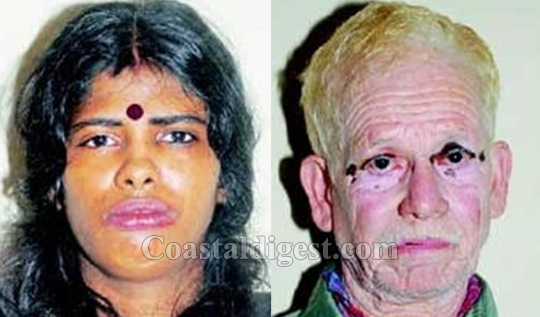
Mangaluru, Apr 1: Nearly six years after a three-year-old girl was murdered in a black magic ritual in the city, a District and Sessions Court has sentenced an elderly man and his suspected foster daughter to life imprisonment.
blackmagic

Pronouncing the order Bhavani Nerale Veerabhadraiah, the judge of IV Additional District and Sessions court, Mangaluru, sentenced Kamalaksha Purusha (79) and Chandrakala (33), both residents of Kampadakody near Yeyyadi, here. The convicts were also sentenced to three years imprisonment for the offence of destroying evidence.

On December 17, 2010, the body of Priyanka, daughter of Firan Kumar Jha and Anjali Devi, a poor couple, was found with burns in the areca-nut garden of Kamalaksha Purusha at Yeyyadi. The girl had gone missing since December 16 afternoon from her parents' rented residence owned by Kamalaksha Purusha's brother.

Chandrakala had befriended Priyanka and used to take the girl to her residence in the neighbourhood frequently. Jha, a native of Madhubani district in Bihar, worked with an electronics retailer in Bengaluru for over two decades before being sent to the retailer's Mangaluru showroom.

After Chandrakala took Priyanka home in the afternoon of December 16, 2010, the girl did not return and a search launched by her parents was futile. The next day, the girl's body was found in the plantation of Kamalaksha Purusha. The post-mortem report said that the child was strangled to death after she had been doused with boiling water.

Though there was no eyewitness to the incident, neighbours told the police that the family of Kamalaksha Purusha was engaged in sorcery for materialistic gains. There were people who had seen Chandrakala taking the girl to her house, they said.

Prosecutors Harishchandra Udyawar and Pushparaj Adyantaya examined 18 witnesses during trial. While the then Mangaluru East Police Inspector Niranjan Urs initially investigated the case, Assistant Commissioner of Police Raveendra K. Gadadi filed the charge sheet before court.

Considering the circumstantial evidence, the judge convicted the two for offences under Sections 302 (murder) and 201 (destroying of evidence) of the Indian Penal Code. While Kamalaksha Purusha was directed to pay fine of Rs. 60,000, Chandrakala was asked to pay Rs. 20,000 for the two offences.

A sum of Rs. 10,000 out of the total fine has to be paid to the government while the balance is to be paid to the deceased girl's parents. The court has also directed the District Legal Services Authority to pay compensation under the Karnataka Victim Compensation Scheme to the parents.

The then Chief Minister B.S. Yeddyurappa had released Rs. 2 lakh compensation to the family of Priyanka through the district administration.

Comments

Aakhash
 - 
Friday, 1 Apr 2016

Instead of making un necessary issues like Bharath Maathaa Ki Jai., RSS should concentrate to address the people to come out from these types of ugly practice in the community.

Meenakshi Rao
 - 
Friday, 1 Apr 2016

This is ridiculous,..murderers should be murdered as same like they killed that innocent girl.

Karan
 - 
Friday, 1 Apr 2016

who knows this may not be the first time they killed, which has came to light.

Deepika
 - 
Friday, 1 Apr 2016

Ghostly act by these two, dont want to c their face , coastaldiget please blur their face, felt like watching some horror movie.

Mohan
 - 
Friday, 1 Apr 2016

Planet SKS land belongs to him, builder succeed.

Priyanka
 - 
Friday, 1 Apr 2016

syco path in mangalore, both should be hanged.

Add new comment

  • Coastaldigest.com reserves the right to delete or block any comments.
  • Coastaldigset.com is not responsible for its readers’ comments.
  • Comments that are abusive, incendiary or irrelevant are strictly prohibited.
  • Please use a genuine email ID and provide your name to avoid reject.
News Network
June 20,2020

Bengaluru, Jun 20: The Karnataka Health Department has issued guidelines on the admission of COVID-19 patients in private hospitals after clinical assessment, mandating that the district surveillance officer (DSO) should be first informed to initiate further procedures, an official said on Friday.

"A health team sent by the DSO should visit the home or hospital where the patient is staying. The team should conduct a rapid assessment of his or her health condition," said Karnataka's Additional Chief Secretary Jawaid Akhtar.

In the rapid health condition assessment, the team should first check the patient's body temperature, followed by SpO2 (oxygen saturation) level and confirm if there are any comorbidities such as hypertension, diabetes, tuberculosis, HIV, cancer, stroke etc.

Depending on the health condition of patients, Akhtar said, two categories have been made.

"Those who have body temperature greater than 37.5 degrees Celsius, SpO2 level below 94 percent, elderly (above 60 years) and suffering from known comorbid conditions should be taken to a dedicated Covid hospital (DCH)," he said.

"All other patients, even if older but not suffering from co-morbidities, those below 60 and suffering from co-morbidities and asymptomatic cases should be taken to a dedicated Covid health centre (DCHC) or a private hospital as opted by the patient," he added.

Private hospitals have been asked to pitch in due to the rising number of cases in Karnataka. Currently, there are 2943 active cases in the state after 337 cases were reported on Friday.

"The patients are assessed clinically and evaluated at DCHCs or private hospitals with appropriate diagnostic tests. After evaluation, if the patients are asymptomatic, they are shifted to a COVID Care Centre (CCC) for further management," said Akhtar.

CCCs are expected to be equipped with ventilated rooms, pulse oximeters, handheld thermal scanners and blood pressure apparatus.

A nurse has to be present round the clock for every 50 patients and should visit each patient twice a day for assessment whereas the medical officer has to visit the CCC once a day. He should also be available on call in case of an emergency.

Staff serving food and others should wear personal protective equipment and an N-95 mask. Explaining the procedures at DCHCs, Akhtar said general examinations for medical conditions like body temperature, BP, pulse, oxygen saturation and urine output should be in place.

Investigations such as complete blood count, fasting blood sugar, random blood sugar, liver function tests, renal function tests, ECG and chest X-ray facilities should be available.

"DCHCs should ensure that above examinations are over in an orderly timeline of 24 hours and depending on the examination, the patient is continued to be lodged at the DCHC or sent to DCH or CCC," said the senior officer.

Likewise, the discharge policy should be done as per the protocols issued by the Health Department from time to time.

The Karnataka government is yet to fix an upper limit on the cost of treating COVID-19 patients in private hospitals. While reports indicated that this could be capped at Rs 5200 per day, health officials are yet to specify this is the case. Private hospitals in the state have asked the government to take a collaborative approach in deciding the fixed cap on treatment cost.

Comments

Add new comment

  • Coastaldigest.com reserves the right to delete or block any comments.
  • Coastaldigset.com is not responsible for its readers’ comments.
  • Comments that are abusive, incendiary or irrelevant are strictly prohibited.
  • Please use a genuine email ID and provide your name to avoid reject.
News Network
March 12,2020

Bengaluru, Mar 12: Karnataka government on Wednesday issued a temporary regulation -- Karnataka Epidemic Diseases, COVID-19 Regulations, 2020 -- which aims to prevent the spread of the disease.

According to the regulation, all government and private hospitals should have flu corners for the screening of suspected cases of COVID-19.

All hospitals during the screening of such cases shall record the history of travel of the person if he or she has travelled to any country or area where COVID-19 has been reported in addition to the history of coming in contact with a suspected or confirmed case of COVID-19 shall be recorded.

Any person with a history of travel in the last 14 days to a country or area from where COVID-19 has been reported must report to the nearest government hospital or call at toll-free helpline number 104 so that necessary measures if required, may be initiated by the Department of Health and Family Welfare.

If a suspected case of COVID-19 refuses admission or isolation, the offices authorised under Section 3 of the regulation shall have powers to forcefully admit and isolate such case of a period of 14 days from the onset of symptoms or till the reports of lab tests are received, or such period as may be necessary.

No person, institution or organisation shall use print or electronic media to spread misinformation on COVID19. If a person is found indulging in any such activity, they will be punished.

If the cases of COVID-19 are reported from a defined geographic area, the district administration of the concerned district shall have the right to implement the following containment measures but not limited to these in order to prevent the spread of diseases:

* Sealing of geographic

* Barring of entry and exit of the population from the containment area

* Closure of schools, offices and banning public gathering

* Banning vehicular movement in the area

* Designating any government or private building as a containment unit for the isolation of cases

* The staff of all govt departments shall be at the disposal of the concerned district administration of the concerned area for discharging the duty of containment measures

Any person, institution or organisation found violating any of these regulations, shall be deemed to have committed an offence punishable under section 188 of the Indian Penal Code (IPC).

Comments

Add new comment

  • Coastaldigest.com reserves the right to delete or block any comments.
  • Coastaldigset.com is not responsible for its readers’ comments.
  • Comments that are abusive, incendiary or irrelevant are strictly prohibited.
  • Please use a genuine email ID and provide your name to avoid reject.
News Network
March 30,2020

Bengaluru, Mar 30: The nationwide lockdown has left the state on the brink of a fresh agrarian crisis.

The lack of transport facilities spells doom for ready-to-harvest grapes worth Rs 500-600 crore in Bengaluru Rural, Chikkaballapur and Kolar districts. Unable to find buyers, several farmers have begun dumping their produce into compost pits.

On Sunday, Munishamappa, a farmer in Chikkaballapur, emptied four truckloads of grapes into the pit as buyers didn’t turn up due to the lockdown. “If the grapes wither and fall to the ground, it will affect the soil’s fertility and I will be forced to dispose of them,” he said.

Venkata Krishnappa, Munishamappa’s son, said their 1.5-acre vineyard yielded 25 tonnes of grapes. “Just before the lockdown, 10 tonnes were harvested and delivered to the market. Due to lack of transport, buyers haven’t turned up for the remaining 15 tonnes which we are dumping into the pit.”

For latest updates on coronavirus outbreak, click here

Anjaneya Reddy, a farmer leader, said that in Chikkaballapur alone, they have cultivated grapes on 2,000 acres. “Even if you consider 15 tonnes per acre as yield, there are about 30,000 tonnes ready to be harvested in the district. At a market rate of Rs 50 to Rs 60 per kilogram, the net worth will be Rs 200 crore to Rs 300 crore. And if you consider the crop in Kolar and Bengaluru Rural, grapes worth Rs 500 to Rs 600 crore are at stake,” he explained.

The ‘Dilkush’ grapes is the most preferred variety of domestic consumption, according to the farmers.

This apart, farmers would have invested about Rs 3 lakh to 4 lakh per acre on fertilisers, pesticide and labour. “With markets being shut and no of the transport facilities available, farmers are forced to dump their produce into pits. It is high time the government intervened and provided us with market options so that farmers can sell at an affordable price of Rs 30 to 40,” Reddy said.

Somu, a farmer in Ganjam village of Srirangapattana, dumped two tonnes of chikku (sapota) citing market shutdown in Mandya. Reddy appealed to the government to emulate the Maharashtra model where the government is helping farmers market fruits through Hopcoms or dairy units as nutrient supplements to people.

Comments

Add new comment

  • Coastaldigest.com reserves the right to delete or block any comments.
  • Coastaldigset.com is not responsible for its readers’ comments.
  • Comments that are abusive, incendiary or irrelevant are strictly prohibited.
  • Please use a genuine email ID and provide your name to avoid reject.