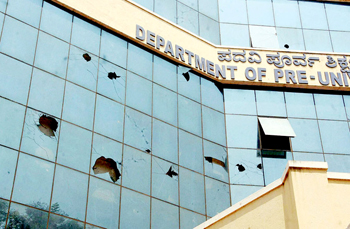
II PU paper leak: CID hunts for key suspect; results likely to be delayed

[email protected] (CD Network)
April 4, 2016

Bengaluru, Apr 4: After identifying a few people, including a couple of teachers, as suspects in the II PU Chemistry question paper leak, the Criminal Investigation Department (CID) has set out on a massive manhunt for the prime suspect.

PUThe CID sleuths have also narrowed down on a few government school teachers, engineers of Public Works Department and officials from DPUE who could be part of the racket.

However, their links could be established only after the arrest of the suspected kingpin — identified as Kiran, an LIC agent from Tumakuru, said a senior police officer. The prime suspect was identified after the CID sleuths questioned the students who received the leaked paper on WhatsApp.

The suspect is on the run and has even switched off his mobile phone, but a team is constantly monitoring his movements and will nab him soon, a CID officer said. He, however, refused to divulge more details about the suspect.

The probe so far has revealed that several lakhs rupees had exchanged hands, the officer said. CID officials have questioned over 100 suspects with alleged links to the re-exam paper leak. The police have also questioned the 40 DPUE officials who were suspended after the March 31 incident.

Results may be delayed

Meanwhile, a possible delay in the announcement of results of II PUC is expected as the Department of Pre-University Education is bogged down with worries of lecturers boycott of evaluation. Further, the evaluators have to be relieved midway through the evaluation work to allow them to join their examination centres to conduct the chemistry paper re-examination on April 12.

The evaluation of SSLC examination answer scripts is also likely to be hit as the Karnataka State High School Assistant Masters' Association after a meeting on Sunday decided to boycott evaluation

Meanwhile, Pre-University students who on Sunday wrote the offline Joint Entrance Examination (main) for entrance in undergraduate engineering programs at NITs, IIITs and other centrally funded technical institutions found the examination moderately tough.

Comments

Prem Sagar
 - 
Monday, 4 Apr 2016

get them the culprit soon and should not allow them to enter the university again.

Mohammed Sheikh
 - 
Monday, 4 Apr 2016

whose miskate.. whom to punish, dont understand india's rules sometimes.

Add new comment

  • Coastaldigest.com reserves the right to delete or block any comments.
  • Coastaldigset.com is not responsible for its readers’ comments.
  • Comments that are abusive, incendiary or irrelevant are strictly prohibited.
  • Please use a genuine email ID and provide your name to avoid reject.
coastaldigest.com news network
July 31,2020

Mangaluru, July 31: Coronavirus related deaths in Dakshina Kannada continued to surge, with the district administration recording five more fatalities in a day, thus taking the tally to 155.

The district has recorded multiple deaths every day from July 1 to 31. A majority of the deaths are due to comorbid conditions.

Among the five deaths reported today, a 47-year-old man from Mangaluru, was admitted to private hospital on July 30, and breathed his last on the same day. He was suffering from ARDS, Type 1 respiratory failure, COPD, Type II DM, HTN and died due to cardiac arrest.

Another patient was a 75-year-old man from Bantwal, who was admitted to a private hospital on July 23, and passed away on July 30. He was suffering from acute coronary syndrome, pneumonia (ARDS), metabolic encephalopathy, acute kidney injury, systemic hypertension, and type 2 diabetes mellitus.

The third patient was a 63-year-old man from Mangaluru, who was admitted to a private hospital on July 18, and passed away on July 30. He was suffering from ARDS, septic shock, renal failure, and secondary bacterial infection.

The fourth patient was an 88-year-old woman from Davanagere, who was admitted to a private hospital on July 9, and passed away on July 30. She was suffering from septic shock, and secondary bacterial infection.

The fifth patient was a 75-year-old man from Mangaluru. He was admitted to Wenlock hospital on July 15, and passed away on July 30. He was suffering from refractory ARDS, septic shock, renal failure, acute coronary event, arrhythmias, pulmonary thromboembolism, and hemoperitoneum.

The district administration said that though the above patients contracted coronavirus, the exact cause of their deaths is being investigated by a team of experts and their report is awaited.

On the other hand, Dakshina Kannada district recorded a total of 204 fresh cases, taking the tally to 5,713. Among the 204 new cases are 75 primary contacts, 63 with influenza-like illness (ILI), and 14 with severe acute respiratory illness (SARI). As many as 52 cases are under investigation. As many as 70 patients were discharged on Friday from Wenlock as well as private hospitals.

As per the district health bulletin, a total of 40,706 samples have been tested so far and 34,993 out of them have tested negative. Among the 5,713 positive cases reported in the district, only 2,929 are currently active. As many as 2,631 persons have recovered and been discharged.

Comments

Add new comment

  • Coastaldigest.com reserves the right to delete or block any comments.
  • Coastaldigset.com is not responsible for its readers’ comments.
  • Comments that are abusive, incendiary or irrelevant are strictly prohibited.
  • Please use a genuine email ID and provide your name to avoid reject.
News Network
March 15,2020

While it makes perfect sense for IT employees to work from remote locations via video conferencing and collaboration tools seamlessly - especially in the case of tech giants like Google or Microsoft -- workers from the non-IT companies and small and medium enterprises (SMBs) are the worst-hit in India as most of them have little or no clue about how these messaging and collaboration tools work amid the coronavirus pandemic.

Small companies -- from corporate to education verticals -- are scrambling to get their act together as new coronavirus threat has reached their premises, prompting them to send employees home who have age-old laptops, poor network and connectivity with no UPS backups and little knowledge about how to handle group chat and collaboration software like Zoom, Google Hangouts Meet, Microsoft Teams and Flock etc.

Instead of halting operations, however, businesses can choose to shift towards remote working methods with teaching non-IT staff on how to use the latest digital software to connect and work, say industry experts.

The training will take some time and may hamper productivity in the short run but is a win-win situation for the non-tech companies in the long run, in case any such global emergency arises in the future.

According to a latest report by Gartner, 54 per cent of HR leaders have cited that poor technology and/or infrastructure for remote working is the biggest barrier to effective remote working.

Sandy Shen, Senior Director Analyst, Gartner, says that with COVID-19 disrupting the business landscape, CIOs should relook at the digital fulfillment of market demand.

"The value of digital channels, products and operations is immediately obvious to companies everywhere right now. This is a wake-up call for organisations that have placed too much focus on daily operational needs at the expense of investing in digital business and long-term resilience," warned Shen.

Businesses that can shift technology capacity and investments to digital platforms will mitigate the impact of the outbreak and keep their companies running smoothly now, and over the long term.

"Videoconferencing, messaging, collaboration tools and document sharing are just a few examples of technologies that facilitate remote work. Additional bandwidth and network capacity may also be needed, given the increasing number of users and volume of communications," informed Shen.

The IT industry's apex body Nasscom has asked the government to relax norms for a month to allow work-from-home for technology and back-office employees as a measure to deal with the spread of Covid-19 in India.

Networking giant Cisco said that it has seen "significant growth" in the usage of its web conferencing and video-conferencing service Webex in India.

According to Muneer Ahmad, Business Head, ViewSonic India, due to COVID-19 pandemic, the corporate and educational sector is severely getting affected in the country.

"ViewSonic IFP has a cloud-based software which help teachers and corporates to connect through video conferencing to multiple people at the same time and can split the screen into six screens. It can also connect with various tools like Skype, Cisco WebEx, Zoom, Google Hangouts and GoToMeeting," Ahmad told IANS.

Co-working sector has also taken a hit and the industry is looking at several measures to tackle it -- from ensuring supply of juices rich in Vitamin C to supply of disinfectants and giving work from home facilities.

"The scheduled visits of the clients at our co-working offices have been postponed. Few of our clients have cancelled their outstation meetings and have now started audio/video conferencing for virtual meetings," said Nakul Mathur, MD, Avanta India.

According to reports, India has approximately 1,000 co-working locations (as of September 2019) and is the second-largest market for the co-working industry after China.

As India's first licensed B2B Virtual Network Operator, CloudConnect Communications offers a collaborative platform that allows companies to overcome the COVID-19 threat while maintaining seamless business continuity and optimum employee productivity.

"We offer a secure, robust, reliable, scalable and trackable mobile-first unified communication infrastructure that aids remote teleworking so that businesses can continue operating even under any unforeseen circumstances," said Gokul Tandon, Executive Chairman, CloudConnect Communications.

Comments

Add new comment

  • Coastaldigest.com reserves the right to delete or block any comments.
  • Coastaldigset.com is not responsible for its readers’ comments.
  • Comments that are abusive, incendiary or irrelevant are strictly prohibited.
  • Please use a genuine email ID and provide your name to avoid reject.
News Network
February 12,2020

Mumbai, Feb 12: The Income Tax department's Criminal Investigation wing has identified 2,000 Indian citizens who hold properties in Dubai but had failed to declare it in their IT returns.

In its ongoing crackdown on black money, the agency has identified Indian citizens who purchased properties in Dubai but failed to declare and explain the source of funds used to purchase these properties.

In the past few years, people have used shell companies to route illegal money and buy overseas properties to evade income tax.

However, the tax department has now increased its efforts to track down those involved in major tax evasion cases.

The 2,000 persons and companies identified mainly include businessmen, top professionals, and government officials.

The IT department will initiate action against the accused under the Black Money Act.

Citizens who own properties outside the country but fail to declare the source of funds or income used for the purchase could be prosecuted under the Black Money Act.

Under Section FA (Foreign Assets) of the Income Tax Act, an individual has to declare purchase and ownership of properties, assets, companies owned outside the country while filing the income tax returns annually.

In the recent drive against black money, the IT department identified 2,000 Indian nationals who failed to provide information on the same while filing IT returns.

Of the 2,000 citizens owning properties in Dubai, around 600 could not furnish details regarding purchase details.

Those who haven't been able to explain the source of funds used for the purchase of properties could be prosecuted and their properties can be attached by the agency.

Other than the attachment of the property, they can face a monetary penalty up to 300 per cent of the property value and also face imprisonment under the Black Money Act.

The properties owned by Indians in Dubai raised red flags as this pattern of parking money is used by money launderers, smugglers, underworld gangsters and drug traffickers for making payments.

It is worth mentioning that of the 2,000 citizens identified, most are residing in Mumbai, followed by Kerala and Gujarat.

The clause under section FA (foreign Assets) came into effect in the year 2011-12 and it is mandatory for people owning properties outside India to declare it in their IT returns.

Those identified by IT department could also face action under FEMA (Foreign Exchange Management Act) by the Enforcement Directorate under Section 4.

Recently the Enforcement Directorate (ED) launched a crackdown on black money parked overseas by tracking and identifying immovable assets bought overseas by Indian nationals illegally.

The move is being carried out under rules laid down under Section 4 of FEMA (Foregn Exchange Manipulation Act), 1999. Section 4 of FEMA states that no person resident in India shall acquire, hold, own, possess or transfer any foreign exchange, foreign security or any immovable property situated outside India.

On January 17, the Enforcement Directorate (ED) conducted searches at the residence of a former chief engineer of Brihanmumbai Municipal Corporation (BMC) in connection with an inquiry related to FEMA.

In the raids, the ED officials recovered documents related to the purchase of a property in Dubai in an allegedly illegal manner.

The ex-BMC chief engineer was posted with some of the most crucial wings of the municipal corporation -- the building proposal department and development plan department.

The agency did not disclose the name of the ex-BMC chief engineer but it has been learnt that he had superannuated around seven years ago from the municipal corporation.

ED, in a statement, said incriminating documents with regard to illegal acquisition of a property held in Dubai was recovered during the search operation.

The former BMC chief engineer has stated that he had purchased the property in Dubai at 'Park Island, Bonaire Marsa, Dubai' for Rs 70 lakh in 2012. The property is held jointly in his name, his spouse and son.

The retired BMC officials could not furnish any documents which would help ascertain the value of the property and also could not provide details on how the payments were made to buy the property in Dubai.

The citizens identified by the IT department recently also adopted a similar route to buy property in Delhi. It remains to be seen how the income tax department plans to penalise them.


Comments

Add new comment

  • Coastaldigest.com reserves the right to delete or block any comments.
  • Coastaldigset.com is not responsible for its readers’ comments.
  • Comments that are abusive, incendiary or irrelevant are strictly prohibited.
  • Please use a genuine email ID and provide your name to avoid reject.