


II PU paper leak: CID hunts for key suspect; results likely to be delayed

[email protected] (CD Network)
April 4, 2016

Bengaluru, Apr 4: After identifying a few people, including a couple of teachers, as suspects in the II PU Chemistry question paper leak, the Criminal Investigation Department (CID) has set out on a massive manhunt for the prime suspect.
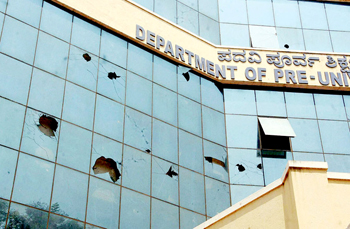
PUThe CID sleuths have also narrowed down on a few government school teachers, engineers of Public Works Department and officials from DPUE who could be part of the racket.

However, their links could be established only after the arrest of the suspected kingpin — identified as Kiran, an LIC agent from Tumakuru, said a senior police officer. The prime suspect was identified after the CID sleuths questioned the students who received the leaked paper on WhatsApp.

The suspect is on the run and has even switched off his mobile phone, but a team is constantly monitoring his movements and will nab him soon, a CID officer said. He, however, refused to divulge more details about the suspect.

The probe so far has revealed that several lakhs rupees had exchanged hands, the officer said. CID officials have questioned over 100 suspects with alleged links to the re-exam paper leak. The police have also questioned the 40 DPUE officials who were suspended after the March 31 incident.

Results may be delayed

Meanwhile, a possible delay in the announcement of results of II PUC is expected as the Department of Pre-University Education is bogged down with worries of lecturers boycott of evaluation. Further, the evaluators have to be relieved midway through the evaluation work to allow them to join their examination centres to conduct the chemistry paper re-examination on April 12.

The evaluation of SSLC examination answer scripts is also likely to be hit as the Karnataka State High School Assistant Masters' Association after a meeting on Sunday decided to boycott evaluation

Meanwhile, Pre-University students who on Sunday wrote the offline Joint Entrance Examination (main) for entrance in undergraduate engineering programs at NITs, IIITs and other centrally funded technical institutions found the examination moderately tough.

Comments

Prem Sagar
 - 
Monday, 4 Apr 2016

get them the culprit soon and should not allow them to enter the university again.

Mohammed Sheikh
 - 
Monday, 4 Apr 2016

whose miskate.. whom to punish, dont understand india's rules sometimes.

Add new comment

  • Coastaldigest.com reserves the right to delete or block any comments.
  • Coastaldigset.com is not responsible for its readers’ comments.
  • Comments that are abusive, incendiary or irrelevant are strictly prohibited.
  • Please use a genuine email ID and provide your name to avoid reject.
News Network
June 25,2020

Belagavi, Jun 25: Union Minister of State for Railways Suresh Angadi on Wednesday said that coronavirus was created to "scare us" and to create tensions on the border, in an apparent reference to China.

He said that everyone should learn to live with the virus and follow all norms needed to combat the disease.

"We all know who created the coronavirus. It was created to scare us and to create tensions on the border, we know who did it. We have to learn to live with the coronavirus. We do not need to be scared of it. We must maintain social distancing and follow all the sanitation norms," Angadi told reporters here.

Karnataka on Wednesday reported 397 new COVID-19 positive cases, taking the total count in the state to 10,118.

According to the state health department, the state's death toll has reached 164 after 14 fatalities were reported. As many as 6,151 people have been discharged so far.

Comments

Add new comment

  • Coastaldigest.com reserves the right to delete or block any comments.
  • Coastaldigset.com is not responsible for its readers’ comments.
  • Comments that are abusive, incendiary or irrelevant are strictly prohibited.
  • Please use a genuine email ID and provide your name to avoid reject.
Agencies
June 15,2020

Bengaluru, Jun 15: Karnataka Chief Minister B S Yediyurappa on Monday said those coming to the state from Chennai and Delhi will have to undergo three days of institutional quarantine followed by 11 days of home isolation.

Up till now a seven-day institutional quarantine was prescribed for those returning from Maharashtra, while there was no mandatory institutional quarantine for asymptomatic people returning to Karnataka from other states.

Those returning from states other than Maharashtra were asked to quarantine themselves at home.

"Those coming from Maharashtra are subjected to seven days of institutional quarantine followed by seven days of home quarantine, while those coming from Chennai and Delhi will have to go for three days of institutional quarantine and eleven days of home quarantine," Yediyurappa said.

Speaking to reporters here, he said the decision has been taken following the increase in the number of coronavirus cases from these states.

"It is because of returnees from other states the cases have increased, not because of the local (intra-state) movement, so we have to control people coming from outside, we have to quarantine them and have to tighten measures.

We are making honest efforts in this regard," he added.

Yediyurappa was speaking to reporters after chairing a meeting with top ministers and officials to discuss about the surge in COVID cases in the state.

"There are no plans for any lockdown, and we will request the Prime Minister for more relaxations," the Chief Minister said in response to a question.

Out of total 7,000 cases in the state 4,386 are returnees from Maharashtra and their contacts are 1,340.

Those who returned from abroad comprise 216.

Returnees from other states constitute- Delhi 87, Tamil Nadu 67, Gujarat 62.

Noting that there are indications that the coronavirus infections are expected to increase in the days to come, Yediyurappa assured people that the government will take all precautionary measures required, and appealed to people to cooperate, follow social distancing, and wear masks.

He said it has been decided to observe the coming Thursday as "mask days" by organising a walk across the state and the main event will be held at Vidhana Soudha, the state secretariat.

"Strict measures will be taken against those not wearing masks and not maintaining social distancing here on.

Initially Rs 200 fine will be imposed, this will be throughout the state," he said.

Further stating that the government has made special efforts to control the spread of COVID, he said a special COVID-19 taskforce has been constituted for Bengaluru and surrounding areas, BBMP (city civic body) commissioner and Deputy Commissioners of neighbouring districts have been asked to pay special attention.

As of June 14 evening, cumulatively 7,000 COVID-19 positive cases have been confirmed in the state, which includes 86 deaths and 3,955 discharges.

Out of 2,956 active cases in the state till last evening, 2,940 patients are in isolation at designated hospitals and are stable, while 16 are in ICU.

Yediyurappa said the state's mortality rate is 1.2 per cent while the national average is 2.8 per cent.

The state's recovery rate is 56.6 per cent and the national average is 51 per cent, he said, adding that 93 per cent of the total cases are asymptomatic while the remaining seven per cent are symptomatic.

In Bengaluru, there are 697 cases and out of them 330 are active. The city has reported 36 deaths.

Comments

Add new comment

  • Coastaldigest.com reserves the right to delete or block any comments.
  • Coastaldigset.com is not responsible for its readers’ comments.
  • Comments that are abusive, incendiary or irrelevant are strictly prohibited.
  • Please use a genuine email ID and provide your name to avoid reject.
News Network
June 20,2020

Bengaluru, Jun 20: The Karnataka Health Department has issued guidelines on the admission of COVID-19 patients in private hospitals after clinical assessment, mandating that the district surveillance officer (DSO) should be first informed to initiate further procedures, an official said on Friday.

"A health team sent by the DSO should visit the home or hospital where the patient is staying. The team should conduct a rapid assessment of his or her health condition," said Karnataka's Additional Chief Secretary Jawaid Akhtar.

In the rapid health condition assessment, the team should first check the patient's body temperature, followed by SpO2 (oxygen saturation) level and confirm if there are any comorbidities such as hypertension, diabetes, tuberculosis, HIV, cancer, stroke etc.

Depending on the health condition of patients, Akhtar said, two categories have been made.

"Those who have body temperature greater than 37.5 degrees Celsius, SpO2 level below 94 percent, elderly (above 60 years) and suffering from known comorbid conditions should be taken to a dedicated Covid hospital (DCH)," he said.

"All other patients, even if older but not suffering from co-morbidities, those below 60 and suffering from co-morbidities and asymptomatic cases should be taken to a dedicated Covid health centre (DCHC) or a private hospital as opted by the patient," he added.

Private hospitals have been asked to pitch in due to the rising number of cases in Karnataka. Currently, there are 2943 active cases in the state after 337 cases were reported on Friday.

"The patients are assessed clinically and evaluated at DCHCs or private hospitals with appropriate diagnostic tests. After evaluation, if the patients are asymptomatic, they are shifted to a COVID Care Centre (CCC) for further management," said Akhtar.

CCCs are expected to be equipped with ventilated rooms, pulse oximeters, handheld thermal scanners and blood pressure apparatus.

A nurse has to be present round the clock for every 50 patients and should visit each patient twice a day for assessment whereas the medical officer has to visit the CCC once a day. He should also be available on call in case of an emergency.

Staff serving food and others should wear personal protective equipment and an N-95 mask. Explaining the procedures at DCHCs, Akhtar said general examinations for medical conditions like body temperature, BP, pulse, oxygen saturation and urine output should be in place.

Investigations such as complete blood count, fasting blood sugar, random blood sugar, liver function tests, renal function tests, ECG and chest X-ray facilities should be available.

"DCHCs should ensure that above examinations are over in an orderly timeline of 24 hours and depending on the examination, the patient is continued to be lodged at the DCHC or sent to DCH or CCC," said the senior officer.

Likewise, the discharge policy should be done as per the protocols issued by the Health Department from time to time.

The Karnataka government is yet to fix an upper limit on the cost of treating COVID-19 patients in private hospitals. While reports indicated that this could be capped at Rs 5200 per day, health officials are yet to specify this is the case. Private hospitals in the state have asked the government to take a collaborative approach in deciding the fixed cap on treatment cost.

Comments

Add new comment

  • Coastaldigest.com reserves the right to delete or block any comments.
  • Coastaldigset.com is not responsible for its readers’ comments.
  • Comments that are abusive, incendiary or irrelevant are strictly prohibited.
  • Please use a genuine email ID and provide your name to avoid reject.