


Expected? Key documents in Malegaon blasts case missing from NIA court!

April 7, 2016

Mumbai, Apr 7: All the statements were given in front of a magistrate and hence admissible as evidence to nail the alleged culprits that include a 'sadhvi' and a serving Indian Army officer.
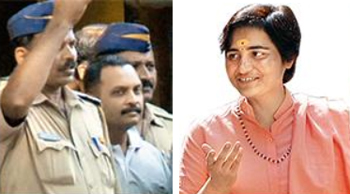
blastIn a major setback to the 2008 Malegaon blasts case, seven statements of witnesses - all recorded in the presence of a magistrate and admissible as evidence - have gone missing from the Special NIA Court.

Coming in the wake of Special Public Prosecutor Rohini Salian's statement in June last year that National Investigation Agency (NIA) officers were putting pressure on her to go soft in the case, the disappearance of the crucial court documents will again call into question the prosecution's intent and ability to take the case, in which members of an alleged Hindu radical group stand accused, to its logical conclusion.

Two low-intensity explosions in Malegaon's Bhikku Chowk on September 29, 2008, had left seven people dead and left over 80 injured. The Maharashtra police's Anti Terrorist Squad, which investigated the case before it was handed over to NIA in 2011, arrested a dozen-odd accused, including self-styled Sadhvi Pragya Singh Thakur and serving Indian Army officer Lt Col Srikant Purohit. Both worked for Hindu radical group Abhinav Bharat.

An embarrassed NIA has formed three teams to look for the missing statements, while the court officials have also joined in the search. Salian, who quit the case last year over, what she called, NIA's pressure to not push too hard, on Wednesday told media that an official from the Special NIA Court came to her looking for the documents. "One of the staff from the special court enquired with me if I am in the possession of the key documents, including several witness statements recorded under section 164 of the Criminal Procedure Code, which, he said, were not traceable in the court," she said.

Salian said she had handed over all documents to the designated special prosecutor Avinash Rasal in the presence of NIA officials. "I have not kept a single document related to the case with me," she said.

Rasal, on his part, said he had no knowledge of any witness statements having gone missing, but said that it is possible that some documents may have been misplaced. "The documents have been moved frequently from one court to the other. If the documents are not in the Special NIA Court, then they are probably some place else and the court officials should be able to locate them," he said.

Top NIA officials, including DIG Abhin Modak, all through Wednesday did not respond to calls and text messages and an agency spokesman said he had no comment to offer on the matter.

Among the witness statements gone missing is that of Dharmendra Bairagi, a close aid of Ramji Kalsangra, a key accused in the case who is absconding. Bairagi, in his statement recorded before a magistrate, had said that he was witness to a meeting between Kalsangra and Pragya Thakur in Ujjain just months before the 2008 blasts. He had also said he had heard the two discussing a plan to engineer blasts.

Another key statement that is missing is that of the founder of Abhinav Bharat Hemani Savarkar. Savarkar's statement details a meeting between Lt Col Purohit and Pragya Thakur in Nashik in 2007. It also accuses Lt Col Purohit of misusing Abhinav Bharat's name to raise funds.

Top criminal lawyer Majid Memon called the disappearance of the documents shocking. "In a case relating to terror, which is considered a serious offence, if lethargy, negligence or deliberate removal of important documents surfaces, it is an extremely serious matter. The court should not tolerate such lapses."

He added that this appears as a deliberate attempt at weakening the case and helping the accused. "On the face of it, this cannot be accidental or a case of omission."

While copies of the missing statements are available with the accused, these, in the absence of the originals, become secondary evidence. Statements recorded in the presence of a magistrate have evidentiary value before the trial court. Though a witness can still be called for deposition before the trial court so that he can be cross-examined, if the witness deviates from the statement given before the magistrate, the trial court can still rely on the statement.

Advocate Shirikant Bhat said that while statements can be reconstructed from a copy of the same available either with the prosecution or the defence, it all depends on how reliable or authentic this document being relied upon is. "And whether or not that document should be relied upon for reconstruction is for the court to decide," he said.

Advocate Shrikant Shivade, who is appearing for Col. Purohit in the case, said reconstruction based on the copies available either with the prosecution or the defense will be possible only if the process of filing the documents on record has been followed. "We will have to check if the statements were ever on record in this case," he said.

Comments

PONDER & Use UR
 - 
Saturday, 9 Apr 2016

Naren, Bopanna..
I dont think U guys have read QURAN...
I feel U just quoted the same thing which the devils agent salman rusdie... explained in his book...
If U read QURAN with its content ... U will understand the TRUTH. Sometimes try to read by yourself and dont be like animals, whatever is fed, U accept it.
Also If we quote from the Hindu scriptures... We can find many such wars & violence done ... But we use our intellectual which ALLAH and Prophet Muhammad pbuh taught us... not to insult other religion.
Please quote from hindu scriptures also, there are plenty of verse of Violence.... and some verses, I feel disgusting to read ... which u people say its from god... But its NOT and which was added by some shaukuni along with the word of God.....to FOOL U and those who blindly follow without using the intellect that God has given us.

Please read with open mind and Stop following blindly..

Curious
 - 
Friday, 8 Apr 2016

NIA looks like a RSS wing works pro for some community and anti for other communities.

Naren kotian
 - 
Thursday, 7 Apr 2016

Jai Sri ram ...god knew that nationalist Indians will never commit henious crimes like one particular community... So documents disappeared...welcome nationalist Indians ..soon we will make sure all sangh parivar guys are out from jail .hara hara modi ..death to jihad ...we must create terror in the hearts of terrorist community ..its the mossad policy ...jai ho Israel jai ho Indo Israel relationshi ...sangh parivar must double up nexus with Israel in all fields covertly and overtly ...hahaha jihadi galige menasina kaayi itta haage madlikke ishtu saaku ...ummah muah chummah ..

Bopanna
 - 
Thursday, 7 Apr 2016

Koran instruct in violence, 4:89; 5:33. 9,5,111,123. 47;4. but still further the Koran also teaches that the Jewish people are descendants of swine and apes.2:65.; 7:166; 5:60. T

PONDER & Dont
 - 
Thursday, 7 Apr 2016

When Tiger bit human --- There is no law to punish the Tiger
When leopard bit human --- There is no law to punish the leopard
When snake bit human --- There is no law to punish the snake
When Dog bites the human --- There is no law to punish the Dog

Dear HUMAN, when human makes trouble to other human, there is LAW to protect the innocent... (cos humans are intelligent creature, Created by God)
Some people in the authorities are joining the ANIMALs category and they are proving it by their EVIL plans & DECEPTION.

HONeST
 - 
Thursday, 7 Apr 2016

Our system in the hands of DECIEVERS and LIARS... An OPEN LIE to protect the KILLERS

ummar
 - 
Thursday, 7 Apr 2016

AAB KI BAAAR MODHI SARKAAR ,,'

EFFECT OF FEKUUMODHII

Rikaz
 - 
Thursday, 7 Apr 2016

That means no justice for those who killed due to their heinous crime. They should have put to gallows.

Add new comment

  • Coastaldigest.com reserves the right to delete or block any comments.
  • Coastaldigset.com is not responsible for its readers’ comments.
  • Comments that are abusive, incendiary or irrelevant are strictly prohibited.
  • Please use a genuine email ID and provide your name to avoid reject.
News Network
February 10,2020

Chitradurga, Feb 10: President of the BJP State unit Nalin Kumar Kateel on Sunday hit out at Congress leader M. Mallikarjun Kharge for allegedly likening Prime Minister Narendra Modi to a “zero candle bulb”.

Mr. Kateel told reporters here that Mr. Modi was a “1,000 watt bulb that gave light to the world”, and compared Mr. Kharge to a lamp that had burned out politically.

Mr. Kateel charged that Mr. Kharge had become frustrated after losing the elections and after his party did not even consider him for a Rajya Sabha seat. And this had made the Congress leader to make wild charges against the Prime Minister.

Lashing out at the Congress, Mr. Kateel alleged that the Congress was continuing the “divide and rule” policy of the British and accused the former Prime Minister H.D. Deve Gowda of being the “other face of the Congress”.

Mr. Kateel also came down on the former Chief Minister Siddaramaiah. He ridiculed the Congress for the delay in choosing a new KPCC chief after Dinesh Gundu Rao submitted his resignation.

Comments

Secular indian
 - 
Monday, 10 Feb 2020

I dont  think these  fights dont deserve to be on news. 

Add new comment

  • Coastaldigest.com reserves the right to delete or block any comments.
  • Coastaldigset.com is not responsible for its readers’ comments.
  • Comments that are abusive, incendiary or irrelevant are strictly prohibited.
  • Please use a genuine email ID and provide your name to avoid reject.
Ram Puniyani
February 4,2020

As democracy is seeping in slowly all over the world, there is an organization which is monitoring the degree of democracy in the individual countries, The Economist Intelligence Unit. As such in each country there are diverse factors which on one hand work to deepen it, while others weaken it. Overall there is a march from theoretical democracy to substantive one. The substantive democracy will herald not just the formal equality, freedom and community feeling in the country but will be founded on the substantive quality of these values. In India while the introduction of modern education, transport, communication laid the backdrop of beginning of the process, the direction towards deepening of the process begins with Mahatma Gandhi when he led the non-cooperation movement in 1920, in which average people participated. The movement of freedom for India went on to become the ‘greatest ever mass movement’ in the World.

The approval and standards for democracy were enshrined in Indian Constitution, which begins ‘We the people of India’, and was adopted on 26th January 1950. With this Constitution and the policies adopted by Nehru the process of democratization started seeping further, the dreaded Emergency in 1975, which was lifted later restored democratic freedoms in some degree. This process of democratisation is facing an opposition since the decade of 1990s after the launch of Ram Temple agitation, and has seen the further erosion with BJP led Government coming to power in 2014. The state has been proactively attacking civil liberties, pluralism and participative political culture with democracy becoming flawed in a serious way. And this is what got reflected in the slipping of India by ten places, to 51st, in 2019. On the index of democracy India slipped down from the score of 7.23 to 6.90. The impact of sectarian BJP politics is writ on the state of the nation, country.

Ironically this lowering of score has come at a time when the popular protests, the deepening of democracy has been given a boost and is picking up with the Shaheen Bagh protests. The protest which began in Shaheen Bagh, Delhi in the backdrop of this Government getting the Citizenship amendment Bill getting converted into an act and mercilessly attacking the students of Jamia Milia Islamia, Aligarh Muslim University along with high handed approach in Jamia Nagar and neighbouring areas.  From 15th December 2019, the laudable protest is on.

It is interesting to note that the lead in this protest has been taken by the Muslim women, from the Burqa-Hijab clad to ‘not looking Muslim’ women and was joined by students and youth from all the communities, and later by the people from all the communities. Interestingly this time around this Muslim women initiated protest has contrast from all the protests which earlier had begun by Muslims. The protests opposing Shah Bano Judgment, the protests opposing entry of women in Haji Ali, the protests opposing the Government move to abolish triple Talaq. So far the maulanas from top were initiating the protests, with beard and skull cap dominating the marches and protests. The protests were by and large for protecting Sharia, Islam and were restricted to Muslim community participating.

This time around while Narendra Modi pronounced that ‘protesters can be identified by their clothes’, those who can be identified by their external appearance are greatly outnumbered by all those identified or not identified by their appearance.

The protests are not to save Islam or any other religion but to protect Indian Constitution. The slogans are structured around ‘Defence of democracy and Indian Constitution’. The theme slogans are not Allahu Akbar’ or Nara-E-Tadbeer’ but around preamble of Indian Constitution. The lead songs have come to be Faiz Ahmad Faiz’s ‘Hum Dekhenge’, a protest against Zia Ul Haq’s attempts to crush democracy in the name of religion. Another leading protest song is from Varun Grover, ‘Tanashah Aayenge…Hum Kagaz nahin Dikhayenge’, a call to civil disobedience against the CAA-NRC exercise and characterising the dictatorial nature of the current ruling regime.

While BJP was telling us that primary problem of Muslim women is Triple talaq, the Muslim women led movements has articulated that primary problem is the very threat to Muslim community. All other communities, cutting across religious lines, those below poverty line, those landless and shelter less people also see that if the citizenship of Muslims can be threatened because of lack of some papers, they will be not far behind in the victimization process being unleashed by this Government.

While CAA-NRC has acted as the precipitating factor, the policies of Modi regime, starting from failure to fulfil the tall promises of bringing back black money, the cruel impact of demonetisation, the rising process of commodities, the rising unemployment, the divisive policies of the ruling dispensation are the base on which these protest movements are standing. The spread of the protest movement, spontaneous but having similar message is remarkable. Shaheen Bagh is no more just a physical space; it’s a symbol of resistance against the divisive policies, against the policies which are increasing the sufferings of poor workers, the farmers and the average sections of society.

What is clear is that as identity issues, emotive issues like Ram Temple, Cow Beef, Love Jihad and Ghar Wapasi aimed to divide the society, Shaheen Bagh is uniting the society like never before. The democratisation process which faced erosion is getting a boost through people coming together around the Preamble of Indian Constitution, singing of Jan Gan Man, waving of tricolour and upholding the national icons like Gandhi, Bhagat Singh, Ambedkar and Maulana Azad. One can feel the sentiments which built India; one can see the courage of people to protect what India’s freedom movement and Indian Constitution gave them.

Surely the communal forces are spreading canards and falsehood against the protests. As such these protests which is a solid foundation of our democracy. The spontaneity of the movement is a strength which needs to be channelized to uphold Indian Constitution and democratic ethos of our beloved country.

Comments

Add new comment

  • Coastaldigest.com reserves the right to delete or block any comments.
  • Coastaldigset.com is not responsible for its readers’ comments.
  • Comments that are abusive, incendiary or irrelevant are strictly prohibited.
  • Please use a genuine email ID and provide your name to avoid reject.
News Network
July 5,2020

Bengaluru, Jul 6: With a record 1,925 new cases across the state during the last 24 hours, Karnataka's Covid-19 tally rose to 23,474 including 13,251 active after 9,847 were discharged till date, an official said on Sunday.

"Of the total cases across the state on a single day, Bengaluru accounted for 1,235, taking its positive tally to 9,580, including 8,167 active," said the health official in a statement.

With 37 succumbing to the disease in the state, including 16 from Bengaluru, the state's death toll increased to 372, with 145 from this tech city since March 9.

Of the 603 discharged from across the state during the day, 302 were from Bengaluru, taking its total number of cured to 1,267 so far.

Of the 243 cases in the intensive care unit (ICU) across the state, 132 are in Bengaluru, 15 at Dharwad, 12 at Kalaburagi and 10 each at Ballari and Raichur.

Of the 16,899 samples tested in the day, 14,649 were negative and 1,925 positive. Of the total 7,06,425 samples tested so far, 6,65,525 were negative and 23,474 positive.

After Bengaluru, Dakshina Kannada reported 142 positive cases followed by Ballari 90, Vijayapura 57, Kalaburagi 49 and Udupi and Dharwad 45 each.

Of the total 603 discharged, 52 were from Kalaburagi, 37 from Ballari, 36 from Dakshina Kannada and 22 each from Udupi and Dharwad.

Comments

Add new comment

  • Coastaldigest.com reserves the right to delete or block any comments.
  • Coastaldigset.com is not responsible for its readers’ comments.
  • Comments that are abusive, incendiary or irrelevant are strictly prohibited.
  • Please use a genuine email ID and provide your name to avoid reject.