


Pregnant women in India barred from Hajj pilgrimage

[email protected] (CD Network)
April 8, 2016

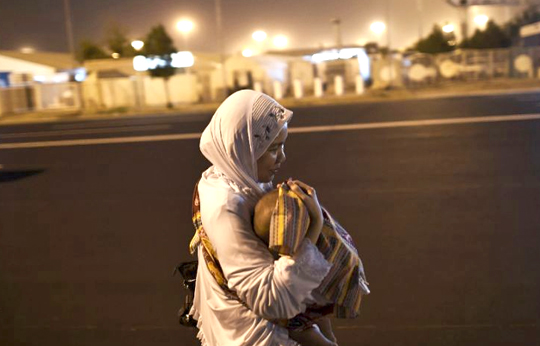
Bareilly, Apr 8: As per the latest directive by the Hajj Committee of India, women who are pregnant at the time of filing application and complete four months of pregnancy in September when Hajj Yatra begins would not be allowed to proceed.
hajj

Even if they hide this fact and proceed on Hajj, they can be de-boarded from the flight if it is found that they have concealed the above fact, say Hajj officials. It is not clear who will check their pregnancy status in-flight.

Bareilly Hajj Sewa Samiti secretary Nazim Beg said, "This year the Hajj pilgrimage is scheduled to start in September. It has been decided that pregnant women wishing to go on Haj should make sure that they have not completed four months of pregnancy at the time of leaving the country, failing which they would be barred from the pilgrimage."

The directive has come from the chief executive officer of Central Hajj Committee, Ata-ur-Rehman, who has clearly asked such women to take back their money and cancel their seats.

When asked the rationale behind such step, Beg said, "It is in the interest of pregnant women. The first five days of Hajj are a gruelling test of stamina and endurance of Hajis who have to move from one spot to other in quick succession. Besides, they are also supposed to make several rounds of the holy places as a part of the ritual. The decision has been taken in view of the safety and health of pregnant women."

Bareilly Hajj Sewa Samiti president and Baheri MLA, Ataur Rehman, said, "In case of labour pain, the Haj committee has to make arrangements for admitting the woman to hospital, which adds up to the expenses of the committee. This is the reason why we would ask such women to undergo mandatory medical check-up to ascertain the status of their pregnancy."

Rehman added that the CHC has asked all centres in the country to convey the decision to all pregnant women who have applied for the Hajj pilgrimage this year.

Comments

Fair talker
 - 
Saturday, 9 Apr 2016

Though Hajj is an obligatory deed of Muslims, Islam / Sharia exempts the Hajj on the grounds of
Health, wealth, safety.

This rule needs to be implemented for protecting in general.
People should respond positively. The agency who made the law has no personal interest in it.

SK
 - 
Saturday, 9 Apr 2016

Amazing.....Non Muslims are commenting on this topic, where as Muslim readers are silent..... Health is most important....Allah has set two conditions for performing Haj..... It is only for those who are Finanially strong and Healthy people....

Add new comment

  • Coastaldigest.com reserves the right to delete or block any comments.
  • Coastaldigset.com is not responsible for its readers’ comments.
  • Comments that are abusive, incendiary or irrelevant are strictly prohibited.
  • Please use a genuine email ID and provide your name to avoid reject.
News Network
April 28,2020

Bengaluru, Apr 28: Karnataka has found that the rapid antibody test kits for COVID-19 that the Centre supplied to the state have only 47% sensitivity. The state will be returning the kits to the Indian Council of Medical Research (ICMR).

Karnataka had received 11,400 rapid antibody test kits from the ICMR a few days back, out of which it had sent around 200 of them to NIMHANS for validation.

After the ICMR, on Monday, sent a circular to all states to return the test kits to the suppliers, Dr CN Manjunath, Director, Jayadeva Institute of Cardiovascular Sciences and Research, and nodal officer for lab testing in the state's COVID-19 task force, said, "We have cancelled the orders we placed to Guangzhou Wondfo Biotech and Zhuhai Livzon Diagnostics for one lakh rapid antibody test kits. Since the ICMR supplied us with 11,400 kits out of the 6.5 lakh kits it procured, we will be returning the kits to them."

Manjunath told said that the validation at NIMHANS revealed the kits to have only 47% sensitivity. Sensitivity is the ability of a test to identify the true-positives in a population, i.e., the actual number of people who've been infected with the disease. With the rapid antibody testing kits being shelved, the state's plan to randomly test high risk groups has taken a backseat. 

So far, the state has tested 43,791 samples. 

Karnataka now has 22 testing facilities -- 14 government and seven private labs. Many private labs have not tested any samples so far because of the lack of test kits (the state has made it clear that it will not provide test kits to private labs). So, getting an ICMR approval for testing has become a moot point.p

Agreeing to the setback the state's plans of ramping up testing has taken, Manjunath said, "It is true that RT-PCR test kits are in shortage. Even Pune's Mylabs had a shortage in supplying test kits. But we are relying on institutes like Kidwai, Narayana Health and Biocon's Syngene that have received approval for testing. They're big institutes and we hope that they will test a large number of samples."

On reports that the Centre has RT-PCR test kits that will last for only a week, he said, "We have test kits that will last for eight to 10 days. We have ordered for more. We are hoping to receive them before the current kits run out."

Comments

Add new comment

  • Coastaldigest.com reserves the right to delete or block any comments.
  • Coastaldigset.com is not responsible for its readers’ comments.
  • Comments that are abusive, incendiary or irrelevant are strictly prohibited.
  • Please use a genuine email ID and provide your name to avoid reject.
News Network
June 26,2020

Bengaluru, Jun 26: The National Restaurant Association of India (NRAI) on Thursday came up with a Standard Operating Procedure (SOP) for restaurants whereby among other physical distancing norms, it has suggested a 2-metre gap between tables.

Formulated in partnership with Releski, a Bengaluru based skill-tech company, the SoP suggests that in case of back-to-back seating, people sitting with their backs towards each other will have their seats divided by 'Plexiglass' divider raised up to 2 meters from the ground.

"In a typical restaurant, the improvised seating plan should have a minimum distance of 2 metres between tables. The distance of 2 metres (6 feet) between tables should measure from one edge of the table to the other table's edge," it said.

In case of loose or free seating such as in banquet style or food court style seating, a minimum 2 meters of distance should be maintained between tables.

The guidelines noted that, to encourage physical distancing, restaurants have to sacrifice their seating capacity, to promote health and safety, and also to gain trust from their patrons.

"In order to perform this, divide your restaurants under different sectors. Pull out your restaurant's floor plan and colour code different sections red and yellow. Red sections are potential areas where maximum footfall or traffic is observed. Yellow sections are areas where the footfalls are average," it said.

All the red sections are encircled or bordered by placing barricades or Q manager and will open at specific points to access the yellow section and all the opening points will have hand sanitisers and sprays, and every guest who walks from red zones to yellow zones will sanitise himself/herself to reduce the chances of contamination.

For air conditioning, the guidelines of CPWD shall be followed which inter alia emphasises that the temperature setting of all air conditioning devices should be in the range of 24-30 degree Celsius, relative humidity should be in the range of 40- 65 per cent, intake of fresh air should be as much as possible and cross ventilation should be adequate, the guidelines suggested.

The industry body has also suggested appointment of a COVID-free Ambassador who would operate as the Chief Health Officer within the restaurant team, preferably from the management team in each shift.

The ambassador's would put the new daily work routines into practice, to monitor compliance with good practice and to lead the preventative measures, adapt to health & safety recommendations and requirements of the restaurant and oversee the implementation of the norms.

Anurag Katriar, President of NRAI and CEO & Executive Director of deGustibus Hospitality, said: "Every restaurant cutting across formats is facing the harsh reality of subdued to shut business volumes in the present and the uncertainty of business environment in the future. One thing is certain that hygiene and safety will be a key differentiator in the post-pandemic restaurant operations."

Comments

Add new comment

  • Coastaldigest.com reserves the right to delete or block any comments.
  • Coastaldigset.com is not responsible for its readers’ comments.
  • Comments that are abusive, incendiary or irrelevant are strictly prohibited.
  • Please use a genuine email ID and provide your name to avoid reject.
News Network
March 18,2020

Bengaluru, Mar 18: Karnataka Congress President DK Shivakumar on Wednesday met the Director-General of Police in Bengaluru and demanded police protection for Madhya Pradesh Congress MLAs and the removal of BJP workers from the hotel in Bengaluru, where the legislators are currently lodged.

"The (Madhya Pradesh) legislators have come here and have requested police protection, that is all. Let the police give them protection, our candidate (Digvijaya Singh) has come, let him meet the legislators. Why are BJP workers protecting them? We know that they are under threat and hence we need to vacate them (BJP workers)," Shivakumar told reporters here after the meeting.

"We will give protection to our men and that is why we are telling them they cannot stop us. They should be in a free and fair position. I have communicated to DGP that BJP needs to vacate," he added.

Earlier today, Congress' Rajya Sabha candidate from Madhya Pradesh and former chief minister Digvijaya Singh was placed under preventive arrest after he sat on a dharna near Ramada Hotel here, allegedly for not being allowed by police to meet the 21 Congress rebel MLAs lodged in a hotel.

"I am a Rajya Sabha candidate from Madhya Pradesh, voting is scheduled for March 26. My MLAs have been kept here, they want to speak to me, their phones have been snatched, the police is not letting me speak to them saying there is a security threat to MLAs," Singh told reporters.

Singh who sat on the dharna with a face mask on said: "We were expecting them to come back, but when we saw they're being held back, messages came from their families...I personally spoke to five MLAs, they said they're captive, phones snatched away, there is Police in front of every room. They're being followed 24/7," Singh said.

The development comes amid the political crisis in Madhya Pradesh after the exit of Jyotiraditya Scindia from the Congress party.

Scindia's departure was followed by 22 Congress MLAs resigning from the party as well as from the state legislative Assembly.

The resignation of these MLAs has left the Kamal Nath government below the majority mark.

Comments

Add new comment

  • Coastaldigest.com reserves the right to delete or block any comments.
  • Coastaldigset.com is not responsible for its readers’ comments.
  • Comments that are abusive, incendiary or irrelevant are strictly prohibited.
  • Please use a genuine email ID and provide your name to avoid reject.