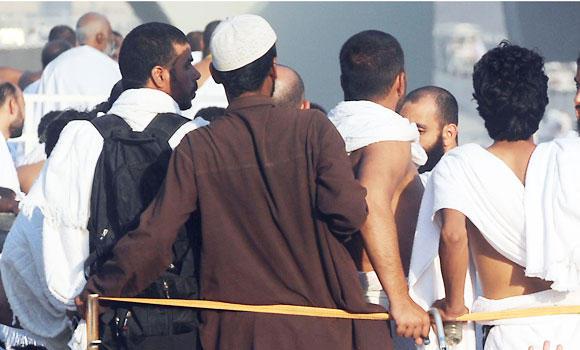
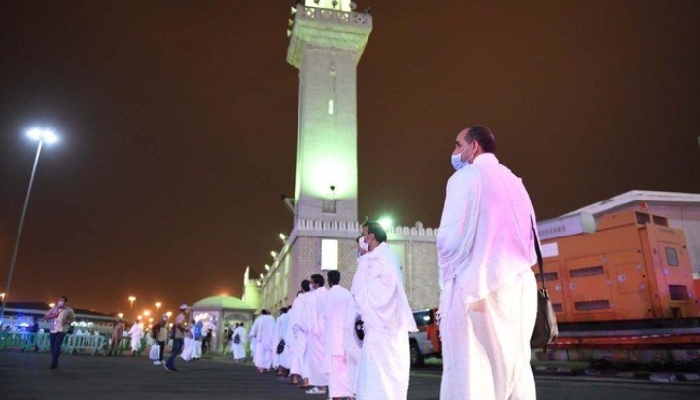
Expats who went for illegal Haj to be sacked, deported

October 19, 2013

Illegal_Haj

Jeddah, Oct 19: The Passport Department has sent text messages to sponsors and employers to fire their expatriate employees who performed Haj illegally this year, in preparation for their deportation.

The Kingdom's security agencies used new fingerprinting devices in Makkah and the holy sites this year to detect expatriates without Haj permits.

Ali Massoud, who has a barbershop in Jeddah, told Arab News he received a message to fire his workers.

“I have two Egyptian workers who went to Haj without permits. They did not tell me about their plans. I received a text message to end their contracts because they will be deported following their return from Haj,” said Massoud.

Khaled Abbas, a human resources supervisor at a private company, said his office also received SMSs from the passport department.

“We have a number of expat workers who went to perform Haj without permits. We received text messages to end their contracts when they return from Makkah. We will pay all their financial obligations to help them leave the Kingdom,” said Abbas.

Makkah Gov. Prince Khaled Al-Faisal had warned that expatriates found violating Haj rules would be deported and banned for 10 years. The governor also warned Saudi drivers they would face punishment for transporting illegal pilgrims.

Saudi Arabia has reduced the number of illegal pilgrims this year by 65 percent using the new fingerprinting devices, according to an Arabic daily. Prince Khaled said 15,000 illegal pilgrims were prevented from performing Haj this year.

Comments

naseer awan
 - 
Friday, 29 Jul 2016

i was in that case 2014 my finger print is taken at meeqat i did not go for hajj and i came back.before going back to my country i visited to the passport office and said that i have the issue they said no prob you can go.after 2 years now i came here and while entry there is no issue but when i am going back to country stopped me for immigration. i visited all of the pass[port offices and also in the airport they said no issue but while boarding issue raised.my request is for the saudi government that if some one accept his mistake and he needs to clear it legally so it should be given..

Ahmed
 - 
Tuesday, 12 Apr 2016

some body can help me how to remove haj fingers my iqama is expired and not renewed becoze of haj fingers
some body can help me i will pay as he want but just i need help some body know any person who can remove haj finger

Add new comment

  • Coastaldigest.com reserves the right to delete or block any comments.
  • Coastaldigset.com is not responsible for its readers’ comments.
  • Comments that are abusive, incendiary or irrelevant are strictly prohibited.
  • Please use a genuine email ID and provide your name to avoid reject.
News Network
April 28,2020

Dubai, Apr 28: Riyadh municipality has announced 13 requirements to restore commercial activity in malls starting Wednesday (April 29), in accordance with the government’s coronavirus precautionary measures.

The requirements include: the continued closure of all entertainment and playing areas inside malls, and not allowing the entry of children under the age of 15.

The municipality requires all malls to ensure the availability of medical examination and sterilization teams to measure the temperature of all individuals entering the mall at all entrances throughout opening hours, prevent any person with a temperature exceeding 38 degrees Celsius from entering, remove all chairs and benches in the corridors, and provide masks and gloves for visitors at the entrances.

All malls are to have security personnel stationed at all entrances to ensure that visitors are wearing masks.

The municipality also requires all malls to sterilize the entire facility every 24 hours, allocate rooms for medical isolation when there is any suspicion of an individual being infected with COVID-19, ensure the presence of a sufficient number of security personnel, and carry out regular rounds to verify full compliance, and suspend the valet service.

It also called for malls to put up explanatory signs of the guidelines to ensure that everyone understands the precautionary measures.

Malls should rely on the use of escalators and stairs for movement between floors, and in the event they are not available, only two people are allowed to ride the elevator at a time.

Revised curfew

Saudi Arabia had revised on April 21 its coronavirus curfew timings for the holy month of Ramadan, allowing residents in all areas and cities not currently under a 24-horu lockdown to go out between 9 a.m. and 5 p.m.

However, areas under a complete lockdown will only be allowed to go out for essential needs, such as grocery shopping or medical visits, between the hours of 9 a.m. and 5 p.m. Residents in these areas must stay within their neighborhoods

A 24-hour lockdown was previously imposed on the cities of Riyadh, Tabuk, Dammam, Dhahran, and Hofuf and throughout the governorates of Jeddah, Taif, Qatif, and Khobar.

The government had imposed a full lockdown on the holy cities of Makkah and Madinah as well. Other cities and governorates had a curfew implemented from 3 p.m. to 6 a.m. daily.

Comments

Add new comment

  • Coastaldigest.com reserves the right to delete or block any comments.
  • Coastaldigset.com is not responsible for its readers’ comments.
  • Comments that are abusive, incendiary or irrelevant are strictly prohibited.
  • Please use a genuine email ID and provide your name to avoid reject.
Agencies
July 31,2020

Jeddah, Jul 31: Hajj 2020 pilgrims arrived in Muzdalifah Thursday night to rest after spending the day in Arafat.

Earlier, the pilgrims scaled Mount Arafat to pray and repent, as a highly unusual Hajj approached its climax. They listened to a sermon delivered by Sheikh Abdullah Al-Manea and prayed Dhuhr and Asr prayers together at the Al-Namirah Mosque in Arafat.

This year’s pilgrimage is the smallest in modern times, after the number of participants was greatly restricted to prevent the spread of the coronavirus. 

Tight security was in place around the foot of the rocky hill outside Makkah, also known as Jabal Al-Rahma or Mount of Mercy, in preparation for the high point of the annual ritual.

Video footage shown on state television showed the pilgrims setting off on their climb to the summit. They wore face masks and observed strict social-distancing rules imposed by Saudi authorities.As sprinklers sprayed water on them to provide relief from the summer desert heat, the pilgrims raised their palms as they climbed the slopes of the hill — the site of Prophet Muhammad’s last sermon. When they reached the top they recited holy verses and prayed for forgiveness for their sins.

Earlier, the pilgrims were taken in buses from Mina to Mount Arafat. Strict precautionary measures were in place, with each group accompanied by security teams, ambulances and civil defense vehicles. 

When they arrived, their temperatures were checked before they entered Namirah Mosque to hear a sermon that was translated into 10 languages.

“The camps were set up for pilgrims in Arafat early on,” said Minister of Hajj and Umrah Muhammad Salih Bentin. The sermon at Namirah Mosque was delivered by Sheikh Abdullah Al-Manea, who led the pilgrims in noon and afternoon prayers.

“During Hajj this year, we reiterate that it is essential for pilgrims, as well as everyone assisting them, to adhere to the precautionary regulations that have been implemented,” Al-Manea, a member of the Council of Senior Scholars, said during his sermon. “This is to be done for their own safety.

“Precautions have been put in place to protect lives against the damage that the pandemic can cause, and also to actualize Islam’s teachings pertaining to safeguarding human life by Allah’s permission.”

The stay in Arafat is described as the pinnacle of Hajj and Muslims around the world reflect the actions of pilgrims by asking for forgiveness and praying for their deepest desires.
Pilgrims left Arafat in coaches for Muzdalifah after sunset and will pray the Maghrib and Isha prayers there.

After sunset prayers, the pilgrims made their way down Mount Arafat to Muzdalifah, where they will spend the night before the final Hajj ritual, the symbolic stoning of the devil. 

This year, each pilgrim received sanitized pebbles in advance of the event on Friday, which is the first day of Eid Al-Adha.
This year the Kingdom faced the unprecedented challenge of ensuring pilgrims attending Hajj were protected as much as possible from the risks of the coronavirus.

They will then sleep, pray the Fajr prayer there tomorrow and then leave for Mina.

Comments

Add new comment

  • Coastaldigest.com reserves the right to delete or block any comments.
  • Coastaldigset.com is not responsible for its readers’ comments.
  • Comments that are abusive, incendiary or irrelevant are strictly prohibited.
  • Please use a genuine email ID and provide your name to avoid reject.
News Network
May 11,2020

May 11: Saudi Arabia will triple its value-added tax rate and suspend a cost of living allowance for state workers, it said on Monday, seeking to shield finances hit by low oil prices and a slump in demand for its lifeline export worsened by the new coronavirus.

Historic oil output cuts agreed by Riyadh and other major producers have given only limited support to prices after they sank on oversupply caused by a war for petroleum market share between the kingdom and its fellow oil titan Russia.

Saudi Arabia, the world's largest oil exporter, is also being hit hard by measures to fight the new coronavirus, which are likely to curb the pace and scale of economic reforms launched by Crown Prince Mohammed bin Salman.

"The cost of living allowance will be suspended as of June 1, and the value added tax will be increased to 15% from 5% as of July 1," Finance Minister Mohammed al-Jadaan said in a statement reported by the state news agency. "These measures are painful but necessary to maintain financial and economic stability over the medium to long term...and to overcome the unprecedented coronavirus crisis with the least damage possible."

The austerity measures come after the kingdom posted a $9 billion budget deficit in the first quarter.

The minister said non-oil revenues were affected by the suspension and decline in economic activity, while spending had risen due to unplanned strains on the healthcare sector and the initiatives taken to support the economy.

"All these challenges have cut state revenues, pressured public finances to a level that is hard to deal with going forward without affecting the overall economy in the medium to long term, which requires more spending cuts and measures to support non-oil revenues stability," he added.

The government has cancelled and put on hold some operating and capital expenditures for some government agencies, and cut allocations for some reform initiatives and projects worth a total 100 billion riyals ($26.6 billion), the statement said.

Central bank foreign reserves fell in March at their fastest rate in at least 20 years and to their lowest since 2011, while oil revenues in the first three months of the year fell 24% from a year earlier to $34 billion, pulling total revenues down 22%.

"The reforms are positive from a fiscal side as greater adjustment is essential. However, the tripling of VAT is unlikely to help that much in 2020 revenue wise with the expected fall in consumption," said Monica Malik, chief economist at Abu Dhabi Commercial Bank.

She said she kept unchanged her deficit forecast of 16.3% of GDP for this year, which already factors in a greater than previously announced spending cut.

About 1.5 million Saudis are employed in the government sector, according to official figures released in December.

In 2018, Saudi Arabia's King Salman ordered a monthly payment of 1,000 riyals ($267) to every state employee to compensate them for the rising living costs after the government hiked domestic gas prices and introduced value-added tax.

DIFFICULT TIMES

A committee has been formed to study all financial benefits paid to public sector employees and contractors, and will submit recommendations within 30 days, the statement said.

In late 2015, when oil prices fell from record highs, the kingdom slashed lavish bonuses, overtime payments and other benefits once considered routine perks in the public sector.

In a country without elections and with political legitimacy resting partly on distribution of oil revenue, the ability of citizens to adapt to such reforms is crucial for stability.

"Tripling the VAT will test the limits of the balance between revenues and consumption as the economy dives into a deep recession. The move will impact consumption and could also lower the expected revenues," said John Sfakianakis, a Gulf expert at the University of Cambridge.

"These are pro-austerity and pro-revenue moves rather than pro-growth ones," he said.

Hasnain Malik, head of equity strategy at Tellimer, said the VAT rise could bring about $24-$26.5 billion in additional non-oil fiscal revenue. The rise would hit consumer spending further but was a needed step towards fiscal sustainability, he said.


Comments

Add new comment

  • Coastaldigest.com reserves the right to delete or block any comments.
  • Coastaldigset.com is not responsible for its readers’ comments.
  • Comments that are abusive, incendiary or irrelevant are strictly prohibited.
  • Please use a genuine email ID and provide your name to avoid reject.