NIA trying to weaken case against saffron terrorists in Samjhauta blasts too?

[email protected] (CD Network)
April 16, 2016

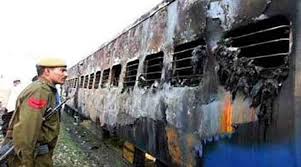
New Delhi, Apr 16: Amidst report of a massive state sponsored conspiracy to give clean chit to saffron terrorists, the National Investigation Agency under PM Narendra Modi led government has allegedly made an attempt to give a new twist to the Samjhauta Express terror attack case.

samjThe NIA had arrested a few leaders of extremist Hindutva groups in connection with the Samjhauta train blasts of 2007 a few years ago. However, now the NIA Director-General Sharad Kumar has requested the US for information on a key financier of the Lashkar-e-Taiba in the case.

According to reports, this might be an attempt to soften the case against RSS leader Aseemanand in the Samjhauta case by making enquiries about Arif Qasmani, who was designated a global terrorist by the U.N. 1267 Sanctions Committee.

Mr. Kumar said he had gone to the U.S. “to pursue pending requests under the Mutual Legal Assistance Treaty (MLAT). The case of LeT financier Arif Qasmani was one of them, and we have asked them [U.S. authorities] to send further details of Qasmani's role in the Samjhauta blasts.”

Mr. Kumar's statement comes on the heels of a series of moves by the NIA to review cases of “Hindu terror” between 2006 and 2008. Sixty-eight people, mostly Pakistanis, were killed in the Samjhauta train blasts in February 2007, and the explosives were traced to Indore.

In the 2008 Malegaon blasts, the NIA opposed the discharge of nine Muslim youths last week, despite its charge sheet having named Abhinav Bharat, an extremist group.

Comments

wellwisher
 - 
Saturday, 16 Apr 2016

A big mistakes done by the previous ruling govt that they not banned the communal rss. Now they planned communal unrest all over India through their children like Bajrangdal;Ramsena;vhp;Hindu Mahasabha;
and so on sena's . Totally rss is a child with several head. But it will not alive more days.
Jai Hind!

100%
 - 
Saturday, 16 Apr 2016

Whatever games U play with the people ... One day YOU will be payed for the deception U are playing now... Thats for SURE.

Add new comment

  • Coastaldigest.com reserves the right to delete or block any comments.
  • Coastaldigset.com is not responsible for its readers’ comments.
  • Comments that are abusive, incendiary or irrelevant are strictly prohibited.
  • Please use a genuine email ID and provide your name to avoid reject.
News Network
January 10,2020

Bengaluru, Jan 10: The National Commission for Scheduled Tribes (NCST), which met with officials of the Social Welfare Department Thursday, has urged the state government to increase the reservation provided to the ST community.

The Commission's suggestion comes even as a committee headed by Justice Nagamohan Das is currently studying a demand for increase of reservation for the community from the existing 3% to 7.5%.

Addressing mediapersons on Thursday, Commission Chairperson Nand Kumar Sai, said the Commission had discussed the issue with the Social Welfare Department, Karnataka, asking officials to expedite the process.

In response to this suggestion, Social Welfare Department Principal Secretary G Kumar Naik said the government would take a call based on the Nagamohan Das Committee's report.

A meeting was held between members of the National ST Commission and the Social Welfare Department Thursday with regard to various projects taken up by the department.

In June last year, the then Kumaraswamy-led coalition government constituted the Justice Nagamohan Das Committee, after protests from members of the Valmiki community for an increase in reservation to 7.5%. At present, Karnataka provides 15% reservation for SCs, 3% for STs and 32% for other backward classes (OBC).

The national commission also urged the state government to ensure permanent faculty in all the 824 residential institutions run by the department. At present, as much as 50% of the faculty in these institutions have been hired on a contractual basis. "We have assured that the recruitment will be done in a short time," Naik told mediapersons.

Comments

Add new comment

  • Coastaldigest.com reserves the right to delete or block any comments.
  • Coastaldigset.com is not responsible for its readers’ comments.
  • Comments that are abusive, incendiary or irrelevant are strictly prohibited.
  • Please use a genuine email ID and provide your name to avoid reject.
coastaldigest.com news network
June 8,2020

Hubballi, June 8: If everything goes as expected, the railway station in Hubballi, the commercial capital of the state and also the headquarters of South Western Railway (SWR), will have the world’s longest railway platform next year.

E Vijaya, chief public relation officer of SWR, said the work is being done as part of doubling between Hubballi and Bengaluru. 

“At present, Hubballi has five platforms, and the number will be increased to eight. Inspection carriage line is getting converted to full platform. 

Platform No. 1 will be extended from 550m to 1,400m with 10m width. At present, Gorakhpur’s 1,366m platform is the world’s longest facility,” the officer said.

She added that one more entry point is coming up at Gadag Road. “Rs 90 crore is being spent on the works related to full yard, signalling, electrical and building. 

The works, started in November 2019, will be completed in the next one year,” said Vijaya.

Comments

Add new comment

  • Coastaldigest.com reserves the right to delete or block any comments.
  • Coastaldigset.com is not responsible for its readers’ comments.
  • Comments that are abusive, incendiary or irrelevant are strictly prohibited.
  • Please use a genuine email ID and provide your name to avoid reject.
Agencies
July 8,2020

The Central Board of Secondary Education (CBSE) has rationalised by up to 30 per cent the syllabus for classes 9 to 12 for the academic year 2020-21 to reduce course load on students amid the COVID-19 crisis, Union HRD Minister Ramesh Pokhriyal 'Nishank' announced on Tuesday.

The curriculum has been rationalised while retaining the core elements, the Human Resource Development said.

Among the chapters dropped after the rationalisation exercise are lessons on democracy and diversity, demonetisation, nationalism, secularism, India's relations with its neighbours and growth of local governments in India, among others.

"Looking at the extraordinary situation prevailing in the country and the world, CBSE was advised to revise the curriculum and reduce course load for the students of classes 9 to 12.

"To aid the decision, a few weeks back I also invited suggestions from all educationists on the reduction of syllabus for students and I am glad to share that we received more than 1.5K suggestions. Thank you, everyone, for the overwhelming response," Nishank tweeted.

"Considering the importance of learning achievement, it has been decided to rationalise syllabus up to 30 per cent by retaining the core concepts," he added.

The Union minister said the changes made in the syllabi have been finalised by the respective course committees with the approval of the curriculum committee and the Governing Body of the Board.

"The heads of schools and teachers have been advised by the board to ensure that the topics that have been reduced are also explained to the students to the extent required to connect different topics. However, the reduced syllabus will not be part of the topics for internal assessment and year-end board examination.

"Alternative academic calendar and inputs from the NCERT on transacting the curriculum using different strategies shall also be part of the teaching pedagogy in the affiliated schools," a senior official of the HRD ministry said.

For classes 1 to 8, the National Council of Education Research and Training (NCERT) has already notified an alternative calendar and learning outcomes.

According to the updated curriculum, among the chapters deleted from class 10 syllabus are-- democracy and diversity, gender, religion and caste, popular struggles and movement, challenges to democracy

For class 11, the deleted portions included chapters on federalism, citizenship, nationalism, secularism, growth of local governments in India.

Similarly, class 12 students will not be required to study chapters on India's relations with its neighbours, changing nature of India's economic development, social movements in India and demonetisation, among others.

Universities and schools across the country have been closed since March 16 when the central government announced a nationwide classroom shutdown as one of the measures to contain the COVID-19 outbreak.

A nationwide lockdown was announced on March 24, which came into effect the next day. While the government has eased several restrictions, schools and colleges continue to remain closed.


Comments

Add new comment

  • Coastaldigest.com reserves the right to delete or block any comments.
  • Coastaldigset.com is not responsible for its readers’ comments.
  • Comments that are abusive, incendiary or irrelevant are strictly prohibited.
  • Please use a genuine email ID and provide your name to avoid reject.