


Violence erupts in Aligarh Muslim University campus: 1 ex-student killed

April 24, 2016

Aligarh (UP), Apr 24: Violence erupted at the Aligarh Muslim University campus around midnight last night following a clash between two regional student groups in which a former student was killed, prompting authorities to step up security and deploy Rapid Action Force.
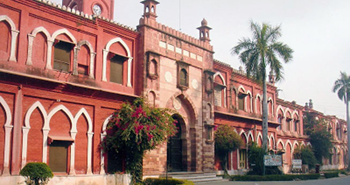
amuTrouble started when a resident of Mumtaz hostel was assaulted and his room set afire, DIG Aligarh Range Govind Agarwal, who led the police operations.

The victim rushed to the proctor's office to file his complaint. As soon as news of the incident spread students belonging to the two rival factions gathered and a clash broke out.

Police said that Mehtaab was shot dead late last night near the Proctor's office where the warring groups exchanged fire with each other.

The rampaging students set afire a jeep and over half-a-dozen bikes. The mob also indulged in arson and set afire the proctor's office building.

The violence was so widespread that it took the police nearly two hours to defuse the situation at different spots of the campus.

An official of AMU said that trouble between rival groups belonging to Azamgarh and Sambhal regions has been simmering since quite some time now.

Rapid Action Force has been deployed at all sensitive spots especially in view of the entrance test for the engineering college is scheduled today and more than 13,000 candidates are expected to appear from the Aligarh campus centre alone.

Comments

KhasaiKhaane
 - 
Monday, 25 Apr 2016

manuSmriti irani, becoming an education minister itself is a big tragedy to the students...LOL..Apashukuna!
Police should probe into this matter for few days... people will forget this issue in 1 week and move on to another issue.!

Add new comment

  • Coastaldigest.com reserves the right to delete or block any comments.
  • Coastaldigset.com is not responsible for its readers’ comments.
  • Comments that are abusive, incendiary or irrelevant are strictly prohibited.
  • Please use a genuine email ID and provide your name to avoid reject.
coastaldigest.com news network
August 4,2020

Bengaluru, Aug 4: As the stage is set for the ground-breaking ceremony for Ram temple construction at Ayodhya on Wednesday, retired Supreme Court judge N Santosh Hegde has called for the promotion of religious harmony and peaceful coexistence and respect for different faiths.

"It is a good idea to make that as an object of the temple so that there can be peace in the world," the former Solicitor General of India said when asked if the temple should be promoted as a symbol of national integration, and social and communal harmony.

Hegde said one of the most dangerous things for conflict today is religion. "In that background, there should be some effort from somebody or other to bring about peaceful coexistence, respecting each religion," the former Karnataka Lokayukta told PTI on Tuesday. "It is a good idea to start Bhumi Pujan as an indicator of that or foundation for developing harmony among various religions," he added.

The Supreme Court had in November last year paved the way for the construction of a Ram temple by a Trust at the disputed site of the Babri Masjid's demolition in Ayodhya. It also directed the Centre to allot an alternative 5- acre plot to the Sunni Waqf Board for building a new mosque at a "prominent" place in the holy town in Uttar Pradesh. The Uttar Pradesh government has allotted a five-acre land in Dhannipur village in Sohaval Tehsil of Ayodhya for the mosque's construction.

Comments

Add new comment

  • Coastaldigest.com reserves the right to delete or block any comments.
  • Coastaldigset.com is not responsible for its readers’ comments.
  • Comments that are abusive, incendiary or irrelevant are strictly prohibited.
  • Please use a genuine email ID and provide your name to avoid reject.
News Network
January 2,2020

Tumakuru, Jan 2: Prime Minister Narendra Modi on Thursday paid respects to the 'Gadduge' (final resting place) of Shivakumara Swamiji at Siddaganga Math, a prominent Lingayat seminary here, and said the Swamiji's work would continue to inspire everyone.

The Swamiji, who was known as the 'Walking God' among his countless followers, had passed away last year at the age of 111. The Prime Minister, who arrived at the Yelahanka Airbase in Bengaluru, went directly to Tumakuru, where the Math is located, by a chopper along with Chief Minister B S Yediyurappa, Union Minister Pralhad Joshi and former Chief Minister D V Sadananda Gowda among others. Modi, after offering respects to the 'Gadduge', planted Bilva plant (Aegle marmelos) on the premises of the Math and also laid the foundation for the construction of a museum dedicated to Swamiji here before addressing the gathering, largely comprising students. Speaking on the occasion, Modi said he was feeling blessed to begin 2020 from the sacred land of Siddaganga, but at the same time was feeling the "vacuum" in the absence of Shivakumara Swamiji. "It is rare see the number of people swamiji had inspired during his life time. I'm really fortunate to lay the foundation for the museum in swamiji's memory. Through this museum, his works will continue to inspire generations," he said. Also, Prime Minister remembered Vishwesha Theertha of Udupi's Pejawar Math who passed away recently. Yediyurappa and the present pontiff of the Math Siddalinga Swamiji were among the others present. Known as "trivida dasohi" for his triple sacraments - food, shelter and education - among his followers, Shivakumara swamiji was considered as the incarnation of Basavanna, the 12th-century social reformer, as he accepted all irrespective of their religion or caste. There has been a growing clamour from people of different walks of life, including politicians, for conferring "Bharat Ratna" on the late Swamiji.

After the Swamiji's demise, the then Chief Minister H D Kumaraswamy had written to Modi urging him to confer the country's highest civilian order on the late seer.

Opposition Congress on Thursday questioned the Prime Minister about not conferring the"Bharat Ratna" on Shivakumara Swamiji.

Questioning Modi as to why he did not visit Tumakuru when Shivakumara Swamiji of Siddaganga Math passed away, the principal opposition party in the state assembly in a tweet also sought to know why the seer was not conferred with the Bharat Ratna yet, while pointing out that former Chief Minister Siddaramaiah had written a letter in this regard in January 2018.

The present seer of the seminary Siddalinga Swamiji presented Modi a silver statue of Shivakumara Swamiji as a memento.

Comments

Add new comment

  • Coastaldigest.com reserves the right to delete or block any comments.
  • Coastaldigset.com is not responsible for its readers’ comments.
  • Comments that are abusive, incendiary or irrelevant are strictly prohibited.
  • Please use a genuine email ID and provide your name to avoid reject.
News Network
February 28,2020

Bengaluru, Feb 28: Historian S. Shettar, 85, breathed his last early on February 28 in Bengaluru. He was suffering from respiratory problems and was hospitalised for over a week.

Shettar was known for his multi-disciplinary work, encompassing linguistics, epigraphy, anthropology, the study of religions and art history. He had extensively worked on the Jain practice of ritual death in Karnataka and Asoka edicts. He had studied and compiled early edicts in Kannada and worked extensively on the growth of Kannada language down the ages.

Born in 1935 at Hampasagara, Ballari district, he went on to study at Cambridge University and started his career as a Professor of History at Karnatak University, Dharwad, his alma mater. He later headed the National Museum Institute of the History of Art, Conservation and Museology in 1978 and Indian Council for Historical Research in 1996. He was also a visiting professor at the National Institute of Advanced Studies, Bengaluru.

He was a bilingual historian who wrote in English for most of his career, but started writing in Kannada in later years. In the last two decades, he developed a keen interest in linguistics and wrote multiple books on classical Kannada and Prakrit. His 2007 book “Shangam Tamilagam” is considered a seminal work in the study of the early period of Dravidian languages. It won him Bhasha Samman from Central Sahitya Akademi. He later wrote two works on Halegannada, classical Kannada. His most recent work was “Prakrita Jagadvalaya” in 2018.

Comments

Add new comment

  • Coastaldigest.com reserves the right to delete or block any comments.
  • Coastaldigset.com is not responsible for its readers’ comments.
  • Comments that are abusive, incendiary or irrelevant are strictly prohibited.
  • Please use a genuine email ID and provide your name to avoid reject.