Mangaluru: Bajrang Dal protests before multiplexes to stop ‘Dilwale’

[email protected] (CD Network)
December 21, 2015

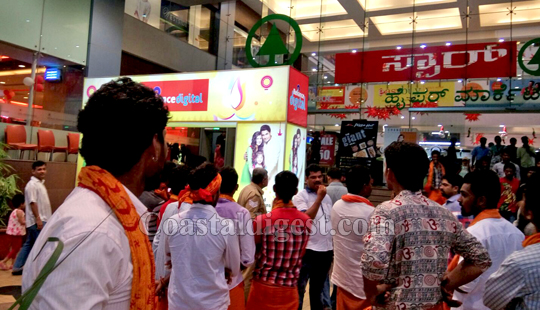
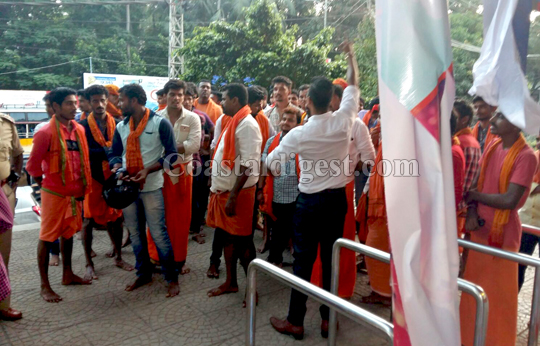
Mangaluru, Dec 20: Activists of Bajrang Dal on Sunday evening tried to raid multiplexes at prominent malls in Mangaluru to stop the screening of Shah Rukh Khan starrer Dilwale.

bajrang 3

The reason for the agitation is the statement made by the King Khan, film's lead actor and producer, against rising 'intolerance' in India last month.

On November 2, Khan had said at a press conference in Mumbai that “religious intolerance and not being secular is the worst kind of crime that you can do as a patriot.”

The protesters gathered in front of Bharat Mall, City Centre Mall and Forum Fiza Mall that house multiplexes and warned to raid the cinemas if the failed to stop the screening of Dilwale.

However, the police managed to convince the Bajrang Dal men to end the protest. Meanwhile, the screening of the movie was also reportedly stopped in view of the security concerns, sources said.

Sharan Pumpwell, state convenor of Bajrang Dal, confirmed that the members of his outfit staged protest at the City Centre Mall, Forum Mall and Bharat Mall.

"We requested the multiplex representatives to stop screening the movie. It was the people of India who made Shah Rukh Khan a superstar and now he is speaking against India in the name of intolerance," he said.

Police said that it was a peaceful protest and nobody was arrested. Aggressive campaigns against Dilwale from Mangaluru have been reported on social networking sites.

bajrang 1

bajrang 2

Comments

Marcela
 - 
Wednesday, 27 Apr 2016

I still believe the very best personal finance book ever composed is a series of stories written from the 1920s to 1940s by George S.
Clason, put together into a single book, and published as \The Richest Man in Babylon\".
You can pick it up at any book shop for $7. LikeLike

My weblog personal injury case: http://www.google.com"

Jenni
 - 
Thursday, 7 Apr 2016

Tim, Great post! I've in fact developed a good muse from \active investing\".
For income, I trade the e-mini futures agreements. And with the four-hour-work-week in practice, I trade an optimum of 90 minutes a day and
can work from anywhere, which permits me to take a trip as
much as I like. With the considerable earnings
provided from day trading e-minis, I have the ability to reinvest in various markets, all the while
implementing the very same day trading strategies into my longer-term investments.Take a peek at my blog.My advisable, Chris DunnLikeLike

Also visit my blog ... good lawyers: http://www.google.com"

Add new comment

  • Coastaldigest.com reserves the right to delete or block any comments.
  • Coastaldigset.com is not responsible for its readers’ comments.
  • Comments that are abusive, incendiary or irrelevant are strictly prohibited.
  • Please use a genuine email ID and provide your name to avoid reject.
News Network
March 31,2020

Kasaragod, Mar 31: Two more Kasaragod natives lost their lives on Monday due to blockade of the interstate border by Karnataka police in the wake of outbreak of novel coronavirus.

They could not get emergency health care as the Karnataka police stopped the ambulance carrying them to a hospital in Mangaluru at the border.

Another critically-ill person, who was sent back by Manguluru hospital authorities on March 23 for being a Kasaragod native, also died on Monday.

This is the fifth such case in many days.

The deceased are Madhavan, 50, Ayesha, 55 and Aziz Haji, 61 respectively.

All three of them lived near the Karnataka border.

Madhavan, who hailed from Thummanattu in Manjeswaram, died enroute to Kanhangad hospital after being denied entry to cross over to Karnataka. He had an acute bronchial attack.

Udyavar native Ayesha, an asthma patient, was referred to the Mangaluru Hospital by the hospital authorities at Uppali. When the authorities stopped her at the border, she was taken to the Kanhangad hospital. However, she died before reaching the hospital.

Aziz Haji, from Nayabazar Cherugoli MA Cottage at Uppala, was allegedly refused entry into a Manguluru Hospital on March 23 on account of being a Kasaragod native. Haji was a dialysis patient at the hospital. “We were unable to contact his doctor at the time,” his relatives said. Haji, who was on the ventilator, lost his life Monday morning.

One more from Kerala dies as Karnataka police stop ambulance at border
Kunjathoor native Abdul Hameed and Bandwal native Fathima also lost their lives due to the closing of the interstate border.

The district authorities has appealed to the Government to intervene in the matter and influence Karnataka as to lift a ban in crossing over for ambulances carrying critical patients.

The people of Kasaragod are largely dependent on the medical facilities in Mangaluru for critical illness care.

The Kasaragod MP, Rajmohan Unnithan has said he would move the Supreme court against this.

Kerala Chief Minister Pinarayi Vijayan has already taken up the issue with the Centre.

Kerala HC takes up issue with Karnataka AAG

The Kerala High Court on Monday sought the views of the Advocate General of Karnataka on the issue of the government of the neighbouring state blocking its borders with Kerala.

Considering a Public Interest Litigation (PIL) filed by Kerala High Court Advocates Association, seeking a direction for opening the roads, a bench comprising Justices A K Jayasankaran Nambiar and Shaji P Chali requested the Advocate General of Karnataka to join the hearing at 11 am on Tuesday through video conferencing.

The Court orally observed that the blockades erecting embankments on the inter-state roads would affect the people's right to life.

The Karnataka government blocked the state highway with to prevent movement of vehicles carrying essential goods and people seeking emergency treatment at hospitals in the city of Mangalore bordering Kasaragod.

With 97 infected patients, Kasaragod has the largest number of COVID-19 cases in Kerala. 7,437 people are under observation in the district.


Comments

Add new comment

  • Coastaldigest.com reserves the right to delete or block any comments.
  • Coastaldigset.com is not responsible for its readers’ comments.
  • Comments that are abusive, incendiary or irrelevant are strictly prohibited.
  • Please use a genuine email ID and provide your name to avoid reject.
Media Release
February 14,2020

Veteran journalist P. Sainath has said that the nation is in a crisis. And this crisis is not limited to just the rural area. It has become a national crisis at various areas such as agriculture, education, economy, job creation etc.

He was delivering the endowment lecture on the topic ‘Indian democracy at the post-liberalization and post-truth era’ at Media Manthan 2020 organized by the PG department of journalism and mass communication at St Aloysius College (Autonomous). 

Mr Sainath said that the many policies adopted in the 90s led to India becoming unusually unequal. Referring to the speech Ambedkar had made at the Constituent Assembly while handing over the draft of the Constitution, Mr Sainath said, “Ambedkar had warned about the weakness of Indian democracy that liberty without equality allows the supremacy of a few over the multitude. Liberty, equality and fraternity must be kept together as we cannot have one without the other.” 

Mr Sainath stated that the agrarian crisis was no longer about the loss of productivity, employment or about farmer suicide; it was a societal, civilizational crisis. Commenting on the lopsided policies such as cow-slaughter ban, he explained how cow slaughter ban had adversely affected many industries due to their interdependency. While Muslims who slaughtered cows were rendered helpless, the cattle traders who were mostly OBCs lost their earnings as the cattle prices crashed. An important industry like Kolhapur sandals industry in Maharashtra went bankrupt as a result of the cow slaughter ban in Maharashtra. He said the policymakers had no idea how the rural industries were interconnected. Demonetisation too devastated the rural economy as 98 percent of rural transactions happen through cash. 

Mr Sainath also spoke about the crisis of inequality which affects the Dalits and the Adivasis far more than anyone else as 90 percent of the rural households take home less than Rs 10,000/- per month. “Women are yet another group whose labour is never counted in the gross domestic product. Women and girls globally do unpaid work which amounts to about 12.5 billion working hours per year. Monetarily speaking, this is worth 10.8 trillion dollars,” Mr Sainath added. 

Speaking about the crisis of jobs Mr Sainath said that major companies were laying off employees just to create more profits for the investors and the adoption of artificial intelligence in the industry would further destroy millions of jobs.

Rector of St Aloysius College Institutions Fr Dionysius Vaz SJ, Principal Dr (Fr) Praveen Martis SJ, HOD of Journalism and Mass Communication department Dr (Fr) Melwyn Pinto SJ were present.

‘Veerappan and Vijay Mallya’s business models are interesting!’

Addressing the gathering during his endowment lecture on Friday, Mr Sainath made an interesting comment on the so called ‘revenue model’. “Whenever I visit IIMs and IITs for lectures on my PARI project, the students there ask me what my revenue model for my project is. I tell them that I do not have a revenue model. In fact, journalism does not begin with a revenue model. Gandhiji, Ambedkar, Bhagat Singh were all great journalists. But they did not have a revenue model,” Mr Sainath said.

On a lighter note, he said that the best revenue model that he liked was that of forest brigand Veerappan and liquor baron Vijay Mallya. “Veerappan ruled the forest for forty years and from the top ministers to the villagers he could dictate terms and liver royally. Similarly, Mallya’s revenue model was to steal the banks and run away abroad and live like a king,” Mr Sainath added.

Journalism is not and can never be a business. It is a calling, he opined. While newspaper can be a business, television can be a business, journalism per se cannot be reduced to a business. “Unfortunately today, journalists are recruited on a contract basis and they have no bargaining power; and there are no unions to fight for their cause. Hence, they are at the mercy of the corporate media houses for their survival and are made to write stories that cannot be called journalism,” Mr Sainath said.

Answering a question as to the pressures he faced as a journalist, he said that external pressures from the government or others could be very well handled. It is the internal pressures from once own media house that journalists find it difficult to manage.


Comments

Add new comment

  • Coastaldigest.com reserves the right to delete or block any comments.
  • Coastaldigset.com is not responsible for its readers’ comments.
  • Comments that are abusive, incendiary or irrelevant are strictly prohibited.
  • Please use a genuine email ID and provide your name to avoid reject.
News Network
March 27,2020

Bengaluru, Mar 27: With the numbers of COVID-19 optimistic instances rising at an alarming price in Karnataka, the state is on the verge of coming into stage three of the coronavirus epidemic. Which means that the virus is spreading to individuals who haven’t any journey historical past to Covid-19 affected international locations or contact with a COVID-19 optimistic individual with such a historical past.
Consequently, authorities in Karnataka expect a surge in optimistic instances within the coming days. This surge is probably going to come from pockets throughout the state which have a lot of coronavirus suspects, primarily individuals who have returned from Covid-19 affected international locations.

Within the parlance of the corona epidemic fighters, these pockets are referred to as clusters. Bengaluru is one massive cluster with many suspects, a lot of whom are IT professionals who lately returned from Europe, USA and Australia, and many others. The coastal belt is one other cluster, with suspects who’ve lately travelled to Center East. There are different clusters in Karnataka, the place suspects are those that returned after a pilgrimage to Mecca.

Medical schooling minister Ok Sudhakar admitted that the speed of enhance of COVID-19 positives in Karnataka is alarming. For over a month, the state had restricted the variety of optimistic instances to single digits. Nevertheless, within the final 4 days, the quantity has gone up sixfold and Karnataka now has 55 instances, the third largest variety of COVID-19 optimistic instances within the nation.

Dr Sudhakar stated the federal government was changing each authorities hospital right into a quarantine centre to accommodate any variety of optimistic instances.

“Our goal just isn’t to get right into a scenario like Italy, the place the federal government has been lowered to expressing helplessness. In subsequent 20 days, now we have to keep away from moving into such a scenario. I visited Chinnaswamy and Kanteerava stadiums and we’re working out if the stadiums will be transformed into quarantine centres, if warranted,” Dr Sudhakar stated.

The state police are struggling to implement the lockdown due to non-cooperation from some folks. They plan to rope in celebrities to ship throughout the message on social distancing.

Whereas some with home-quarantine seals are discovered roaming within the streets, some nonetheless assume the lockdown is a vacation.

“We’re roping in film stars in addition to sports activities personalities to give out a critical message on COVID-19. If the message goes dwelling, it could assist us management folks to a big extent,” he added.

Comments

Add new comment

  • Coastaldigest.com reserves the right to delete or block any comments.
  • Coastaldigset.com is not responsible for its readers’ comments.
  • Comments that are abusive, incendiary or irrelevant are strictly prohibited.
  • Please use a genuine email ID and provide your name to avoid reject.