


Swamy links Sonia with chopper deal, Cong forces adjournments

April 27, 2016

New Delhi, Apr 27: Angry exchanges between opposition Congress and ruling BJP members over Subramaniam Swamy seeking to drag Sonia Gandhi's name in the controversial AgustaWestland helicopter contract bribery case led to two adjournments of the Rajya Sabha in the pre-noon session.
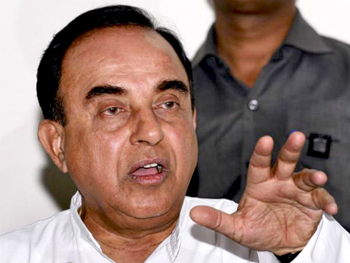
SwamyHowever, Gandhi's name was later expunged by Deputy Chairman P J Kurien.

Swamy had raised the issue through a zero hour notice, his first intervention since he took oath in the House yesterday, and referred to the allegations made by Christian Micheal, the middleman in the scandal, through a letter in the High Court of Italy.

The naming of Gandhi led the Congress members to angrily storm into the Well, with a handful even moving closer to the treasury benches menacingly. Members of the treasury benches too got up on their seats to counter the opposition.

Fearing an ugly showdown, a couple of marshalls too stepped into the Well to act as a wall between the opposition and the ruling side.

Before things got out of hand, Deputy Chairman P J Kurien adjourned the House for 10 minutes.

When the House reassembled, Kurien expunged Swamy's reference to Gandhi saying he should not name a member who cannot come and defend himself or herself.

"I am not admonishing you as this is your first speech in the House" after being nominated to the Upper House. "But the name is expunged," Kurien said.

This did not satisfy the Congress members who were in the Well again shouting slogans against Swamy.

Kurien said though it was Swamy's first day today after being nominated to the Rajya Sabha, "you have been member of this House before and you should know that the name of a member of the other House cannot be taken here".

As Congress members continued to raise slogans from the Well, the Deputy Chairman again adjourned the House till noon.

During the 10 minute break, Swamy was surrounded by BJP members, seemingly complimenting him for provoking an angry reaction from Congress.

Defence Minister Manohar Parrikar walked up to him and was seen exchanging notes with Swamy. HRD Minister Smriti Irani too walked up and complimented him.

Few Congress leaders including Anand Sharma and Leader of the House and Finance Minister Arun Jaitley walked into the Chairman's chamber during the break.

Just before the House reassembled, Minister of State for Parliamentary Affairs Mukhtar Abbas Naqvi took Swamy aside, apparently to give him some advice.

After the second adjournment, Jaitley took Swamy with him for a chat on the issue.

Earlier Jaitley, while responding to Leader of Opposition Ghulam Nabi Azad's question, said the reports about a meeting between Prime Minister Narendra Modi and his Italian counterpart were "false and untrue in entirety."

"No such meeting at all has been held," he said debunking a media report of Modi offering to free Italian marines in exchange of information on Gandhi family.

He said the principal issue was that there were allegation of bribe being paid to secure the defence deal. "The bribe giver has been convicted and now bribe taker has to be identified," he said adding written admission by the alleged middle man has to be examined.

"Investigation is underway," he said.

Earlier, Azad quoted media reports to ask the government if the Prime Minister had during a meeting with his Italian counterpart in September last year offered to free two Italian marines in exchange of information on Gandhi family in the controversial chopper deal.

"Pronouncement of judgment (on the chopper deal) has come and now NDA government is now allowing Italian marines to return home. So the deal is struck," he said.

Azad said the Congress-led UPA government had in 2013 cancelled the deal when wrong-doings were reported and had directed the CBI and ED to investigate corruption charges.

Also, the then Government had encashed bank guarantee and got back advance money paid. Besides, three helicopters received as part of the deal were not returned, he said.

The VVIP chopper deal relates to a 2010 decision of the UPA government to buy 12 helicopters from Italian manufacturer, Finmeccanica. But reports later said the Italian company had paid a bribe of up to Rs 3,565 crore to swing the deal.

Though the Italian company was blacklisted by UPA, it was part of Modi government's 'Make in India' drive, the Congress leader alleged.

Comments

Fair talker
 - 
Wednesday, 27 Apr 2016

Swamy( Asamy) is receiving Wahee from the shaitan.

Add new comment

  • Coastaldigest.com reserves the right to delete or block any comments.
  • Coastaldigset.com is not responsible for its readers’ comments.
  • Comments that are abusive, incendiary or irrelevant are strictly prohibited.
  • Please use a genuine email ID and provide your name to avoid reject.
Agencies
January 11,2020

Those owning a single house in joint names would continue to file their income tax returns (ITRs) in much simpler ITR-1 (Sahaj) and ITR-4 forms (Sugam) for assessment year 2020-21 with the government issuing a clarification in this regard.

The clarification has come days after the government modified the eligibility for filing the returns in ITR-1 and ITR-4, stating that those owning a property jointly, spending Rs 2 lakh on foreign travel and paying electricity bill of Rs 1 lakh in a year would not be able to file returns in the simpler forms.

They would have to file their returns with much more detailed information in other specified forms.

Following the changes in the eligibility for filing returns in the two forms, concerns were raised over it with taxpayers claiming that it will cause huge hardship for them.

"The matter has been examined and it has been decided to allow a person, who jointly owns a single house property, to file his/her return of income in ITR-1 or ITR-4 Form, as may be applicable, if he/she meets the other conditions," a Finance Ministry statement said.

"It has also been decided to allow a person, who is required to file return due to fulfilment of one or more conditions specified in the seventh proviso to section 139(1) of the Act, to file his/her return in ITR-1 Form," it added.

Tax practitioners welcomed the government’s move of going back to the previous position.

"This is a welcome clarification allowing middle class taxpayers owning a single house property to file simpler ITR forms, 1 and 4, and not the detailed ITR forms even if they own house property in joint names," said Shailesh Kumar, Director, Nangia Andersen Consulting.

It may be noted that taxpayers holding multiple house properties would have to file more detailed return forms.

In the major changes notified earlier this month by the Income-Tax department, individual taxpayers were disallowed to file return either in ITR-1 or ITR 4 if he or she was a joint-owner in house property.

In another change, those who deposited more than Rs 1 crore in bank account or spent Rs 2 lakh on foreign travel or paid Rs 1 lakh on electricity bill in a financial year were also barred from using the easy-to-fill return forms.

"By today's clarification, the government has maintained status quo. Now, the taxpayers can continue filing their returns in the same fashion in which they did last year," said Naveen Wadhwa, Deputy General Manager (DGM), Taxmann.

Comments

Add new comment

  • Coastaldigest.com reserves the right to delete or block any comments.
  • Coastaldigset.com is not responsible for its readers’ comments.
  • Comments that are abusive, incendiary or irrelevant are strictly prohibited.
  • Please use a genuine email ID and provide your name to avoid reject.
News Network
May 24,2020

New Delhi, May 24: New rules for domestic travel during the lockdown were released by the government today, including advising passengers to download the Aarogya Setu application on their mobile devices and asking states to ensure thermal screening at departure point of airports, railway stations and bus terminals. The guidelines were shared by Civil Aviation Minister Hardeep Singh Puri, who also shared new rules for international travel.

The minister had recently said that international flight operations may start by mid-June or end-July if the COVID-19 virus "behaves in a predictable manner".

"Prescribed clinical protocol will be followed in case any domestic or international traveller shows symptoms of COVID-19. States can also develop their own protocol for quarantine and isolation as per their own assessment," Mr Puri said.

The guidelines come a day before the resumption of air travel after nearly two-months hiatus following lockdown to prevent the spread of coronavirus.

The Indian Railways has also issued a list of 100 pairs of trains that it will operate from June 1, putting in operation popular trains such as Durontos, Sampark Krantis, Jan Shatabdis and Poorva Express.

Dos and Don'ts shall be provided along with tickets to travellers by agencies concerned, said the Health Ministry's guidelines for domestic travel (air/train/inter-state bus travel).

Latest guidelines on domestic & international travel have been issued by @MoHFW_INDIA.

I hope travellers strictly follow these self-regulatory norms & strengthen India's hands in this fight against COVID19. Remember, each one of us is a soldier against the pandemic.@MoCA_GoIpic.twitter.com/xVbTG1K44n

— Hardeep Singh Puri (@HardeepSPuri) May 24, 2020
Travellers shall give 14-day quarantine undertaking before boarding

The states and Union Territories shall ensure that all passengers undergo thermal screening at the point of departure and only asymptomatic passengers are allowed to board the flight, train or bus. Asymptomatic passengers, however, will be permitted to travel after they give an undertaking to self-monitor for 14 days, the ministry said.

Those having moderate or severe symptoms will be admitted to dedicated COVID health facilities and managed accordingly, the guidelines said.

Those having mild symptoms will be given the option of home isolation or isolated in the COVID Care Centre (both public and private facilities) as appropriate and tested as per ICMR protocol, they said.

"If positive, they will continue in COVID Care Centre and will be managed as per clinical protocol. If negative, the passenger may be allowed to go home, isolate himself/herself and self-monitor his/her health for further 7 days," the health ministry said.

In case, any symptoms develop they shall inform the district surveillance officer or the state or the national call centre (1075), it said.

Use of face covers, following respiratory hygine during travel

During boarding and travel, all passengers shall use face covers or masks and will also follow hand hygiene, respiratory hygiene and maintain environmental hygiene, the ministry said in its guidelines.

At airports, railway stations and bus terminals, required measures to ensure social distancing shall be taken, the guidelines said.

Airports, railway stations and bus terminals to be regularly sanitised

Airports, railway stations and bus terminals should be regularly sanitised or disinfected and the availability of soaps and sanitisers shall be ensured, the health ministry said.

The ministry said that states can also develop their own protocol with regards to quarantine and isolation as per their assessment.

Guidelines for International Travel

The guidelines for international travel include mandatory undertaking for quarrantine for 14 days. "Only for exceptional and compelling reasons such as cases of human distress, pregnancy, death in family, serious illness and parent(s) accompanied by children below 10 yrs, as assessed by the receiving states, home quarantine may be permitted for international travellers for 14 days," the Civil Aviation minister said.

Asymptomatic travelers will be allowed to board flight/ship

At the time of boarding the flight or ship, only asymptomatic travellers will be allowed to board after thermal screening, the health ministry said.. Passengers arriving through land borders will also have to undergo the same procedure, it said.

"Self-declaration form in duplicate shall be filled by the person in the flight/ship and a copy of the same will be given to Health and immigration officials present at the airport/seaport/landport. The form will be made available through the Aarogya Setu app," the new order said.

Passengers found to be symtomatic during screening shall be immediately isolated and taken to medical facility as per health protocol. "These passengers will be kept under institutional quarrantine for a minimum period of 7 days and should undergo necessary tests as per ICMR protocol," the guidelines said.

Sanitisation and disinfection must inside flights

Authorities must take adequate measures to such as environmental sanitation and disinfection at the airports as well as within the flights, the guideline said.Suitable announcement about COVID-19 including precautionary measures to be followed shall be made at airports/ports, it added.

While on board flight, ships, passengers and crew required precautions such as wearing of masks, environmental hygiene, respiratory hygiene, hand hygiene, the ministry said.

This morning, India registered the biggest-single day jump in the number of coronavirus cases as 6,767 new patients were reported in the last 24 hours. This is the third consecutive day that India has reported more than 6,000 COVID-19 cases with a record number of new patients each day. The county has officially logged 1,31,868 cases, 3,867 deaths linked to the highly infectious illness since the pandemic began. Of these, 147 patients died in the last 24 hours. The global number of novel coronavirus cases has passed 5.25 million with more than 339,000 deaths. Since the outbreak first emerged in China in December, 5,260,970 cases have been recorded across 196 countries and territories, with 339,758 deaths attributed to the virus.

Comments

Add new comment

  • Coastaldigest.com reserves the right to delete or block any comments.
  • Coastaldigset.com is not responsible for its readers’ comments.
  • Comments that are abusive, incendiary or irrelevant are strictly prohibited.
  • Please use a genuine email ID and provide your name to avoid reject.
News Network
February 19,2020

New Delhi, Feb 19: India will switch to the world's cleanest petrol and diesel from April 1 as it leapfrogs straight to Euro-VI emission compliant fuels from Euro-IV grades now - a feat achieved in just three years and not seen in any of the large economies around the globe.

India will join the select league of nations using petrol and diesel containing just 10 parts per million of sulphur as it looks to cut vehicular emissions that are said to be one of the reasons for the choking pollution in major cities.

Sanjiv Singh, Chairman of Indian Oil Corp (IOC) - the firm that controls roughly half of the country's fuel market, said almost all refineries began producing ultra-low sulphur BS-VI (equivalent to Euro-VI grade) petrol and diesel by the end of 2019 and oil companies have now undertaken the tedious task of replacing every drop of fuel in the country with the new one.

"We are absolutely on track for supplying BS-VI fuel from April 1. Almost all refineries have begun supplying BS-VI fuel and the same has reached storage depots across the country," he said.

From storage depots, the fuel has started travelling to petrol pumps and in the next few weeks all of them will only have BS-VI grade petrol and diesel, he said. "We are 100 per cent confident that fuel that will flow from nozzles at all the petrol pumps in the country on April 1 will be BS-VI emission compliant fuel."

India adopted Euro-III equivalent (or Bharat Stage-III) fuel with a sulphur content of 350 ppm in 2010 and then took seven years to move to BS-IV that had a sulphur content of 50 ppm. From BS-IV to BS-VI it took just three years.

"It was a conscious decision to leapfrog to BS-VI as first upgrading to BS-V and then shifting to BS-VI would have prolonged the journey to 4 to 6 years. Besides, oil refineries, as well as automobile manufacturers, would have had to make investments twice - first to producing BS-V grade fuel and engines and then BS-VI ones," he said.

State-owned oil refineries spent about Rs 35,000 crore to upgrade plants that could produce ultra-low sulphur fuel. This investment is on top of Rs 60,000 crore they spent on refinery upgrades in the previous switchovers.

BS-VI has a sulphur content of just 10 ppm and emission standards are as good as CNG.

Originally, Delhi and its adjoining towns were to have BS-VI fuel supplies by April 2019 and the rest of the country was to get same supplies from April 2020.

But oil marketing companies switched over to supply of BS-VI grade fuels in the national capital territory of Delhi on April 1, 2018.

The supply of BS-VI fuels was further extended to four contiguous districts of Rajasthan and eight of Uttar Pradesh in the National Capital Region (NCR) on April 1, 2019, together with the city of Agra.

BS-VI grade fuels were made available in 7 districts of Haryana from October 1, 2019.

Singh said the new fuel will result in a reduction in NOx in BS-VI compliant vehicles by 25 per cent in petrol cars and by 70 per cent in diesel cars.

The switchover, he said, is a tedious task as every drop of old, higher-sulphur content fuel has to be flushed out in depots, pipelines and tanks before being replaced by BS-VI.

"We are confident of disruption-free switchover to BS-VI supplies across the country," he said. "What we will be supplying is the best quality available anywhere in the world. You don't have any better fuel that is supplied in any part of the world. Perhaps our BS-VI fuel will be better than equivalent fuel in some parts of the US and Europe."

India adopted a fuel upgradation programme in the early 1990s. Low lead gasoline (petrol) was introduced in 1994 in Delhi, Mumbai, Kolkata and Chennai. On February 1, 2000, unleaded gasoline was mandated nationwide.

Similarly, BS-2000 (Euro-I equivalent, BS-1) vehicle emission norms were introduced for new vehicles from April 2000. BS-II (Euro-II equivalent) emission norms for new cars were introduced in Delhi from 2000 and extended to the other metro cities in 2001.

Benzene limits have been reduced progressively from 5 per cent in 2000 to 1 per cent nationwide. Lead content in gasoline was removed in phases and only unleaded gasoline is being produced and sold from February 1, 2000.

The octane number of gasoline signifies the improved performance of the engine. Loss in octane number due to phasing out of lead was made up by installing new facilities in the refinery and changes in refinery operation. RON (Research Octane Number) of gasoline for BS-2000 spec was increased to 88. This has over time been increased to 91.

Singh said sulphur reduction will reduce Particulate Matter (PM) emissions even in the in-use older generation diesel vehicles.

Comments

Add new comment

  • Coastaldigest.com reserves the right to delete or block any comments.
  • Coastaldigset.com is not responsible for its readers’ comments.
  • Comments that are abusive, incendiary or irrelevant are strictly prohibited.
  • Please use a genuine email ID and provide your name to avoid reject.