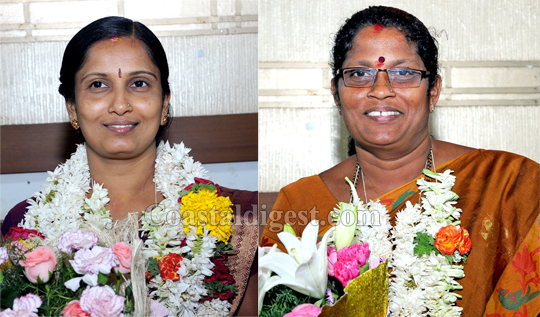
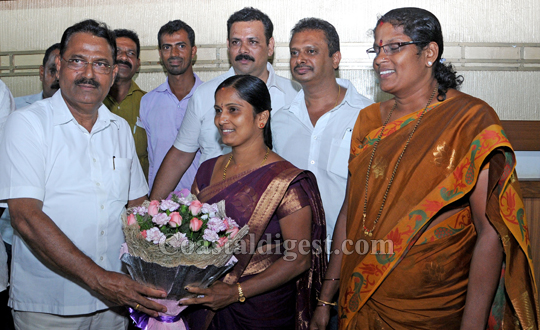
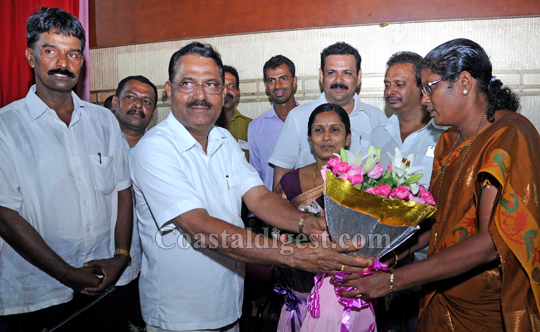
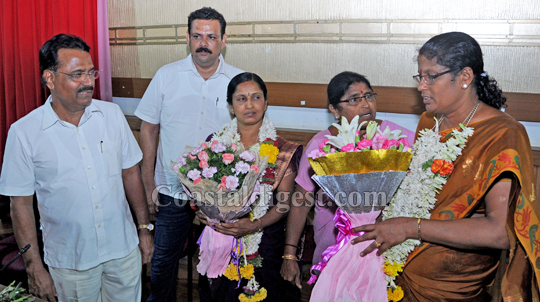
Meenakshi Shantigodu elected Dakshina Kannada ZP chief, Kasturi Panja deputy

[email protected] (CD Network | Suresh)
April 28, 2016

Mangaluru, Apr 28: Meenakshi Shantigodu and Kasturi Panja of Bharatiya Janata Party have been elected the president and vice-president of the Dakshina Kannada Zilla Panchayat respectively on Thursday.

zp 1

Elections to the zilla panchayats across the state including Dakshina Kannada were held in February this year. While Congress member Shekar Kukkedi was in fray for the president's post, Anitha Hemanath Shetty of the party contested for the post of vice-president.

The BJP candidates defeated their Congress counter parts by bagging 21 votes each in the zilla panchayat, which has a strength of 36 members. Congress candidates bagged 15 votes each.

The post of the president was reserved for SC/ST candidates while the vice-president post was for general category. The election officer AM Kunjappa conducted the election process and announced the result. The term of the newly elected president and vice-president will end in 20 months.

Priority for water'

Speaking to reporters after her victory, the new Zilla Panchayat president said that more emphasis will be given to provide drinking water to villages in the district.

“Basic facilities will be provided and roads will be developed in rural areas. Efforts will be made to implement all government schemes in the district effectively,” she promised adding that problems of all sections of the society including members of the backward communities and Dalits will be solved through a transparent administration.

zp 2

zp 3

zp 4

Comments

Chitra Salian
 - 
Thursday, 28 Apr 2016

Congratulation to newly elected Zp chief and Deputy.

Swetha
 - 
Thursday, 28 Apr 2016

all the best to both of you, development of your area should be prime priority for u.

Jeevan Rao
 - 
Thursday, 28 Apr 2016

The post of the president was reserved for SC/ST candidates ? we common people are not human's ?

sadananda
 - 
Thursday, 28 Apr 2016

all the best, let me c in 20 months what development u can make.

Add new comment

  • Coastaldigest.com reserves the right to delete or block any comments.
  • Coastaldigset.com is not responsible for its readers’ comments.
  • Comments that are abusive, incendiary or irrelevant are strictly prohibited.
  • Please use a genuine email ID and provide your name to avoid reject.
coastaldigst.com web desk
June 20,2020

New Delhi, Jun 20: As part of measures to check the spread of covid-19, Indian Railways is likely to stop distributing blankets and pillows in trains to AC passengers in coming days and it will make arrangements for sale at stalls on platforms.

The railways already stopped distributing blankets and pillows in 15 pair Special Rajdhani trains and 100 pair of fixed timetabled special trains, which is being operted at present. The system of not distributing blanks and pillows may continue in future once train operations normalise, said the official.

Passengers are encouraged to bring their own blankets and pillows. However same will be made available for purchase at shops so that if passengers want they can buy it, said an official.

The railways also made arrangements to sell sanitisers, masks and gloves at shops. The national transporter also said sale price should not exceed maximum retail price.

As per the Railway Board circular to zonal railways, " Amongst the items which fulfill the needs of travelling public and in keeping with the emphasis for providing safe and hygine travel facilities to passengers, it must be ensured that take away bedrolls kits/items other COVID-19 related protective items such as masks, sanitiser, gloves etc are also made available for sale through multi purpose stalls."

All items should be in good quality and will be sold only at MRP rate, circular said. The railways has also permanently removed curtains inside the AC coaches.

Comments

Add new comment

  • Coastaldigest.com reserves the right to delete or block any comments.
  • Coastaldigset.com is not responsible for its readers’ comments.
  • Comments that are abusive, incendiary or irrelevant are strictly prohibited.
  • Please use a genuine email ID and provide your name to avoid reject.
News Network
March 13,2020

Mysuru, Mar 13: A state-of-the-art viral research laboratory in the city has been identified as one of the testing laboratories for the detection of COVID-19, official sources said here on Friday.

The samples of suspected cases could be sent to the lab for analysis and it would take about three hours to get the results.

The Viral Research and Diagnostic Laboratory (VRDL), which was set up from Central grants and functions at the Microbiology Department of K.R. Hospital, has been authorised to carry out the tests. This lab in Mysuru is among the 52-plus laboratories in the country.

Though the VRDL is equipped to carry out the tests, the sole authority of confirming the virus lies with the Indian Council of Medical Research (ICMR)-National Institute of Virology (NIV) in Pune. VRDL is also the sole agency for collection and transportation of suspected samples of COVID-19 to NIV.

VRDL, which is part of the Mysore Medical College and Research Institute, functions on the advice of NIV.

According to the guidelines issued by ICMR, the results of the tests done here have to be shared with NIV the same day and the labs are not supposed to disclose the results since the NIV is the only authority to declare positive cases. Also, confirmation from the NIV should be awaited in case the samples test negative for COVID-19. The ICMR, in the guidelines made available on its website, has advised clinicians at labs to isolate the patient tested positive for COVID-19 in the identified facility and follow bio-safety precautions.

VRDL is a part of a network of labs established by the Department of Health Research, Government of India. The rise in the number of viral outbreaks and the resultant mortality had been cited as key reasons for the launch of network of such hi-tech labs in the country.

The NIV and the National Centre for Disease Control, Delhi, are the top laboratories for the network, while the National Institute of Epidemiology, Chennai, is the supervising authority for the data generated by the network of labs, sources added.

Comments

Add new comment

  • Coastaldigest.com reserves the right to delete or block any comments.
  • Coastaldigset.com is not responsible for its readers’ comments.
  • Comments that are abusive, incendiary or irrelevant are strictly prohibited.
  • Please use a genuine email ID and provide your name to avoid reject.
News Network
February 6,2020

Kalaburagi, Feb 6: The State government will take steps to ensure that Kannada as a language is taught in all private schools, Chief Minister B.S. Yediyurappa announced today at the 85th Akhila Bharata Kannada Sahitya Sammelana in Kalaburagi.

This comes in the wake of the demand by some Kannada activists for making Kannada medium compulsory in all schools in the State. Sammelana president H.S. Venkatesh Murthy, who spoke after the Chief Minister, also made this demand.

The Chief Minister said “We are committed to putting in place a series of steps to see that Kannada is taught in all schools, aided and private, as a language. Kannada should be taught as the first or second language. We will also take steps to strengthen government schools. However, the government alone cannot do much. The community and parents should offer support to make sure that government schools provide quality education to all.”

To inculcate the spirit of scientific inquiry, the State government is setting up mobile planetariums. This will increase the interest of children in space technology and India’s efforts in space exploration.

The government is committed to protecting the interests of the State in Mahadayi and other river water disputes. It will take the border row issue, based on the Mahajan Commission report pending in the Supreme Court, to its logical end.

The government will also address backwardness and related issues. It will make sure that adequate funds are allocated to the development of Kalyana Karnataka. Among other things, it will establish a hostel for students from Kalaburagi region in Bengaluru. Land has been allotted in Nagarabavi for the hostel that can accommodate around 200 students. The government has decided to celebrate Kalyana Karnataka Utsav once every two years. This will showcase the culture of the region.

“We are working towards forging sentimental and emotional unity of the State other than unity based on language or administration. Our dream is to see that Karnataka remains a homogeneous unit with equality and equal opportunity for all,’’ the Chief Minister added.

Kambar bats for technology

Chandrashekar Kambar, Sahitya Akademi president and former president of the Akhila Bharata Kannada Sahitya Sammelana, favoured effective implementation of technology in administration and for universal use of Kannada in computing and e-governance.

Speaking at the Sammelana inauguration, he said “Several years ago, at the insistence of writer Poornachandra Tejaswi, I appealed to the State government to give a push to Kannada computing. We were convinced that no language can survive without the use of modern technology and use of the language in computers. The Department of Kannada and Culture, headed by then director Manu Baligar, released ₹2 crore for the project. The work began in earnest and teams of technologists came up with software and fonts. Some departments started using Kannada software. But this work has stopped or slowed down at some level. I appeal to Chief Minister B.S. Yediyurappa to continue the work and ensure that computerised Kannada is used at all levels of government and in e-governance.’’

Supports dubbing

Mr. Kambar batted for content dubbing of informative TV channels in Kannada. Channels such as Discovery and History produce good quality content that can be educative and informative. They are very useful for children. These channels are now available in Tamil, Telugu and Hindi and some other Indian languages. But they are not available in Kannada. That is because some people in the film industry are opposing dubbing. Such opposition is not good. Informative channels are our window to the world and allowing dubbing will enhance our knowledge base. There is no merit in not allowing dubbing. I appeal to C.T. Ravi, Minister for Kannada and Culture, to allow dubbing in Kannada, he said.

Mr. Kambar favoured primary education in the mother tongue of the child and urged the State government to introduce universal and compulsory education in Kannada medium in all schools. “This will help preserve our culture. Nothing else can,’’ he said.

He blamed the East India Company administration for inculcating a craze for English education among the people. “The introduction of English education by the British was strongly welcomed by the masses in India as they had been denied the opportunity for education for millenia. The deprived classes and Dalits who had not been exposed to education till then, were excited about the opportunity. However, along with English education, the British were successful in introducing inferiority in our minds. We are yet to escape from this inferiority complex.”

Quoting from Greek mythology, Mr. Kambar said that Hercules had killed his children and relatives in a fit of alcohol-induced rage. “We should not behave like that. We may be very strong, but we should not kill our mother tongue, in our power-induced rage,’’ he said.


Comments

Add new comment

  • Coastaldigest.com reserves the right to delete or block any comments.
  • Coastaldigset.com is not responsible for its readers’ comments.
  • Comments that are abusive, incendiary or irrelevant are strictly prohibited.
  • Please use a genuine email ID and provide your name to avoid reject.