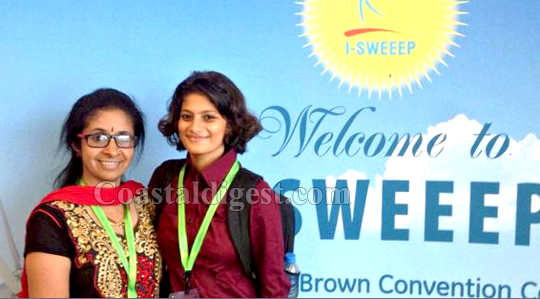
Puttur girl Aneesha Nayak wins bronze at international science fair in the US

[email protected] (CD Network)
May 2, 2016

Mangaluru, Apr 2: A 14-year-old multi-talented girl from Puttur in Dakshina Kannada district has won a bronze medal at the International Sustainable World (Energy Engineering Environment) Project Olympiad (I-SWEEP).

aneesha

I-SWEEP, a largest science fair of its kind worldwide, organised by Harmony Public Schools, a K-12 Public Charter School System, was held at Houston, Texas in United States of America from April 26 to May 1.

Aneesha Nayak, who has just passed Class 9 at Sudana Residential School, Puttur, and will be studying in Class 10 during 2016-17, won the medal for her project titled Hydrophobicity of Colocasia Esculenta leaves as a wall protector' under the Environment-Management and Pollution' category. Sadhana Hebbar, a science teacher at the school, was her guide.

There were 585 projects from 62 countries in the race.

“I feel proud of my daughter. It is an honour for the country,” said Shaila Bhakta, Ms. Nayak's mother.

Ms. Nayak was one among the two girls who represented India at the competition. She will return to Mangaluru on May 4. This was her first attempt at I-SWEEP, Ms. Bhakta added.

Shobha Nagaraj, the headmistress of Sudhana school, is elated at the achievement of her student. “Ms. Nayak is a multifarious person. She is the country's first girl surfer and has won many prizes in the sport. She is a keen science student and is into social service projects taken up by the school from time to time,” she said.

Ms. Nayak is also an Asian-level surfer and a member of Mantra Surf Club in Mulki, near Mangaluru.

aneesha11

aneesha12

aneeshan3

Comments

mahesh
 - 
Monday, 2 May 2016

congrats Aneesha, make a history in all field, we want a girl like you for our country, really proud of you.

Sulthan
 - 
Monday, 2 May 2016

proud to have her in our country.

Priyanka
 - 
Monday, 2 May 2016

Congrats Aneesha, Shining Star of Puttur, i must say.

Shahajan
 - 
Monday, 2 May 2016

Shaila Bhakta lucky mother, she is wonderful talented girl, really proud to have her in our city.

Add new comment

  • Coastaldigest.com reserves the right to delete or block any comments.
  • Coastaldigset.com is not responsible for its readers’ comments.
  • Comments that are abusive, incendiary or irrelevant are strictly prohibited.
  • Please use a genuine email ID and provide your name to avoid reject.
Agencies
January 22,2020

Ahmedabad/New Delhi, Jan 22: Interpol has issued a Blue Corner Notice seeking information about controversial self-styled godman Nithyananda, who fled the country amid allegations of wrongful confinement of children, officials said on Wednesday.

A Blue Corner Notice is issued by the international police cooperation body to collect additional information from its member countries about a person's identity, location or activities in relation to a crime.

The Gujarat Police had sent a request to the CBI, the nodal body for Interpol matters in India, seeking a Blue Corner Notice against Nithyananda, the officials said.

"Interpol issued the Blue Corner Notice against the controversial godman this month," Deputy Superintendent of Police, Ahmedabad (rural), K T Kamariya, told PTI.

The police said they are now working to get Interpol to issue a Red Corner Notice, a global arrest warrant, against Nithyananda.

The Gujarat Police had registered an FIR against Nithyananda after two girls went missing from his ashram in Ahmedabad.

He was charged with kidnapping and wrongful confinement of children to make them collect donations from followers to run his ashram.

Nithyananda was earlier declared wanted by the Gujarat Police.

While police continue to look for him, reports emerged in December last year that he has created a Hindu nation, Kailaasa, with its own flag and political setup, on an island near Ecuador.

Comments

Add new comment

  • Coastaldigest.com reserves the right to delete or block any comments.
  • Coastaldigset.com is not responsible for its readers’ comments.
  • Comments that are abusive, incendiary or irrelevant are strictly prohibited.
  • Please use a genuine email ID and provide your name to avoid reject.
News Network
July 4,2020

Bengaluru, Jul 4: With the increasing number of COVID-19 cases in Bengaluru, the state government has decided to impose a total lockdown in Bruhat Bengaluru Mahanagara Palike (BBMP) limits.

The lockdown will start from 8 pm today till 5 am on Monday. The sale of essential items will only be allowed during the total lockdown.

"Complete lockdown to be imposed from 8 pm today till 5 am on Monday in Bruhat Bengaluru Mahanagara Palike (BBMP) limits, as per instructions by Karnataka Chief Minister BS Yediyurappa in view of COVID-19," BBMP Commissioner Anil Kumar said on Saturday.

"Sale of essential items will be allowed during the lockdown, including meat shops. Police action will be taken against people found roaming outside unnecessarily," he said.

With the number of cases increasing by 994 in the last 24 hours, the total of cases in the city now stands at 7,713. Of these, 6,297 are active cases.

So far, Karnataka has 19,710 cases with 293 deaths. While 8,805 people have recovered from the deadly virus.

At the national level, the total number of cases have now surged to 6, 48,315 out of which 3, 94,227 patients have recorded, while 18,655 have lost their lives.

Comments

Add new comment

  • Coastaldigest.com reserves the right to delete or block any comments.
  • Coastaldigset.com is not responsible for its readers’ comments.
  • Comments that are abusive, incendiary or irrelevant are strictly prohibited.
  • Please use a genuine email ID and provide your name to avoid reject.
Agencies
May 8,2020

Washington D.C., May 8: The prime time for brain development in a child's life is the first year, where the infant spends most of the time asleep. It is the time when neural connections form and sensory memories are encoded.

However, when sleep is disrupted, as occurs more often among children with autism, brain development may be affected, too.

New research led by the University of Washington finds that sleep problems in a baby's first 12 months may not only precede an autism diagnosis but also may be associated with altered growth trajectory in a key part of the brain, the hippocampus.

The study, which was published in the American Journal of Psychiatry, researchers report that in a sample of more than 400 taken of 6- to 12-month-old infants, those who were later diagnosed with autism were more likely to have had difficulty falling asleep.

It also states that this sleep difficulty was associated with altered growth trajectories in the hippocampus.

"The hippocampus is critical for learning and memory, and changes in the size of the hippocampus have been associated with poor sleep in adults and older children.

As many as 80 per cent of the children with autism spectrum disorder have sleep problems," said Annette Estes, director of the UW Autism Center and senior author of the study.

"In our clinical experience, parents have a lot of concerns about their children's sleep, and in our work on early autism intervention, we observed that sleep problems were holding children and families back," added Estes, who is also a UW professor of speech and hearing sciences.

"It could be that altered sleep is part-and-parcel of autism for some children. One clue is that behavioural interventions to improve sleep don't work for all children with autism, even when their parents are doing everything just right. This suggests that there may be a biological component to sleep problems for some children with autism," said Estes.

To consider links among sleep, brain development, and autism, researchers at the IBIS Network looked at MRI scans of 432 infants, surveyed parents about sleep patterns, and measured cognitive functioning using a standardized assessment.

At the outset of the study, infants were classified according to their risk for developing autism: Those who were at higher risk of developing autism -- about two-thirds of the study sample -- had an older sibling who had already been diagnosed.

Infant siblings of children with autism have a 20 per cent chance of developing autism spectrum disorder -- a much higher risk than children in the general population.

In the current study, 127 of the 432 infants were identified as "low risk" at the time the MRI scans were taken because they had no family history of autism.

They later evaluated all the participants at 24 months of age to determine whether they had developed autism. Of the roughly 300 children originally considered "high familial risk," 71 were diagnosed with autism spectrum disorder at that age.

Problems with sleep were more common among the infants later diagnosed with an autism spectrum disorder, as were larger hippocampi. No other subcortical brain structures were affected, including the amygdala, which is responsible for certain emotions and aspects of memory, or the thalamus, a signal transmitter from the spinal cord to the cerebral cortex.

The authors note that while parents reported more sleep difficulties among infants who developed autism compared to those who did not, the differences were very subtle and only observed when looking at group averages across hundreds of infants.

Sleep patterns in the first years of life change rapidly as infants transition from sleeping around the clock to a more adult-like sleep/wake cycle. Until further research is completed, Estes said, it is not possible to interpret challenges with sleep as an early sign of increased risk for autism.


Comments

Add new comment

  • Coastaldigest.com reserves the right to delete or block any comments.
  • Coastaldigset.com is not responsible for its readers’ comments.
  • Comments that are abusive, incendiary or irrelevant are strictly prohibited.
  • Please use a genuine email ID and provide your name to avoid reject.